 RockCloud-基石云安全-官方博客
The practical application of dynamic CAPTCHA in anti-CC attacks isn't about "whether to show it" but "which paths trigger it, what signals trigger it, and which tier to show." According to the Radware 2026 Global Threat Report, network-layer DDoS attacks surged 168.2% year-over-year, and nearly 90% of peak attacks end within 5 minutes. Given this extremely compressed attack window, challenge rules must be pre-configured and auto-triggered. Its value lies in raising the cost per request, blocking stateless mass requests outside business logic. But it can't stop real browser automation, captcha-solving services, or low-frequency distributed requests, nor can it replace rate limiting and edge scrubbing.
Define Boundaries First: What Dynamic CAPTCHA Can and Cannot Solve in Anti-CC
CAPTCHA's real role in CC attacks is to intercept "mindless mass requests" outside business logic. An interactive CAPTCHA raises the completion cost per request from milliseconds to seconds. To sustain the same flood, attackers must pay higher bandwidth and compute costs. However, its boundaries are equally clear: for protocol-level connection exhaustion, real browser automation, or human-mediated relay via captcha-solving services, CAPTCHA is largely ineffective. In an environment where attack windows compress to minutes, rules must be pre-configured and auto-triggered; otherwise, by the time you see the alert and manually enable the switch, the attack is over.
Three Tiers of Challenges: Trade-offs in Overhead and Interception for Transparent, Silent JS, and Interactive CAPTCHAs
Classifying human challenges into three tiers based on user perception helps answer "which is better for anti-CC: JS challenge or image CAPTCHA?"
| Challenge Tier | Trigger Condition | User Perception | Impact on Conversion | Typical Bypass | Use Case |
|---|---|---|---|---|---|
| Transparent Check | Within baseline, low risk | None | Nearly zero | Mimic normal requests | Static pages, low-value APIs |
| Silent JS Challenge | Mild anomaly signals | Nearly imperceptible (runs in background) | Very low | Disable JS or simulate execution | Search, listing pages |
| Interactive CAPTCHA | Clear attack signals or high-value operations | Noticeable (click/slider) | Medium to high | Captcha-solving services, human relay | Login, checkout, coupons |
The principle is to start at the lowest tier and escalate based on signals. Do not deploy interactive CAPTCHAs on the first anomaly, or false positives will rise significantly.
Trigger Timing Matrix: Decide Based on Path Value and Anomaly Signals
The first step in practical dynamic CAPTCHA application is path classification. Different paths have vastly different tolerance for CAPTCHAs. High-value write operations like login, checkout, and coupon redemption can tolerate CAPTCHAs reasonably well; high-cost read operations like search and listings are better suited for silent JS challenges. Static resources and APIs require separate handling.
| Path Type | Example | Recommended Challenge Tier | Judging Signals |
|---|---|---|---|
| High-value write operations | Login, registration, checkout, coupons | Interactive CAPTCHA | Source concentration, historical malicious IPs |
| High-cost read operations | Search, product listings, dynamic rendering | Silent JS challenge | UA and TLS fingerprint consistency, request rhythm |
| Low-value static | Images, CSS, static resources | None or transparent check | No obvious anomalies |
| API | Mobile endpoints, public APIs | Signature verification, device tokens, rate limiting | Call frequency, device fingerprint |
Anomaly signals shouldn't rely on a single dimension. Combining source concentration, UA/TLS fingerprint consistency, session continuity, and per-session request rhythm dramatically reduces false positives.
Setting Thresholds: Why Fixed QPS Fails Against Low-Frequency Distributed CC
Fixed QPS thresholds are nearly useless against low-frequency distributed CC: attackers spread requests across many IPs, each with low QPS, but the aggregate is still significant. Triggering CAPTCHAs based on per-IP rate is misguided. You need to base decisions on session, path, and baseline deviation, and refer to Nginx anti-CC rate limiting best practices to tighten per-connection and per-session rate caps.
| Dimension | Example Threshold (adjust per business) | Description |
|---|---|---|
| Session | >30 requests per 60 seconds per session | Covers low-frequency distributed |
| Path | Key path (e.g., login) exceeds same-period baseline by 2 standard deviations | More precise than global limit |
| Baseline deviation | Overall traffic deviates >3σ from weekly mean for 30 seconds | Dynamically adapts to business hours |
Thresholds should be dynamically adjusted based on business peaks. For instance, during a promotion, login requests are naturally high; a fixed threshold would block real users.
API and Mobile Scenarios: Alternatives Without a Browser Environment
"Can APIs use CAPTCHAs against CC?" is a common question. APIs are directly called by machines; there's no environment to render a challenge page or handle human interaction. Hanging an interactive CAPTCHA would block legitimate clients first. Attackers can bypass the frontend and construct requests directly, so the challenge only penalizes legitimate callers. Thus, for pure API scenarios, use signature verification, device tokens, one-time credentials, and quota-based rate limiting. Interactive CAPTCHAs are only suitable at entry points with a browser frontend.
False Positives and Allowlisting: Exemption Channels for Search Engines, Payment Callbacks, and Internal Monitoring
CAPTCHA blocking real users often means exemption channels aren't sufficient. Search engine crawlers, payment callbacks, and internal monitoring probes must be explicitly exempted in the challenge policy.
- Search engines: Verify by UA reverse lookup (e.g., Googlebot IP ranges) and allow, avoiding SEO harm.
- Payment callbacks: IP allowlist + signature verification, skip human challenge.
- Internal monitoring: Dedicated path + separate credentials, avoid triggering own CAPTCHA.
Monitor three metrics: challenge failure rate, abandonment rate, and origin QPS changes. A spike in failure rate indicates expanding false positives; lower the threshold or upgrade the challenge tier (but don't overdo it). Compare abandonment rate with baseline from periods without challenges; persistent elevation suggests the challenge tier is too high.
Three Types of Traffic You Can't Block and Subsequent Fallbacks
Honestly, CAPTCHAs can't block the following three types:
- Real browser automation: Attackers use Playwright, Selenium to drive real browsers; CAPTCHA is useless against them.
- Captcha-solving services and human relay: Images are sent to solving services where humans solve them, externalizing CAPTCHA cost.
- Low-frequency distributed requests: Each IP sends a few requests, but aggregate is large; thresholds aren't triggered.
Corresponding fallbacks: for automation, use behavioral risk control to identify mouse trajectories and click intervals; for solving services and relay, use frequency quotas and device fingerprinting for secondary checks; for low-frequency distributed, use edge CDN Anycast and connection-level convergence, e.g., refer to slow CC attack protection to limit requests per connection.
Why Challenge Policies Must Auto-Trigger: Process Changes Under Minute-Level Attack Windows
The Radware 2026 report notes that most record-breaking attacks last under 5 minutes, some even under 60 seconds, like a 31.4 Tbps attack lasting only 35 seconds. In such windows, "alert → human review → manually enable CAPTCHA" is impossible. Challenge rules must be pre-configured, auto-escalate and de-escalate based on signals, and automatically retreat after the attack to avoid prolonged pop-ups that ruin conversion.
Why Challenges Should Be Served at the Edge, Not Origin: How RockCloud Positions It
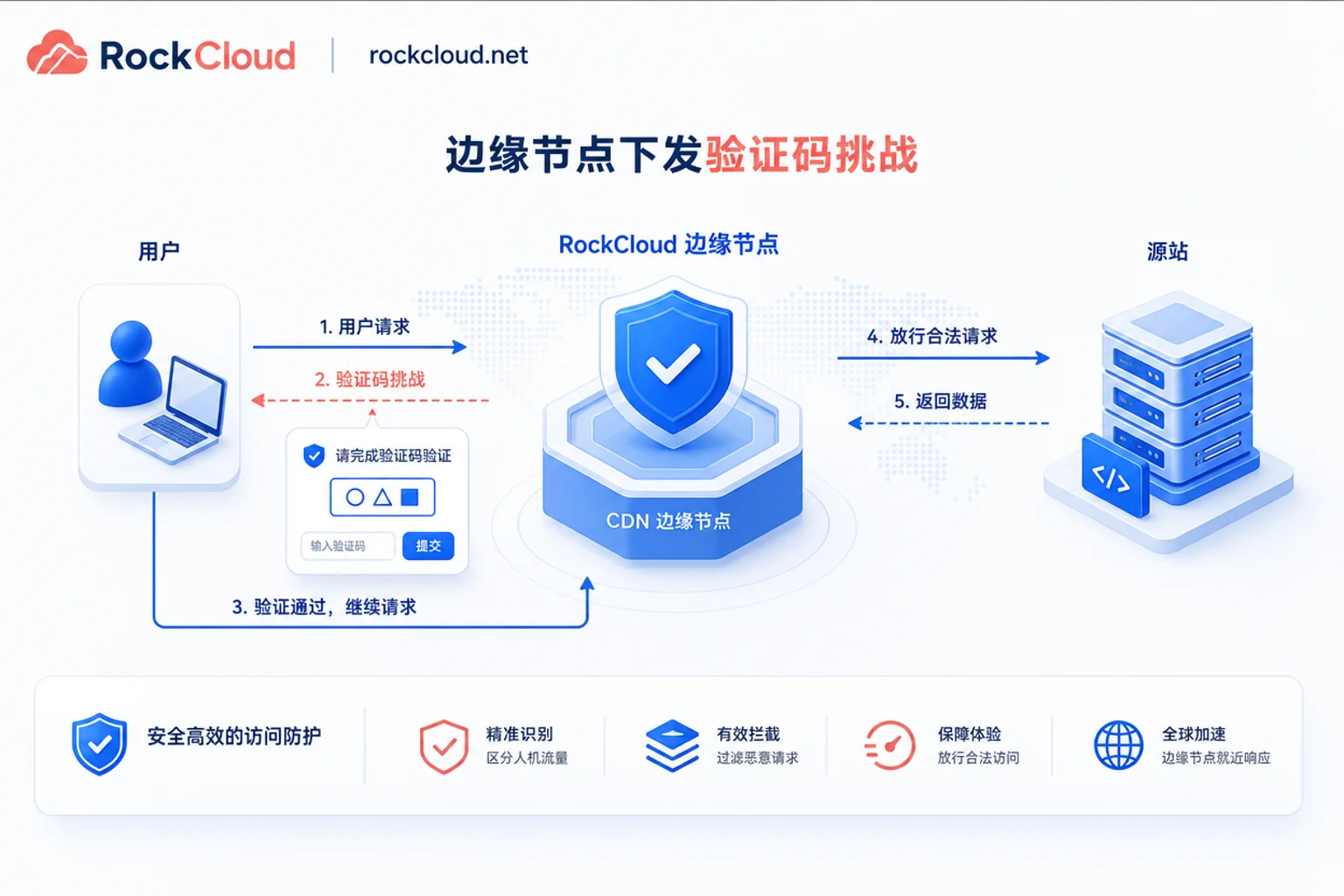
If CAPTCHAs are rendered at the origin, during an attack the origin both maintains connections and renders/verifies, amplifying resource consumption per request. CISA guidelines emphasize that protocol-layer abuse (e.g., HTTP/2 Rapid Reset) can exhaust connection pools with minimal cost; once the origin is exposed, even strong firewalls struggle. Therefore, challenge decisions must move forward: WAF protection at edge nodes, Bot management to distinguish normal and abnormal traffic, then decide whether to issue challenges. RockCloud's intelligent WAF and high-defense CDN move behavioral detection, tiered challenge issuance, and exemption channels to the edge, so the origin only processes verified requests. Another benefit: CAPTCHA scripts and result callbacks don't pass through the origin, naturally hiding the origin IP.
Pre- and Post-Launch Verification Checklist and Common Issues
The practicality of dynamic CAPTCHA in anti-CC depends on three observed metrics after launch. Before launch, map high-value paths and exemption lists, and roll out in stages: static → search → login/checkout. Monitor: challenge rate, pass rate, abandonment rate, origin QPS changes. Define rollback conditions: if abandonment exceeds business tolerance or origin QPS doesn't drop significantly, immediately downgrade or disable challenges. Common misconfigurations include: not exempting search engines, placing interactive CAPTCHAs on APIs, and fixed QPS thresholds too low that harm real users.
FAQ
Does CAPTCHA help against CC attacks?
Yes, but only if challenges auto-trigger, are tiered by path, and are paired with edge scrubbing. It quickly raises per-request cost, blocking mindless mass requests. However, against real browser automation or captcha-solving services, it's limited; you need to layer behavioral risk control and frequency quotas.
What to do when CAPTCHA blocks real users?
First, check exemption channels: search engines, payment callbacks, internal probes allowlisted? Then check if thresholds are too strict; lower trigger conditions. Finally, consider downgrading, e.g., from interactive to silent JS challenge, and continuously monitor abandonment rate against baseline; a persistent rise indicates the challenge tier is too high.
Which is better for anti-CC: JS challenge or image CAPTCHA?
Silent JS challenges suit low-value paths like search and listings, with no user perception; image CAPTCHAs suit high-value write operations like login and checkout. Combining both is more balanced and reduces false positives.
Can APIs use CAPTCHAs against CC?
Yes, but not directly with interactive CAPTCHAs. For pure API scenarios, use signature verification, device tokens, and one-time credentials. If front-end challenges are needed, place them at entry points with browser support, not in machine-called endpoints.
What if captcha-solving services bypass CAPTCHAs?
Solving services essentially bypass image recognition, so layer behavioral risk control: mouse trajectories, click intervals, keyboard rhythm. Also strengthen frequency quotas and device fingerprints; directly reject anomalous high-frequency device IDs.
What thresholds should trigger human verification?
Don't rely solely on per-IP QPS; combine session, path, and baseline deviation. For example, >30 requests per session per 60 seconds, or key path traffic exceeding same-period baseline by 2 standard deviations, should trigger challenges. Adjust thresholds dynamically based on business cycles, easing during promotional peaks.




Comments(0)