 RockCloud-基石云安全-官方博客
Let’s start with the conclusion. If your business is open to the public internet, may face DDoS or CC attacks, has obvious traffic peaks and valleys, and your team lacks dedicated security operations staff, prioritize cloud WAF. If your business runs in a self-built data center, data cannot leave your domain, you mainly serve intranet or dedicated line users, and you are unlikely to be targeted by large public traffic attacks, hardware WAF is more suitable. If both conditions apply, you can deploy them in series, but before going live, evaluate latency and rule conflicts.
Below, we expand on the questions most commonly asked during procurement.
First, use five questions to determine direction
- Is the business open to the public internet? Has it been attacked before?
- Can traffic and HTTPS certificates be handled by a third party?
- Does the team have anyone responsible for maintaining devices and rules?
- Is the budget better suited to a one-time investment, or monthly/yearly payments?
- Does traffic have obvious off-peak and peak seasons, or sudden spikes during events?
The answers to the first two questions usually already determine the general direction, while the last three determine how to implement it specifically.
| Dimension | Hardware WAF | Cloud WAF |
|---|---|---|
| Deployment | Deployed inline or out-of-band at the data center network boundary, requires bypass and dual-machine hot standby | Modify DNS/CNAME or use BGP traffic diversion, does not change origin network topology |
| Resistance to large traffic | Limited by device throughput and data center entrance bandwidth | Distributed nodes clean at the edge, can scale elastically |
| Rule updates | Upgrade firmware yourself, track 0day vulnerabilities yourself | Managed by provider, virtual patches delivered uniformly |
| Cost | Equipment purchase, rack space, power, and maintenance, capital expenditure | Subscription-based, billed by peak or usage, operational expenditure |
| Data control | Traffic and keys stay local | Need to decrypt HTTPS in the cloud, origin must be locked down |
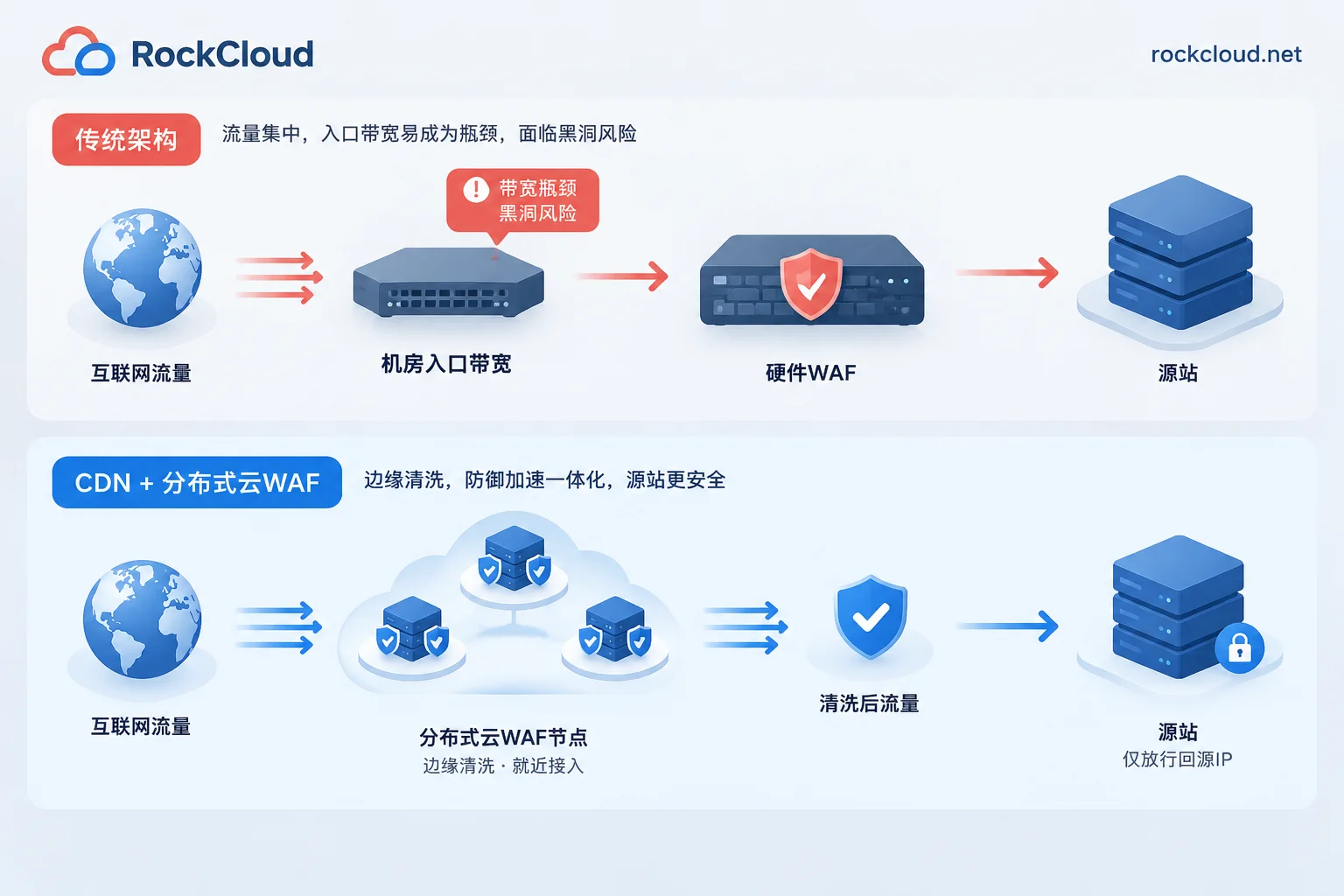
Where the gap is largest: large traffic attacks
Hardware WAF is deployed after the data center entrance, so its upper limit is not determined only by the device itself. Once attack traffic exceeds the data center entrance bandwidth, the line will be saturated first; to protect other customers, the data center may also directly blackhole the target IP. In this case, the business is already down before the WAF even starts inspecting. Sudden CC attacks will directly consume the device's throughput and SSL decryption capacity.
Cloud WAF inspects on distributed nodes, usually working with CDN and DDoS scrubbing, so attack traffic is blocked at the network edge, and the origin only receives cleaned back-to-origin requests.
The impact on procurement is: if the business has been attacked before, or belongs to common attack targets such as e-commerce, gaming, APIs, and payments, deploying only hardware WAF carries relatively high risk.
Operations: who maintains the rules
Hardware WAF requires network and security teams to handle firmware upgrades, hardware troubleshooting, and policy customization. When a 0day vulnerability appears, you either manually write rules to respond or wait for the vendor to release a patch.
Cloud WAF is managed by the provider, and threat intelligence, Bot signatures, and virtual patches are automatically delivered to all nodes. But managed does not mean completely hands-off. False positives on the business side still need your own troubleshooting and allowlisting. For example, if payment callbacks are blocked, you can refer to How to whitelist payment callbacks blocked by WAF.
Cost: compare at least three-year total cost
Hardware WAF has high initial investment, followed by rack space, power, and maintenance costs. Equipment usually must be configured for peak capacity, leaving a considerable portion idle during normal times. When the business grows and needs expansion, you often need to buy another unit.
Cloud WAF is subscribed monthly or yearly, generally billed by QPS, bandwidth, or peak, and specifications can be adjusted with off-peak and peak seasons. Note that billing criteria vary greatly between providers; before signing, clarify the algorithm. You can refer to How high-defense CDN peak billing is calculated.
When comparing the two options, it is advisable to calculate the three-year total cost and include expansion costs and labor costs, rather than only looking at the first-year quote.
Compliance: cloud WAF has several prerequisites
The advantage of hardware WAF is that traffic inspection and SSL certificates/keys remain within the enterprise's local network, making it easier to pass audits for financial and government systems with strict requirements on data residency and physical isolation.
Before choosing cloud WAF, confirm two things:
- Whether certificate hosting is allowed. Cloud WAF needs to decrypt HTTPS in the cloud to inspect, so first confirm whether compliance requirements allow handing certificates to a third party.
- Whether the origin is already locked down. Security groups or firewalls only allow cloud WAF back-to-origin IPs. If the origin's real IP is exposed, attackers can bypass WAF and attack the origin directly. For lockdown steps, refer to Website under large traffic attack: CDN onboarding order and origin lockdown key points.
For onboarding, you can choose CNAME or NS. The two differ in activation speed and protection scope; see Should you change NS when onboarding high-defense CDN for how to choose.
Match by scenario
Situations more suitable for hardware WAF:
- Has a self-built data center, traffic is relatively stable
- Subject to strong regulatory constraints, data cannot leave the domain
- System runs on intranet or private network
- Basically no threat of large public traffic attacks
Situations more suitable for cloud WAF:
- Public-facing businesses such as overseas e-commerce, game official sites and login APIs, open APIs, payment services, live streaming events
- Has sudden traffic spikes
- Needs CDN acceleration and DDoS/CC protection linkage
- Uses multi-cloud or hybrid cloud architecture
Combining both: The public entrance is cleaned by the cloud, and a hardware WAF is placed in front of internal core systems for deep auditing, balancing attack resistance and local control. This architecture has three costs: duplicate blocking by two layers of rules; troubleshooting requires first identifying which layer blocked the request; and an extra forwarding hop increases latency. Before going live, test with real traffic.
Also note protocol scope. WAF mainly handles HTTP and HTTPS traffic. Long-lived game connections or private TCP/UDP protocols are generally outside WAF's protection scope. For such businesses, consider game shield solutions; see How to choose between game shield and high-defense CDN.
After deciding on cloud WAF, what to verify before purchasing
- Whether WAF and DDoS/CC protection are on the same link, and whether separate high-defense protection is needed
- Whether billing is by fixed peak, 95th percentile bandwidth, or usage, and whether traffic is limited
- Whether logs show exactly which rule blocked a request, and whether false positives can be precisely allowlisted by path
- How certificates are hosted, and whether automatic SSL is supported
- Whether you can test with a real domain first
RockCloud's WAF, DDoS/CC protection, and CDN acceleration are completed on the same link, with only one fee and no need to purchase separate protection. It provides free SSL and a logging panel, bills by fixed peak, and does not limit traffic. For specific capabilities, see the WAF product page, and you can also apply for testing via Plans and free trial. During testing, focus on three things: whether there are false positives, whether origin lockdown is effective, and whether access latency is normal across regions.


Comments(0)