 RockCloud-基石云安全-官方博客
Let's start with the conclusion: attacks in 2026 are hard to defend against for two main reasons. First, AI scripts combined with residential proxies make CC requests look more and more like real user visits. If you only ban by IP or set fixed rate thresholds, you either fail to block them or accidentally hurt legitimate users. Second, massive volumetric attacks come and go quickly, and manual configuration changes or ticket submissions usually can't keep up. What can withstand such attacks is an architecture: automatic network-layer scrubbing, application-layer behavior identification, complete origin hiding, and a billing model that won't be dragged down by attack traffic.
First, assess your current situation: if you're under attack right now, skip directly to the mitigation order in Part 2; if you're doing procurement or a post-mortem, read from Part 1.
1. What AI-Driven Attacks Look Like in Logs
Application Layer (CC): A Single IP Looks Fine, Only Aggregating by Endpoint Reveals the Problem
The sources of new CC attacks are mostly residential networks. Each IP's request rate is low, and the UA and request headers look normal. After being blocked, they automatically switch to a different request method. So if you only stare at the "top single-IP request volume" ranking, you often won't find anything. It's better to switch to several other angles:
- Bandwidth hasn't risen much, but origin CPU and database connections are high: This indicates the attack is targeting computationally expensive endpoints, such as search, login, SMS verification codes, checkout, or API queries.
- Aggregate request volume by URL path: A particular endpoint's request volume or error rate suddenly spikes, while homepage and static resource traffic doesn't grow in sync.
- Check whether sessions are coherent: Real users load page resources, and requests have Cookie continuity; bot traffic usually goes straight to the target endpoint, with session context broken and intermittent.
- Check request header fingerprints: A large number of requests from different IPs have highly consistent header combinations, or their ordering doesn't match the browser they claim to be.
For how to trace from an anomaly on the dashboard all the way to a single request in the console, see "How to Read Traffic and Network Logs in the CDN Console".
Network Layer: Attacks Are Often Short and Fierce
Public industry DDoS threat reports for the first half of 2026 show a clear increase in flooding attacks exceeding 1 Tbps and DNS reflection amplification attacks, with over 90% ending within 10 minutes. By the time on-duty staff receive an alert, log into the backend, and finish modifying rules, the attack may already be over—and the business may have already experienced an outage. So network-layer defense depends on two things: whether bandwidth reserves are large enough and whether automatic scrubbing is possible.
2. Under Attack: Mitigation in This Order
- First confirm whether the origin IP is exposed. If attackers can connect directly to the origin, no amount of protection in front will help. When the origin is exposed, you must also change the origin IP after enabling protection.
- Connect the domain to a high-defense CDN and tighten origin ingress. The origin firewall should only allow the CDN's back-to-origin addresses and reject all other sources. For the specific connection order, see "Website Under Large-Scale Attack: CDN Attachment Order and Ingress Lockdown Essentials".
- Add verification separately to the endpoints being hit. Don't apply a blanket rule across the whole site; only enable CAPTCHA or stricter rate policies for sensitive paths like login, SMS, and checkout. For LLM APIs, layered rate limiting by token dimension is possible; see "How to Rate-Limit Stolen LLM API Calls".
- Check whether legitimate business is being affected. Server-to-server requests such as payment callbacks and third-party webhooks are the most likely to be blocked by new rules. Whitelisting by path is needed; see "How to Whitelist When WAF Blocks Payment Callbacks".
If you can't handle it yourself, you can directly contact RockCloud for emergency onboarding.
3. Four Key Things to Look at During Selection
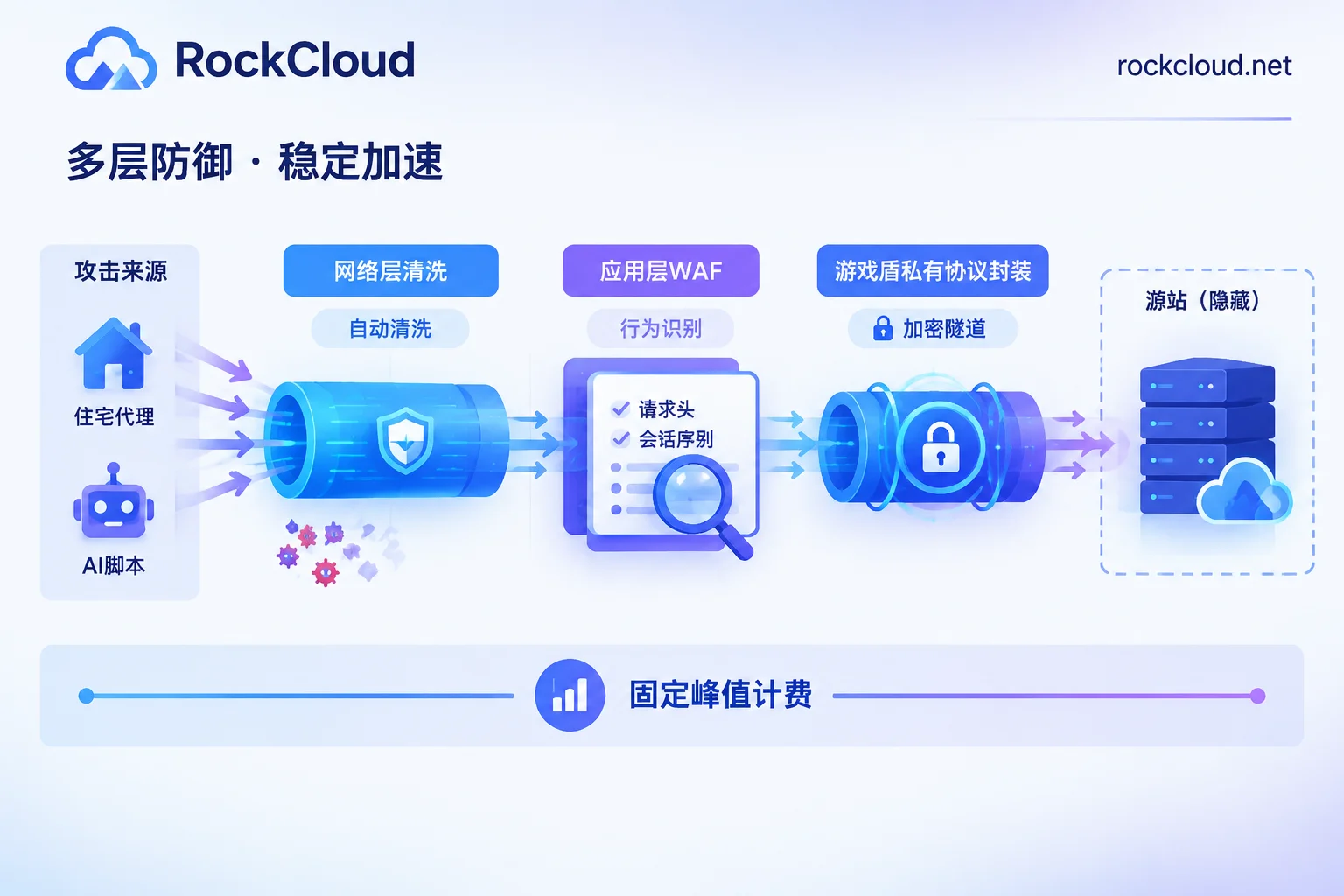
1. Network layer and application layer should be evaluated separately. For the network layer, look at bandwidth reserves and automatic scrubbing capability to ensure no manual intervention is needed when an attack comes. For the application layer, check whether the WAF can perform dynamic identification using request header fingerprints, request sequences, and session context, and whether it can configure anti-abuse policies for individual endpoints rather than only offering IP blacklists and global rate limiting.
2. For non-HTTP or sensitive-protocol businesses such as games, client apps, and payments, don't rely only on a web-layer CDN. These businesses are prone to two problems: origin exposure and protocol parsing that can't keep up. Private protocol encapsulation plus complete origin hiding (solutions like game shields) can make it impossible for automated scanning tools to even find the real entry point. For how to choose between the two solutions, see "How to Choose Between Game Shield and High-Defense CDN".
3. Calculate the bill clearly when under attack. With traffic-based or elastic billing, even if attackers can't take you down, they may still stick you with a bill far beyond expectations—this is "Denial of Wallet". With fixed peak-based billing and unlimited traffic, costs during an attack are predictable. For the difference in billing algorithms, see "How Peak-Based Billing Works for High-Defense CDN".
4. Whether alerts can reach on-duty staff in time. Attacks often end within minutes. No matter how detailed the dashboards and logs are, someone needs to see them in time. Solutions that can push directly to instant messaging tools are better suited for small teams on duty.
4. How RockCloud Does It
RockCloud (RockCloud) handles these attacks through the very chain described above, without relying on any special algorithm:
- Acceleration and defense are completed on the same link, with only one fee. Defense doesn't need to be purchased separately, and you don't need to switch back and forth between two providers.
- For web businesses, WAF is used to configure rules by path. For game and client businesses, the game shield is used, supporting private protocol encapsulation, TCP/UDP, and origin hiding.
- Fixed peak-based billing with unlimited traffic. The price is written into the contract, so bills won't spiral out of control when under attack.
- Provides a log panel and Telegram data push, making it easy to troubleshoot using the methods above, and ensuring on-duty staff get notified as soon as an attack begins.
- Free automatic SSL certificates. For domestic access that requires a no-ICP-filing route, CN2 acceleration is also available.
Protection effectiveness depends on your business type and actual attack conditions. Specific defense capacity and node information are subject to the official website. A more reliable approach is to first run a round of testing with real business, focusing on verifying three things: back-to-origin ingress lockdown, sensitive endpoint policies, and alert push. For test application materials and verification points, see "How to Apply for a Free High-Defense CDN Test", or submit an application directly on the plans and free test page.



Comments(0)