 RockCloud-基石云安全-官方博客
First, the conclusion: peak-based billing measures bandwidth (Mbps/Gbps), not total transfer volume (GB/TB). The system takes one bandwidth sample every 5 minutes, 288 per day, then picks one value from these points according to the rules agreed in the contract and multiplies it by the unit price. How many TB of traffic flowed does not directly enter the bill; it only determines how high or low those sampling points are.
Once you understand how sampling points are generated, the difference between the remaining algorithms is simply "which one to pick from the 288 points."
How Sampling Points Are Calculated
The common approach is to count the total outbound traffic within 5 minutes, then convert it to the average bandwidth for those 300 seconds:
5-minute total traffic (MB) × 8 ÷ 300 = bandwidth at that point (Mbps)
For example, if a node sends 15000 MB to users within a 5-minute window, then that point is 15000 × 8 ÷ 300 = 400 Mbps. Over 24 hours a day, this gives 288 such values, and about 8640 in a calendar month.
There is an easily overlooked consequence here: peaks are averaged out over 5 minutes. An instantaneous spike lasting 20 seconds will be heavily flattened when spread over 300 seconds; only a sustained high level lasting more than ten minutes will actually raise the sampling point. That is why the instantaneous curve on a monitoring dashboard often does not match the billing curve.
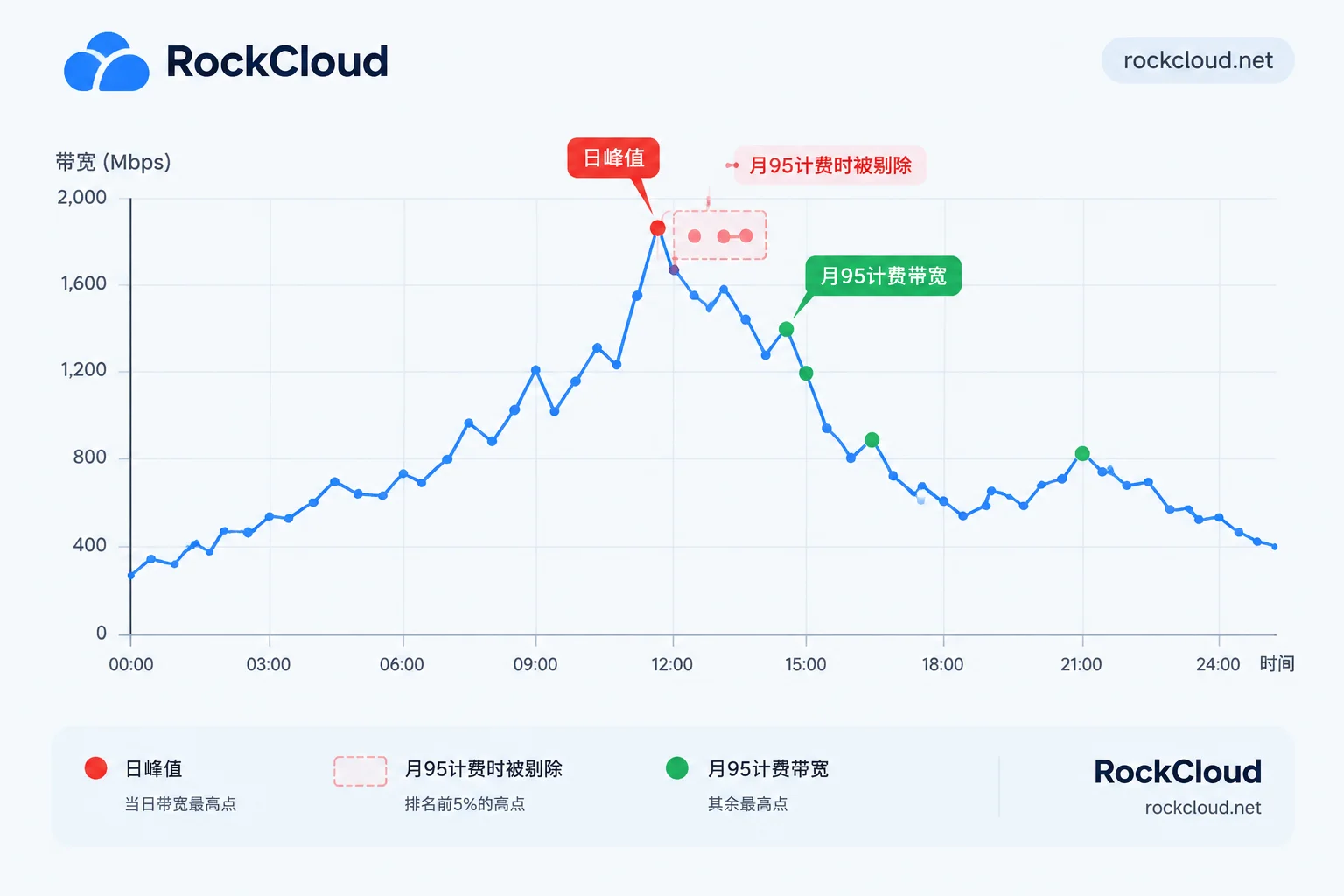
Four Algorithms: Formulas and Differences
1. Daily Peak Bandwidth
The maximum value among the day's 288 points is used as the daily billing bandwidth, billed daily:
Daily peak bandwidth (Mbps) × tiered unit price (yuan/Mbps/day)
It is sensitive. If any day has an abnormal high level lasting more than ten minutes, that day's bill is calculated at that high level. Suitable for businesses with smooth traffic curves that do not fluctuate wildly.
2. Monthly 95th Percentile (95th Percentile)
Sort all sampling points in the calendar month (about 8640) from high to low, remove the top 5% (about 432 points, equivalent to allowing about 36 hours of burst high levels not to be billed), and the highest remaining value is the monthly 95th percentile billing bandwidth:
Monthly 95th bandwidth (Mbps) × unit price (yuan/Mbps/month) × valid days ÷ total days in the month
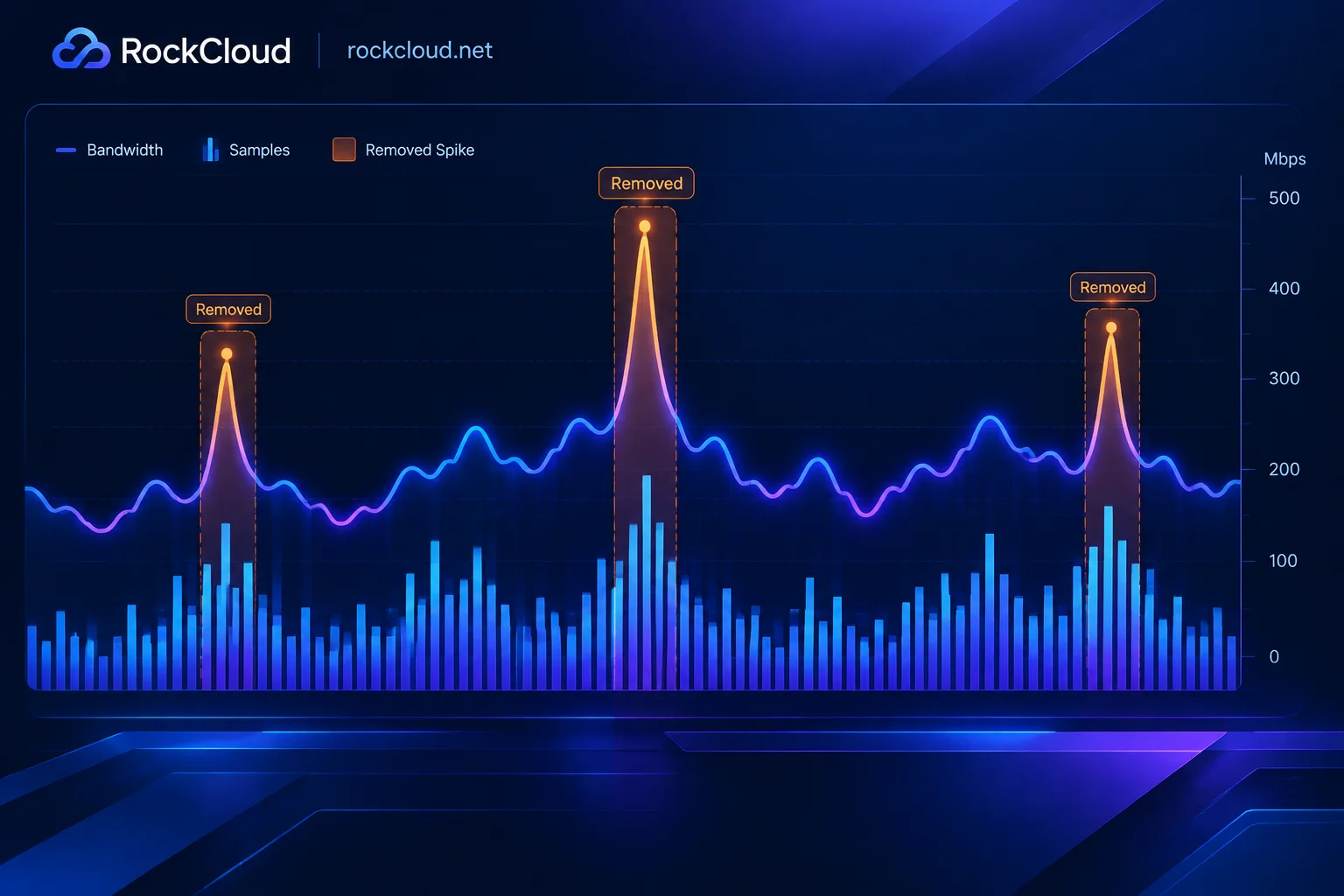
This "36-hour exemption" is the most valuable part of monthly 95th: spikes such as campaigns, new server launches, and version updates that occur a few times a month and last a few hours each usually fall into the removed 5% and will not raise the whole month's cost. Conversely, if your high level is fixed for several hours every day (for example, 8 PM to 11 PM), the cumulative monthly total far exceeds 36 hours, so the 95th value is basically equal to the daily peak, and you cannot save money.
Also note the "valid days" factor at the end. For mid-month onboarding, mid-month disconnection, or days with no effective traffic, different vendors define "valid days" differently. This definition directly changes the month-end number, so clarify it at signing.
3. Daily Peak Bandwidth Averaged Monthly
First take the maximum value among each day's 288 points (Max₁, Max₂...Maxₙ), then take the arithmetic average of these daily peaks:
(Max₁ + Max₂ + ... + Maxₙ) ÷ n × unit price × valid days ratio
This algorithm's tolerance for "an occasional one-day surge" falls between the previous two: the surge day is diluted by averaging, but not entirely removed as with monthly 95th. For businesses with obvious traffic differences between weekends and weekdays, this algorithm is usually more cost-effective than daily peak.
4. Fixed Peak Monthly Subscription (Most Common in High-Defense Scenarios)
The first three are all postpaid point-based billing, charged according to actual usage. Services oriented toward defense usually use a different contract: reserve a fixed business bandwidth peak (Mbps) + a DDoS protection specification (Gbps), with monthly or annual contract pricing. Within the agreed business peak range, the fee remains unchanged no matter how many GB/TB are actually transmitted.
It solves a risk unique to high-defense scenarios: during attacks or abuse, the traffic curve is not under your control. Under point-based billing, an anomaly lasting a few hours can turn into an uncontrollable bill; fixed peak locks the upper limit into the contract, making costs predictable. RockCloud uses this fixed-peak, unlimited-traffic contract pricing method, where acceleration and defense are completed on the same link and billed as one fee, with no separate purchase required for protection—specific specifications and plan and free test entry are here.
The trade-off is that you must estimate the peak accurately before signing. Estimate too high and you waste budget; estimate too low and you either trigger rate limiting or trigger elastic overage charges.
How to Back-Calculate How Many Mbps You Should Buy
When you only have traffic data (for example, "2TB per day"), convert it in the following three steps:
Step 1: Calculate the daily average bandwidth. 1 TB/day ≈ 92 Mbps of all-day average bandwidth (8×10⁶ Mb ÷ 86400 seconds). Conversely, 1 Mbps running at full capacity for a month corresponds to about 316 GB of traffic. Remember these two numbers; they are enough for daily estimation.
Step 2: Multiply by the peak-to-valley ratio. Traffic is not evenly distributed over 24 hours. There is no universal value for the peak-to-valley ratio; you must look at your own historical curve: domestic user-facing entertainment and content businesses concentrate in the evening peak, and the ratio is usually significantly higher than for all-weather API businesses. Do not guess—pull up the bandwidth curve for the past 30 days and read the highest point directly.
Step 3: Leave margin and check campaign days. Look separately at the bandwidth of your largest past campaign and largest version update. If you are on a fixed-peak contract, such predictable spikes should either be included in the contracted bandwidth or a temporary scaling method should be agreed with the service provider in advance.
Bill Bandwidth Is Higher Than Log Statistics—Usually Not a Calculation Error
You need to know two scope differences in advance, otherwise reconciliation will lead to repeated disputes:
Only downstream outbound traffic is counted. CDN billing bandwidth generally only counts downstream traffic sent from edge nodes to clients. Origin-pull traffic is usually not included in basic service bandwidth (whether origin-pull fees are charged separately varies by vendor and must be confirmed separately).
Protocol overhead increases it. Network-layer billing bandwidth includes TCP/IP headers, handshakes, packet loss retransmissions, and other overhead, and is higher than the byte count accumulated in application-layer logs. The common industry difference range is about 7%–15%. For businesses with many small files and frequent connection establishment (such as many small images and short API requests), the increase is more obvious. When budgeting, directly multiplying log numbers by the unit price will usually be too low.
Four Things You Must Clarify Before Signing a Contract
- How overage beyond the agreed peak is handled. This is the item with the greatest variation among vendors and the greatest impact on business continuity: some charge postpaid at elastic bandwidth tiers, some directly rate-limit and drop packets, and some trigger blackholing. There is no unified industry standard; you can only confirm thresholds and handling actions vendor by vendor and write them into the contract. Do not assume "it will automatically scale when exceeded."
- How valid days/valid factors are defined. Especially for mid-month onboarding or mid-month specification adjustments.
- Whether domestic and overseas nodes are priced separately. Different node locations mean different unit prices and compliance requirements—domestic nodes usually require the domain to complete ICP filing, which affects the onboarding plan. You can refer to Does High-Defense CDN Require ICP Filing?.
- Whether protection specifications are billed separately. "Bandwidth fee + protection fee" quoted separately and "one fee for the same link" are two different cost structures. When comparing prices, restore them to the same scope first.
The Trial Period Is the Best Time to Calibrate the Peak
Estimation is ultimately estimation. The truly reliable approach is to route part of real traffic during the free trial period, observe the 5-minute sampling curve in the panel, see which range the daily high level falls into and when the highest point appears, then go back and set the contracted bandwidth. This is much cheaper than adjusting the contract afterward.
For what materials to prepare during the trial period, in what order to onboard, and which metrics to observe, see How to Apply for a Free High-Defense CDN Trial.
A brief wrap-up: the logic for choosing an algorithm is one sentence—choose monthly 95th for occasional spikes, daily peak for smooth curves, and fixed peak monthly subscription for uncontrollable fluctuations when you fear runaway bills. And no matter which you choose, pulling up your own bandwidth curve for the past 30 days and taking a look is more useful than any price comparison table.



Comments(0)