 RockCloud-基石云安全-官方博客
Let's start with the conclusion: Hong Kong CN2 DDoS protection is suitable for businesses that simultaneously meet three conditions: primary users in mainland China, sensitivity to latency and packet loss, and frequent DDoS or CC attacks. When all three conditions are met, its advantages of no ICP filing and direct mainland connectivity are cost-effective. If only one or two are met, such as users mainly overseas or the business is not latency-sensitive, most of the extra CN2 bandwidth cost you pay will be wasted.
Additionally, the name "Hong Kong CN2 DDoS-Protected Server" often leads people to think they need to buy a server with defense capabilities. In actual production environments, a more common practice is to place the CN2 line and defense at the front end, using ordinary servers for the origin and hiding the real IP. Let's first look at which businesses are suitable, then discuss limitations and architectures.
Where Its Advantages Come From
The value of Hong Kong CN2 mainly lies in two points:
- Close to mainland China with good routing quality. CN2 GIA or three-network direct-optimized lines have a short physical distance to mainland China and pass through fewer routing nodes. Industry references often cite: packet loss rate typically below 0.5%, latency in coastal areas as low as 10–30ms, and nationwide average within 50ms. Actual values depend on the specific line and user location, so test results should prevail.
- Nodes are overseas, no ICP filing process required. Business can go live directly without waiting for the filing cycle. For the relationship between filing and node location, refer to Does DDoS-Protected CDN Require ICP Filing?.
The "DDoS protection" part solves another issue: whether the business can continue providing services after being attacked. The simultaneous need for low latency and attack resistance is the main reason to choose Hong Kong CN2 DDoS protection.
Three Types of Suitable Businesses
1. Real-time Competitive Games, Mobile Games, and PC Game Launches
This is the most typical scenario. Real-time competition is highly sensitive to round-trip latency and packet loss, typically requiring latency below 50ms. The gaming industry also frequently faces DDoS and CC attacks from competitors or hackers, and attacks on launch day are common. No ICP filing, low latency, and attack resistance—these three are all needed for such businesses.
When selecting, first confirm the protocol. Many games use TCP/UDP private protocols, which ordinary web DDoS-protected CDNs cannot handle; you need a game shield that can encapsulate protocols, support TCP/UDP, and hide the origin. For the difference between the two, see How to Choose Between Game Shield and DDoS-Protected CDN. For UDP battle servers, see Can UDP Battle Servers Under Attack Use CDN Protection?.
2. Cross-border Financial Trading, Payment Interfaces, and Critical Business APIs
Forex, crypto platforms, and payment gateways need real-time market data refresh and fund interface calls, with very low tolerance for network jitter. Such businesses are also targeted by ransomware DDoS and face CC attacks like automated credential stuffing and API abuse.
For these businesses, relying solely on lines and DDoS scrubbing is insufficient; application-layer WAF protection is also needed. After integrating WAF, pay special attention to payment callbacks: overly strict rules may block third-party callback requests. For solutions, refer to How to Whitelist Payment Callbacks Blocked by WAF.
3. Overseas Independent Websites, Cross-border E-commerce, and Promotional Landing Pages Targeting Domestic Users
These sites have servers overseas but users in China. Access speed directly affects conversion rates, and during major promotions, they may face competitor API abuse or DDoS attacks. Hong Kong CN2 DDoS protection allows sites to go live quickly without ICP filing, while balancing access speed and protection.
Such businesses have obvious traffic peaks and troughs, so focus on comparing billing methods rather than just bandwidth at a single moment. For algorithm differences, refer to How Is DDoS-Protected CDN Peak-Based Billing Calculated?.
When It's Not Suitable
- Primary users overseas: CN2's advantage is in the mainland direction; overseas users won't benefit from this line advantage.
- Large file downloads, video distribution, and other high-bandwidth, low-margin businesses: CN2 bandwidth is expensive, and costs may exceed business revenue.
- Already filed, users concentrated in mainland China, with average latency requirements: Consider including mainland node solutions in the comparison; Hong Kong CN2 is not mandatory.
Two Easily Overlooked Limitations
Limitation 1: CN2 Bandwidth Is Expensive, and Large-Capacity Local Scrubbing Is Costly
The wholesale unit price of CN2 bandwidth is significantly higher than international BGP lines and European/American bandwidth. If a single server needs tens of Gbps or even hundreds of Gbps of pure local CN2 scrubbing bandwidth, the monthly rent will be very high. Therefore, low-priced "Hong Kong CN2 DDoS-Protected Servers" on the market usually compromise on defense capacity, line purity, or over-capacity handling.
Limitation 2: After Attacks Exceed Capacity, the Line May Change
Some products labeled "Hong Kong DDoS Protection" switch traffic to North America or other international nodes for scrubbing when attacks exceed local capacity, to save scrubbing costs. Then the return latency may rise above 150ms or even packet loss. Another approach is direct blackholing of the mainland direction. The business may test smoothly normally, but once attacked, it becomes unavailable exactly when stability is most needed.
Operators' blackhole thresholds and scrubbing route switching rules for cross-border CN2 are not publicly disclosed, so you cannot assume all providers handle it the same way. The safest approach is to ask directly before procurement and put it in the contract.
Three Common Architectures
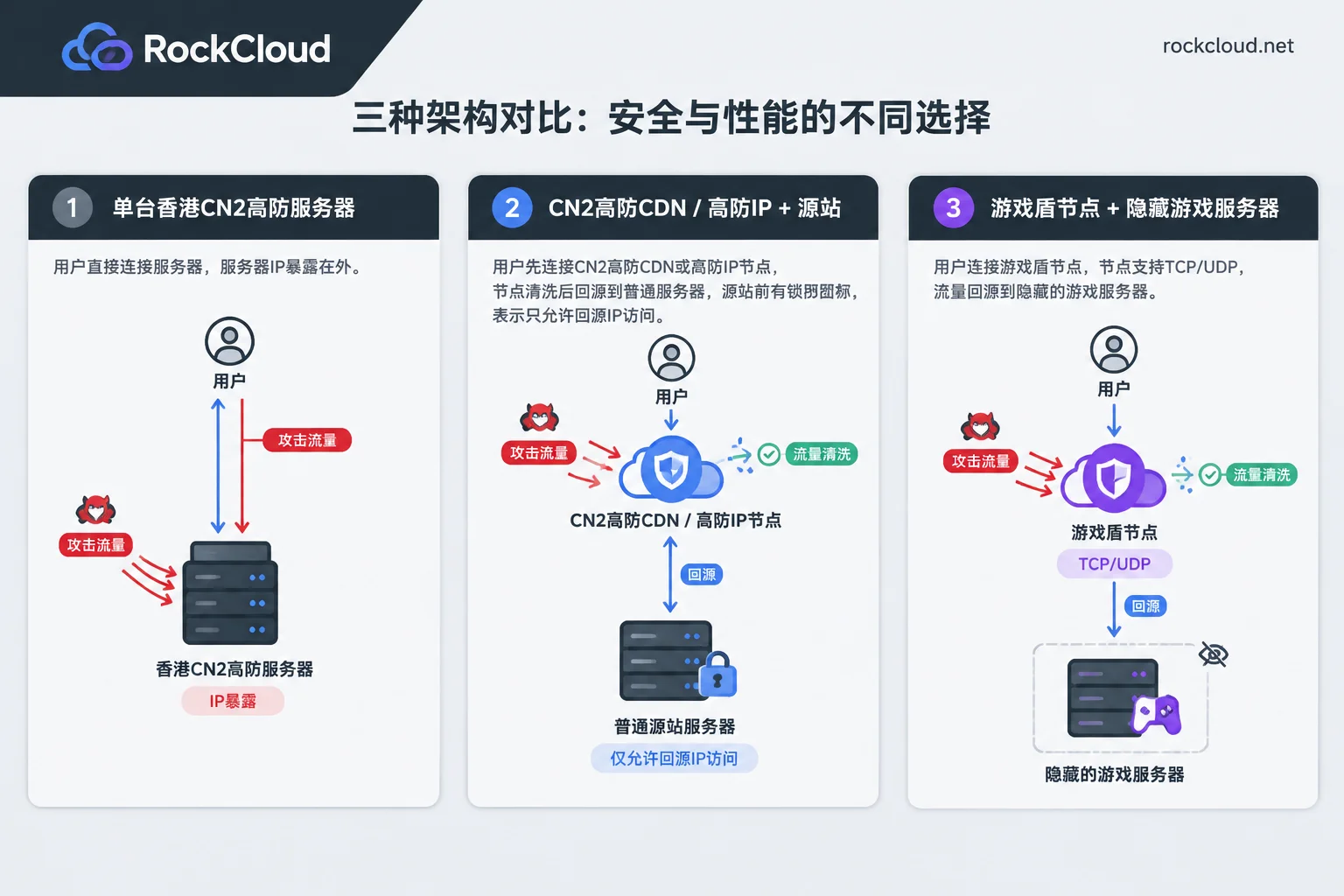
Solution A: A single Hong Kong CN2 DDoS-protected server hosting all business.
Simplest to deploy, suitable for small-scale businesses with low attack volumes. Its problem is that the origin IP is directly exposed: after attacks exceed the machine's defense capacity, you can only wait for the blackhole to lift or change IPs. Also, defense capacity is limited by single-machine bandwidth, and scaling costs are high.
Solution B: Ordinary origin + front-end CN2 DDoS-protected CDN or DDoS-protected IP, suitable for websites, APIs, and independent sites.
Users first connect to the front-end CN2 node, where traffic is scrubbed and accelerated, then returned to the ordinary origin. The origin can be placed in a lower-cost data center, with the firewall allowing only the back-to-origin IPs of the DDoS-protected nodes. This maintains low-latency direct connection to the mainland without purchasing expensive CN2 bandwidth for each origin. For whether to choose CNAME or NS when integrating, refer to Do You Need to Change NS When Integrating DDoS-Protected CDN?.
Solution C: Ordinary origin + game shield, suitable for TCP/UDP gaming businesses.
The idea is the same as Solution B, except the front end handles private protocol traffic. The key to this solution is completely hiding the origin: if the old IP is already exposed, adding a game shield alone is not enough; you must also change the IP and restrict back-to-origin sources. For the specific order, refer to How to Hide Origin IP When a Card Game Server Is Attacked.
For most businesses of a certain scale, Solutions B or C are easier to control costs and scale defense capabilities than standalone solutions. Solution A is suitable for startups or projects with limited budgets, but you must understand its defense limits.
Five Things to Clarify Before Procurement
- Whether both forward and return paths of all three networks use CN2: Some products only guarantee one direction or one operator. Use Telecom, Unicom, and Mobile networks separately for traceroute to check the actual path.
- How to handle attacks exceeding defense capacity: Will traffic be switched to overseas scrubbing, or will the mainland direction be blackholed? For how long, and how to recover?
- How defense and bandwidth are billed: Is defense an additional purchase, is it billed by peak or by traffic, and how are overages calculated?
- Which protocols are supported: Only HTTP/HTTPS, or also TCP/UDP forwarding and private protocols?
- Whether testing is possible first: Integrate real business during the trial period, check latency, packet loss, and log panels; don't just rely on the vendor's speed test page.
Selection Conclusion and Next Steps
If your business fits one of the three scenarios above and you confirm the "front-end CN2 protection + ordinary origin" architecture, you can proceed to product comparison and testing. RockCloud provides the front-end layer and does not sell servers. Its CN2 China Acceleration offers three-network direct connection without ICP filing, with acceleration and DDoS/CC defense completed on the same link, charged as one fee, and defense is not an additional purchase. Billing is by fixed peak, unlimited traffic, with contract pricing. For line details and integration methods, see CN2 China Acceleration.
Specific metrics such as defense level, nodes, and latency are subject to the official website. It is recommended to run real business during the trial period and make a decision after confirming the results. For what to verify during the trial, refer to How to Apply for a Free Trial of DDoS-Protected CDN.



Comments(0)