 RockCloud-基石云安全-官方博客
The core role of a global acceleration network is to optimize the transmission path through Anycast nearest-access and dedicated backbone relays. Its capability is strictly limited to improving link quality; it does not involve content caching or security cleansing. For the question 'Can it solve slow cross-border access?', the answer is affirmative—but only if you understand that link quality and attack bearing are two independent capability lines. Taking RockCloud as an example, it offers both Anycast global network acceleration and CN2 China dedicated line capabilities. The former handles route optimization, while the latter ensures return bandwidth to China. These two capabilities must be technically verified separately during procurement.
More nodes don't necessarily mean faster cross-border access—sometimes the opposite
Many technical leaders mistakenly believe that the total number of edge nodes is the core metric for measuring acceleration effectiveness. However, real-world tests show that the same group of users may experience worse time-to-first-byte on networks with denser nodes. This is because whether access points are dense and which backbone route is used after access, and how the traffic returns to China, are two completely independent variables. The public BGP protocol prioritizes AS-Path (autonomous system hop count) and network topology distance, not physical straight-line distance. If there is no good direct peering relationship, data packets can be forced to detour through multiple international carrier interconnection points even when entering from the nearest node, resulting in increased latency. Therefore, what procurement really needs to verify is not the node count advertised by the vendor, but the actual connectivity quality of valid landing points and return-link segments.
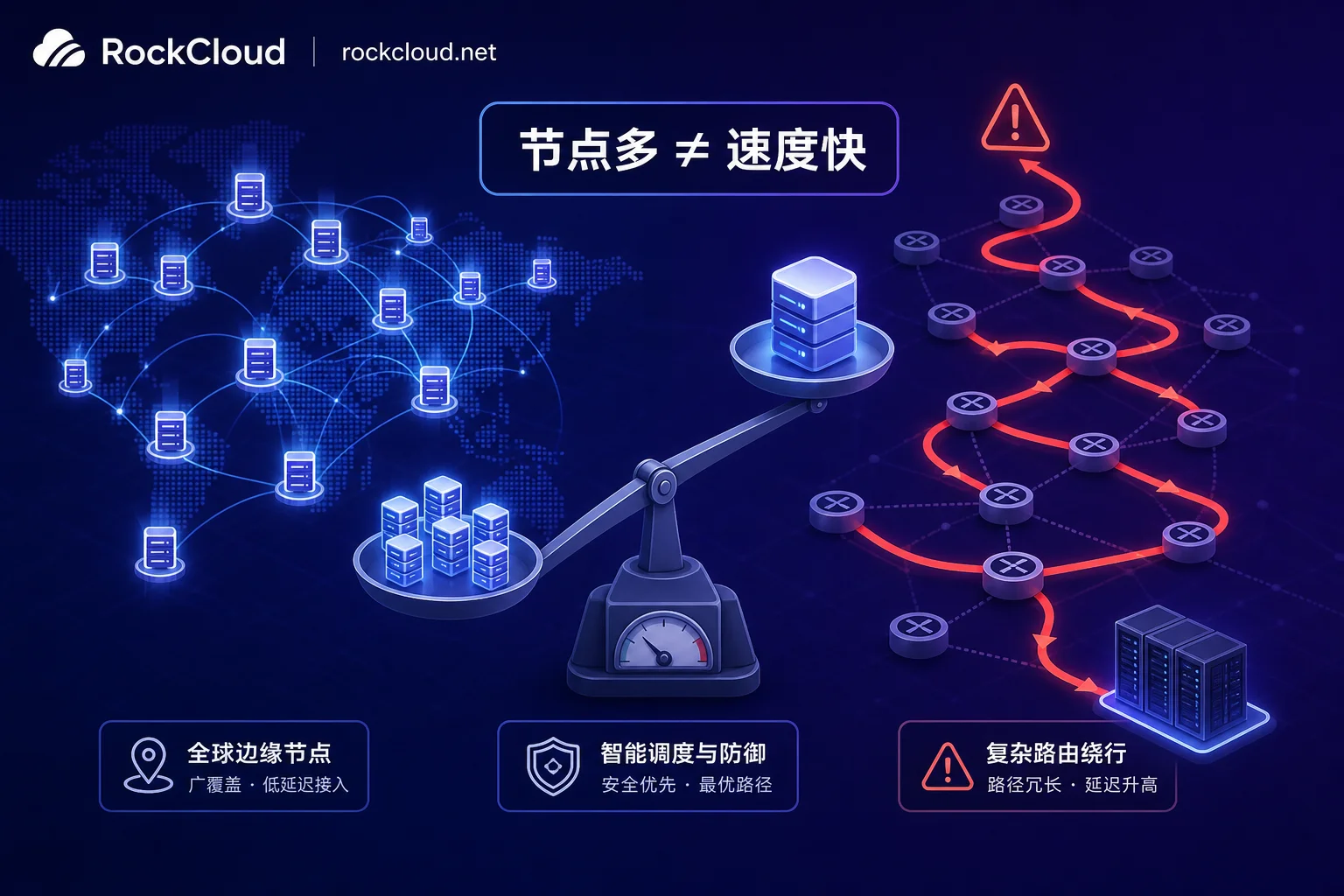
Anycast routes by AS-Path, not by physical distance
The core of Anycast is announcing the same IP address from multiple locations worldwide, letting routers choose the 'nearest' path based on BGP policies. However, 'nearest' here refers to minimal hops in network topology, not shortest geographic distance. AWS official documentation notes that the Global Accelerator service announces static IP addresses via Anycast BGP at edge nodes, routing client traffic to the protected dedicated backbone network. But in complex international internet environments, commercial interconnection policies between carriers often dominate routing decisions. When there is no direct peering connection between two autonomous systems, data packets may need to pass through third-party relays, causing cross-ocean detours. To mitigate this, mainstream vendors introduce health checks, endpoint weights, and traffic-steering knobs to dynamically adjust paths, but this cannot eliminate the latency floor imposed by physical distance.
Capacity crowding when acceleration and cleansing share the same edge network
According to a single-vendor report from Cloudflare, in the first half of 2026, ultra-large network-layer attacks exceeding 1 Tbps surged 519% quarter-over-quarter, with 935 automatically mitigated within six months. The main vectors were DNS and CLDAP reflection. This data only reflects observations from that specific statistical period and does not represent the entire internet. When acceleration and DDoS cleansing are deployed on the same edge network, if an attack consumes the total cleansing capacity of a particular PoP node, that node may trigger BGP route withdrawal or traffic rerouting. In such cases, normal users originally served by that node are forced to connect to remote nodes, resulting in a sudden increase in access latency rather than direct unavailability. This clearly shows that link optimization and attack-bearing capacity are separate tasks: the former focuses on transmission efficiency, while the latter focuses on resource isolation and buffering capability. For specific countermeasures, see Architectural Solutions for Handling T-level DDoS Attacks.
What's the difference between global acceleration network and CDN: division of labor for three traffic types
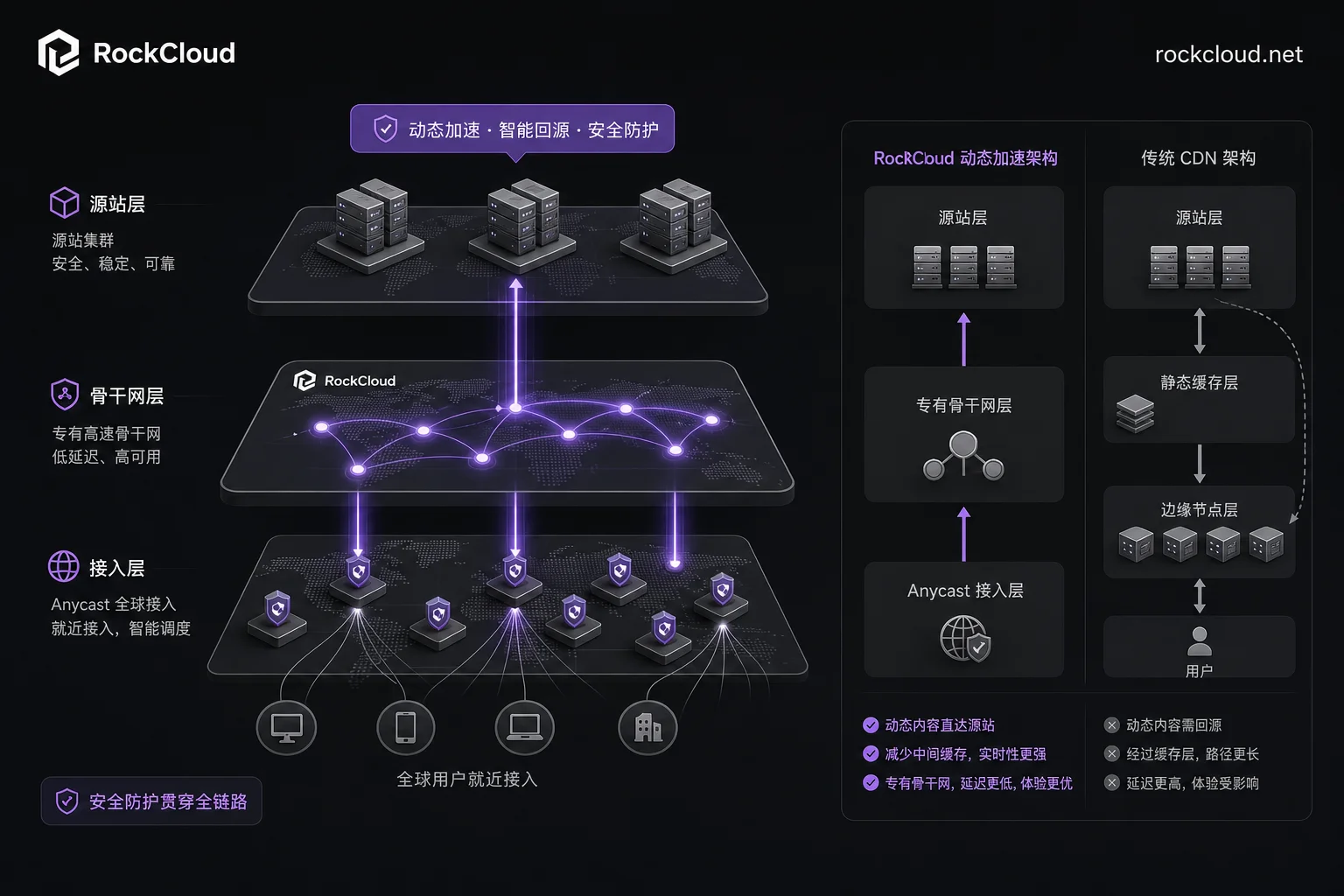
To understand the difference between a global acceleration network and a traditional CDN, it is key to dissect three traffic forms: static cache, dynamic origin fetch, and Layer-4 relay. Traditional CDNs rely mainly on high hit rates for static content, caching images, videos, and other files at edge nodes to reduce origin pressure; their optimization occurs at the access segment and is ineffective for pure dynamic APIs. In contrast, a global acceleration network focuses more on optimizing dynamic content transmission. It does not rely on content caching but instead terminates TCP connections at the edge and uses a dedicated backbone for relay transmission; its optimization occurs in the backbone relay segment and is effective for pure dynamic APIs. In this division, cross-border dedicated lines like CN2 usually serve as part of the backbone relay, solving congestion on the final segment back to China, while Anycast handles the front-end nearest access. For further clarification of security-side responsibilities, refer to the layered protection logic in CDN Security Acceleration.
Criterion 1: Multi-location probing to detect routing drift and detours
To verify acceleration effectiveness, you cannot rely solely on a single-location ping test. It is recommended to initiate multi-point probes from the main regions where your target users are located, comparing differences in both outbound and return paths. Key observations include: whether the reverse DNS hostname/PoP code of the access IP changes unexpectedly over time, and whether the last few hops in Traceroute show obvious cross-ocean detours. For example, when accessing Shanghai from Singapore, if the path shows relay points via the US or Europe, it indicates severe routing drift. Single-point tests can easily be misled by local ISP routing policies, so you must record raw Traceroute data and MTR reports to provide concrete evidence when communicating with vendors. Since carrier backbone peering policies are not public, proactive probing is the only feasible acceptance method.
Criterion 2: Why time-to-first-byte and packet loss must be tested at different times
Network quality exhibits significant time-based fluctuations, especially during peak evening hours. Tests should be conducted during both off-peak and business peak hours, sampling TCP handshake time, time-to-first-byte (TTFB), and packet loss rates. If performance is normal during the day but degrades during the evening peak, it usually indicates a bottleneck at the local ISP interconnection or backbone congestion. Additionally, long-distance links such as trans-Pacific have a physical latency floor, and no software optimization can break the speed of light. Therefore, evaluation standards should be based on relative ranges: compare the performance improvement of accelerated vs. direct connections, and the stability differences across time periods, rather than pursuing an absolute millisecond value.
What acceleration cannot solve: origin exposure and Layer-7 requests
Adopting a global acceleration network does not mean your origin server is completely secure. Attackers can still locate the real IP via historical DNS records, certificate transparency logs, or internet-wide port scanning, allowing them to launch direct attacks bypassing the acceleration network. If strict origin security group whitelist is not configured, the origin remains vulnerable to direct access. On the other hand, application-layer CC attacks and non-HTTP proprietary protocol attacks are not within the scope of link optimization. These require independent WAF rules and dedicated cleansing clusters; pure network acceleration cannot absorb such malicious traffic.
How to choose for overseas sites & APIs, gaming match nodes, and cross-border origin fetching
Selection strategies should vary according to business types. For pure static or media-heavy overseas sites, focus primarily on CDN cache hit rates and edge coverage breadth. For dynamic APIs and SaaS services, prioritize time-to-first-byte and packet loss control on backbone relays. For gaming match nodes, extreme attention must be paid to jitter and packet loss stability, with average latency as a secondary concern. For cross-border origin fetching aimed at mainland China users, verify the performance of the return link during evening peak hours. In this context, pay special attention to the differences revealed in CN2 GIA vs CN2 GT Line Performance and Latency Comparison. For hybrid deployment architectures, clearly define the responsibility boundaries between acceleration and hosting sides to prevent two paths from masking each other's faults. When evaluating overseas nodes, also refer to the selection logic in How to Choose US CN2 Servers and make comprehensive judgments using RockCloud's real-world test data.
Common Questions
What is the difference between a global acceleration network and a CDN?
The core difference lies in the object they handle. CDNs excel at static content caching, reducing origin fetches by hitting edge copies. Global acceleration networks focus on dynamic transmission, optimizing routes through Anycast nearest-access and dedicated backbone relays, suitable for APIs and real-time interactions. They are often used together rather than as substitutes.
What should I do if the login API for mainland users becomes slow during peak hours?
First, check whether the routing is causing detours. Try using an acceleration service with high-quality return links (such as CN2). Second, verify that DNS resolution points to the correct edge node. Finally, optimize the origin server's response speed to ensure backend processing time is not the bottleneck.
Between a single-node dedicated line and Anycast, which has lower total latency?
Anycast theoretically achieves lower access latency because it connects users to the nearest entry point. However, if the backbone path from that entry point to the origin is poor, the total latency may be higher than a well-optimized single-node dedicated line. The actual path quality must be considered.
Is more global acceleration nodes always better?
Not necessarily. More nodes only mean more potential access points. If there is no high-quality backbone interconnection, data packets may hop multiple times within the internal network, increasing latency. The key lies in the quality of interconnection between nodes and the stability of the return bandwidth.
If one node is hit by a large-scale attack, will other users on the same network be affected?
Yes. If an attack saturates the cleansing capacity of a node, that node may withdraw its route, causing its users to be passively migrated to remote nodes, leading to sudden latency spikes. Therefore, confirm whether the service provider has sufficient redundant cleansing capacity and intelligent scheduling mechanisms.




Comments(0)