 RockCloud-基石云安全-官方博客
For teams doing cross-border business, app distribution, game operations, or private domain promotion, the most feared midnight message is: "The website won't open," "Clicking the link in WeChat shows a red page," or "It works on mobile data but shows connection reset on home broadband."
When a domain is blocked, many ops teams' first reaction is to quickly switch to a backup domain. But frequent domain changes come at a high cost: ad landing pages become invalid, old user bookmarks break, SEO weight drops to zero, and once the API endpoints hardcoded in the app are lost, users may even be forced to reinstall the client.
To achieve domain block recovery, the first step is not blindly changing domains, but identifying which layer of blocking mechanism your domain is stuck at, then applying targeted pollution cleaning, block recovery, or seamless redirects to restore normal access without changing the domain.
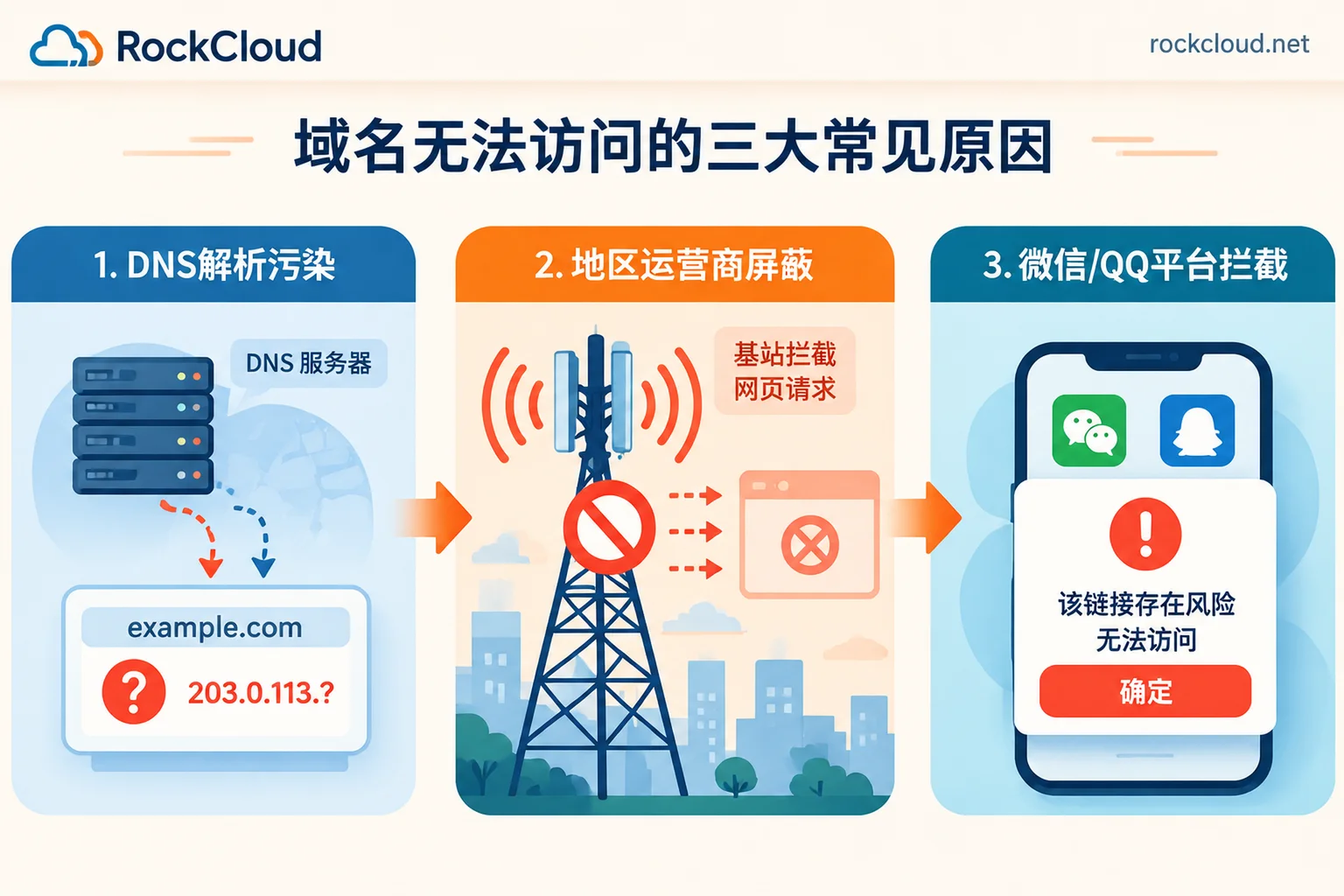
1. The Same "Won't Open" Symptom: Domain Blocking Actually Has Three Types
Users see "webpage cannot be accessed," but the underlying blocking mechanisms are completely different. Common domain anomalies fall into three categories:
1. DNS Pollution (Domain Resolution Tampered With)
When domestic users initiate access, DNS requests are preempted at backbone or recursive nodes and return forged IP addresses (e.g., 127.0.0.1, blackhole IPs, or unrelated overseas IPs). As a result, the browser cannot obtain your real origin or CDN node IP and directly reports a connection error.
2. Regional ISP Blocking and HTTP/HTTPS Hijacking
Sometimes resolution works fine in most parts of the country, but fails only in certain provinces on China Mobile, China Unicom, or China Telecom networks, or redirects to an anti-fraud warning page or ISP error page. This is usually ISP blocking and traffic hijacking at the provincial or metropolitan network level, often targeting specific domains or SNI handshake signatures.
3. Built-in Blocking by Social Platforms like WeChat and QQ
The domain works perfectly in the system browser, but as soon as it's sent to a WeChat chat, Moments, or a QQ group, clicking it shows "This webpage has been stopped from visiting" or a risk warning red page. This is an application-layer ecosystem blacklist mechanism, often triggered by malicious complaints from competitors, high-frequency inducement sharing, cross-domain redirects of unfiled domains, or malicious scripts on the page.
2. Four-Step Self-Check: Quickly Locate Which Layer Your Domain Is Blocked At
Before taking recovery action, ops teams can run the following four steps in 10 minutes to pinpoint the fault boundary:
- Compare domestic and international DNS resolution results: On a terminal, use the
nslookupordigcommand to query the target domain against domestic public DNS (e.g.,223.5.5.5) and overseas public DNS (e.g.,8.8.8.8,1.1.1.1). If the domestic IP returned does not match your actual configuration, or even returns a loopback address, it can basically be diagnosed as DNS pollution. - Multi-province, multi-network connectivity testing: Use multi-node probing tools to check HTTP status codes and resolution latency across all three major ISPs in various provinces. If only specific provinces or a single ISP return timeouts, connection resets (RST), or redirects to a fixed blocking IP, it indicates regional ISP blocking.
- Cross-validate access environments: Enable mobile data on your phone and open the same link in the system browser (Safari/Chrome) and in WeChat/QQ built-in browsers. If the system browser opens instantly but the social app shows a red page, the problem is purely platform-level domain blocking.
- Check if the origin is also under attack or blackholed: Sometimes the domain is inaccessible not because of blocking, but because the origin IP is under a volumetric attack and has been blackholed by the data center, or attackers are using malicious crawlers to scan at high frequency and trigger risk control. In this case, you can first refer to How to Determine Whether a Website Is Under DDoS or CC Attack and How to Read Traffic and Network Logs in the CDN Console to rule out origin downtime and traffic saturation.
3. Why Traditional "Change Domain + Manual Appeal" Is Increasingly Unworkable
After identifying the cause, traditional approaches often lead to frustration:
- Manual appeals take a long time and have low success rates: For WeChat and QQ blocking, although official appeal portals exist, rectification, investigation, document submission, and waiting for review often take one to several weeks; for overseas unfiled businesses or domains that have been reported multiple times, appeals often go unanswered.
- Ordinary 301 redirects can cause "guilt by association": Many teams try to use a new domain for ordinary 301 redirects, but if the entry domain itself is DNS-polluted or flagged by social platforms, the client cannot even complete the first handshake, so the 301 instruction never reaches the user's browser; even if it does, social platform risk-control crawlers will follow the redirect chain and blacklist the new domain as well.
- Frequent domain changes disrupt business flow: Every domain change requires updating promotional materials, notifying channel partners, and updating client configurations, causing massive churn of old customers during the transition window.
Therefore, when dealing with domain anomalies, mature business teams have only one core demand: restore in place whenever possible; if traffic takeover is necessary, make it completely seamless for end users.
4. Practical Recovery Solutions: DNS Pollution Cleaning and Recovery Without Changing Domain
To address these pain points, RockCloud offers a dedicated block and pollution recovery technical solution that works in conjunction with high-defense acceleration links to recover at different blocking levels:
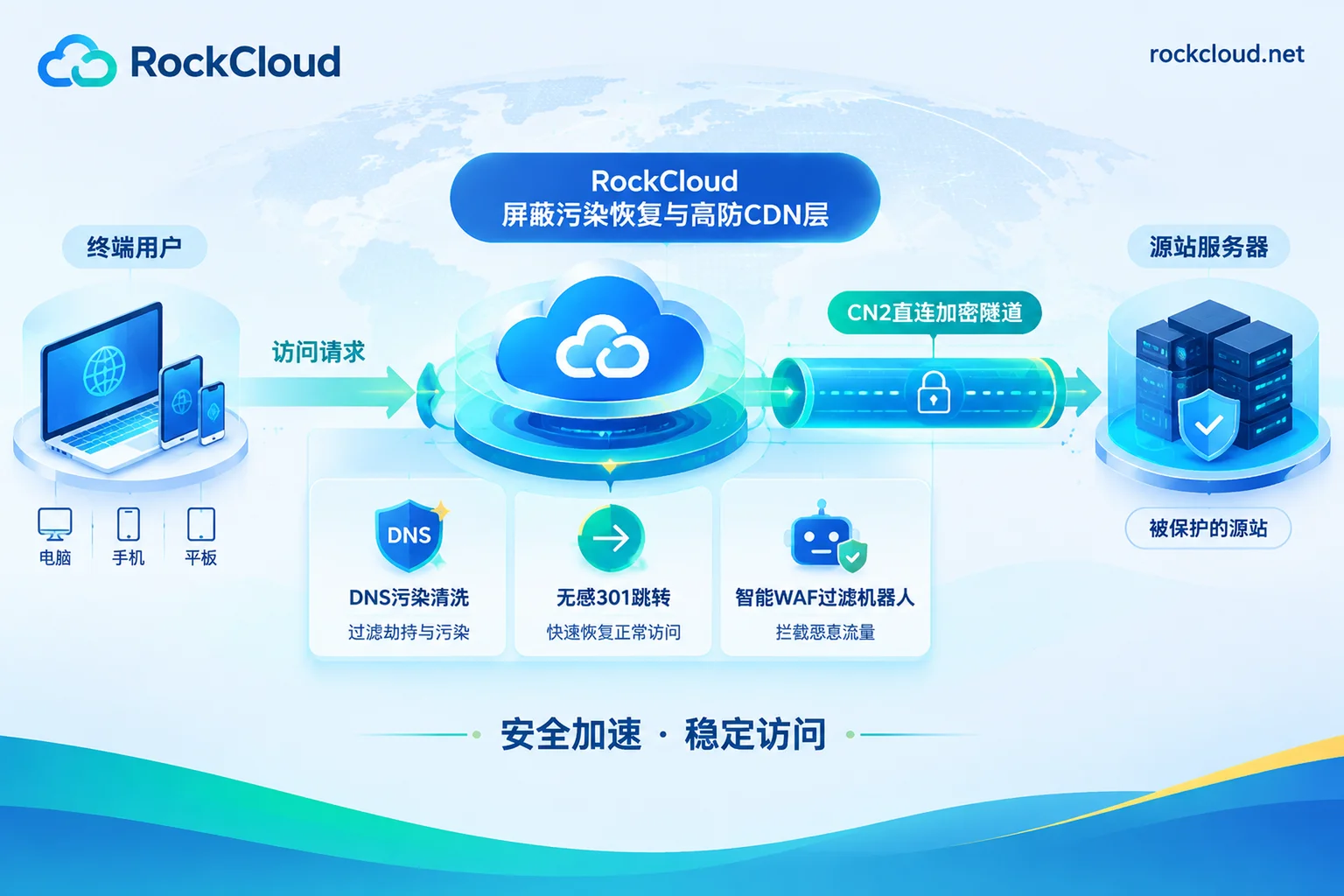
1. For DNS Pollution and Regional ISP Blocking: Pollution Cleaning and Original Domain Recovery
When a domain suffers DNS pollution or regional ISP blocking, it doesn't mean the domain is completely doomed. By accessing the block and pollution recovery service, DNS pollution cleaning and ISP-level block recovery can be performed on the affected domain. The core advantage is that there is no need to change the original domain; old users' historical bookmarks, external ad links, and app built-in APIs can all continue to be used, avoiding the loss of existing customers caused by domain changes.
2. For Social Platform Blocking like WeChat and QQ: In-Place Recovery and Seamless 301 Redirects
For businesses heavily reliant on social ecosystems such as private domain traffic, H5 campaigns, and app distribution, the solution supports domain block recovery for WeChat, QQ, and other platforms. At the same time, combined with the seamless 301 redirect mechanism, it smoothly schedules and isolates access links while ensuring end users can open landing pages normally, preventing business from completely stalling due to a single point of failure.
3. Long-Term Hardening After Recovery: Consolidate Acceleration, Anti-Hijacking, and Security Protection into One Link
Many domains are repeatedly blocked or flagged for two root causes: first, cross-border bare connections are easily sniffed or hijacked by intermediate nodes on the public internet; second, websites lack basic web security protection, allowing hackers to exploit SQL injection or XSS vulnerabilities to plant hidden links, or being frequently probed and reported by malicious scanners or competitor crawlers.
After domain recovery, it is recommended to upgrade the architecture to reduce the probability of being blocked again:
- Access high-defense and acceleration without changing NS: Use high-defense CDN and DDoS/CC protection to completely hide the origin IP behind Anycast distributed nodes. When accessing, you only need to add a CNAME record at your original DNS provider without modifying NS, and switch between old and new links in parallel (see Why Unfiled CDN Domestic Access Is Often Slow: Return Path, High-Defense Cleaning, and NS-Free Access Solutions).
- Enable intelligent WAF to block malicious crawlers and tampering: One-click enable the Intelligent Web Firewall (WAF) in the control panel to block SQL injection, XSS, and malicious script injection (preventing the website from triggering security software alerts due to being hacked) based on the OWASP core rule set, and identify and filter malicious scanner and automated bot requests. If there are special business API whitelisting requirements, the security technical team can assist in configuring custom rules.
- Unfiled three-network direct connection improves domestic access experience: For businesses deployed overseas, CN2 China Acceleration can be added to achieve direct return to China via China Telecom CN2 GIA, China Unicom AS9929, and China Mobile CMI three-network direct connections, with nearby access from Hong Kong, Japan, South Korea, Singapore, and other circum-China nodes. Stable mainland access speed can be obtained without ICP filing, and combined with free fully automatic SSL, anti-hotlinking, and IP/region blacklist/whitelist general features to further tighten access boundaries.
5. Access and Daily Operations Recommendations
In daily operations, it is recommended to include all important business domains in a unified monitoring and protection system:
- Use the control panel and real-time push to detect anomalies early: After accessing RockCloud, the ops team can view traffic and bandwidth reports and network logs at any time through the control panel, and enable Telegram real-time data push (for configuration, see How to Push CDN Data to Telegram). Once traffic drops sharply in a region or abnormal requests surge, they can intervene and troubleshoot immediately.
- Clearly calculate protection and recovery costs: In terms of plans and billing, RockCloud's basic plans are billed monthly by fixed peak bandwidth by default, with unlimited traffic and requests, and acceleration and defense are integrated into the same link (DDoS/CC defense, WAF, and SSL are all included, no separate purchase required); while CN2 mainland acceleration dedicated line and anti-hijacking/block and pollution recovery are billed separately according to actual business needs, with support for USDT or USD payment.
If your main domain or core promotional link is currently suffering from DNS pollution, regional ISP blocking, or being blocked in WeChat/QQ and causing business disruption, don't rush to abandon your hard-earned old domain. You can go directly to the block and pollution recovery page for details, or contact the security response team via Contact Us and official Telegram (@rockclouds) to get a targeted domain recovery and anti-hijacking access solution.


Comments(0)