 RockCloud-基石云安全-官方博客
For startups that need to launch tests quickly, cross-border e-commerce, overseas-published games, Web3, and AI API businesses, the ICP filing process that often takes more than ten working days can delay the business window. Therefore, deploying the origin server overseas and putting a non-filing CDN in front has become a mainstream approach that balances launch efficiency and business compliance flexibility.
However, in actual operations, many teams find that non-filing CDNs show obvious "acclimatization" issues after onboarding: overseas access is acceptable, but once mainland Chinese visitors are involved, pages frequently spin during evening peak loading; or speeds are normal most of the time, but when a DDoS flood or CC attacks mixed into normal requests arrive, origin connection counts are instantly saturated and teams even receive huge excess-traffic bills.
To solve these problems, you cannot just look at node count. You need to re-examine non-filing CDN architecture selection from four layers: cross-border return routing, attack scrubbing paths, onboarding switch methods, and billing models.
1. Why do ordinary non-filing CDNs easily lag in mainland access?
According to regulatory requirements, edge nodes of non-filing CDNs must be deployed outside mainland China (such as Hong Kong, Japan, South Korea, Singapore, Europe, or the United States). When mainland users access these nodes, packets must pass through international egress gateways. Ordinary overseas CDNs perform poorly toward mainland China usually because of the following two bottlenecks:
- Public internet international route detours and congestion: Many general-purpose international CDNs focus on European and American markets and use global Anycast. When mainland users initiate requests, if routing is not optimized for Chinese carriers, traffic may first detour to US West or European nodes, then return via the ordinary public internet (such as the traditional 163 backbone). Once international egress is congested during evening peak, packet loss and latency rise sharply (for related troubleshooting ideas, see What to Do About Packet Loss on Hong Kong CN2 Servers During Evening Peak: Check the Local Machine First, Then Test the Return Route, and Finally Switch Lines or Add an Acceleration Layer).
- Scrubbing nodes separated from acceleration nodes: Some providers' daily acceleration nodes are in Hong Kong or Singapore, but their high-defense scrubbing centers are in Europe or the United States. Latency is acceptable in normal times, but once DDoS traffic牵引 is triggered, all access requests are forced to detour through European or American scrubbing centers, making it nearly impossible for normal users to open pages during an attack.
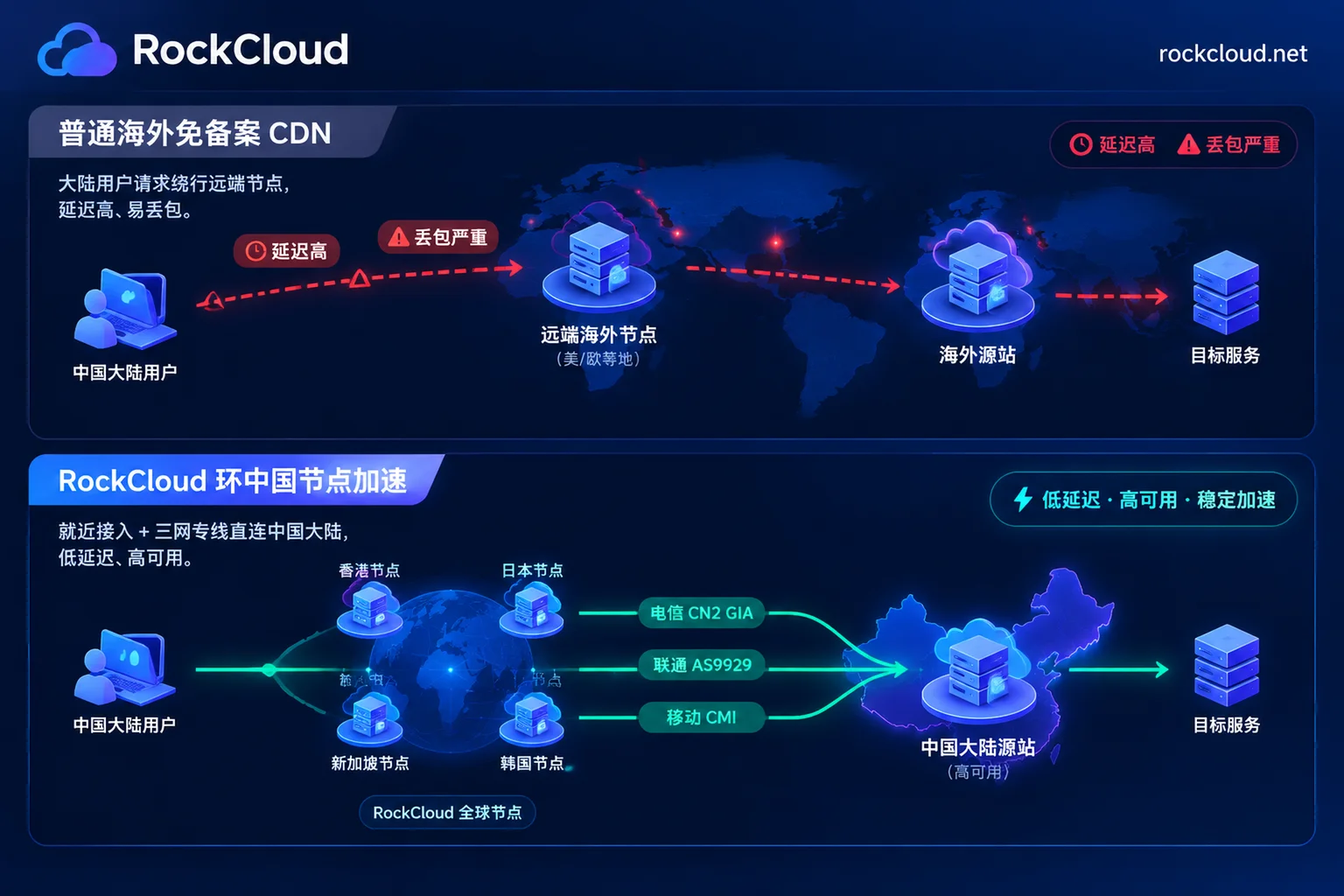
2. Breaking the mainland access bottleneck: China-surrounding nodes + three-network direct-connect return dedicated lines
If your core user base includes mainland Chinese visitors, the first criterion for non-filing CDN selection is edge node locations and return routes to China.
In RockCloud's CN2 China Acceleration solution, non-filing onboarding and low-latency mainland access are achieved through a two-layer network design:
- Nearby access around China: Edge nodes are densely deployed in core hubs around China such as Hong Kong, Japan, South Korea, and Singapore. Physical distance is shortest, and domains can be used directly without ICP filing.
- Three-network premium dedicated lines directly back to China: To address cross-network bottlenecks among China Telecom, China Unicom, and China Mobile, the underlying layer directly integrates China Telecom CN2 GIA, China Unicom AS9929, and China Mobile CMI three-network direct-connect return links (if you do not know how to distinguish genuine dedicated lines, read How to Tell Whether It Is a Real CN2 Line: Check AS4809 and 59.43, and Test Both Outbound and Return Routes).
- Protocol-layer concurrency acceleration: On top of link optimization, combined with HTTP/3 supported by the global CDN acceleration network (based on QUIC to reduce handshakes and head-of-line blocking), TLS 1.3 0-RTT fast connection resumption, and the Brotli compression algorithm, it effectively offsets the physical latency of cross-border transmission and supports flexible configuration of custom caching, origin retries, and backup origin rules.
3. When non-filing meets attacks: same-path scrubbing and intelligent WAF blocking
Non-filing businesses are often also hard hit by cybercriminals and malicious peer competition. Many teams only buy basic content delivery services when selecting a provider, and their defenses quickly collapse under mixed attacks.
1. DDoS and CC defense must be on the same request path
Some cloud providers split CDN acceleration, DDoS high-defense IP, and web application firewall into three separately billed products. This is not only cumbersome to configure, but multi-layer forwarding also adds extra latency. RockCloud's high-defense CDN and security protection architecture uses Anycast distributed scrubbing, integrating acceleration and defense into the same request path and the same plan. DDoS and CC defense do not need to be purchased separately.
2. Handling complex application-layer CC and vulnerability probing
Simply expanding bandwidth cannot stop CC attacks that consume origin CPU and database connections (see Can High-Defense CDN Stop CC Attacks: What It Relies On to Block, When It Gets Overwhelmed, and How to Self-Check After Onboarding). After enabling the intelligent WEB firewall (WAF) with one click in the control panel, the system first blocks SQL injection, XSS, file inclusion, command injection, and malicious scanners through the OWASP core rule set, then uses machine learning to dynamically identify mutated malicious requests not yet included in the rule base. For business-specific API logic, the security technical team also assists in configuring custom rules and exceptions.
3. Blocking recovery and non-website protocol extensions
- Domain blocking and DNS pollution: Cross-border and non-filing domains often face regional carrier hijacking or red-name blocking within social platforms such as WeChat and QQ. Through the pollution blocking recovery service, DNS pollution scrubbing and normal social platform access recovery can be performed without changing the domain name, and seamless 301 redirects can be implemented.
- Special scenarios such as games and streaming: If it is a client game that requires TCP/UDP full-protocol forwarding, ordinary web CDNs cannot proxy it. You can switch directly to the game shield solution, which encapsulates private protocols and keeps connections alive when switching nodes. If it is a live streaming or VOD platform, you can use the video CDN, which supports multi-protocol streaming, Multi-DRM, and secure token protection, to achieve non-filing distribution.
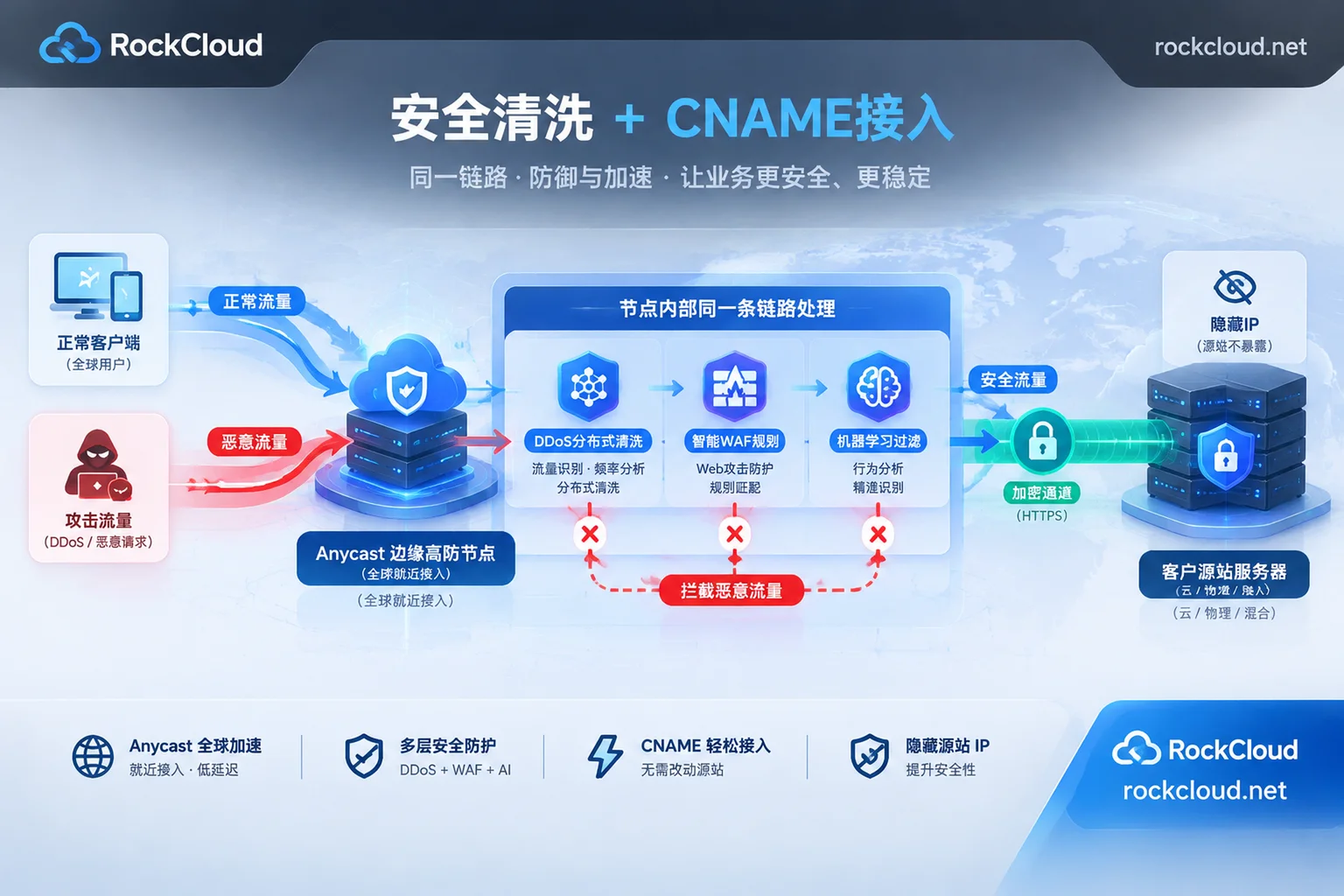
4. Smooth onboarding and cost control: no NS changes, unlimited traffic to prevent bill abuse
When migrating existing businesses to a non-filing high-defense CDN, operations and procurement staff usually care most about two practical issues: Will the switch cause business interruption? Will an attack generate huge traffic fees?
| Selection evaluation dimension | Pain points of traditional overseas general-purpose CDNs | RockCloud non-filing high-defense CDN solution |
|---|---|---|
| Onboarding method | Forcibly requires changing domain NS records; original DNS configuration is easily lost during migration, and switching takes effect slowly | Add one CNAME to onboard, no NS changes, DNS stays with the original provider, old and new links run in parallel for a smooth transition |
| Mainland access performance | Uses ordinary international public internet, prone to packet loss during evening peak, and may detour to Europe or America during scrubbing | China-surrounding nodes (Hong Kong/Japan/South Korea/Singapore) for access, China Telecom CN2 GIA / China Unicom AS9929 / China Mobile CMI three-network direct connect |
| Billing and risk resistance | Postpaid by traffic (GB) or request count; large-traffic CC abuse can easily generate huge bills | Fixed monthly peak billing, unlimited traffic and requests; DDoS/CC/WAF/free fully automatic SSL all included |
| Compliance and payment convenience | Strict corporate real-name verification and card-binding thresholds; cumbersome account opening linked to cloud hosts | No ICP filing required, contract quotation, supports USDT or USD payment; also provides international cloud account opening and top-up without real-name verification |
Reminder on closing origin exposure during onboarding
RockCloud sits in front of your existing servers or cloud hosts, so you do not need to purchase new servers. For daily onboarding, you only need to add a CNAME record and enable free fully automatic SSL. However, if your business is currently under attack and needs urgent onboarding while still under attack, while attaching the high-defense CDN, be sure to simultaneously change the origin server IP and set a whitelist on the origin firewall (only allow back-to-origin node IPs), completely cutting off the path for attackers to bypass the CDN and hit the origin directly (for specific steps, see Will the Origin IP Still Be Exposed After High-Defense CDN Onboarding: Five Leakage Paths, Closure Order, and Handling After Exposure).
In addition, daily operations can use general console features for batch operations across multiple domains, configuring IP/region blacklists and whitelists and signed URL hotlink protection, and pushing real-time traffic report alerts directly to Telegram, greatly reducing multi-site monitoring costs.
Conclusion: Match non-filing architecture to business scenarios
A non-filing CDN should not be just "an expedient to bypass filing." Choosing the right foundation with three-network return dedicated lines and same-path scrubbing capabilities can also deliver access experience and high-availability defenses comparable to domestic nodes. You can view architecture references for websites, apps, APIs, payments, AI services, and Web3 through industry solutions, or learn detailed differences from Cloudflare, AWS, and traditional high-defense servers on the mainstream vendor selection comparison page.
If you need to evaluate plan billing and free test specifications suitable for your current business bandwidth scale, or your business is facing sustained attacks and needs immediate mitigation, feel free to visit the contact page to summon the security response team, or get one-on-one architecture support directly via Telegram (@rockclouds).



Comments(0)