RockCloud-基石云安全-官方博客
Conclusion first: DNS pollution cleaning is indeed effective, and the vast majority of businesses can restore normal access without changing their primary domain; but the premise is to distinguish the depth of pollution and choose the right approach: "correction and refresh" or "seamless redirect bypass".
Many operations or business leaders, when their domain suddenly shows "inaccessible in some provinces and cities, normal overseas but timeout domestically", their first reaction is to ask users to change 8.8.8.8 themselves, or directly buy a new domain and start over. In fact, if it is only a local ISP recursive DNS caching a wrong IP, through professional server-side cleaning and high-frequency correction, it can usually gradually recover within hours to 24–72 hours; but if it encounters persistent link preemption or regional policy blocking, simply refreshing the cache will repeatedly fail. At this time, it is necessary to combine seamless 301 redirect and clean edge nodes to stably restore business.
I. What exactly is DNS pollution cleaning "cleaning"? First understand the two-layer principle
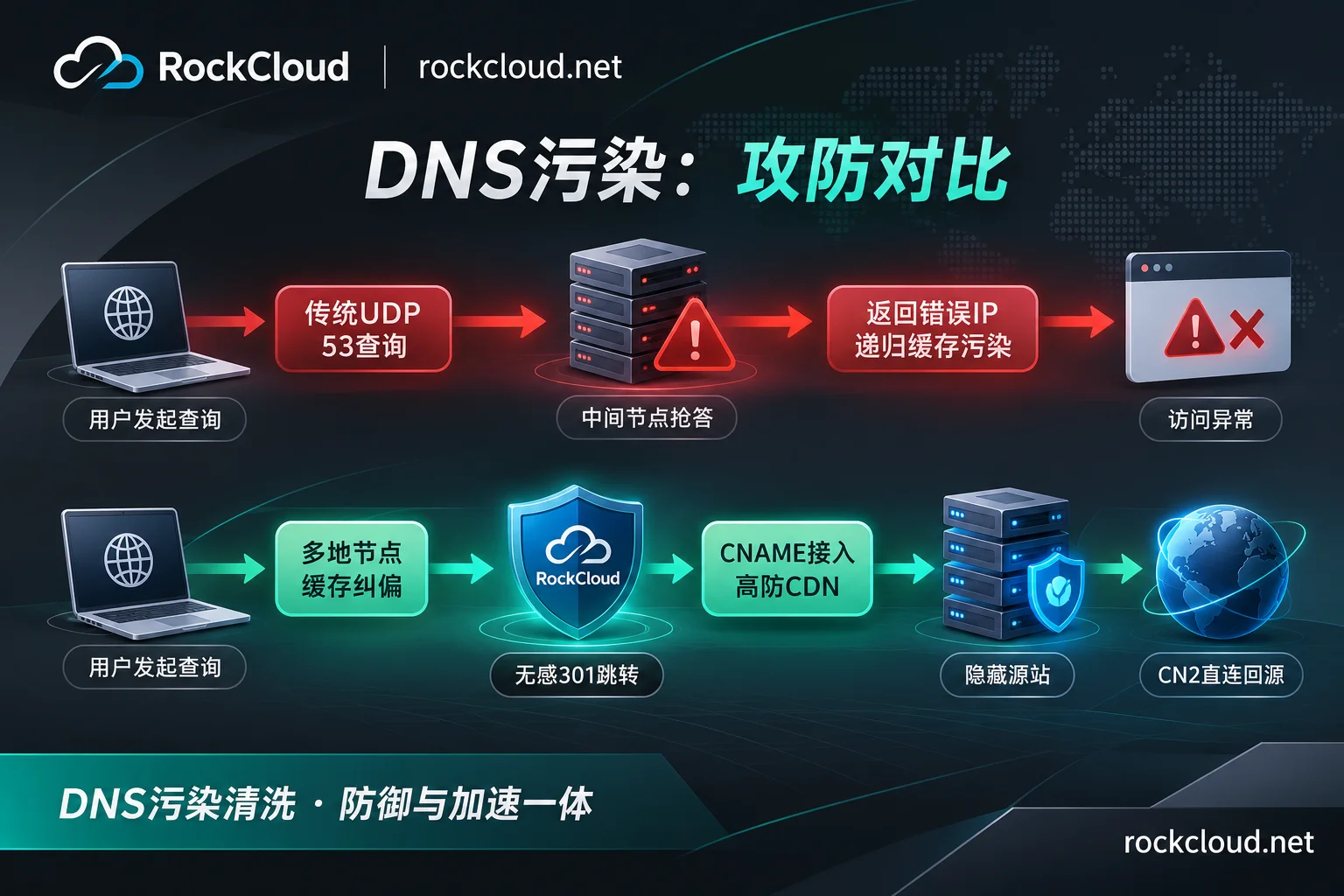
To judge whether cleaning is reliable, you must first understand how DNS pollution occurs. Traditional DNS queries default to UDP port 53, which is neither encrypted nor verifies the identity of the responder. When a user initiates a domain query to the ISP's recursive DNS, interference devices or attackers in the intermediate link will race to inject a forged IP (such as 127.0.0.1 or an unreachable address) to the recursive server before the authoritative DNS server returns the real result.
Once the recursive server accepts the fake packet, it will write it into the local cache according to the TTL time, causing all users in that region using the default DNS to collectively fail to access. Around this mechanism, what the industry commonly calls "DNS pollution cleaning" actually includes two completely different technical actions:
- Recursive cache correction cleaning (treats local and occasional): Using detection and request nodes distributed in various provinces and ISPs, continuously detect damaged areas, and within the error cache expiration window, frequently initiate compliant queries to the corresponding recursive DNS, flushing the correct resolution results from the authoritative DNS back into the cache, overwriting the dirty data.
- Architecture bypass and seamless recovery (treats persistent and deep interference): If the pollution source continuously sends fake packets at a higher link layer, the cache will be re-poisoned within minutes after being cleaned. At this time, simply "refreshing DNS" cannot completely solve the problem; it is necessary to introduce relay and seamless 301 redirect solutions on the server side, or guide traffic to clean nodes and encrypted resolution links that are not polluted.
If you are still unsure whether the current failure is DNS pollution, single ISP blocking, or social platform blocking, it is recommended to first perform a layered diagnosis. You can refer to our Guide to Distinguishing Three Types of Domain Blocking Recovery Failures for preliminary positioning.
II. How long does DNS pollution cleaning take effect? Why can't some regions still access?
Many teams find that after starting cleaning, "some provinces are accessible, some are still stuck", or "mobile data works, company Wi-Fi still times out". This is usually not a complete failure of cleaning, but the influence of three layers of caching and propagation mechanisms:
1. Inconsistent refresh rhythms of ISP recursive caches across provinces
Recursive DNS nodes in different provinces and different ISPs (China Telecom, China Unicom, China Mobile) have different cache cleaning strategies and TTL respect levels. Mild local pollution usually shows a "wave-like recovery" within hours to 72 hours, and it is difficult to turn all green synchronously within minutes; when deeper cascading pollution is involved, the recovery period will be longer.
2. End-user operating systems and browsers retain "dirty cache"
Even if the ISP recursive server has recovered, the user's own computer or browser will still directly read the locally cached wrong IP before the TTL expires. When testing or guiding internal personnel for troubleshooting, both system and browser caches must be cleared:
# Windows 刷新系统 DNS 缓存(需以管理员身份运行命令行)
ipconfig /flushdns

# macOS 刷新系统 DNS 缓存
sudo dscacheutil -flushcache; sudo killall -HUP mDNSResponder
After clearing the system cache, Chrome and Edge browsers also have independent host caches. You need to enter chrome://net-internals/#dns in the browser address bar (also applicable to Edge) and click Clear host cache to take full effect.
3. Persistent attacks create a "cleaning-repollution" tug-of-war
If the domain itself is suffering from malicious poisoning attacks or has been listed in high-frequency blocking lists, the recursive cache is just corrected, and the next round of UDP 53 queries will be preempted and overwritten again. In this "cleaned then dropped" situation, it is necessary to decisively switch from "passive cache refreshing" to "active server-side fallback".
III. Don't choose solutions blindly: 3 practical boundaries that determine whether cleaning can succeed
Different business forms and pollution levels require completely different disposal paths. Before starting, you can use the following boundary comparison table to quickly judge:
| Evaluation Dimension | Scenarios Suitable for Pure Cache Cleaning | Scenarios That Must Add Seamless Redirect / Edge Architecture |
|---|---|---|
| Pollution Scope | Only a few provinces or a single ISP resolution anomaly | Nationwide large-scale ERR_CONNECTION_TIMED_OUT or overseas normal but domestic completely down |
| Recurrence Frequency | Occasional poisoning, can remain stable for more than a few days after correction | Recovered for a few hours or even minutes before being overwritten by forged IP again |
| Business Carrier | Regular Web sites extremely sensitive to old domain weight | Both Web and H5 promotion links, or entrances frequently spread on social platforms |
| Accompanying Risks | Only resolution anomaly, origin server and server bandwidth normal | Simultaneously accompanied by DDoS/CC attacks, origin IP exposure, or WeChat/QQ blocking |
In addition to the boundaries in the table above, two practical experiences need to be noted in technical selection:
- Web businesses must protect SEO and old user bookmarks: Traditional domain changes will cause search engine weights to zero and all external promotion links to become invalid. Using compliant seamless 301 redirect with clean nodes can preserve weight and access smoothness without changing user entry habits.
- App and API businesses should actively move away from UDP 53: If your users mainly call interfaces through native apps or clients, in addition to server-side cleaning, it is recommended to gradually integrate DoH (DNS over HTTPS) / DoT or built-in HTTPDNS in the client, encapsulating domain resolution in an encrypted channel, fundamentally making it impossible for intermediate links to identify and tamper with resolution results.
IV. How to achieve stable recovery without changing the domain? RockCloud server-side practical path
When the business has been substantially affected by access interruption and revenue decline, or when it encounters both regional DNS pollution and blocking by WeChat/QQ platforms and ISPs, it is too late to simply modify local configurations or wait for TTL to naturally expire. At this time, you can introduce RockCloud's DNS Pollution Cleaning (blocking pollution recovery service) to build a closed loop from "restore access" to "anti-bypass hardening" without changing the primary domain:
- In-place recovery without changing domain and seamless 301 redirect: For DNS pollution and blocking by platforms such as WeChat, QQ, and regional ISPs, RockCloud provides a server-side recovery mechanism without changing the domain, and supports seamless 301 redirects, minimizing interruption of promotion links and loss of old users.
- No NS change, add CNAME for parallel access to high-defense acceleration: During domain recovery, the most taboo is to make major changes to NS (Name Server) causing secondary resolution fluctuations. When accessing RockCloud High-Defense CDN, the original DNS remains with the original service provider, and only one CNAME record needs to be added to achieve parallel switching between old and new links (for detailed trade-offs between CNAME and NS access, please refer to Do You Need to Change NS When Accessing High-Defense CDN). After access, the real IP of the origin server can be hidden incidentally, and Anycast DDoS/CC cleaning and intelligent WAF can be unified on the same request path, avoiding "domain just fixed, origin server killed".
- ICP-free cross-border business with CN2 three-network direct connection: Many businesses suffering from pollution are deployed in Hong Kong or overseas nodes. After resolution recovery, if they return via ordinary international public network, peak-hour packet loss will still make users unable to open pages. RockCloud global network can access through Hong Kong, Japan, South Korea, Singapore and other China-surrounding nodes, and overlay CN2 China Acceleration (Telecom CN2 GIA, Unicom AS9929, Mobile CMI three-network direct return to China), ensuring access experience after domain recovery without ICP filing.
If your business is currently in an emergency state of large-scale resolution failure or concurrent attacks, you can directly contact the technical team through the RockCloud Security Response Contact Page or official Telegram (https://t.me/rockclouds), and apply for testing and special troubleshooting based on specific pollution characteristics.
V. 4 anti-recurrence hardening checklist after cleaning takes effect
Restoring normal domain access is not the end; only by patching vulnerabilities can you avoid falling into the vicious cycle of "pollution-cleaning-repollution":
- Enable authoritative DNSSEC: Add digital signature verification to domain resolution records, reducing the space for response forgery in the recursive query chain.
- Enforce HTTPS and HSTS site-wide: Even in extreme cases where resolution is hijacked to a wrong IP, the browser will block phishing or ad injection due to certificate mismatch and HSTS policy, protecting user account and session security.
- Clean up historical risks and sensitive external links: Check the domain's past history or implanted illegal pages and malicious redirect scripts in the site, reducing the probability of being flagged by security vendors or reported.
- Establish multi-province detection alarms and redundancy mechanisms: Configure national multi-ISP DNS detection alarms on the monitoring platform. Once a province's resolution result deviates from expectations, intervene immediately. For more long-term governance details, you can read Closed-loop Architecture from In-place Recovery to Anti-secondary Blocking.