 RockCloud-基石云安全-官方博客
With the explosive growth of overseas short dramas, cross-border live streaming, paid courses, and long- and short-form video platforms, audio and video business owners and operations teams often discover that what crushes their profits is sometimes not customer acquisition cost, but a sudden sky-high CDN traffic bill, or a DDoS/CC attack that strikes during a live-streaming prime-time window.
Recently, major cloud providers have issued "CDN warnings on traffic abuse and high bill risk," revealing three pain points commonly faced by the audio and video industry:
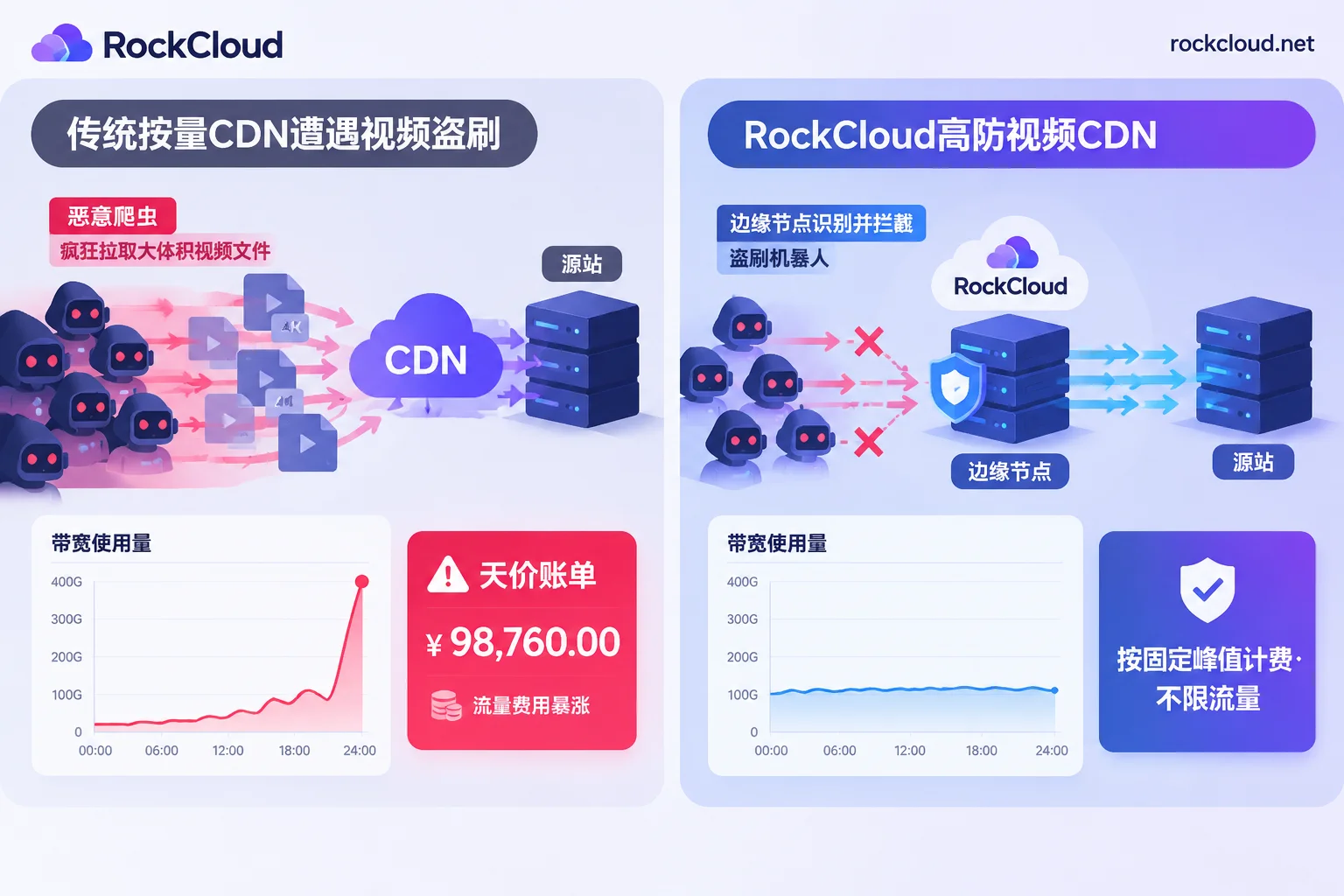
- Traffic being maliciously abused (PCDN traffic farming and malicious crawlers): To farm upstream and downstream traffic subsidies, black-market actors or PCDN freeloaders use automated scripts to repeatedly pull large MP4 VOD files or HLS segments (.ts) 24/7.
- High-value content being hotlinked and re-uploaded: Overseas short dramas, exclusive live sports events, or paid VOD courses that cost a fortune to produce are packet-captured by piracy sites shortly after launch, with push/pull stream addresses extracted and embedded directly into third-party web pages to freeload bandwidth.
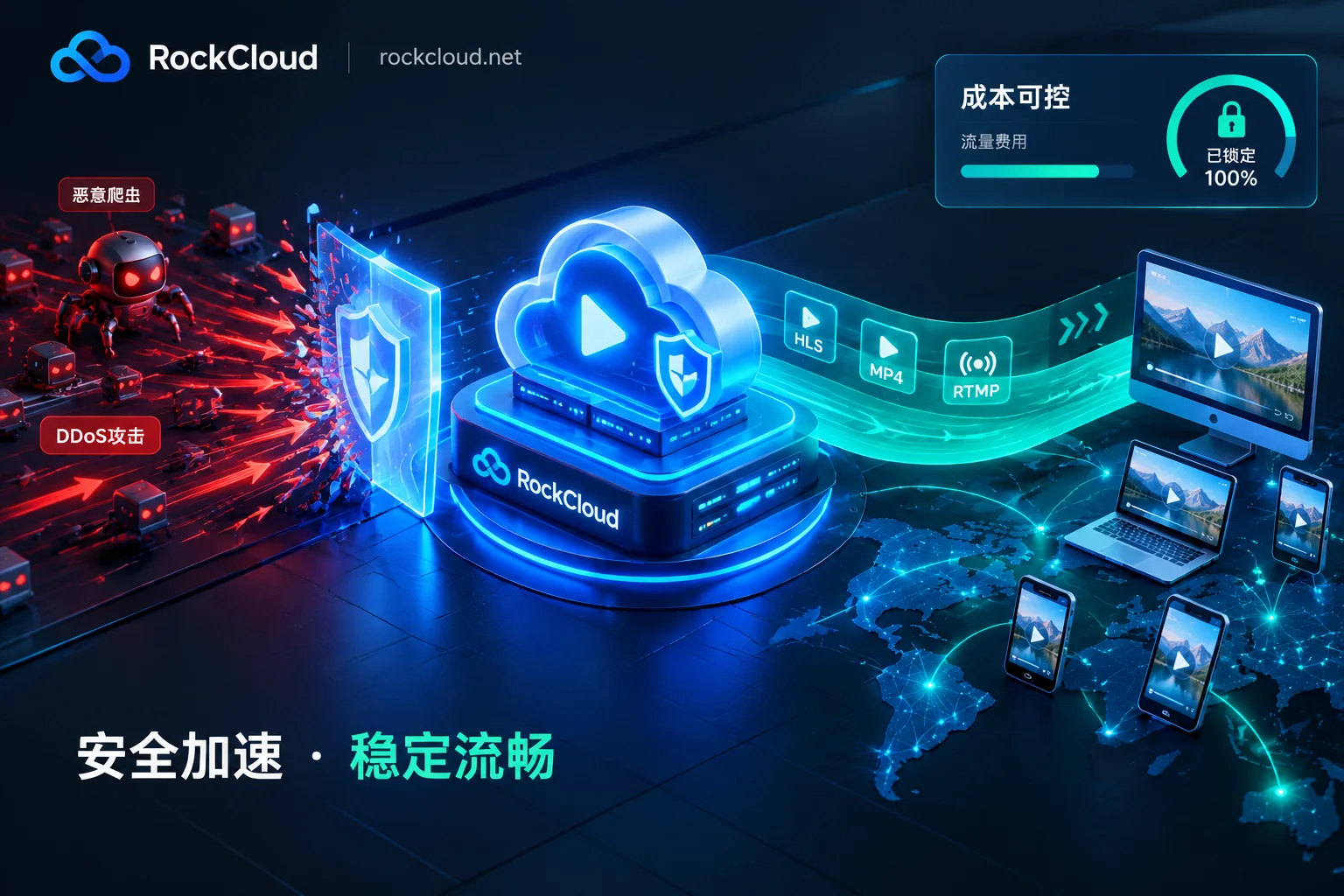
- Media and live streaming as DDoS hotspots: According to the latest global DDoS threat trend reports, media, film and television production, and live streaming industries have long ranked among the sectors most severely hit by HTTP DDoS attacks. Malicious competition from peers often targets peak livestream selling hours or event kickoff times with Tbps-scale traffic floods and high-frequency CC requests.
If you use a conventional CDN with traditional "pay-per-traffic/pay-per-bandwidth postpaid" billing and "no security defense by default," once abuse or an attack occurs, because billing settlement has a delay of several hours, by the time operations receives an arrears warning, a high bill that cannot be waived has often already been generated. If you set a "bandwidth cap and cutoff" to stop the bleeding, paying viewers will instantly be disconnected.
To completely escape the dilemma of "either blow up the bill or cut off the business," audio and video businesses must solve multi-protocol smooth delivery, multi-dimensional content protection, same-path high-defense scrubbing, and a predictable billing model within a single architecture when selecting a video CDN.
1. Why can't traditional pay-as-you-go CDNs withstand video abuse and attacks?
Conventional CDNs were designed to "distribute cached content as fast as possible," not to help customers distinguish the intent behind requests. In audio and video scenarios, this mechanism exposes three obvious weaknesses:
1. Video files are large, so abuse amplification is extremely strong
A single HTML or CSS file on a regular web page is only tens of KB; even if a CC attack hits it a million times, the outbound traffic consumed is limited. But in video business, a single HD video segment is several MB, and a complete MP4 can reach hundreds of MB. A malicious script only needs to run a few hundred concurrent threads pulling continuously to saturate tens of Gbps of bandwidth within hours, quickly exhausting the traffic package and switching to expensive pay-as-you-go billing.
2. Acceleration and security are separated, and temporarily attaching high defense hurts first-screen instant playback
Many cloud providers sell CDN, DDoS high defense, and WAF as separate products. To save money, you normally run bare CDN; once a livestream is attacked, you temporarily switch the domain to a high-defense IP. Not only is DNS propagation slow (see "How Long Does It Take for High-Defense Line Switching to Take Effect"), but an extra layer of non-video-specific proxy forwarding easily causes live push stream interruptions or frequent spinning and stuttering on the viewer side.
3. Simple Referer anti-leeching is easily bypassed
Black-market crawlers and piracy collectors already have the ability to forge HTTP headers. Basic Referer allowlists and blocklists alone cannot stop automated scraping targeting .m3u8 index files and underlying media streams.
2. Four layers of anti-leeching and anti-attack defense for video CDN
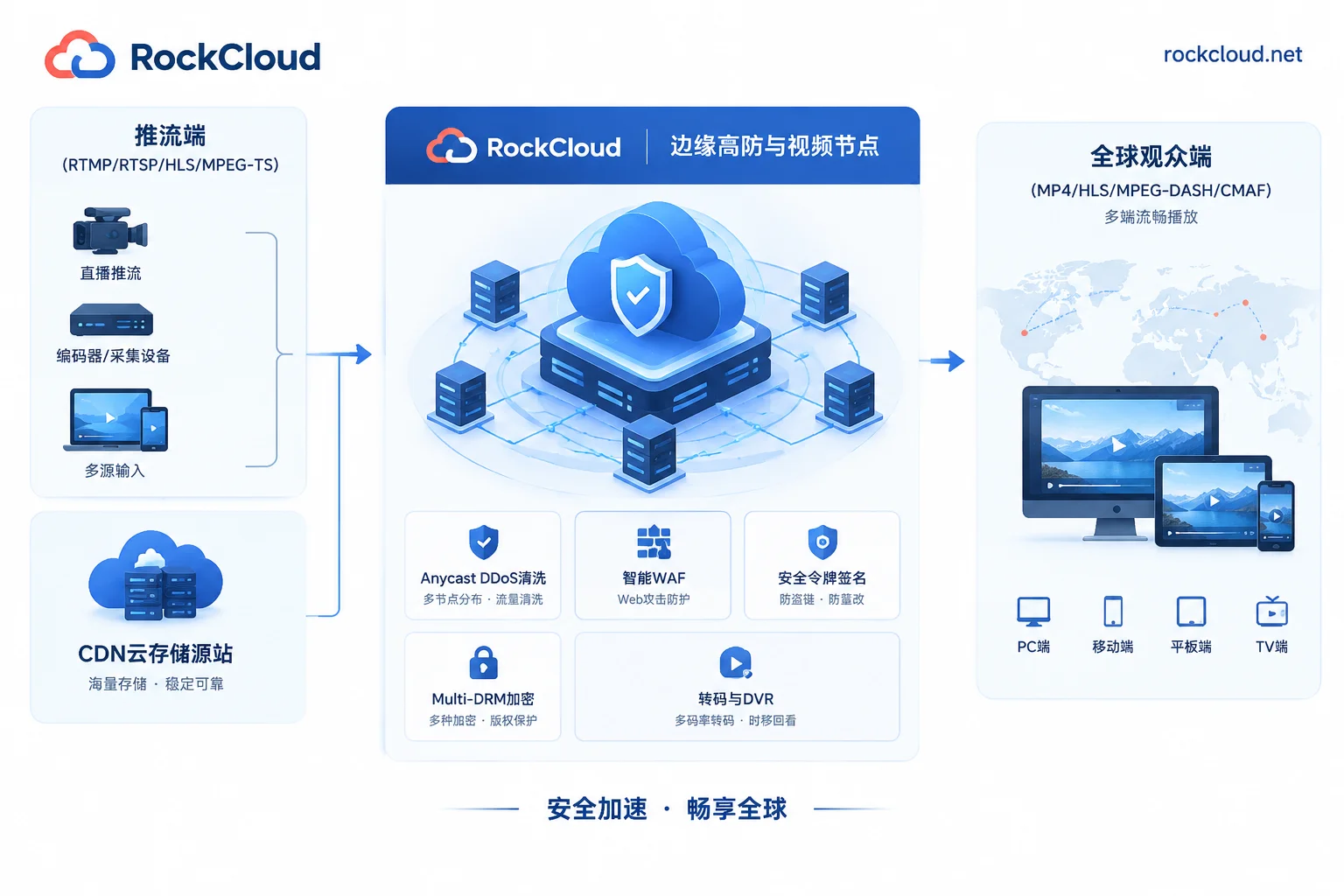
Targeting the real pain points of live streaming and short video solutions, RockCloud integrates "media-specific acceleration, multi-layer content protection, and Anycast high-defense scrubbing" on the same edge path, locking down risk from four dimensions:
1. Layer 1: Anti-leeching, security tokens (signed URLs), and Multi-DRM
To prevent video resources from being freeloaded by third-party websites or batch-downloaded by scripts, RockCloud video CDN provides content protection mechanisms from basic to advanced:
- Anti-leeching and IP/region blocking: Supports basic anti-leeching and IP and region allowlists/blocklists. For example, if a short drama app is distributed only to North America and Southeast Asia, abnormal stream-pull requests from non-business regions can be blocked directly at edge nodes.
- Security tokens and signed URLs: Generates a dynamic signed URL with a timestamp and encrypted hash for every playback request. Once the link expires or is tampered with, it becomes invalid immediately, completely defeating static link scraping by piracy sites.
- Multi-DRM digital rights management: For high-value paid short dramas, exclusive film and TV VOD, and paid educational videos, Multi-DRM encryption protection is supported. Even if the video stream is packet-captured and downloaded locally, it cannot be decoded and played without a valid authorization key.
2. Layer 2: DDoS and CC defense on the same path, so livestreams stay resilient without stuttering
Audio and video businesses fear attacks during traffic peak hours the most. RockCloud's high-defense CDN and DDoS/CC defense run on the same request path as video delivery, with no need to purchase separately and forward twice:
- Anycast distributed scrubbing: When facing sudden large-traffic DDoS attacks against livestreams or VOD sites, global edge nodes use BGP Anycast for nearest routing and layered scrubbing, absorbing attack traffic directly at the edge and hiding the customer's origin IP.
- Intelligent WAF and bot detection: Enable the intelligent web application firewall (WAF) with one click in the console. In addition to blocking SQL injection and XSS attacks against business APIs (such as login, tipping, and danmaku interfaces) based on the OWASP core rule set, it also uses machine learning to identify malicious crawlers and traffic-farming bots not yet covered by the rule library, precisely blocking CC consumption against video interfaces. If complex custom abuse signatures appear, the security technical team also assists in configuring custom rules and exception allowances.
3. Layer 3: Full-protocol push/pull streaming support and CDN cloud storage as origin
Different terminals and business scenarios have very different requirements for audio and video streaming protocols. If the origin server itself also has to handle heavy static file reads, disk I/O is easily saturated under high concurrency.
- Full protocol compatibility: RockCloud video CDN supports RTMP, RTSP, HLS, MPEG-DASH, and MPEG-TS on the push side; on the playback delivery side, it fully supports MP4, HLS, MPEG-DASH, and CMAF. Whether it is interactive live streaming pursuing ultra-low latency or VOD segments pursuing cross-platform compatibility, it can connect directly.
- Underlying transport optimization: Combined with global CDN acceleration capabilities, the edge fully supports HTTP/3 (QUIC) and TLS 1.3 0-RTT. In weak mobile network environments (such as subways or cross-border mobile networks overseas), it greatly reduces handshake latency and packet-loss stuttering, improving the instant-play rate of short drama swiping.
- Store VOD files directly in CDN storage: For VOD business, customers can store VOD video files directly in RockCloud's CDN storage to serve as the origin, eliminating the bandwidth overhead of self-built large-capacity object storage and frequent origin fetches. In addition, cloud transcoding, DVR (live replay recording), and an HTML5 player with viewer analytics can be customized on demand.
4. Layer 4: China-adjacent CN2 dedicated lines and anti-blocking recovery
For video platforms targeting Chinese-speaking markets or operating across borders, network paths and domain availability are equally critical:
- CN2 three-network direct return to mainland China: Through CN2 China acceleration, accessing from Hong Kong, Japan, South Korea, Singapore, and other China-adjacent nodes, traffic is routed to mainland China via China Telecom CN2 GIA, China Unicom AS9929, and China Mobile CMI three-network direct connections. Without ICP filing, you can still get a viewing experience with low latency and no packet loss during evening peak hours (see "Why Is ICP-Filing-Free CDN Access to China Often Slow").
- Domain anti-blocking and recovery: Video sharing links are extremely easy to block on social platforms. With blocking and DNS pollution recovery services, in-place recovery without changing the domain and seamless 301 redirects can be achieved against DNS pollution, regional carrier blocking, and domain blocking by platforms such as WeChat and QQ.
3. Doing the math: the billing advantages of fixed peak and unmetered traffic
Back to the billing anxiety at the beginning of the article. Why do many video teams not dare to enable high bitrates and stare at monitoring all day for fear of traffic abuse? The root cause is the uncertainty of "billing per GB of traffic" or "postpaid billing based on the 95th percentile peak."
In selection comparisons, RockCloud adopts a package billing mechanism that better fits the demands of high-concurrency, high-risk businesses:
| Comparison Dimension | Traditional Pay-as-You-Go Video CDN | RockCloud Video High-Defense CDN |
|---|---|---|
| Billing Basis | Billed by actual traffic consumed (GB) or postpaid bandwidth | Monthly fixed peak billing, unmetered traffic, unlimited requests |
| Abuse/Attack Bill Risk | Sudden malicious traffic directly generates high arrears bills that cannot be waived | No risk of sky-high excess traffic bills; cost is locked at purchase |
| Security Protection Cost | DDoS high defense, WAF, and SSL certificates usually require extra add-on purchases | Acceleration and defense on the same path and in the same package; DDoS/CC, WAF, and free fully automated SSL are all included |
| Onboarding Method | Often requires changing domain NS or complex configuration | Add one CNAME record to onboard; no NS changes, old and new paths run in parallel during switching |
| Business and Payment | Cumbersome enterprise real-name verification; only traditional fiat settlement | Contract quotation, supports USDT or USD payment, free trial available on request |
Note: If your video origin is deployed on overseas cloud platforms such as AWS, GCP, Alibaba Cloud International, or Tencent Cloud International, RockCloud also provides international cloud account opening and top-up services without enterprise verification or real-name procedures (supporting USDT payment), which can be seamlessly combined with the video high-defense CDN.
4. Practical recommendations for video business onboarding and routine inspection
When you are ready to migrate your existing VOD or live streaming business to RockCloud, it is recommended to proceed smoothly according to the following steps:
- Confirm protocols and storage architecture: Sort out the current push (such as RTMP) and pull (such as HLS/CMAF) protocols; for VOD business, evaluate whether to upload popular series directly to CDN storage to reduce origin pressure.
- Smooth CNAME traffic switching: Add one CNAME record at your original DNS provider to complete onboarding, with no need to modify domain NS records, ensuring a smooth parallel transition between old and new paths.
- If onboarding while under attack: If your video site is currently under DDoS or CC attack, when onboarding to the high-defense CDN be sure to change the origin server IP at the same time, and configure the origin firewall to "only allow RockCloud origin-fetch node IPs," preventing hackers from bypassing the CDN and directly breaching the origin (see "A Site Under Large-Traffic Attack: Onboarding Order and Key Closure Points for Quickly Attaching a CDN").
- Enable real-time monitoring and Telegram alerts: After onboarding, in addition to viewing traffic and bandwidth reports in the console and troubleshooting network logs, it is recommended to enable real-time Telegram data push, so the operations team can keep track of peak bandwidth and WAF interception dynamics on their phones at any time.
Conclusion
For video, live streaming, and overseas short dramas, the technical architecture must not only manage "instant first-screen playback and HD smoothness," but also cover the "bottom line of anti-leeching and anti-attack," and moreover calculate "fixed monthly costs."
If you are struggling with video stuttering, severe piracy, DDoS attack disconnections, or high CDN traffic bills, welcome to visit the RockCloud Video CDN page for details, or contact our security and architecture team directly through the contact page and official Telegram (@rockclouds) to determine business specifications and apply for a free trial.


Comments(0)