 RockCloud-基石云安全-官方博客
The key to judging a US CN2 server is whether the return data packets fully traverse China Telecom's AS4809 private network (59.43.. nodes). This routing characteristic directly determines the stability of mainland China visitors' experience during peak evening hours. Many so-called "high-speed" offerings on the market often confuse outbound optimization with return path quality, and some even package GT lines that are only optimized at the international egress as GIA. After clarifying that "return path quality" and "capacity under attack" are two independent things, infrastructure providers like RockCloud typically classify CN2 China dedicated lines under link quality, while classifying Anycast global acceleration and traffic scrubbing under attack-bearing capacity. These two types of capabilities are provided by different products, and buyers need to clearly distinguish them during procurement.
Three Types of Peak-Hour Symptoms on US CN2 Servers
Many运维 teams find that US servers are fine during the day but become very laggy at night. This is usually not a single fault but a manifestation of three different root causes. The first is congestion at the transoceanic egress segment, characterized by overall latency increase and random packet loss, often due to queue backlog on the ordinary public 163 backbone (AS4134) during peak hours. The second is degradation in the domestic aggregation layer, meaning that after entering China's provincial networks, the return path switches back to 202.97 nodes, causing time-based jitter. The third is being subjected to an attack that triggers carrier blackholing, making the entire server unreachable.
| Symptom Manifestation | Potential Root Cause | Routing Characteristics | Impact Scope |
|---|---|---|---|
| Persistent high latency + packet loss | Transoceanic international egress congestion | 202.97 hops appear already in the overseas segment | All mainland users widely affected |
| Jitter worsens at specific times | Domestic provincial network aggregation degradation | 59.43 in overseas segment, switches back to 202.97 in domestic segment | Obvious for users in specific provinces or ISPs |
| Suddenly completely unreachable | DDoS attack triggers blackhole | Route interruption, no ICMP response | Entire target IP paralyzed |
The criterion for distinguishing US CN2 from regular US servers lies here: the former relies on MPLS-TE dynamic path selection and QoS priority to suppress packet loss, while the latter easily falls into congestion during peak hours.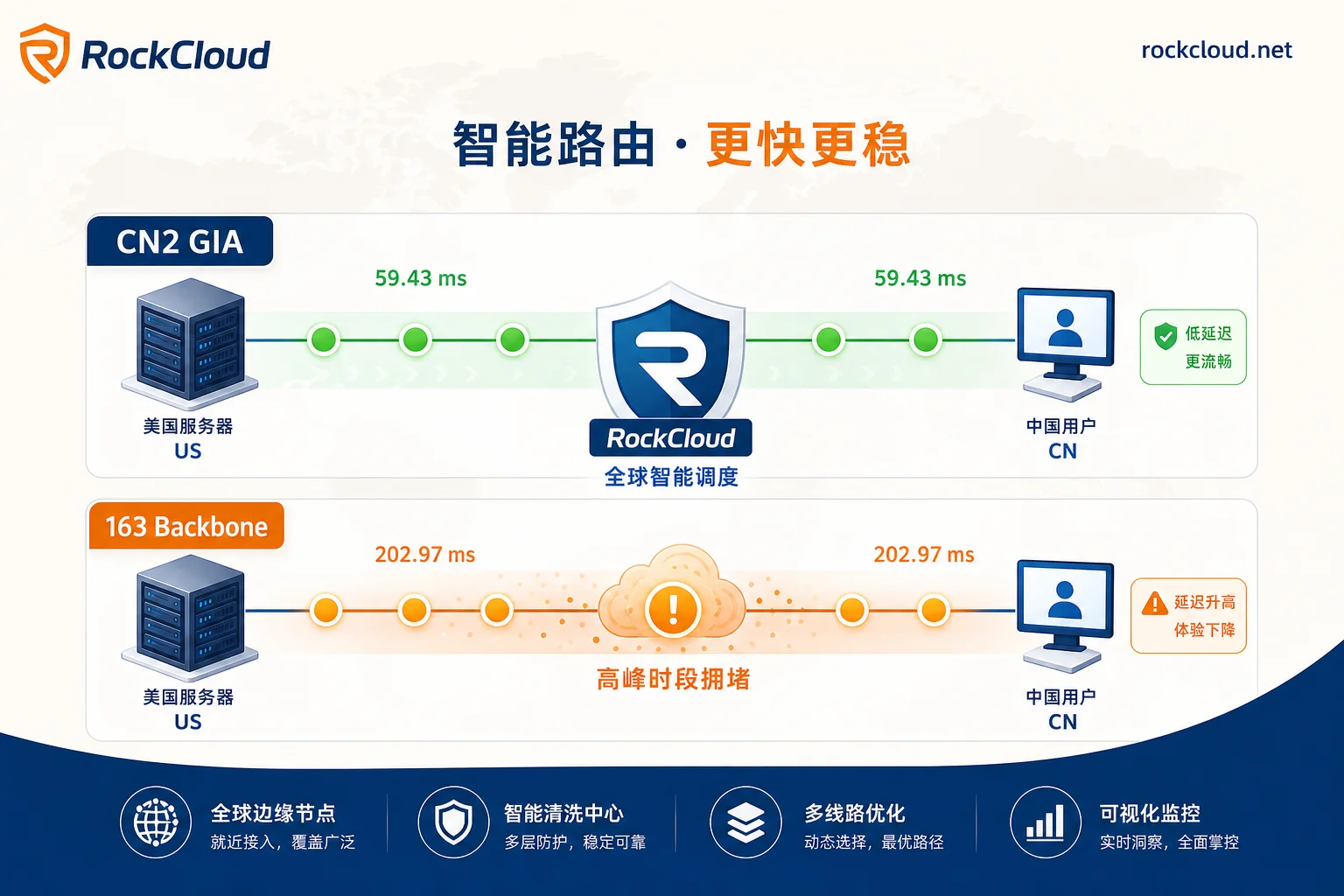
First-Level Localization: Interpreting Return-Path MTR
Local client ping only tests the outbound path. Because BGP routing on the public internet is asymmetric, a server may use high-quality routes for the outbound path but ordinary routes for the return path. To verify authenticity, you must run MTR from the US server side, targeting IPs of China Telecom in different regions of mainland China to initiate return-path tracing. Focus on whether continuous 59.43 hops appear throughout the transoceanic segment and the domestic backbone segment. If you only test one location, misjudgment may occur due to local routing policy deviations, so it is recommended to use multiple IPs in different regions for cross-validation.
| Return Path Characteristics | Corresponding Conclusion |
|---|---|
| 59.43 in transoceanic segment, none in domestic segment | Suspected GT line, susceptible to domestic congestion during peak hours |
| Continuous 59.43 nodes throughout | Meets GIA characteristics, with end-to-end priority |
| No 59.43 or many 202.97 throughout | Not a CN2 line, or only unidirectionally optimized |
The answer to how to test whether the return path of a US server goes through CN2 is in this table: only a return-path MTR initiated from the server side can reveal the true path ownership. If you find 202.97 nodes intervening midway, it indicates that the line is not full GIA.
Second-Level Localization: Degradation Mechanism of US CN2 Servers
The essential difference between CN2 GT and CN2 GIA lies in the return-path logic. GT uses 59.43 only on the international egress segment; once the data packet enters China's domestic provincial aggregation layer, it downgrades back to 202.97 (163 backbone), meaning it still suffers from domestic egress congestion during peak hours. GIA, on the other hand, requires that 59.43 nodes be maintained from the overseas source to the China local provincial backbone across the entire path. To verify the merchant's claim of CN2 GIA, the key is to identify marketing terms like "unidirectional CN2" or "GT pretending to be GIA." If any hop on the return path shows 202.97, it can be determined that it does not have the full-path priority of GIA. For details on CN2 GIA vs. CN2 GT line performance and latency comparison, you can refer to more technical analyses.
Trans-Pacific Physical Latency Floor: Reasonable Range for US West and East
The propagation speed of optical signals in quartz fiber is about 200,000 kilometers per second, a physical constraint that cannot be overcome. The end-to-end RTT floor from US West nodes (e.g., Los Angeles, San Jose) to Chinese coastal cities is typically between 130–150ms. US East nodes, which need to traverse continental US land cables before adding the transoceanic segment, typically have RTTs above 210–260ms. Claims that direct connection from US West can achieve 70–90ms violate the laws of physics and are most likely due to requests being answered by intermediate nodes or caches. Which has lower latency to mainland China, US West or US East? Obviously, US West is better, but you must accept a physical floor above 130ms.
| Data Center Location | Typical RTT Range | Suitable Scenarios | Remarks |
|---|---|---|---|
| US West (LA/SJC) | 130–150ms | Primary node for mainland access | Dense cable landing, shortest path |
| US East | 210–260ms+ | North American local business or remote disaster recovery | Requires traversing US domestic land cables |
| False Advertising | <130ms | Very likely includes CDN relay or caching | Below physical constraint threshold, untrustworthy |
What is considered normal latency for a US CN2 server depends on physical distance; any commitment below the above ranges should be considered suspicious.
Why Line Quality and Attack-Bearing Capacity Cannot Replace Each Other
CN2 GIA is a high-cost, small-capacity premium transmission network designed for low latency and high QoS, with limited international egress bandwidth reserves. When facing large-volume DDoS attacks, the dedicated line can easily be saturated and trigger carrier blackholing. Attack resistance relies on outer-layer Anycast dispersion and traffic scrubbing architecture, which are two independent technical paths from transmission acceleration. Buying an acceleration line does not equal obtaining protection capability, and the two cannot be conflated. For businesses that face both cross-border access quality and attack risks, the architectural solutions for handling T-level ultra-large DDoS attacks need to be evaluated separately for both types of capabilities.
Trade-offs for Overseas Sites & APIs, Cross-border Origin Fetching, and Gaming Nodes
Different businesses place different weight on link sensitivity. Overseas sites and APIs value peak-hour stability more than the lowest peak latency, aiming to avoid page load timeouts. Cross-border origin fetching is concerned about the predictability of the return path and control over origin exposure. Gaming nodes are most tightly constrained by the physical latency floor; you must first confirm the RTT range that the business can accept before discussing line levels. For example, referencing the logic of how to choose a Hong Kong CN2 server, although US West nodes have higher latency than Hong Kong lines, they are still a necessary supplement under certain compliance or resource distribution needs.
| Business Type | Core Concern Metrics | Decision Basis |
|---|---|---|
| E-commerce/API | Peak-hour stability | Whether 59.43 continuity in return path is maintained end-to-end |
| Cross-border origin fetching | Path predictability | Whether the domestic segment switches back to 202.97 |
| Real-time gaming | Absolute low latency | Whether the RTT range approaches the physical floor |
How to Verify After Rectification: Time-Segmented Re-tests and Metrics for Long-Term Monitoring
After switching lines or making adjustments, you should repeat return-path MTR during the peak period of 20:00–23:00, and compare whether 202.97 still intervenes and whether packet loss and jitter have converged. It is necessary to monitor long-term alerts for return path changes, segmented packet loss curves, and short-term jitter during transoceanic link failover. Even on the dedicated network, rerouting during submarine cable faults or maintenance can cause slight packet loss; the purpose of monitoring is to identify trends, not to chase a constant value.
Frequently Asked Questions
Why does the server test fine during the day but lag at night?
During the day, network load is low, masking the congestion defects of the 163 backbone (202.97). During peak hours from 20:00 to 23:00, the surge in consumer traffic causes queue backlog at the international egress, leading to latency spikes and packet loss. If the return path does not traverse CN2 (59.43) end-to-end, this phenomenon is bound to occur.
Can I determine if the line is authentic when I can only test locally?
It is difficult to judge accurately. Local ping only reflects the outbound route; due to BGP asymmetry, a good outbound path does not imply a good return path. You must obtain server-side access to run reverse MTR, or ask the provider to provide public test IPs for multi-person, multi-point cross-validation. Otherwise, you can easily be misled by "unidirectional optimization."
How can I verify a machine claimed to be full CN2 myself?
On the US server, execute mtr -r -c 100 <大陆电信IP> and check whether the output contains continuous 59.43.. nodes. If 202.97.. hops appear in the middle, it indicates that it is not full GIA; it may be a GT line or a hybrid route. Test multiple times at different periods to rule out occasional routing oscillations.
Can I solve attack issues by buying a high-quality line?
No. CN2 dedicated lines are optimized for low latency and high QoS, with limited and expensive bandwidth reserves, and do not possess the capability to scrub massive attacks. Large-scale DDoS will cause congestion on the dedicated line and trigger blackholing. To resist attacks, you need to deploy separate Anycast scrubbing or high-defense IPs. The two architectures are decoupled and cannot replace each other.
It is recommended that readers ask for a test environment before placing an order, and run server-side return MTR during peak hours themselves before deciding on the line level. If your business faces both cross-border access quality and attack-bearing issues, you can separately evaluate the placement of CN2 dedicated lines and Anycast scrubbing capabilities. RockCloud provides corresponding services and technical support on both sides; you can consult them based on your business type before making a choice.




Comments(0)