 RockCloud-基石云安全-官方博客
The core difference between BGP high-protection and single-line high-protection isn't the advertised defense peak, but two points: who decides the inbound routing and how much mitigation authority you have when attacked. According to Radware's “2026 Global Threat Analysis Report” (2026-02), nearly 90% of network-layer DDoS attacks now last less than 5 minutes, even under 60 seconds. This means the key to selection is how much mitigation authority you have during an attack, not the bandwidth numbers on the quote.
First Look at the Quote: What BGP and Single-Line High-Protection Actually Sell
Returning to the difference and selection of BGP vs. single-line high-protection, what you really need to compare on the quote are the routing access method and the mitigation authority during an attack. Single-line high-protection typically relies on a single carrier's (e.g., China Telecom or China Unicom) network segment with static routing. BGP high-protection, on the other hand, announces network segments to multiple carriers through its own AS, and routing policies determine which carrier's entry point users take.
This architectural difference directly determines the operational leeway when facing an attack. The aforementioned trend of shortened attack durations makes the traditional response model of “getting hit first, then manually rerouting” obsolete. Under second-level high bursts, BGP high-protection's multi-point announcement and automatic convergence become more important selection criteria than the advertised bandwidth.
Difference 1: Routing Access Method (BGP Multi-Line Announcement vs. Single-Carrier Static Routing)
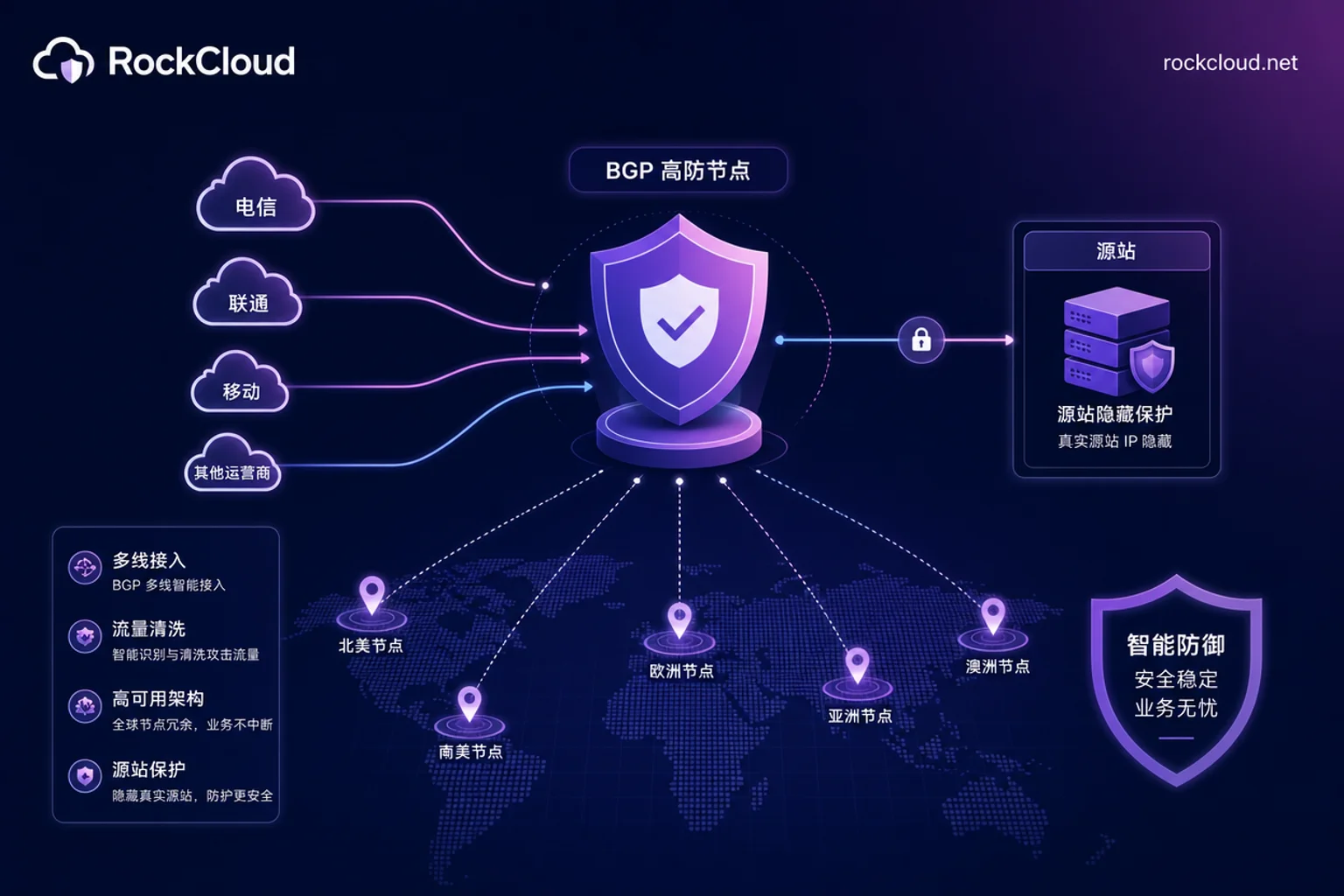
Mechanically, BGP high-protection announces the same network segment to multiple carriers (Telecom, Unicom, Mobile, etc.) through its own AS. User access requests are automatically scheduled to the nearest line entry point via routing policies (e.g., Anycast). Single-line high-protection relies on a single carrier's network segment with static routing, so users can only enter through that carrier's network.
This also explains why BGP is more expensive in data center quotes — it requires maintaining multi-carrier BGP sessions and routing policies, whereas single-line only needs to interface with one carrier, naturally lowering costs. However, BGP high-protection IPs have cross-node migration capabilities: if one entry point is attacked, the announcement can be quickly adjusted.
Difference 2: Handling Logic When Attacked (Cross-Node Re-Announcement vs. Waiting for Blackhole Lift)
When attack traffic exceeds a certain threshold, carriers may trigger blackhole routing, discarding all traffic to the target IP. In BGP high-protection scenarios, if a node's line gets blackholed, the system can re-announce across nodes to shift traffic to other cleaning nodes or egress points, limiting business impact to seconds. With single-line protection, once upstream blackhole is triggered, the IP becomes unreachable within that network, and you can only wait passively until the blackhole window lifts (specific thresholds and unblocking durations are set by the carrier and data center; confirm in writing before signing).
This answers the common concern: “What to do when a single-line IP is blackholed?” The immediate action is to contact the data center to confirm unblocking time and quickly switch business to a backup IP. But if the attack persists, this approach doesn't solve the root problem.
Difference 3: Cross-Network Access Quality and Origin Return Latency
Single-line high-protection usually offers lower latency for users on the same carrier (e.g., Telecom single-line for Telecom users), but cross-network users must traverse interconnects, often leading to higher latency and packet loss. BGP high-protection uses multi-line announcements and route optimization to give users from different carriers a more consistent access path, essentially trading routing redundancy for cross-network consistency. BGP's cross-network latency isn't necessarily higher; it depends on routing scheduling and egress quality. Also, whether the origin return egress matches the origin server's carrier network can affect return latency; we recommend testing the return path as well.
Why Routing Convergence Speed Matters More Than Advertised Bandwidth After Attack Durations Shorten
The 2026 threat landscape has seen two major shifts: attack peaks have entered a T-level new normal (Cloudflare's Q4 2025 to Q1 2026 DDoS threat report recorded a network-layer attack peak of 31.4 Tbps), and attack durations have been drastically shortened (Radware data shows nearly 90% of recorded attacks last under 5 minutes, even under 60 seconds). This means manually logging into the console, observing traffic, and rerouting is simply too slow.
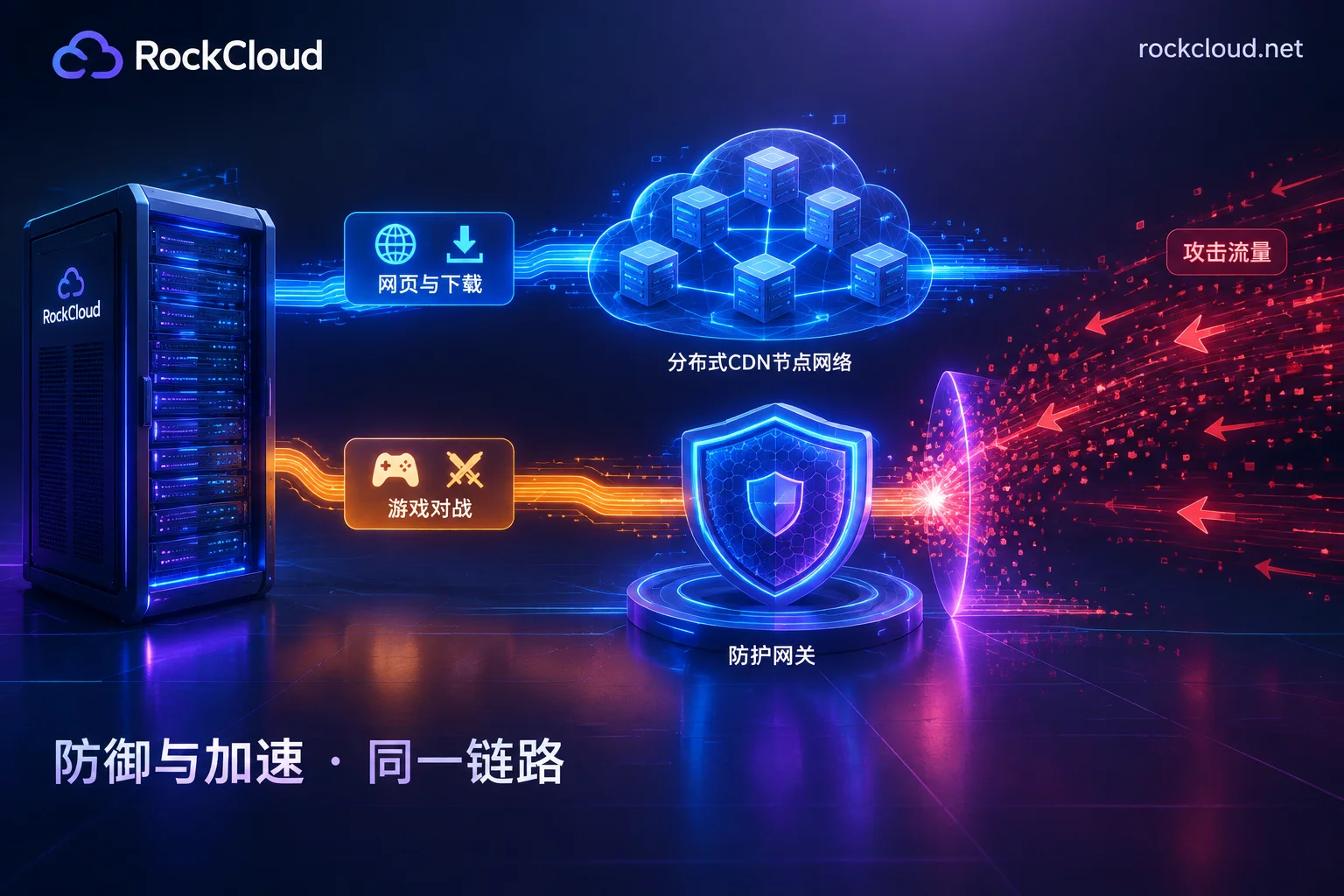
Thus, the new criteria are: whether traffic is normally carried at the edge (rather than rerouting only after an attack), how fast routing converges automatically, and whether the origin IP is directly exposed. This points directly to the value of edge Anycast always-on cleaning and origin hiding (such as RockCloud's publicly offered Anycast global network acceleration, high-protection CDN with edge traffic cleaning, and intelligent WAF) — they intercept attacks before they reach the origin, rather than waiting for the attack and then handling it. Such solutions are suitable for scenarios requiring edge always-on handling and origin hiding, but not for businesses that must retain single-carrier local direct connections.
For more on the evolution of traffic cleaning architectures, see Traffic Cleaning Architecture Evolution.
Six-Dimension Comparison Table: BGP vs. Single-Line High-Protection
| Dimension | BGP High-Protection | Single-Line High-Protection |
|---|---|---|
| Routing Access | Own AS announces to multiple carriers, supports Anycast | Single-carrier static routing |
| Redundancy & Failover | Cross-node re-announcement possible; convergence depends on announcement policy and upstream acceptance speed | Depends on single carrier; failure requires waiting for network recovery |
| Attack Mitigation | Adjust announcements and route to cleaning nodes | After blackhole, only wait for window to lift |
| Cross-Network Access Consistency | Route optimization provides consistent multi-line latency | Better latency within own network; high cross-network detour |
| Origin Exposure Risk | Origin can be hidden; edge handles traffic | Origin may be exposed; higher risk |
| Cost Structure | Higher, includes multi-line BGP maintenance | Lower, single-line cost |
Business-Type-Based Conclusions: Websites and APIs, Gaming, Single-Region Intranet
For websites and APIs serving national or global users, see Website DDoS Protection. With wide user distribution, high cross-network needs, and a higher risk of multi-vector composite attacks (NETSCOUT's H2 2025 ATLAS monitoring data shows nearly half of attacks use multi-vector methods), BGP high-protection is recommended, prioritizing default edge always-on cleaning and origin hiding.
If your users and origin are on the same carrier network and access is mostly local (e.g., internal management systems), single-line high-protection (like Telecom single-line) can meet basic needs at lower cost. However, even for single-region businesses, cross-network attacks or the lowered barrier of DDoS-for-hire services could overwhelm single-point solutions, so at least have a switch plan ready.
Selection Self-Checklist: Questions to Ask Before Signing with a Data Center
Apply the BGP vs. single-line distinction to procurement with this checklist for each candidate data center:
- [ ] Does the high-protection IP belong to your own AS? Is cross-node announcement supported?
- [ ] Is it always-on cleaning by default, or rerouting after attack?
- [ ] What is the blackhole trigger threshold? What is the unblocking duration and notification mechanism?
- [ ] Are test IPs provided for cross-network testing?
- [ ] Will the origin IP be exposed? Is origin hiding supported?
- [ ] Where are the responsibility boundaries for handling multi-vector and L7 attacks?
After reviewing this checklist, another easily confused concept is that BGP high-protection IP and high-protection data centers aren't the same: the former is a line access method, while the latter is a physical colocation mode, and they can be combined. And why BGP is expensive in high-protection quotes? The core is the maintenance cost and routing redundancy capability of multi-line BGP — that's the visible value difference.
Finally, we suggest you: verify routing and blackhole policies line by line, conduct cross-network tests from target user networks, and if you need to assess edge always-on cleaning and origin hiding, contact RockCloud technical support for an architecture review.
For overall changes in attack trends and defense systems, see 2026 DDoS Attack Trends and High-Protection Systems. To further distinguish between high-protection IP and CDN, check High-Protection IP vs. High-Protection CDN.
Frequently Asked Questions
What is the most effective immediate action when a single-line IP is blackholed?
Contact the data center immediately to confirm the unblocking time, and switch business to a backup IP or line. But note: if the attack continues, the new IP may also be quickly targeted. It's best to prepare multi-IP rotation or BGP high-protection as redundancy in advance.
Is BGP high-protection cross-network latency high? How to test it?
Not necessarily. BGP uses route optimization to give users from different carriers better paths, but actual latency depends on routing scheduling quality. The most reliable approach is to request test IPs from the data center and run ping and traceroute from target user networks, comparing latency and packet loss between single-line and BGP.
What businesses is Telecom single-line high-protection suitable for?
It's suitable for businesses whose target users are mainly on Telecom network and don't require high cross-network access, such as local IDC colocation, single-region internal systems, or specific industry applications. If users are distributed nationwide or involve cross-border traffic, Telecom single-line may degrade experience due to cross-network detours.
Why is BGP more expensive in high-protection data center quotes?
Because BGP high-protection requires maintaining its own AS, establishing BGP sessions with multiple carriers, and dynamically adjusting routes, which raises technical costs. Additionally, multi-line redundancy naturally brings higher availability. Single-line only needs to interface with one carrier, so costs are lower and prices cheaper.
Can BGP high-protection completely avoid blackholing?
No. BGP high-protection only reduces the probability of blackholing and shortens recovery time. Under extremely large traffic, a single node may still be blackholed by the carrier, but it can quickly recover through cross-node re-announcement. In contrast, single-line protection can only wait for the network to lift the blackhole.



Comments(0)