 RockCloud-基石云安全-官方博客
The core difference between high-protection IP and high-protection CDN is not about "how many G's of protection," but the protocol layer at which traffic is absorbed: high-protection IP operates at Layer 4 port forwarding, protocol-agnostic but without understanding business semantics; high-protection CDN operates at Layer 7 domain-based access, with caching and WAF but only covering HTTP(S). This boundary is more critical today than ever—Radware's Q1 2026 report shows a 187.1% year-over-year surge in web application layer DDoS attacks, and a 168.2% increase in network layer attacks. When the attack growth is mainly in the application layer, looking only at bandwidth numbers is no longer sufficient for making a choice.
First, Clarify: High-Protection IP and High-Protection CDN Operate at Different Layers
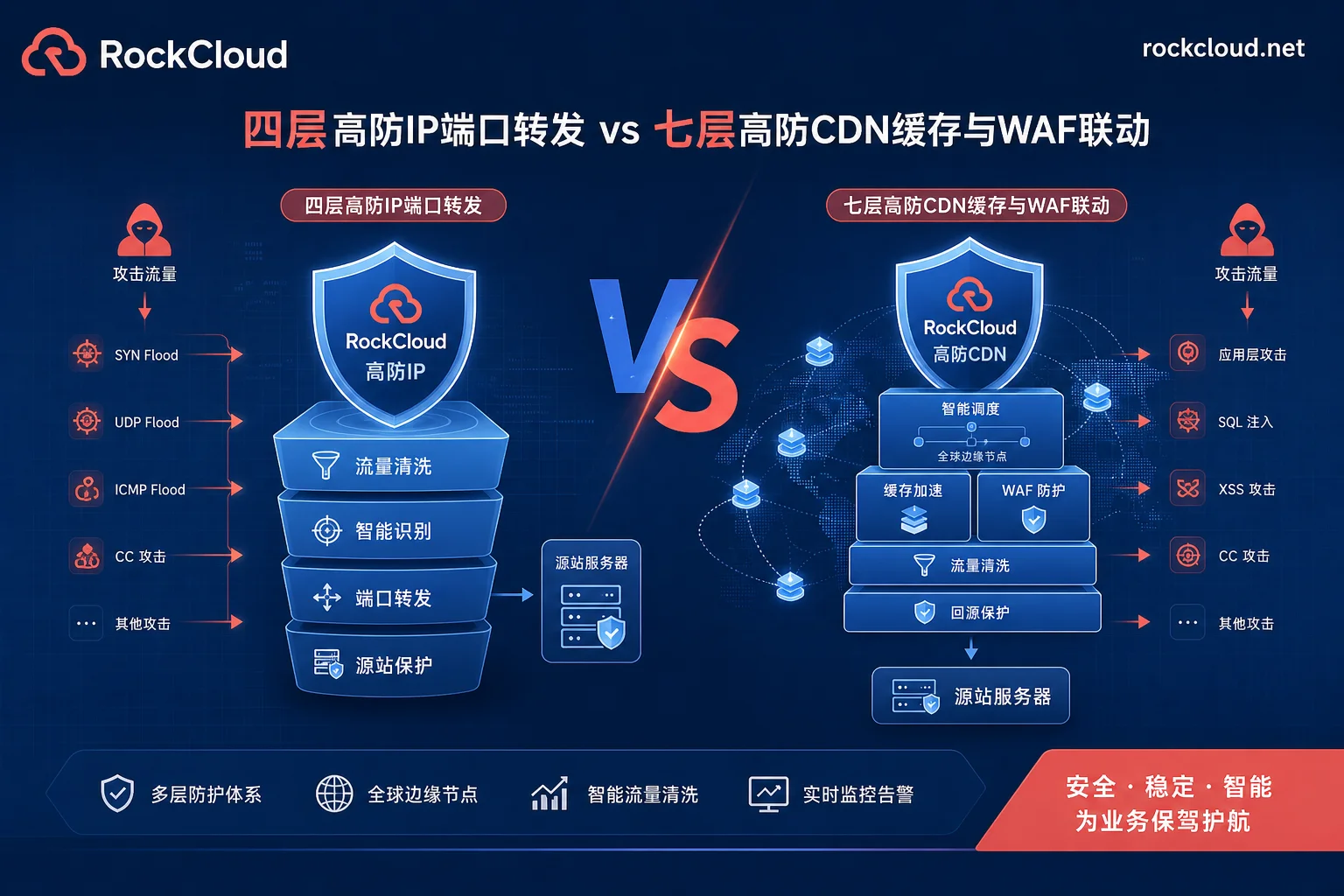
Many teams treat "high-protection" as a single entity, but the two product types handle traffic at completely different positions. High-protection IP works at Layer 4 (transport layer), using port forwarding to direct traffic to scrubbing nodes, then forwarding to your real server; high-protection CDN works at Layer 7 (application layer), using DNS resolution to direct traffic to edge nodes, where it identifies HTTP(S) semantics before deciding to cache, fetch from origin, or trigger protection.
This distinction directly determines what each can and cannot defend against, and is the starting point for understanding the differences between high-protection IP and high-protection CDN.
How High-Protection IP Works: Layer 4 Port Forwarding, Protocol Agnosticism, and Billing Logic
High-protection IP is integrated by replacing the business IP with a high-protection IP and configuring forwarding rules per port. It supports any Layer 4 protocol such as TCP and UDP, and has no awareness of the upper-layer business, so whether it's an HTTP website, a game client, or a custom binary protocol, it can be absorbed.
Based on current mainstream cloud providers' public product forms, common billing models are based on defense bandwidth or the number of forwarding rules, with specific tiers subject to each provider's console pricing. It suits businesses with relatively stable traffic patterns and primarily Layer 4 volumetric attacks.
However, its limitations are obvious: because it does not parse HTTP content, it cannot identify CC attacks that mimic normal user requests, nor can it cache static resources. So if your business primarily runs on HTTP(S), relying solely on high-protection IP to withstand application-layer attacks will be very difficult. For a detailed comparison of tiers and billing, refer to High-Protection IP Selection.
How High-Protection CDN Works: Layer 7 Domain Access, Cache Offloading, and WAF Integration
High-protection CDN uses CNAME to resolve domain names to edge nodes. When traffic arrives, nodes terminate TLS and identify HTTP semantics. It can cache static resources to offload the origin server, and integrate with WAF and bot detection to block slow CC and realistic bot attacks—exactly the capability enterprises need after the surge in application-layer attacks in 2026. For specific rule-level handling, see Application-Layer Attack Protection.
But its coverage is limited to HTTP(S); non-web businesses (such as games with proprietary protocols or TCP long connections) cannot directly use it. This is also the answer to "Can non-web businesses use high-protection CDN?": no, unless the business is willing to change its communication protocol to HTTP(S).
Six-Dimensional Comparison Table: High-Protection IP vs. High-Protection CDN
The table below aligns the differences between high-protection IP and high-protection CDN across six dimensions for quick scanning and decision-making.
| Dimension | High-Protection IP | High-Protection CDN |
|---|---|---|
| Access Method | Replace business IP, configure port forwarding | CNAME resolution to edge nodes |
| Supported Protocols | TCP, UDP, and any Layer 4 protocol | HTTP(S) only |
| Protection Layer | Layer 4 (network layer) | Layer 7 (application layer, including CC/WAF) |
| Caching Acceleration | None, only forwarding | Yes, static resource caching |
| Origin IP Hidden | Via origin IP allowlist + IP replacement | Via node proxy + origin IP allowlist |
| Billing Model | Based on defense bandwidth or forwarding rules | Based on traffic or requests, with value-added security |
It should be emphasized that hiding the origin IP is not automatic for either type. Regardless of whether you use high-protection IP or high-protection CDN, you need to proactively change the origin IP, configure an origin IP allowlist, and disable public direct connections to truly reduce the attack surface. Neglecting this step means even if you switch the entry point, attackers may still find the origin via old DNS records.
Billing model differences also affect cost. High-protection IP is billed by defense bandwidth; during short bursts or large attacks, bandwidth peaks can directly drive up costs. High-protection CDN is billed by traffic or requests; the higher the cache hit rate for static resources, the less origin traffic and the more controllable per-request cost. Therefore, cost assessment should be based on traffic structure, not just unit price.
Why Comparing Only "How Many G's It Can Defend" Is No Longer Enough: Selection Criteria in 2026
The attack landscape in 2026 has changed. NETSCOUT announced in July 2026 that it would double its global Arbor Cloud scrubbing capacity to 33 Tbps, covering 16 scrubbing centers, to handle 30+ Tbps ultra-large volumetric attacks. This expansion indicates that Layer 4 capacity has been pushed to a global distributed traffic scrubbing pool level, and any single data center's high-protection can hardly independently withstand such traffic.
Meanwhile, Radware's Q1 2026 report shows a 187.1% year-over-year increase in application-layer attacks, with short bursts and multi-vector compound attacks becoming the norm. Therefore, selection criteria should shift from "how many G's of defense bandwidth" to "whether both Layer 4 capacity and Layer 7 semantic identification capability are present." This also means the criteria for judging the differences between high-protection IP and high-protection CDN have shifted from a single bandwidth number to a combination of Layer 4 capacity and Layer 7 identification.
Conclusions by Business Type: How to Choose for Websites & APIs, Games, and Non-HTTP Proprietary Protocols
- Websites & APIs: Prioritize high-protection CDN, stack WAF and bot protection, and use caching to reduce origin pressure.
- Games & Real-Time Battles: Use Layer 4 high-protection IP for UDP and proprietary protocols, and additionally integrate high-protection CDN for HTTP endpoints like login and recharge. For details on game scenarios, see Game DDoS Protection.
- Non-HTTP Proprietary Protocols: Can only use Layer 4 high-protection IP; high-protection CDN is not applicable.
For game servers, the decision between high-protection IP and high-protection CDN depends on the protocol: core battle traffic goes to Layer 4, and HTTP interfaces go to Layer 7.
Hybrid Integration: Can High-Protection IP and High-Protection CDN Be Used Together?
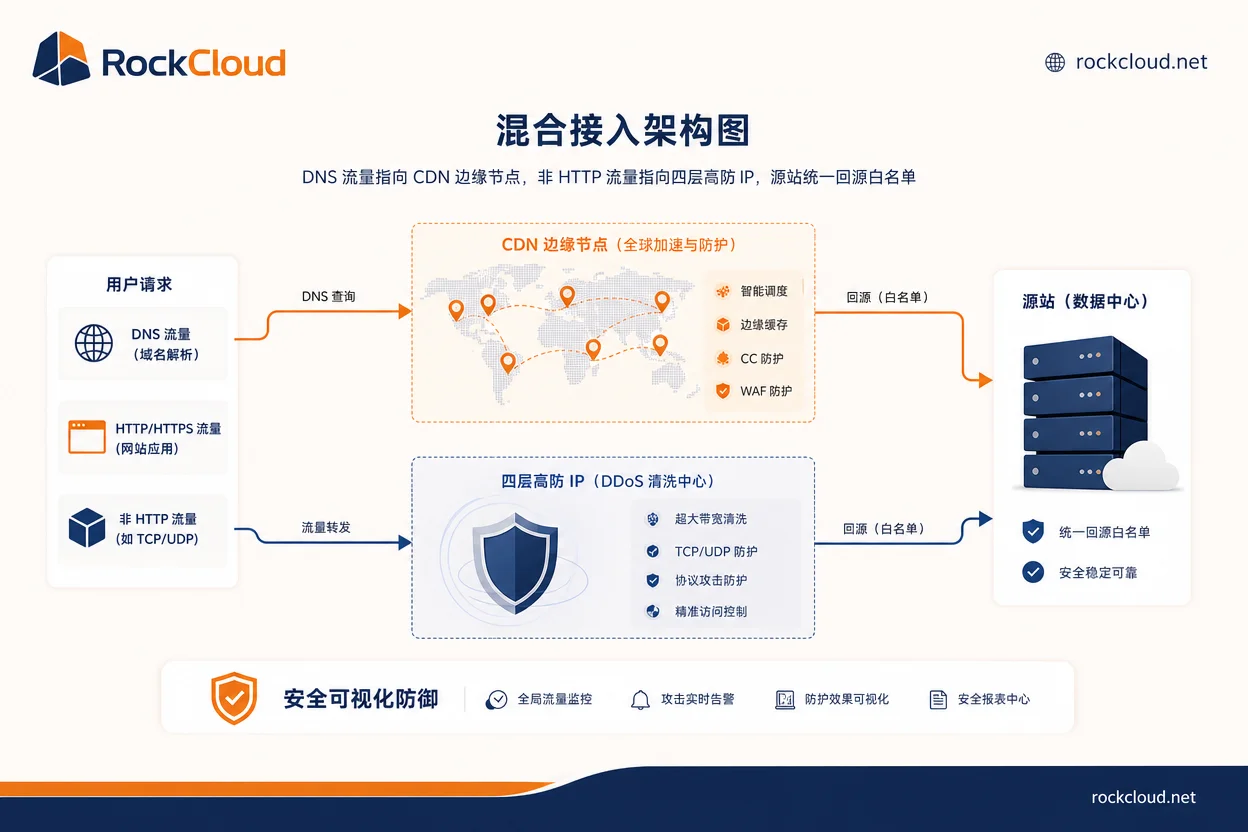
Can high-protection IP and high-protection CDN be used together? Yes, and it's recommended. Split the entry points by protocol: domain-based traffic goes through high-protection CDN, and port-based traffic goes through Layer 4 high-protection IP. The origin server should only allow traffic from the origin IP allowlist, disable public direct connections, and avoid leaking the real IP via historical DNS records. This way, you absorb both the ultra-large scrubbing capacity at Layer 4 and the semantic identification and caching acceleration at Layer 7. RockCloud (基石云) provides layered protection following this approach.
Will the origin IP still be exposed after integration? The risk lies in historical DNS records and active outbound connections. As long as you reduce the attack surface and use the origin IP allowlist, the probability of exposure drops significantly. For teams seeking high cost-effectiveness, you can first offload static resources and high-frequency HTTP requests to high-protection CDN, while leaving low-frequency Layer 4 protocols to high-protection IP. There is no universal answer to which is cheaper; the key is the proportion of HTTP(S) traffic and the attack peak pattern: the higher the cacheable static content ratio, the lower the unit cost of the Layer 7 entry.
Selection Self-Checklist
To apply the differences between high-protection IP and high-protection CDN to your own business, use the following checklist to verify item by item.
- Is the business protocol composition pure HTTP(S) or does it include UDP/custom protocols?
- Are there a large number of static resources that can be cached?
- Is there a risk of slow CC or realistic bot attacks?
- Has the origin attack surface been reduced (public direct connection disabled, historical DNS records cleaned)?
- Does the Layer 4 capacity have T-level scrubbing pool support?
- Is Layer 7 semantic identification (WAF, bot management) in place?
- Does the billing model match the traffic pattern?
First, assess the protocol composition and origin attack surface according to the checklist, then decide on the integration method.
If you end up with a combination of Layer 4 and Layer 7 entry points, RockCloud (基石云) offers high-protection CDN, DDoS & CC defense, intelligent WAF, game shield, and origin protection, allowing you to split traffic by protocol and uniformly reduce origin exposure.
FAQ
Can High-Protection IP and High-Protection CDN Be Used Together?
Yes. It is recommended to split by protocol: domain-based traffic goes through high-protection CDN, and non-HTTP ports go through Layer 4 high-protection IP. The two complement each other, providing both Layer 4 capacity and Layer 7 semantic identification.
Which Is Cheaper: High-Protection IP or High-Protection CDN?
It depends on your traffic structure. For pure HTTP(S) businesses, CDN may be more cost-effective (caching reduces origin traffic); for non-HTTP or high-volume Layer 4 businesses, high-protection IP is usually more direct. It is recommended to compare billing models based on traffic patterns, not just unit price. Billing dimensions differ (bandwidth/rules vs. traffic/requests), so compare based on peak patterns rather than monthly averages.
Can Non-Web Businesses Use High-Protection CDN?
No. High-protection CDN only supports HTTP(S) protocols; non-web businesses such as custom TCP/UDP protocols cannot directly use it and must use Layer 4 high-protection IP.
Does High-Protection IP Require DNS Changes or Port Changes?
High-protection IP generally does not require DNS changes; you only need to replace the business IP with the high-protection IP and configure port forwarding rules. The domain resolution remains unchanged (unless CDN is also used). If the original A record directly points to the origin IP, you need to change the resolution to point to the high-protection IP and also change the origin IP; otherwise, historical DNS records can still be used to bypass protection. If the domain is also connected to CDN, note that resolution records and forwarding rules should not point to the same entry to avoid loops.
Can High-Protection CDN Defend Against CC Attacks?
Yes. High-protection CDN identifies HTTP semantics at Layer 7 and can integrate with WAF and bot management to detect and block slow CC and realistic bot attacks. However, note that high-protection IP alone cannot effectively defend against CC attacks.
Should Game Servers Choose High-Protection IP or High-Protection CDN?
For game core battles (UDP/proprietary protocols), choose high-protection IP; for HTTP endpoints like login and recharge, you can additionally integrate high-protection CDN for hybrid protection.
After High-Protection CDN Integration, Will the Origin IP Still Be Exposed?
It may be exposed, with the risk points being historical DNS records and active outbound connections from the origin. By changing the origin IP, only allowing origin IP allowlist, and cleaning historical DNS records, you can significantly reduce the probability of exposure. Common leak paths include email sending, third-party callbacks, and certificate transparency logs.




Comments(0)