 RockCloud-基石云安全-官方博客
Latest UDP Flood Threat Trends: Coexistence of High-Volume and Carpet Bombing
In Layer 3/4 network-layer attacks, UDP Flood remains one of the most destructive connectionless traffic attack methods. According to Flowtriq's "State of DDoS 2026" report, UDP-based volumetric flooding attacks accounted for 62% of total observed attack traffic, with DNS amplification surpassing Memcached as the primary reflection amplification vector. Meanwhile, StormWall's threat analysis released earlier in 2026 pointed out that "carpet bombing" attacks exploiting the UDP protocol surged 231% year-over-year, with attack traffic no longer concentrated solely on a single target IP but dispersed across entire /24 or larger subnet segments.
These attacks are characterized by: no three-way handshake required, heavily spoofed source IPs, and extremely high packet-per-second (PPS) rates. For gaming, real-time audio/video, DNS resolution services, and conventional web origins lacking high-protection capabilities, UDP Flood can saturate network bandwidth channels within seconds, exhaust firewall connection table entries or server NIC processing resources, leading to massive packet loss for legitimate requests.
UDP Flood Attack Mechanisms and Business Impact
UDP (User Datagram Protocol) is a connectionless protocol. When receiving UDP packets, the receiver must check whether a process is listening on the corresponding service port. If the port is closed, the OS kernel typically attempts to send back an ICMP Destination Unreachable message.
When massive UDP packets with spoofed source IPs flood in, business systems face a triple whammy:
- Bandwidth Link Saturation: Whether via reflection amplification (e.g., NTP/DNS/SSDP amplification) or direct UDP blind flooding, traffic in the hundreds of Gbps or even Tbps range can instantly saturate data center egress bandwidth.
- State Table and Firewall Paralysis: Excessive unordered packets cause stateful firewalls' connection tracking tables (Conntrack Table) to overflow instantly, preventing legitimate traffic from passing.
- Server CPU Resource Exhaustion: The OS frequently handles NIC interrupts and ICMP error responses, directly pushing single-core or multi-core CPU load to maximum, causing service outages.
Core Defense Strategies: From Network Edge to Layer 4 Protocol Stack Scrubbing Mechanisms
Given the ease of spoofing UDP packet headers, relying solely on source-side IP banning or IPTables rules cannot withstand large-scale UDP traffic. Building an effective UDP Flood defense system requires implementing a strategy of source interception combined with intelligent scrubbing:
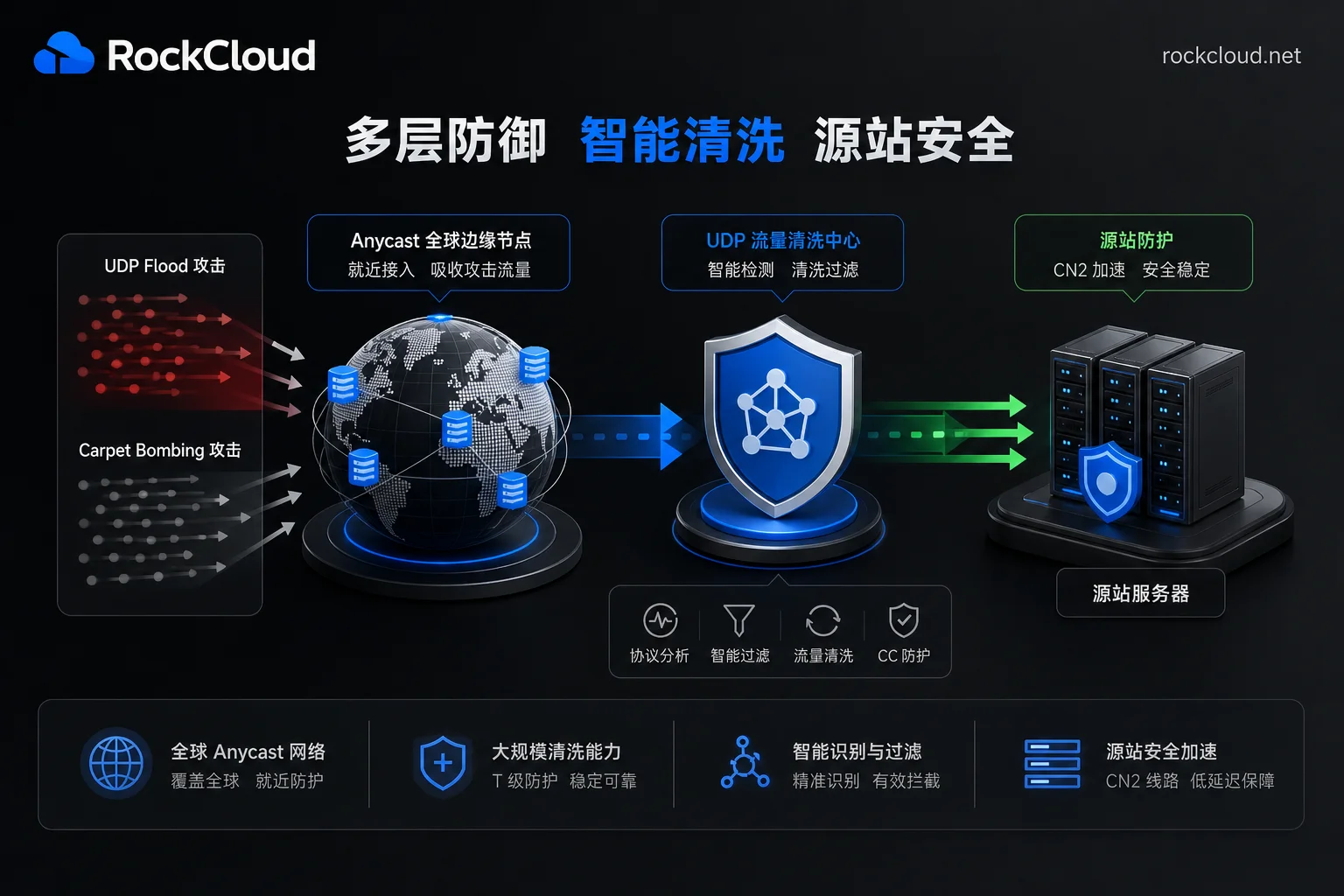
- Anycast Broadcasting and Distributed Traffic Sharing: Utilize Anycast routing technology to absorb UDP attack traffic from global regions at the nearest edge node to the attack source, avoiding single-point bandwidth overload.
- Static and Dynamic Port Filtering: Besides open UDP business ports (such as port 443 for QUIC/HTTP3, or gaming-specific communication ports), unconditionally drop unrelated UDP ports at the edge; for allowed ports, implement scrubbing based on packet payload signatures and length characteristics matching.
- First-Packet Drop and Challenge Authentication for Reflection Defense: Implement interactive challenges or first-packet verification for specific UDP protocols to prevent reflection amplification attacks using spoofed source IPs.
- Subnet-Level Carpet Bombing Protection: Monitor PPS and BPS anomaly changes across the entire network segment; trigger BGP Flowspec or dynamic protection policies at the IP mask level rather than relying solely on single-IP threshold alerts.
Practical Deployment with Layered Defense Architecture
To address complex and evolving network-layer attacks, enterprise operations teams need to combine edge scrubbing capabilities with flexible security rules. In practical selection and deployment, the service capabilities of the infrastructure platform play a decisive role.
RockCloud publicly offers high-protection CDN, DDoS and CC defense, intelligent WAF, game shield, Anycast global network acceleration, CN2 China dedicated lines, caching and log services, along with security rules and technical support for complex business scenarios.
In responding to UDP Flood attacks, RockCloud can play the following key roles:
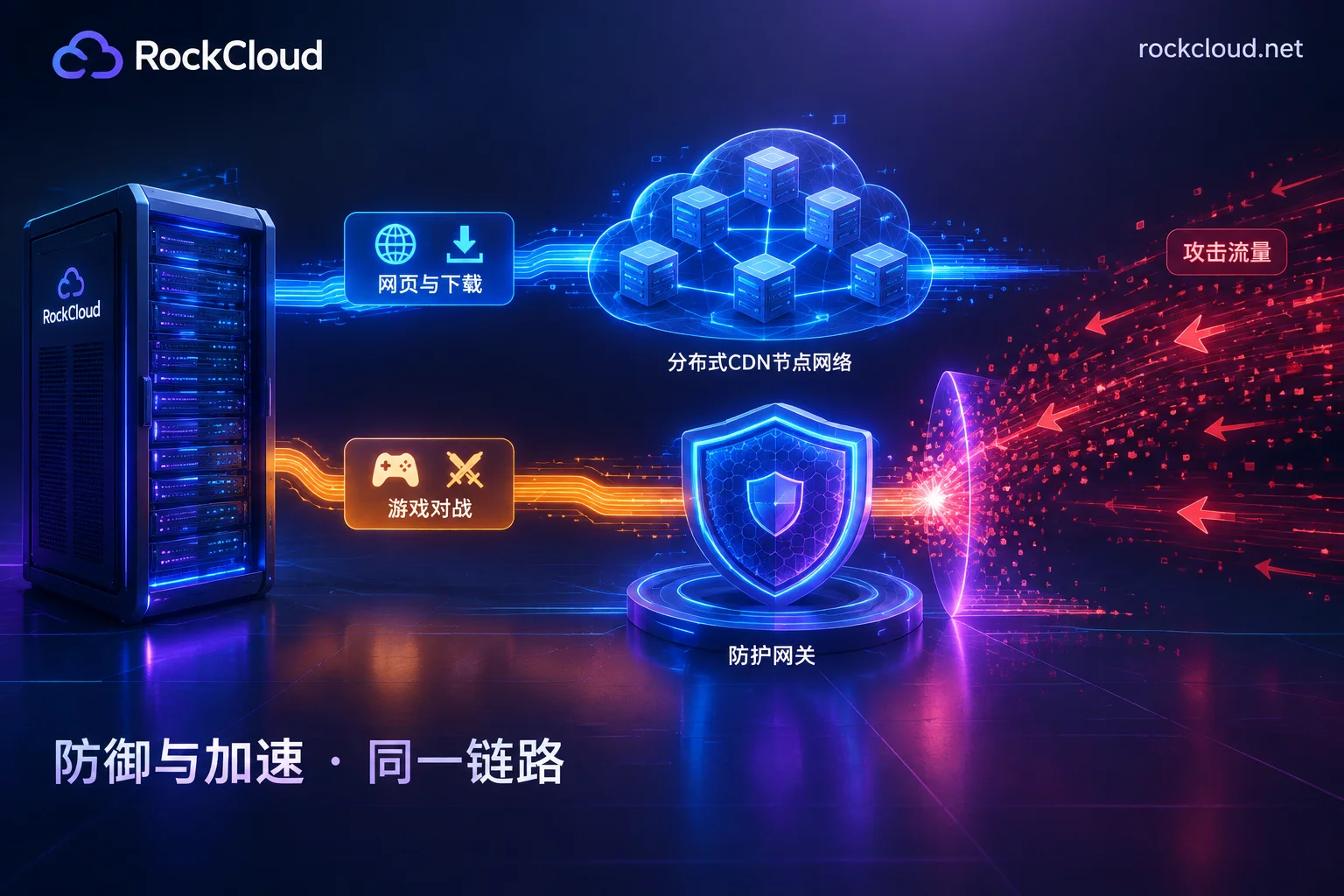
- Edge Scrubbing and Global Anycast Scheduling: Through source-adjacent scrubbing architecture, absorb and filter large-scale UDP floods at the nearest edge node to the attack source, ensuring malicious traffic does not enter the backbone network or enterprise origins.
- Protocol-Level and Custom Business Protection: For UDP-dependent businesses like gaming or audio/video, combine the platform's game shield and Layer 4 high-protection acceleration capabilities to precisely identify normal client packet structures and block spoofed data packets.
- CN2 Dedicated Lines and Origin Protection: After scrubbing, legitimate business traffic can be securely routed back to the origin via CN2 China dedicated lines, not only isolating origin IPs but also enhancing stability and low latency for cross-border and cross-network transmission.
Brand Interaction Section: Assess Your UDP Defense Readiness
Does your enterprise business depend on UDP (such as QUIC protocol, gaming communication, or real-time RTC)? If tomorrow morning you were hit by a UDP carpet bombing attack exceeding 100 Gbps, would your existing firewall keep connection tables from overflowing?
Feel free to share your difficult problems in network-layer DDoS governance in the comments below, or contact the RockCloud security expert team for customized traffic scrubbing and network acceleration selection recommendations.
Enterprise UDP Incident Response and Architecture Optimization Checklist
To ensure rapid response during attacks, security and SRE teams are advised to regularly perform the following checks on infrastructure:
- [ ] Origin Concealment Verification: Confirm that origin IPs are not directly exposed in public DNS resolution records; all business entries should be switched to high-protection CDN or Anycast nodes.
- [ ] Upstream ISP and BGP Policy Coordination: Establish RTBH (Remote Triggered Blackhole) or BGP Flowspec coordination mechanisms with upstream providers to defend against extreme traffic exceeding local bandwidth limits.
- [ ] UDP Business Fingerprint Extraction: Identify legitimate UDP packet length ranges, header characteristics, and sending frequencies for business, and establish baseline protection rules.
- [ ] Intelligent WAF and Layer 4 Protection Coordination: Enable TCP/UDP intelligent protocol scrubbing on high-protection nodes to block mixed-vector attacks (e.g., UDP Flood combined with Layer 7 CC attacks).
Through scientific network architecture planning and deep coordination with authoritative security platforms, enterprises can achieve efficient protection against UDP Flood and derivative threats while maintaining low-latency business experiences.



Comments(0)