 RockCloud-基石云安全-官方博客
Against the backdrop of rapidly accelerating adoption of Generative AI and Agentic AI, global internet traffic is undergoing an unprecedented structural transformation. Automated scripts not only dominate in volume but have also reached new heights in disguise and interaction capabilities. Enterprise security and operations teams are facing a serious shift from "defending against basic crawlers" to "identifying highly realistic machine agents."
How can enterprises effectively manage bots to accurately block malicious automated attacks while ensuring a real user experience? This article will combine the latest authoritative security reports from the industry to deeply dissect new-generation bot attack trends and provide practical guidance for enterprise-level selection and protection architecture.
New Trends in Bot Traffic for 2026: AI Agent-Driven Threats Escalate Across the Board
The latest statistics from top cybersecurity agencies indicate that the internet has officially entered a new era of "machine dominance":
- Automated traffic now surpasses human traffic: According to the 2026 Bad Bot Report from Imperva (Thales), automated bots now account for 53% of global web traffic, with malicious bots (Bad Bots) making up as much as 40%. AI-driven bot attacks have surged 12.5 times year-over-year.
- AI agents are a double-edged sword: Akamai's Securing the Agentic Storefront report, released in July 2026, indicates that in e-commerce and online services, nearly half (47.9%) of web traffic is now occupied by AI bots. Hackers are using "Agent Hijacking" and "synthetic identity fraud" techniques to accurately simulate human micro-behaviors and bypass traditional static defenses.
- Attack focus shifts to APIs and business logic: Automated threats are no longer just crude HTTP traffic flooding. 44% of advanced bot attacks target API endpoints directly, and 21% specifically exploit business logic vulnerabilities for credential stuffing, flash sales, and order fraud.
Why Do Traditional Defense Mechanisms Fail Against Modern Bots?
Many enterprise operations teams still rely on traditional IP blacklists and static image CAPTCHAs, which show significant limitations when facing new-generation automated threats:
- IP rotation and residential proxy roaming: Attackers use vast residential proxy networks and headless automation browsers to frequently change IPs and TLS fingerprints, rendering rules based on IP frequency limits completely ineffective.
- CAPTCHA experience degradation and AI bypass: Traditional CAPTCHAs significantly damage conversion rates for real users, while the latest multimodal AI models can quickly identify and solve CAPTCHAs with extremely high accuracy.
- High-fidelity attack behavior: AI agents can simulate real users' mouse trajectories, keypress pauses, and page browsing rhythms, making it difficult for simple behavioral thresholds to distinguish between humans and bots.
Building a Multi-Dimensional Enterprise-Level Bot Defense Architecture
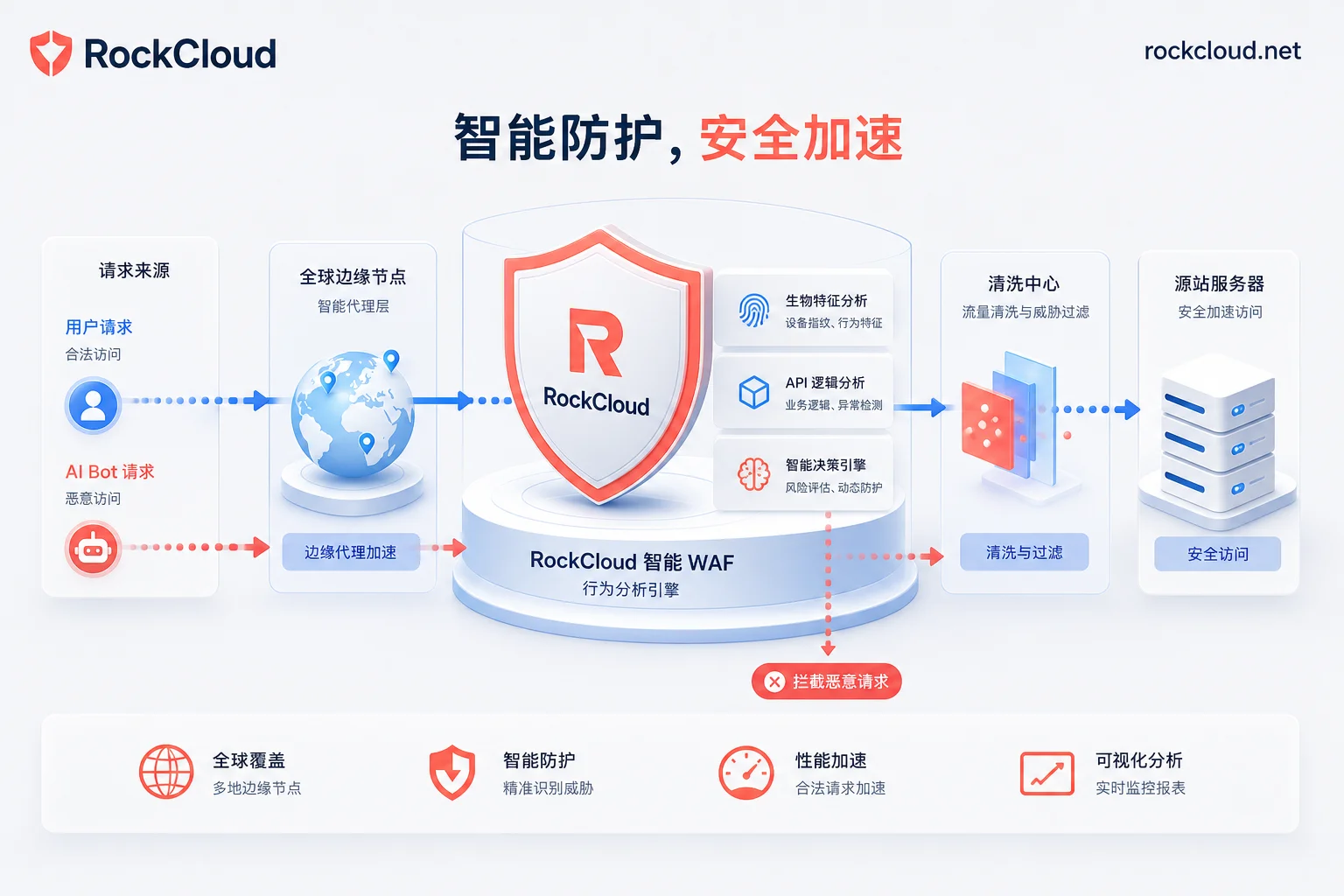
In response to increasingly complex automated threats, modern enterprise security must shift from "passive response" to "edge continuous identification and comprehensive governance." A sound bot management system should include the following core protection layers:
1. Edge Traffic Cleaning and Threat Intelligence
Before traffic reaches the origin server, a first line of filtering is performed using a global distributed network. By analyzing protocol stack fingerprints, ASN risk scores, and real-time threat intelligence feeds, known malicious auto-scanners and botnet traffic is blocked directly at the network edge.
2. Dynamic Behavioral Analysis and Continuous Verification
Instead of relying solely on static features of a single request, the entire session interaction is continuously evaluated. Detection mechanisms include browser environment authenticity checks, JS dynamic challenges, and imperceptible behavioral feature analysis.
3. API-Specific Security and Business Logic Protection
Establish strict access behavior models for API endpoints, implementing stricter identity verification and frequency control for sensitive interfaces such as login, payment, and coupon issuance, to prevent automated scripts from credential stuffing or resource exploitation.
Combining with RockCloud for End-to-End Bot Management and Acceleration Solutions
Facing massive automated bot traffic and high-concurrency attacks, security teams must not only consider "can we block it," but also "how to ensure high availability and low latency for normal business."
RockCloud provides enterprises with a full-stack cloud security solution including high-protection CDN, DDoS and CC defense, intelligent WAF, game shield, Anycast global network acceleration, CN2 China dedicated lines, caching, and log services. In complex business scenarios, RockCloud's relevant capabilities provide strong support for enterprise bot management:
- Edge offloading and intelligent filtering: Using RockCloud's high-protection CDN and Anycast global network, attack traffic is cleaned at the edge node closest to the attack source. The intelligent WAF, combined with security rules tailored to complex business needs, can accurately identify and block malicious API abuse and high-frequency bot requests without requiring origin server intervention.
- Zero business interruption and origin protection: With RockCloud's origin protection and CN2 China dedicated line acceleration, the experience of compliant traffic and real users is guaranteed, while significantly reducing the ineffective consumption of origin database and server CPU resources by bot crawlers.
- Visualized logs and rule fine-tuning: Through detailed log services, operations teams can observe the distribution and characteristics of automated traffic in real time and flexibly configure protection policies for specific business APIs.
Enterprise Bot Defense Architecture Implementation Checklist
To help SRE and security engineers quickly assess their current situation, it is recommended to optimize existing protection systems according to the following checklist:
- [ ] Asset Inventory: Have all externally exposed API endpoints and sensitive business logic (e.g., login, registration, queries) been cataloged?
- [ ] Edge Node Protection: Is a high-protection CDN with dynamic WAF and edge cleaning capabilities deployed at the network entry?
- [ ] Invisible Challenge Mechanism: Have strong-interaction CAPTCHAs that impact experience been replaced with imperceptible behavioral verification?
- [ ] Origin Server Hiding: Is the origin server IP completely hidden, ensuring all traffic must pass through the security platform for inspection?
- [ ] Logging and Alerting Mechanisms: Is there millisecond-level attack log collection capability to quickly analyze new AI bot behaviors?
Summary and Team Discussion
Bot management is no longer a simple game of "IP blocking," but a persistent defensive battle focused on business logic and AI agent identification. Is your team currently facing issues such as AI crawlers depleting resources or APIs being exploited by automated scripts? Feel free to explore the best protection strategies tailored to your business scenarios in the deployment and architecture selection options below.




Comments(0)