 RockCloud-基石云安全-官方博客
2026 Surge in Web Application Attacks: How Enterprises Can Reshape Intelligent WAF Protection Amid High-Risk 0day Exposures?
Driven by automated attack scripts and intelligent offensive-defensive evolution, Web application security is undergoing profound changes. According to a WAF security emergency bulletin released by security vendor Cloudflare in July 2026, high-risk vulnerabilities in mainstream Web frameworks and REST APIs (such as CVE-2026-63030 unauthorized remote code execution and CVE-2026-60137 SQL injection) were quickly scanned and exploited by attackers once exposed. Meanwhile, Radware's Q1 2026 Network and Application Attack Trend Report shows that global blocked malicious Web and API transactions increased significantly by 52% year-over-year, with application-layer DDoS (CC attacks) and API vulnerability probing becoming the foremost threats to enterprise cloud assets.
Facing the dual challenges of "exploit upon exposure" and "high-frequency obfuscated traffic injection," traditional Web Application Firewalls (WAFs) that rely on static regex patterns and single-point deployment are showing their limitations. Enterprise operations and security teams urgently need to reassess and upgrade their WAF protection architectures.
Deep Threat Analysis: Three Major Protection Pain Points for Enterprise Applications
- Extended 0day Vulnerability Response Window
When high-risk CVE vulnerabilities erupt in underlying frameworks or CMS systems, enterprises typically need several days to go from vulnerability verification, troubleshooting, testing, to production patching. Meanwhile, hackers can launch global scans within hours or even minutes using automated scripts, leaving origin servers highly susceptible to attack during the window. - Surge in Application-Layer CC Attacks and Obfuscated Traffic
Modern CC attacks no longer rely solely on simple single-IP high-frequency requests; they combine distributed botnets and behavioral simulation to disguise malicious requests as legitimate user access. Traditional WAF rules that are too strict cause business false positives, while those that are too loose fail to block resource-consumption attacks. - Frequent API Exposure and Logic Privilege Escalation Vulnerabilities
With the expansion of microservices and cloud-native architectures, the number of exposed API endpoints has multiplied. Many attackers bypass frontend pages and directly tamper with parameters, steal credentials, and perform unauthorized access against backend APIs, which traditional network-layer firewalls cannot identify.
Architecture Evolution: Core Elements of Next-Generation WAF Protection
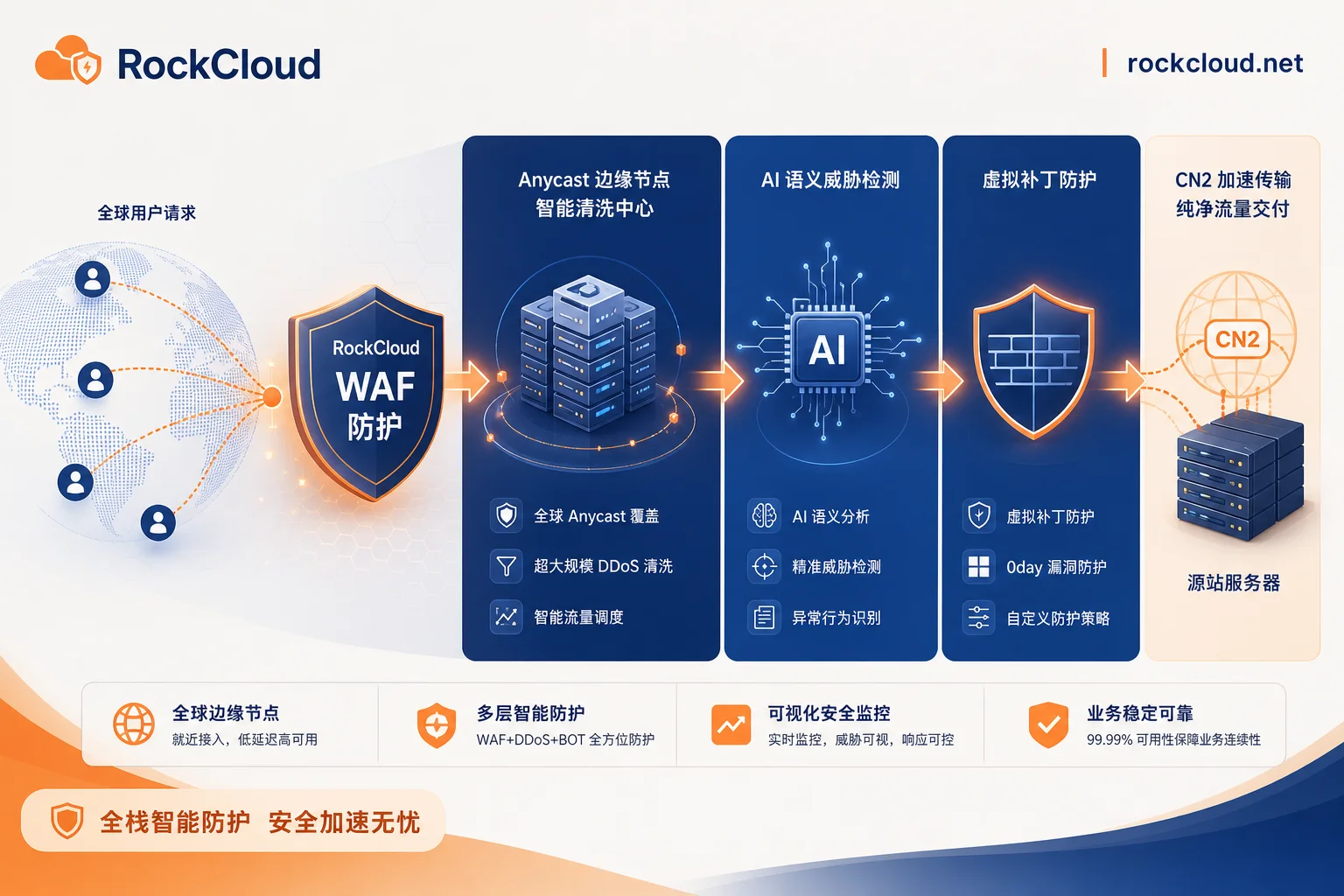
To address these challenges, modern WAF protection must shift from "passive rule matching" to "edge-integrated protection":
- Edge Virtual Patching: Security teams can deploy interception rules for the latest CVE vulnerabilities at the edge firewall layer within seconds without modifying origin server code, blocking malicious payloads and buying valuable time for origin patching.
- AI Semantic Analysis and Behavioral Baselines: Leverage machine learning algorithms to establish baseline traffic patterns for normal application access, accurately distinguishing real users, search engine crawlers, and malicious bots, thereby improving detection rates for obfuscated CC attacks and slow-rate attacks.
- Integration with High-Protection CDN and Cleaning Networks: Distribute WAF detection to distributed edge nodes, utilizing Anycast global networks to absorb large-scale DDoS traffic, preventing high-concurrency traffic from overwhelming WAF compute bottlenecks.
RockCloud Practice: Multi-Layer Application Security Defense Solution
When dealing with complex Web attacks and traffic storms, a defense system deployed at edge nodes is crucial.
RockCloud platform integrates intelligent WAF, high-protection CDN, and Anycast global cleaning capabilities within edge clusters, building multi-dimensional defense barriers from the network layer to the application layer for enterprises. When scanning traffic targeting application-layer CVE vulnerabilities or high-frequency CC attacks are initiated, the system automatically matches security policies at edge nodes and intercepts malicious traffic, protecting backend origin servers from direct impact.
In complex business scenarios (such as e-commerce promotions, gaming API interfaces, and highly sensitive data interactions), operations teams can leverage RockCloud's caching and logging services to achieve full-traffic visibility auditing. Additionally, combined with security rule support tailored by RockCloud's team for complex businesses and CN2 China direct connection acceleration, enterprises can not only build a solid WAF protection position but also ensure legitimate end users enjoy low-latency, high-availability access experiences.
Security Implementation Checklist and Technical Exchange
Enterprise Application Security Self-Inspection Checklist:
- [ ] Is the WAF rule library automatedly synchronized with threat intelligence?
- [ ] Are origin server IPs hidden, allowing only validated requests from WAF/CDN edge nodes?
- [ ] Have strict rate limits and identity token validation been implemented for external API endpoints?
- [ ] Is there full-traffic log analysis and real-time alert response capability at the application layer?
What Do You Care Most About WAF Selection and Security Protection?
As application-layer protection gradually shifts to the edge, how to balance security interception accuracy and business access latency is a core concern for every DevOps and SRE team. Welcome to share the practical challenges you've encountered in WAF configuration or emergency response in the comments!
If you need to further enhance your enterprise Web system's attack resilience and acceleration, we recommend trying RockCloud's intelligent WAF and high-protection CDN joint solution to obtain customized protection strategy support.




Comments(0)