 RockCloud-基石云安全-官方博客
Layer 7 DDoS (application-layer DDoS) attacks have become one of the most severe threats in modern enterprise cybersecurity [1]. Unlike traditional L3/L4 pulse attacks that focus on network throughput and channel occupancy (such as SYN Flood or UDP amplification attacks), Layer 7 DDoS attacks precisely target the application-layer protocols of the OSI model (mainly HTTP, HTTPS, and API interfaces) [1, 3]. Attackers use legitimate-looking requests disguised as real users to penetrate traditional network defense layers, quickly exhausting core backend resources such as CPU, memory, and database connection pools [1, 3].
New Trends in Layer 7 DDoS Threats in 2026: Realism and Short Bursts
According to cybersecurity research by SentinelOne, the frequency and complexity of global DDoS attacks continue to rise, with application-layer attacks represented by HTTP/HTTPS floods showing strong persistence and lethality [1]. Cloudflare Radar's Q4 2025 threat report pointed out that the global network mitigates thousands of DDoS attacks every hour, and the proportion of HTTP/L7 attacks in the overall attack mix is steadily increasing [2].
TR7 security data also shows significant growth in web application-layer DDoS attacks, with financial services, e-commerce, and ICT infrastructure being the primary targets [3]. Combining various statistics, modern Layer 7 attacks exhibit the following three key characteristics:
- Highly realistic request features: Attackers use distributed botnets and automated scripts to precisely mimic real browser User-Agents, headers, and cookie interactions, making malicious requests difficult to distinguish from normal user traffic in single-packet analysis [1, 3].
- Extreme asymmetry in application resources: A simple HTTP POST or complex API query request costs very little to initiate, but the origin server consumes significant computing and database read resources to process it [1, 3].
- High-frequency short bursts and multi-vector concurrency: More and more application-layer attacks last less than 10 minutes, as attackers attempt to overwhelm application systems before automated defense strategies fully take effect, causing instantaneous business service interruptions [1, 2].
Why Traditional L3/L4 Firewalls Struggle Against Application-Layer Attacks?
Many enterprises still find themselves easily paralyzed by Layer 7 attacks even after deploying basic network firewalls. The root cause is that L3/L4 defenses typically rely on packet rate (PPS) and bandwidth (BPS) for threshold monitoring and cleaning [3].
However, Layer 7 DDoS attacks are built on standard TCP three-way handshakes and TLS protocols [3]. From a network-layer perspective, each TLS session establishment and HTTP connection appears as legitimate communication [1, 3]. If IP blocking or port interception is applied crudely, it risks massive false positives and impacts genuine customers; if fully allowed, backend application architectures will quickly crash under instantaneous high concurrency [3].
RockCloud's Technical Practices in Layer 7 Defense Scenarios
Facing increasingly complex application-layer attacks, enterprises need to rely on multi-dimensional edge cleaning capabilities and intelligent behavior judgment logic. RockCloud, as a professional high-protection and cloud acceleration service provider, has built a layered and in-depth security protection system around Layer 7 threats.
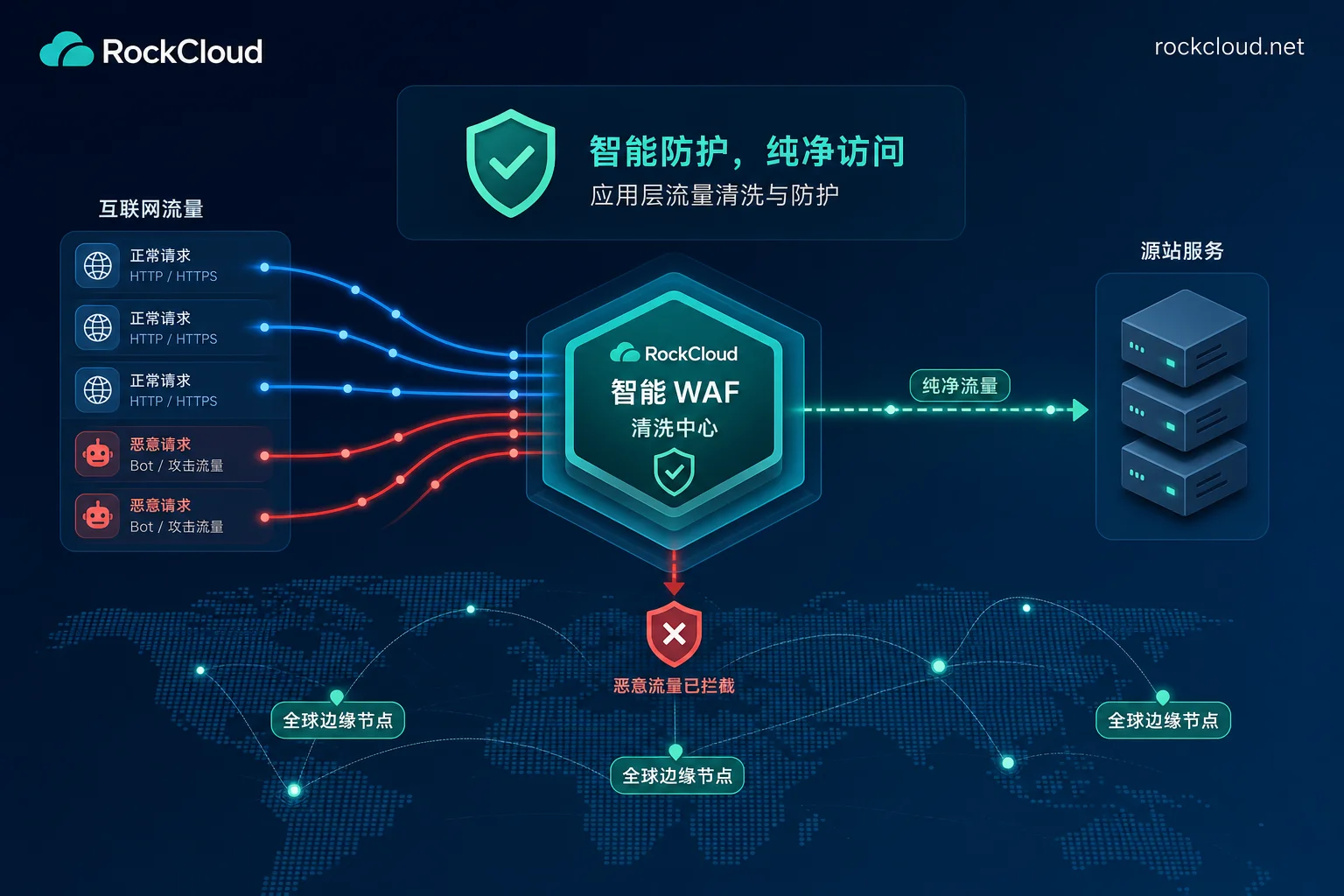
RockCloud leverages a distributed edge high-protection CDN network and intelligent WAF to route business traffic to edge protection nodes for millisecond-level identification and cleaning before it reaches the origin server. Through proprietary protocol validation and real-time behavior modeling, the platform can accurately intercept high-frequency HTTP floods and CC attacks while ensuring zero perceptible impact on real users. In low-latency sensitive business scenarios such as gaming and API interactions, combining RockCloud Game Shield and CN2 China private line acceleration provides high-strength origin server hiding and security cleaning while ensuring smooth and stable business communication.
Emergency Self-Check Checklist for Enterprise Layer 7 DDoS Defense
To address complex and ever-changing application-layer security challenges, operations and security teams can refer to the following steps for systematic self-inspection and architecture reinforcement:
- Hide the origin server and connect to a high-protection CDN: Tighten origin security group rules so that only authorized edge cleaning nodes can access the origin IP, fundamentally isolating direct attacks [3].
- Configure fine-grained API rate limiting: Establish rate limits for high-consumption endpoints such as login, search, and payment to prevent malicious endpoint flooding [3].
- Enable dynamic verification mechanisms: Automatically trigger JavaScript challenges or dynamic verification when abnormal traffic spikes are detected, quickly filtering and blocking automated script attacks.
- Optimize caching rules and origin capacity: Maximize the edge cache ratio for static resources, reduce dynamic request penetration rates, and establish reasonable elastic scaling mechanisms.
Building a Layer 7 DDoS defense system requires deep integration of edge cleaning capabilities with application logic. Regularly evaluating business traffic baselines and optimizing WAF interception rules are key choices to ensure business continuity.




Comments(0)