 RockCloud-基石云安全-官方博客
Yes, but with two prerequisites. First, the high-defense CDN must actually perform Layer 7 (HTTP/HTTPS) scrubbing at edge nodes, such as rate limiting, human verification, and WAF rules. Second, your origin must only be accessible through it. Without the first, the CDN is just helping attackers deliver requests to the origin faster; without the second, attackers bypass the CDN and hit the origin IP directly, and no matter how well the rules are configured on the CDN, it won't see that traffic.
If you're still unsure whether you're facing a CC attack or a volumetric DDoS, you can first read How to tell if your website is under DDoS or CC attack. Below, we'll discuss in order: what it relies on to block, when it fails, and how to check after setup.
CC protection relies on Layer 7 capabilities, not defense bandwidth
CC attacks send HTTP requests that look normal. A single request is not large, but the volume overwhelms the origin's CPU, database, or connection count. So what matters is not how many Gbps it can absorb, but whether it can distinguish at the edge which requests to allow and which to block.
The advertised defense bandwidth mainly corresponds to Layer 3/4 volumetric attacks. When choosing a provider, if they only talk about bandwidth and can't clearly explain how far Layer 7 rules can be configured, you should question their CC protection. Ordinary pure acceleration CDNs usually lack this scrubbing layer and at best can block some static requests via caching.
Four methods high-defense CDN uses to block CC attacks
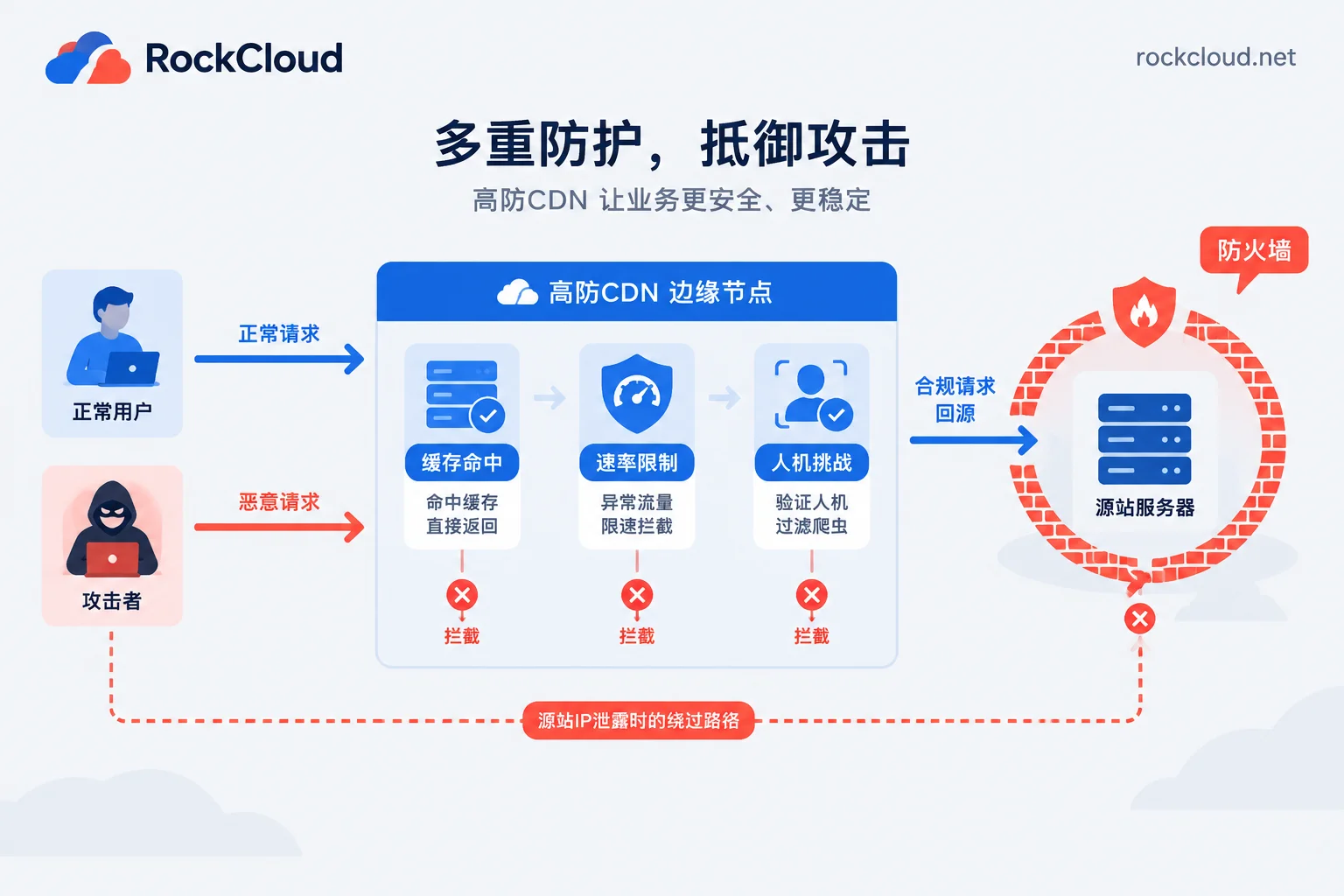
- Reverse proxy hides the origin: Domain resolution points to CDN nodes, and the outside world sees node IPs. This is the prerequisite for the following methods to work.
- Edge cache absorption: Images, JS, CSS, and static pages hit cache on nodes, so no matter how many requests come, they don't go back to the origin. For CC attacks targeting static resources, most are absorbed at this step.
- Rate limiting: Limit the number of requests to a URI within a period based on single IP, single Cookie, or other identifiers. When the threshold is exceeded, block or redirect to a challenge. Alibaba Cloud and Huawei Cloud CC protection rules are also configured around path, statistical dimension, threshold, and action.
- Human verification: JS challenges, Cookie validation, slider CAPTCHAs, etc. Browsers can complete them automatically or users can complete them, and most automated scripts fail.
When it still gets breached
Origin IP already exposed
This is the most common and fatal one. Attackers send HTTP requests directly to the origin IP, completely bypassing the CDN. There are many ways an IP can leak: historical DNS records before CDN integration, email headers, subdomains resolving directly to the origin, hardcoded origin addresses in pages or APIs, etc.
Handling methods:
- In the origin firewall or cloud security group, allow only the high-defense CDN's back-to-origin IP ranges on ports 80/443, and deny all other sources.
- Security groups can only block requests from entering the server; attack traffic will still hit the line where this IP resides. If the origin IP was exposed before, e.g., it was used before CDN integration or has already been attacked, it's recommended to switch to a new IP before integrating.
- Check if there are subdomains, mail services, or other businesses pointing to the same server.
Attacks hit dynamic interfaces that cannot be cached
Login, search, order placement, payment, and various query APIs must go back to the origin for every request. Attackers add random parameters to invalidate the cache and use proxy IP pools to spread request rates across single IPs. These requests will pass through the CDN and directly pressure the origin's database or CPU.
Countermeasures:
- Set separate rate limits for these paths, with thresholds based on normal users' real usage frequency, usually much lower than the site-wide threshold.
- If proxy IP pools make single-IP rate limiting ineffective, you can switch to using Cookie, session, or request characteristics (UA, Referer, parameter format, etc.) as statistical dimensions, or enable stricter human verification for these paths.
- Validate parameter formats and block obviously invalid random parameters directly at the edge.
If an API is being abused in bulk, such as large model interfaces being stolen, you can refer to the layered threshold approach in How to rate-limit stolen large model API interfaces.
Challenge method mismatches client type
JS challenges and slider verification depend on browsers. App APIs, server-to-server calls, and payment callbacks cannot complete such challenges, and enabling them indiscriminately will mistakenly block legitimate business. These paths should instead use rate limiting, signature verification, or source IP whitelisting. For handling mistakenly blocked payment callbacks, see How to whitelist payment callbacks blocked by WAF.
The business itself is not HTTP
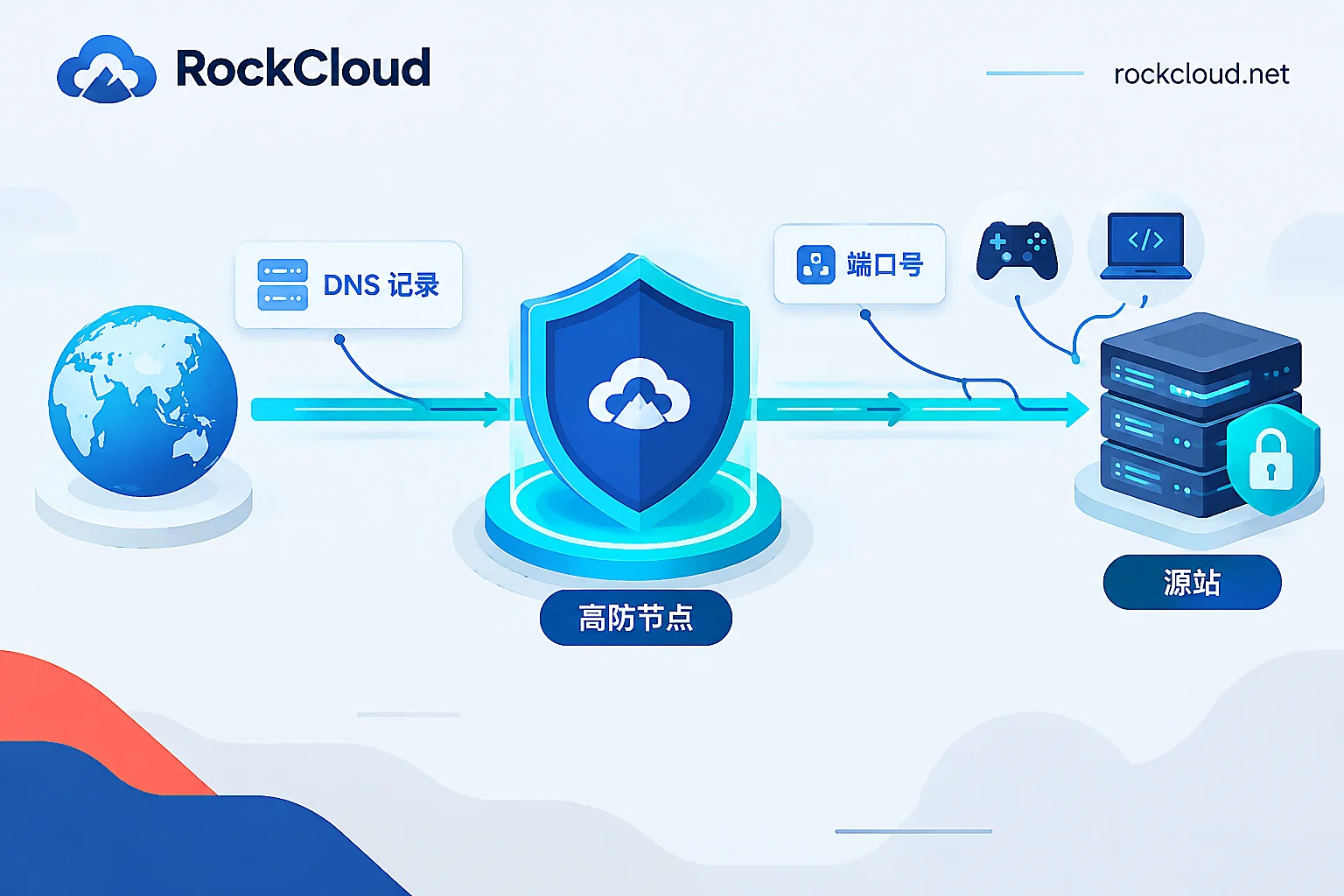
All the above rules operate at the HTTP/HTTPS layer. For WebSocket long connections, App proprietary protocols, and game TCP/UDP connections, high-defense CDN has limited capability, and support varies greatly between products. You need to confirm separately or consider Layer 4 proxies, game shields, etc. For details, see Can high-defense CDN be used for non-website businesses.
Post-setup self-check sequence
- Origin: Security group only allows back-to-origin IP ranges; confirm no subdomains or other services still connect directly to the origin; replace IP if it has been exposed.
- Cache: All static resources go through cache to avoid back-to-origin.
- Rules: List dynamic paths such as login, search, order placement, payment, and core APIs, and set rate limit thresholds and actions for each.
- Challenges: Web paths can use JS challenges or CAPTCHAs; API, App, and callback paths should use rate limiting, signature verification, and whitelisting.
- Observe and tighten: If the product supports monitor-only mode, use it or a looser threshold for a period, then examine real request distribution from logs and gradually tighten thresholds. For how to view logs, see How to view traffic and network logs in CDN console.
Key questions to ask when choosing a provider
- What dimensions can Layer 7 rules rate limit on (IP, Cookie, Header, URI, parameters), and can they be set individually per path?
- What challenge methods are supported, and can they be enabled/disabled per path?
- Are the back-to-origin IP ranges public and stable, making it easy to configure origin whitelisting?
- Is CC protection charged separately, and how is billing handled after exceeding the plan?
- Can you view logs of blocked requests to adjust rules and troubleshoot false positives?
RockCloud's high-defense CDN puts acceleration and DDoS/CC defense on the same link, provides WAF rules and a log panel, and defense does not require additional purchase. Actual protection effectiveness depends on business type and rule configuration. It's recommended to first run a free test with your real domain, configure rules according to the above checklist, and then check the results: WAF and CC protection rules, Plans and free testing.
If your website is under attack and you don't have time for a full assessment, first follow Website under large-scale attack: quick CDN integration sequence and origin lockdown key points to complete integration and origin lockdown.



Comments(0)