RockCloud-基石云安全-官方博客
For cross-border e-commerce, gaming, live streaming, payment, and AI API services whose servers are deployed overseas but whose core users are in mainland China, "the network flies like a plane during the day, then turns into a tractor during the evening peak (20:00–23:00)" is the most persistent headache for operations teams. Pages spin, APIs time out frequently, and audio/video stutters like a slideshow—directly driving user churn and a surge in customer complaints.
To solve congestion and packet loss on cross-border links, CN2 acceleration has become an industry-recognized preferred solution. However, products marketed under the banner of "CN2 optimization" are a mixed bag. Many business teams pay a premium to upgrade their routes, only to find that in real production environments they still face stuttering in some regions—or even total outages the moment an attack hits.
If you've already read why buying a single CN2 server is far from enough, then when actually implementing CN2 acceleration and validating your selection, you need to look more closely at three hidden traps in the underlying routing—and build a truly stable cross-border transport foundation at the edge architecture level.
1. Why Does It Still Lag During Evening Peak After "CN2 Acceleration"? Unpacking Three Common Hidden Pitfalls
When troubleshooting slow cross-border access, operations staff often find that even though the provider promised a CN2 route, the actual experience is still far from ideal. The problem usually lies in the following three dimensions:
1. Conceptual Confusion: You Bought "Half-Way Acceleration" or "One-Way Optimization"
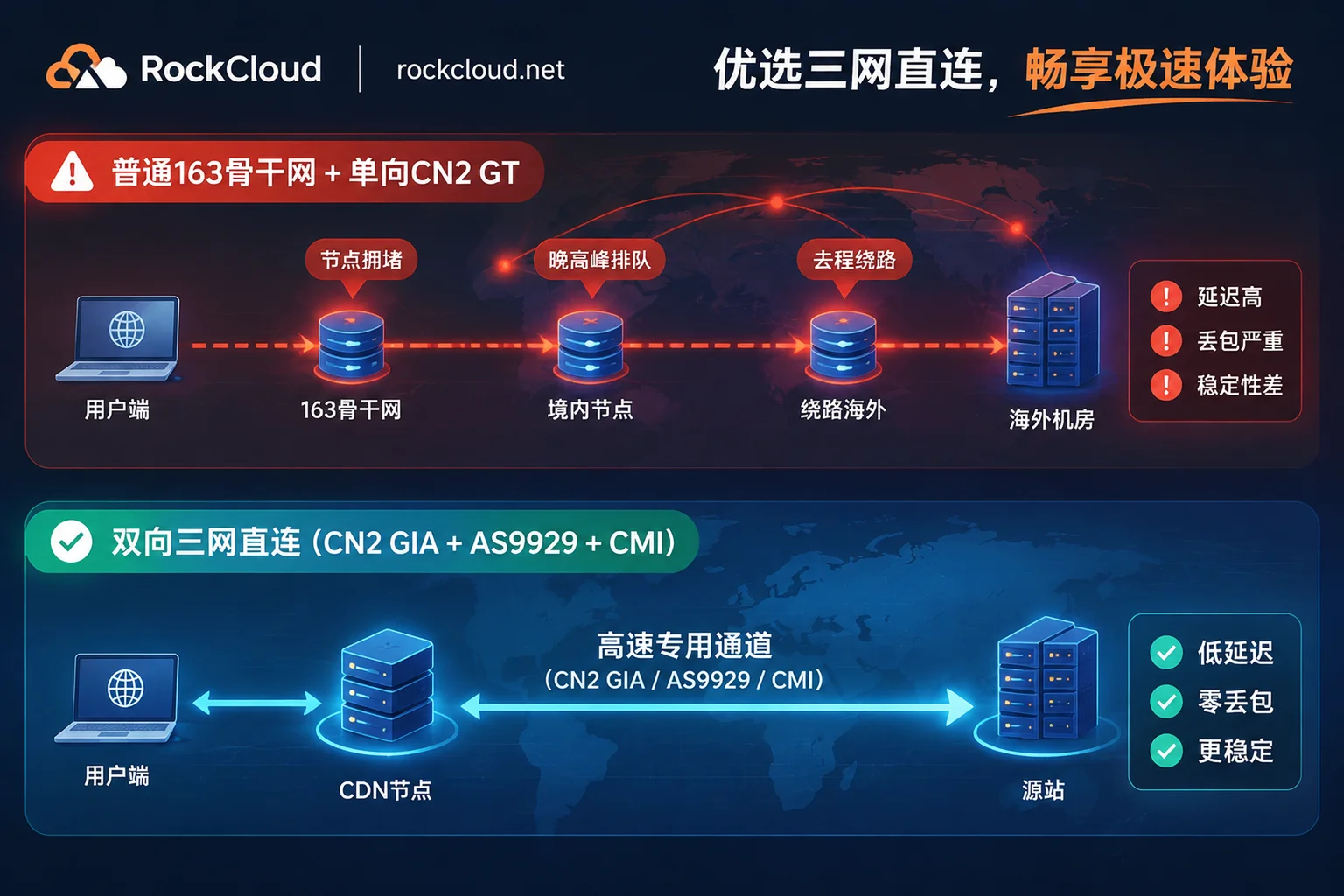
China Telecom's Next Generation Carrier Network (CN2) has clear tier differences, and the most common trick is packaging entry-level CN2 GT as top-tier CN2 GIA:
- CN2 GT (Global Transit): Only the international exit segment uses CN2 nodes, while the domestic provincial backbone still shares the traditional 163 backbone (
202.97.*.*nodes) with ordinary consumer broadband. Once the backbone congests during evening peak, high packet loss still occurs. - One-way return-path optimization: Some low-cost solutions only optimize the return path from "overseas server → mainland user," while the outbound path from "mainland user → overseas server" still detours over the public internet. For dynamic APIs, payment callbacks, or real-time competitive games that require frequent bidirectional interaction, outbound packet loss can equally cripple overall response speed.
- True CN2 GIA (Global Internet Access): In provinces and cities with nodes, traffic travels end-to-end over a dedicated
59.43.*.*high-priority high-speed channel, and neither the domestic nor international segments share bandwidth with ordinary public internet traffic. This is the core safeguard against evening peak congestion.
2. "Lopsided" Optimization: Smooth for Telecom, Detouring for Unicom and Mobile
End users in mainland China are distributed across the three major carriers: China Telecom, China Unicom, and China Mobile. If an acceleration solution only connects to CN2 GIA for Telecom and ignores the routing strategies of the other two carriers, it creates severe experience fragmentation: Unicom users may be forced onto the congested ordinary consumer network (AS4837), while Mobile users may hit strict QoS throttling at the international exit.
To achieve uniform high-speed access for users across all networks, you must build a true three-network direct-connect system—integrating China Telecom CN2 GIA, China Unicom AS9929 (premium A-network), and China Mobile CMI (international interconnect dedicated line) so that requests from each of the three carriers travel their own dedicated VIP channels.
3. The "Fragile Dedicated Line": Forced to Downgrade and Detour to the US When DDoS/CC Attacks Hit
This is the fatal blind spot most easily hit by high-value businesses. Because true CN2 GIA dedicated line bandwidth is extremely costly, traditional data centers or single nodes simply cannot maintain massive DDoS mitigation redundancy bandwidth on premium dedicated lines.
Once a business suffers a burst DDoS flood or high-frequency CC attacks, ordinary providers—to protect themselves—typically trigger null-routing IP blocks directly or reroute traffic to cheap scrubbing centers in Europe or the US. This means: at the very moment of attack defense when stability matters most, your CN2 acceleration fails. Latency instantly spikes from tens of milliseconds to two or three hundred milliseconds, and business is effectively interrupted during scrubbing.
2. The Breakthrough Approach: Shift from "Migrating Servers" to "Edge CN2 Acceleration + Integrated High-Defense"
Many business leads, when facing cross-border lag, instinctively go buy expensive overseas premium-network servers, then spend enormous effort migrating databases and rebuilding runtime environments. But in reality, you don't need to replace your existing origin server at all.
Whether your origin is currently hosted on public clouds like AWS, GCP, or Alibaba Cloud International, or deployed in an ordinary overseas standalone data center, you only need to put a layer of CN2 China acceleration-capable high-defense CDN edge network in front of it to complete the link upgrade without changing your origin architecture.
1. Nearby Access via Circum-China Nodes, Three-Network Direct Connect with No ICP Filing Required
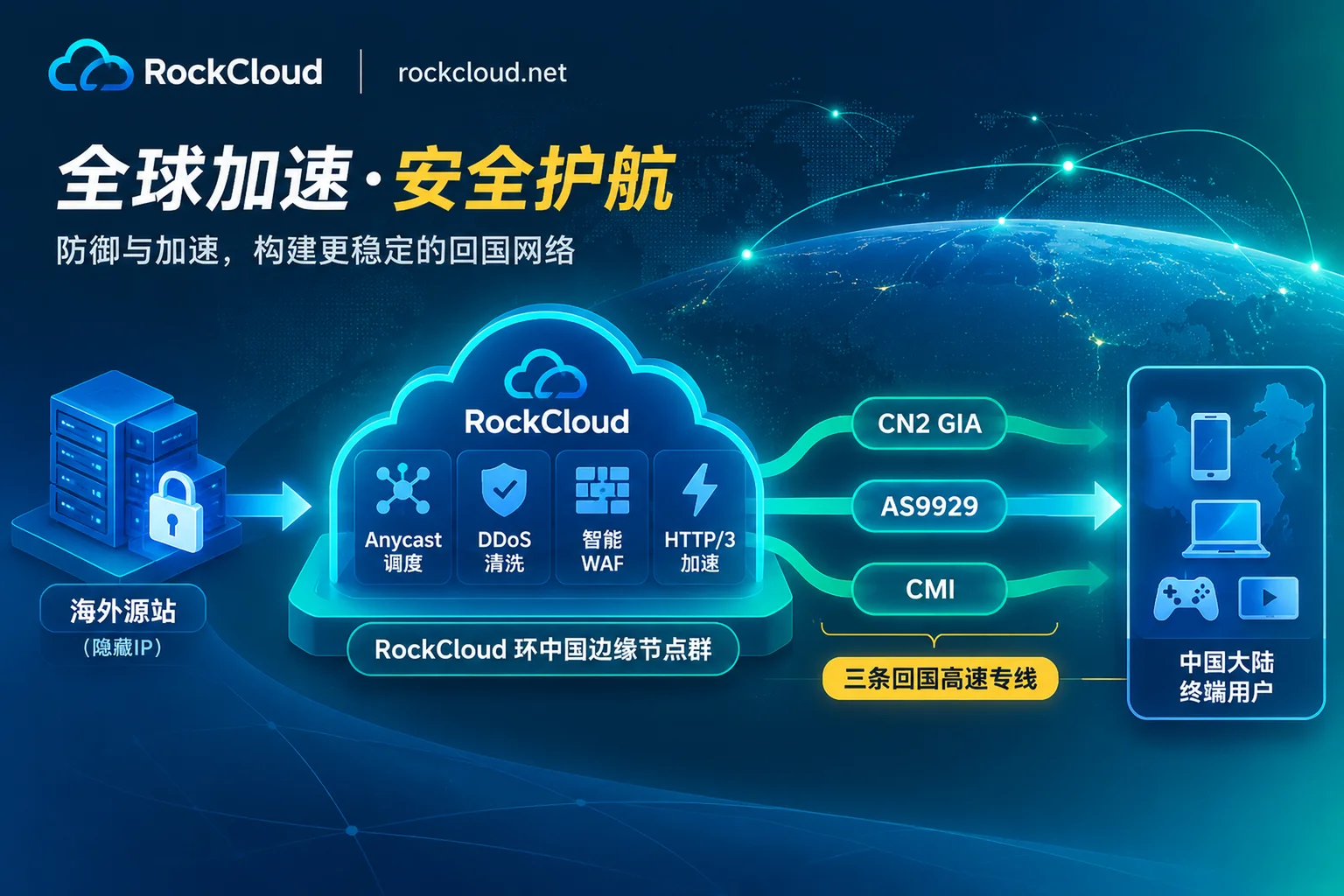
RockCloud (Jishiyun) has deployed high-spec edge access clusters in core circum-China hubs including Hong Kong, Japan, South Korea, and Singapore, adopting a China Telecom CN2 GIA + China Unicom AS9929 + China Mobile CMI three-network direct-connect back-to-China architecture.
- Automatic routing by latency: Through Anycast nearby-access technology, requests from users in every mainland province and city automatically match the lowest-latency edge node and are returned at high speed to mainland China via the private backbone and CN2 dedicated lines.
- Go live immediately with no ICP filing: For projects going overseas, operating overseas for compliance, or needing rapid launch, relying on circum-China overseas edge nodes directly delivers high-speed access toward the mainland without going through the cumbersome and lengthy ICP filing process (for more selection details on ICP-free architectures, see Why domestic access to ICP-free CDNs is often slow and how to solve it).
2. Acceleration and High-Defense on the Same Path: No Downgrade Under Attack, Origin Never Exposed
Unlike traditional solutions that sell "acceleration" and "security" separately, RockCloud deeply integrates global CDN acceleration with high-defense CDN and DDoS/CC protection on the same request path:
- Distributed scrubbing hides the origin: Once connected, your origin's real IP is immediately hidden, and all traffic from the public internet is first handled by distributed edge nodes. Even under large-scale DDoS floods or malicious CC consumption targeting dynamic APIs, traffic is scrubbed and filtered at the edge and will not penetrate the back-to-origin dedicated line.
- Built-in intelligent WAF protection: The control panel supports one-click activation of an intelligent Web Application Firewall (WAF), which, based on the OWASP core rule set and machine learning engines, blocks SQL injection, XSS, malicious scanners, and disguised crawlers in real time along the acceleration path. Security engineers also help configure custom allow rules to ensure security checks don't slow down normal business responses.
3. Squeezing Out More Performance: When CN2 Dedicated Lines Meet Modern Protocol Stacks and Full-Scenario Enablement
Once the physical link is in place, application-layer transport efficiency also determines end-user perceived speed. On top of the underlying three-network direct connect, RockCloud uses multiple protocol and feature optimizations to further amplify the benefits of CN2 acceleration:
- HTTP/3 (QUIC) and TLS 1.3 0-RTT: Even over a dedicated line, cross-border transmission inevitably carries inherent round-trip latency (RTT) due to physical distance. RockCloud fully supports HTTP/3 and TLS 1.3 0-RTT handshakes, greatly reducing connection establishment and encryption negotiation time, and completely eliminating TCP head-of-line blocking during weak-network handovers on mobile (such as Wi-Fi to 5G). Combined with efficient Brotli compression, web pages and API responses feel silky smooth.
- Intelligent back-to-origin retry and backup origin rules: Supports highly customizable caching policies, back-to-origin retry mechanisms, and automatic primary/backup origin failover. When a single origin experiences a momentary glitch, edge nodes can transparently retry or switch to a backup origin, ensuring high availability (for transmission optimization in complex submarine cable environments, you can also read the global acceleration network architecture guide).
Specialized adaptation for multiple business types:
- TCP/UDP full-protocol game acceleration and protection: For mobile and PC games using non-HTTP protocols, private protocol encapsulation can be performed via Game Shield and forwarded through distributed edge nodes; when a node is attacked, it switches to a high-defense node within seconds, ensuring players stay connected and battles don't lag.
- HD low-latency audio/video distribution: For cross-border live streaming and VOD platforms, combined with Video CDN, it supports multi-protocol push/pull streaming such as RTMP/RTSP/HLS, and provides security tokens, IP/region blacklists and whitelists, and Multi-DRM content protection—completely eliminating the pain of frequent buffering when watching videos across borders.
- In-place recovery from blocking and DNS pollution: If your business domain suffers local carrier DNS pollution in the mainland or is blocked on WeChat or QQ, you can seamlessly add the blocking and DNS pollution recovery service, which restores normal access through pollution scrubbing and transparent 301 redirects without changing your old domain.
4. Operations Implementation and Cost Accounting: How to Smoothly Adopt CN2 Acceleration?
During actual procurement and technical cutover, operations and procurement leads care most about access risk and bill predictability.
1. Add Just One CNAME, Zero-Downtime Smooth Cutover
Adopting RockCloud's CN2 acceleration and high-defense network requires no changes to your domain's NS (nameserver) records at all. You can keep DNS resolution with your existing provider and complete onboarding simply by adding one CNAME record in the backend. During the switch, old and new links run in parallel, completely avoiding the risk of slow global DNS propagation or brief service interruptions caused by changing NS records.
(Note: If your business is under attack and needs emergency onboarding, it is recommended to change the origin IP at the same time as switching to the CNAME, and configure the origin firewall to only allow back-to-origin node IPs, so as to completely cut off attackers' direct attack paths that bypass the CDN.)
2. Fixed Peak Bandwidth Monthly Billing: No More "Sky-High Traffic Bills"
Many pay-as-you-go acceleration services generate jaw-dropping excess traffic charges when sudden traffic spikes or malicious traffic floods occur. RockCloud adopts transparent fixed peak bandwidth monthly billing, with unlimited monthly total traffic and unlimited request counts.
- The base plan already integrates acceleration and defense, including DDoS/CC protection, intelligent WAF, and fully automated SSL certificates for free—no need to pay twice for security components.
- CN2 mainland acceleration dedicated lines and anti-hijacking features can be flexibly added and billed according to your business coverage needs, with convenient payment in USDT or USD.
- If your origin is deployed on platforms like AWS, GCP, or Alibaba Cloud International, you can also directly pair it with RockCloud's international cloud top-up service, with no corporate verification or cumbersome real-name procedures—one-stop handling of both underlying cloud host bills and edge network acceleration.
Conclusion: Test First, Then Decide
To judge whether a CN2 acceleration solution lives up to its name, don't just look at the buzzwords on the marketing page. Look at its real latency performance for Telecom, Unicom, and Mobile users during evening peak hours, and its resilience under abnormal traffic floods.
If your website, app, API endpoints, games, or live streaming business is struggling with mainland-bound access latency, evening peak packet loss, or frequent network attacks, there's no need to go through the trouble of migrating servers. Visit Industry Solutions to learn about the architecture details, or contact our technical team directly via Contact Us and official Telegram (@rockclouds) to discuss your business specifications, apply for a free trial, and verify the acceleration results with real evening peak routing performance.