RockCloud-基石云安全-官方博客
Today, as overseas e-commerce, AI service APIs, cross-border payments, real-time audio and video, and globally served games become mainstream businesses, R&D and operations teams often encounter a thorny paradox: even though the domain has already been put behind a CDN, why do overseas or cross-region users still frequently encounter spinning, timeouts, or even connection resets when they click login, initiate payments, or call AI streaming APIs?
According to global internet outage reports tracked by the International Cable Protection Committee (ICPC) and Cloudflare Radar, submarine cables worldwide experience an average of 150 to 200 failure events each year; from damage to the Asia-Europe backbone cables in the Red Sea direction to maintenance on multiple cables in the Asia-Pacific and West Africa directions, partial interruptions of the underlying physical links have become the norm. Whenever a backbone submarine cable fails, cross-border traffic that relies on traditional public BGP "best-effort" routing is forced to detour onto congested paths, causing severe latency jitter and packet loss.
At the same time, the traffic structure of businesses is also undergoing a qualitative change. Early cross-border access was dominated by static resources such as web pages, images, and text; as long as edge nodes hit the cache, the disadvantages of the origin link could be masked. Today's business interactions, however, rely heavily on dynamic requests that cannot be cached for long periods (such as REST/GraphQL APIs, AI token streaming output, Web3 state synchronization, and payment callbacks). Once edge nodes need to frequently go back to the origin, the shortcomings of the traditional "static cache CDN + ordinary public network back-to-origin" model are fully exposed.
If your business is planning to achieve lightning-fast cross-border access under the new trends of global acceleration networks, you need to move beyond the old approach of simply stacking static caches and restructure the uncontrollable long-haul public network journey into an end-to-end deterministic transport architecture of "proximity access + intelligent backbone routing + high-defense on the same path."
1. Why Can Traditional "Public Network Direct Connection + Ordinary Static CDN" Not Support Modern Global Businesses?
When a end user far away overseas or in mainland China initiates a complete business interaction, data packets need to traverse three stages: "terminal to edge (First Mile)," "cross-region backbone network (Middle Mile)," and "edge to origin (Last Mile)." Traditional architectures typically experience performance collapse in the following three links:
1. Access Segment: Cross-Border Handshake Round Trips (RTT) and "Head-of-Line Blocking" on Weak Networks
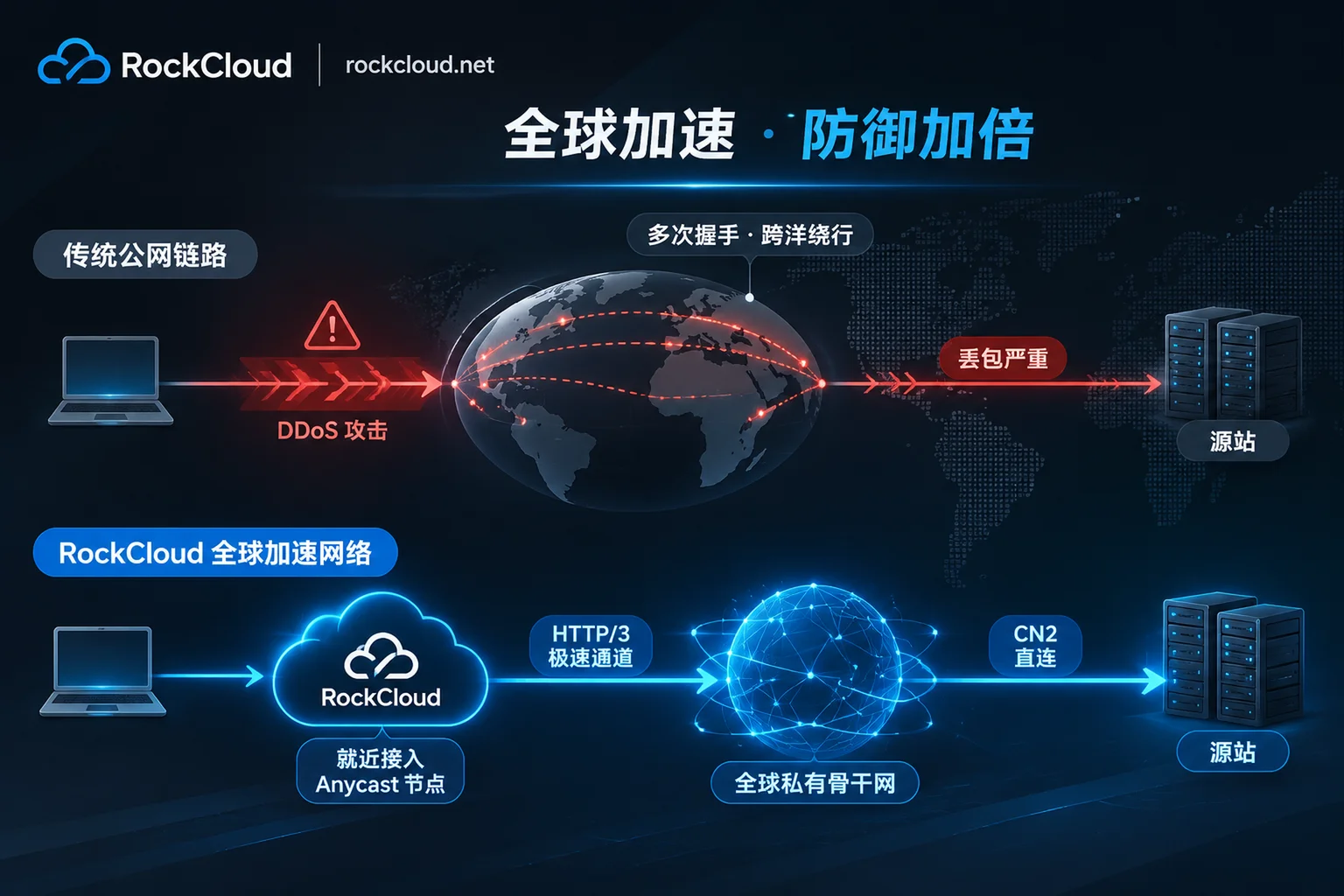
Without a global edge access layer, the client directly establishes a TCP connection with the remote origin and completes the TLS encrypted handshake. The connection establishment process alone consumes several transoceanic round-trip cycles (RTT). More critically, in mobile cellular networks or cross-border weak-network environments, the traditional TCP protocol has a "Head-of-Line Blocking" defect—as long as one packet is lost on the link, all concurrent requests on the entire connection must stop and wait for retransmission, causing noticeable lag in frontend pages and app APIs.
2. Transport and Back-to-Origin Segment: Public BGP Detours and Cross-Border Peak-Hour Congestion
Ordinary BGP routing protocols were originally designed to find paths with the "fewest autonomous system hops" or the "lowest settlement cost," not the paths with the "lowest real-time latency and least packet loss." When submarine cables are under maintenance or international egress enters peak-hour congestion, ordinary public network back-to-origin links are highly prone to packet loss, and single-point retransmission at the origin alone cannot recover the experience.
3. Security Segment: "Secondary Detours" Caused by the Separation of Acceleration and Defense
Many enterprises use ordinary acceleration nodes in daily operations. Once they encounter DDoS or CC attacks, they temporarily divert traffic to third-party off-site cleaning centers. This fragmented architecture of "acceleration in peacetime, cleaning in wartime" not only easily interrupts business during switching but also forces legitimate traffic to make a long detour between cross-continental cleaning centers and the origin, resulting in transactions that cannot be completed normally due to excessive latency even though the business is not completely paralyzed.
2. Rebuilding the Global Acceleration Network: Deconstructing the Three-Layer Deterministic Transport Architecture
To give users around the world a consistent instant-open experience, a mature global CDN acceleration network must go deep simultaneously in three dimensions: protocol stack, backbone routing, and origin disaster recovery.
Layer 1: Edge Proximity Access and Next-Generation Protocol Stack Acceleration
Shortening physical distance is the first step to reducing latency. Through the BGP Anycast proximity access mechanism, a global acceleration network broadcasts the same IP at edge nodes around the world. End-user access requests do not need to cross half the globe; they can automatically land at the nearest edge node at the network layer, turning long public network handshakes into local ultra-short-distance connections.
At the edge access layer, RockCloud natively integrates multiple protocol optimization capabilities for cross-border and weak-network environments:
- HTTP/3 (QUIC-based) support: The underlying transport is based on UDP, completely eliminating the TCP head-of-line blocking problem and keeping multiple data streams flowing smoothly even under cross-border high packet loss and mobile network switching scenarios;
- TLS 1.3 and 0-RTT handshake: Greatly compresses the number of round trips required for encrypted connection establishment, achieving near-zero-wait connection establishment for frequently called APIs and returning users;
- Brotli efficient compression: Further reduces the response size of static resources and text APIs compared with traditional compression algorithms, lowering cross-border bandwidth usage.
Layer 2: Automatic Latency-Based Routing and CN2 Three-Network Direct Connection Back to China
After requests enter the edge node, for dynamic API or real-time interactive requests that miss the cache, the core test lies in the scheduling capability of the backbone transport network. RockCloud global CDN acceleration uses an automatic latency-based routing mechanism, detecting link status in real time and automatically avoiding public network nodes where submarine cable failures or congestion occur.
For bidirectional cross-border scenarios (especially overseas origin servers serving mainland Chinese users, or Asia-Pacific regional interconnection), a recognized network pain point, ordinary international lines alone can hardly survive peak hours. We previously analyzed in detail in "How to Accelerate with CN2 Lines" that high-standard cross-border links need to combine private backbone networks with dedicated lines. RockCloud's CN2 China acceleration solution directly integrates China Telecom CN2 GIA, China Unicom AS9929, and China Mobile CMI three-network direct return lines to China, with proximity access from core nodes around China such as Hong Kong, Japan, South Korea, and Singapore. It not only bypasses congested ordinary international public network egress but also supports ICP filing-free rapid launch, balancing compliance agility with mainland three-network access speed.
Layer 3: Intelligent Caching Strategy and Highly Available Origin Disaster Recovery
At the boundary between edge and origin, refined back-to-origin governance can directly reduce ineffective cross-border transmission by more than 50%:
- Custom cache rules: In addition to conventional static files, micro-cache or hierarchical cache strategies can be flexibly formulated according to business characteristics to reduce origin concurrency pressure;
- Back-to-origin retry and backup origin rules: When the data center or cloud availability zone where the primary origin resides experiences network jitter or response timeouts, edge nodes can automatically trigger back-to-origin retries or seamlessly switch to a preset backup origin, ensuring frontend users are unaware.
| Comparison Dimension | Traditional Public Network Direct Connection + Basic Static CDN | RockCloud Global Acceleration and Security Converged Network |
|---|---|---|
| Terminal Access Method | Traditional unicast DNS resolution, susceptible to inaccurate cross-region resolution | Anycast proximity access, automatic routing by real-time latency |
| Transport Layer Protocol Stack | Mainly HTTP/1.1 or HTTP/2, prone to head-of-line blocking on weak networks | Supports HTTP/3, TLS 1.3 0-RTT, Brotli compression |
| Mainland China Direction Link | Ordinary public network international egress, obvious packet loss and jitter during peak hours | China Telecom CN2 GIA / China Unicom AS9929 / China Mobile CMI three-network direct connection, filing-free |
| Back-to-Origin High Availability Mechanism | Single origin direct connection; origin fluctuations immediately cause frontend errors | Supports custom caching, back-to-origin retries, and automatic primary/backup origin switching |
| Security Protection Coupling | Acceleration and high defense separated; attacks require DNS changes or secondary detours | DDoS/CC defense and intelligent WAF on the same request path, no separate purchase needed |
| Access and Billing Model | Often requires NS changes; pay-as-you-go billing can easily produce exorbitant bills from abnormal traffic | Single CNAME access without NS changes; fixed peak monthly billing, unlimited traffic and requests |
3. Embedding the "Security Line of Defense" into the Acceleration Pipeline: Why Can't Acceleration and Defense Be Purchased Separately?
For overseas and cross-border businesses, network latency and network attacks always come together. High-frequency crawling by AI bots, pulse-style DDoS floods launched by competitors, and CC attrition attacks against login and payment APIs can at any time saturate expensive cross-border bandwidth.
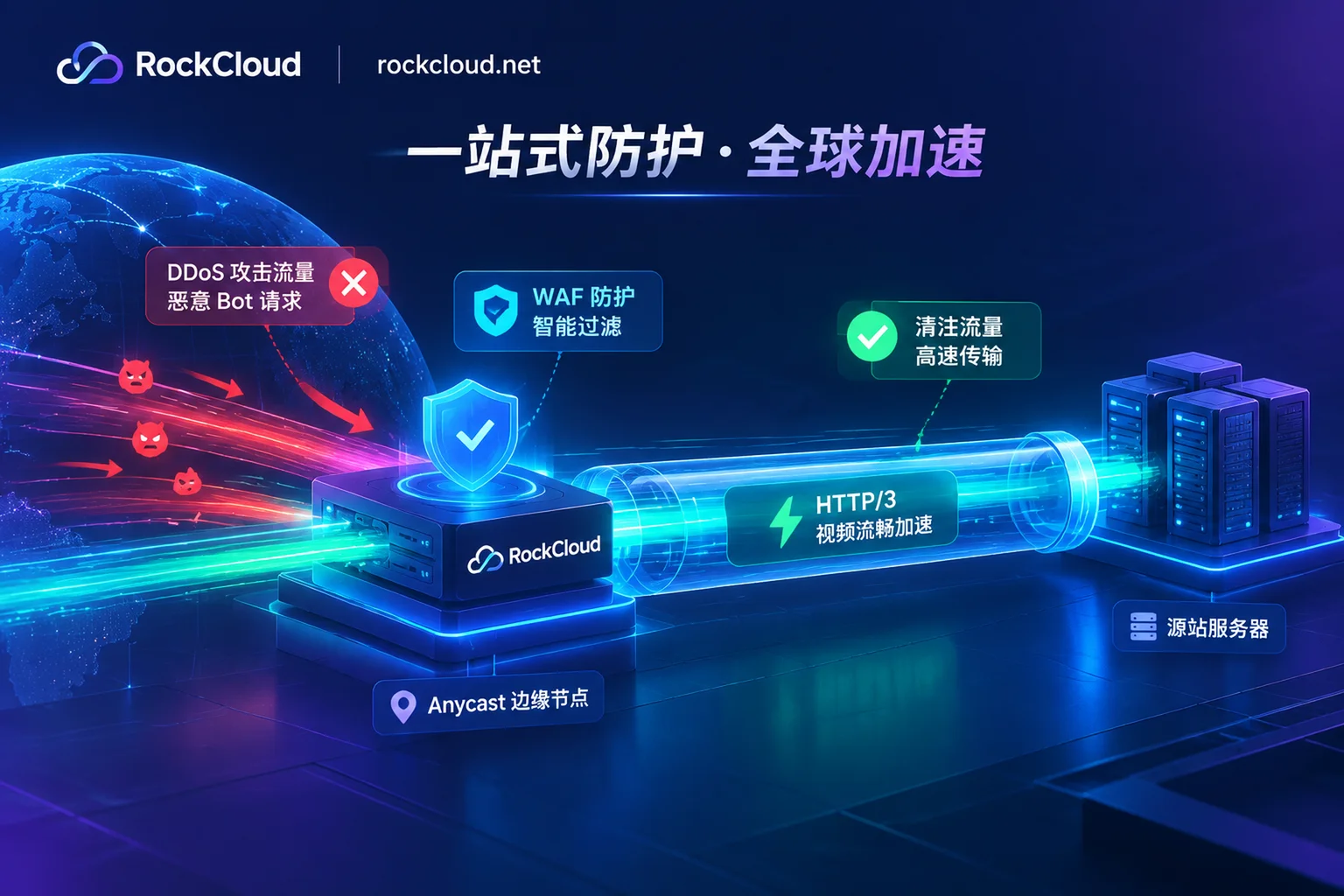
If an enterprise splits "global acceleration" and "security protection" into two independently purchased products, it will not only face a lengthy operations chain but also double billing and stacked latency. In RockCloud's architecture design, acceleration and defense naturally run on the same request path and within the same package system:
- Simultaneous edge cleaning of DDoS and CC attacks: Relying on the Anycast distributed cleaning foundation, the real origin IP is hidden immediately upon access. Whether it is large-traffic network-layer DDoS or application-layer CC attacks that consume origin computing power at high frequency, they are intercepted and filtered directly at global edge nodes. Only clean business requests are sent back to the origin via the optimized backbone network. You can learn more about our high-defense CDN and DDoS/CC defense system (to prevent the origin from being bypassed and directly accessed, we also recommend referring to the origin IP leak prevention and back-to-origin whitelist architecture to restrict the origin firewall to only allow back-to-origin nodes).
- One-click activation of intelligent WEB firewall (WAF): No additional hardware deployment or proxy chaining is required; the intelligent WAF can be enabled with one click in the control panel. The system combines the OWASP core rule set (precisely intercepting SQL injection, XSS, file inclusion, command injection, malicious scripts, and scanners/bots) with machine learning models to automatically identify unknown variant requests not included in the rule base. For complex business APIs, the security technical team also assists in configuring custom rules and exception allowlists to avoid false positives against normal overseas clients.
- Fixed peak billing, completely eliminating "exorbitant traffic bills": Traditional cloud vendors' global acceleration often bills based on outbound traffic (GB) plus request count. Once malicious abuse or CC attacks occur, monthly bills can easily increase dozens of times. RockCloud uses fixed peak monthly billing with unlimited traffic and unlimited requests, and the package already includes DDoS/CC defense, WAF, and free fully automatic SSL, making financial budgets fully controllable (see package billing details).
4. Match by Business Scenario: How Should Different Overseas Architectures Choose?
Different industry applications differ greatly in transport protocols and terminal forms. An excellent global network foundation should provide modular scenario adaptation capabilities (you can refer to each industry solution as needed):
Scenario 1: AI Services, Cross-Border WEB APIs, Independent Sites, and Payment APIs
- Core pain points: High proportion of dynamic requests, sensitivity to TLS handshake latency, and highly prone to attacks by automated scripts and API crawlers.
- Architecture solution: Use global CDN acceleration + intelligent WAF (if there is a mainland user base, add CN2 China acceleration). Enable HTTP/3 and TLS 1.3 0-RTT to reduce API time to first byte (TTFB), use security tokens and signed URLs, IP and region blacklists/whitelists to protect core APIs, and combine back-to-origin retry rules to ensure zero loss of payment callbacks.
Scenario 2: Cross-Border Interactive Live Streaming, Short Video, and VOD Platforms
- Core pain points: Cross-continental push/pull streams are prone to lag and interruption, high-definition video consumes huge bandwidth, and paid content faces risks of hotlinking and illegal recording.
- Architecture solution: Access the dedicated video CDN. Fully supports RTMP/RTSP/HLS/MPEG-DASH/MPEG-TS ingest and MP4/HLS/MPEG-DASH/CMAF playback; VOD files can be stored directly in CDN storage to serve as the origin, saving cross-cloud back-to-origin overhead; at the same time, enable security tokens, IP and region blocking, and Multi-DRM content protection, and optionally customize transcoding, DVR, and HTML5 players with audience analytics.
Scenario 3: Globally Served Mobile Games, Real-Time Battles, and TCP/UDP Non-HTTP Applications
- Core pain points: Games use custom TCP/UDP protocols that ordinary web CDNs cannot forward; zero tolerance for disconnections and reconnections—once an access node suffers a DDoS attack, it can easily cause all players on the server to disconnect.
- Architecture solution: Adopt the game shield architecture. Encapsulate the game's non-HTTP protocols in a private protocol, complete TCP/UDP full-protocol forwarding through globally distributed edge nodes, and completely hide the origin; when an edge node is attacked, the system automatically switches to a high-defense node while keeping existing connections uninterrupted.
Scenario 4: Encountering DNS Pollution in Local Regions or Domain Blocking on Social Platforms
- Core pain points: The business itself runs normally, but resolution errors (DNS pollution) occur in carrier networks in specific regions, or shared links are intercepted and banned on platforms such as WeChat and QQ. Frequent domain changes lead to massive loss of existing users.
- Architecture solution: On top of the acceleration architecture, add the pollution blocking recovery service. Through server-side DNS pollution cleaning, WeChat/QQ and regional carrier blocking recovery technology, and seamless 301 redirects, normal access can be quickly restored without changing the original primary domain.
Multi-Cloud Origin Collaboration Tip: If your business origin is deployed on AWS, Azure, GCP, Alibaba Cloud International, Huawei Cloud International, or Tencent Cloud International, RockCloud also provides international cloud account opening and USDT top-up services free of enterprise verification and cumbersome real-name procedures. They can be seamlessly combined with frontend high-defense CDN and game shield, completing a one-stop closed loop of "underlying cloud host origin + global edge acceleration and security protection."
5. Smooth Migration in Practice: How to Access the Global Acceleration Network Without Changing NS or Causing Downtime?
Many operations managers, when doing filing-free CDN migration and secondary selection, are most worried about the global propagation blind spots lasting hours or even tens of hours caused by changing the domain's NS (Name Server) authoritative resolution servers, as well as business interruptions caused by missing subdomain resolution records during migration.
RockCloud minimizes access friction at the engineering implementation level (you can also view detailed comparisons with Alibaba Cloud, Cloudflare, AWS, and traditional high-defense servers on the selection comparison page):
- Single CNAME access, DNS stays in place: No need to modify the domain's NS records; your DNS resolution remains with your original domain service provider. You only need to add a CNAME record for the business subdomain that needs acceleration and protection, pointing to the assigned edge address.
- Old and new links in parallel, smooth traffic switching: During the switch, the old and new links can work in parallel, supporting subdomain-by-subdomain or phased verification of business connectivity and cache hit status, achieving zero-downtime seamless cutover.
- Visualized operations and real-time alerts: After access, the technical team can intuitively view real-time traffic and bandwidth reports and fine-grained network logs through the control panel, support batch operations on multiple domains, API automation integration, and team member permission collaboration, and can bind Telegram real-time data push to stay informed of global access status and security interception reports at any time (see platform general features).
Conclusion: Verify Your Global Business Acceleration Results Now
In today's increasingly complex global network environment, where dynamic real-time interaction has become mainstream, building a global acceleration network with both low latency and high-defense resilience is no longer a nice-to-have optimization but a lifeline that determines cross-border user retention and business continuity.
If you want to test cross-region latency and protection results for your existing website, API, mobile app, or game, please visit the pricing and plans page to contact online customer service to confirm business specifications and apply for a free test. If your business is currently under large-traffic attacks and urgently needs to replace the origin IP and access protection, please immediately use Contact Us ("Security Response" channel) or directly contact the official Telegram (@rockclouds); security engineers will help you respond in seconds and stop the bleeding quickly.