RockCloud-基石云安全-官方博客
The Q3 2026 Global DDoS Threat Report shows that network-layer attacks are exhibiting an extremely dense "short and swift" trend—automated network-layer attack interceptions reached 18.2 million in a single quarter, averaging one every 0.44 seconds; 96% of these attacks lasted less than 10 minutes, but the concurrency frequency was enough to instantly overwhelm unprotected origin servers.
Faced with this normalized pulse attack, many operations teams for websites, APIs, live streaming, and payment services have deployed high-defense CDN as a first response. But in practice, a frustrating phenomenon often occurs: The domain has already been pointed to the high-defense CDN, so why is the origin bandwidth still instantly saturated, or even directly blackholed by the data center?
Getting overwhelmed after using a high-defense CDN is usually not due to edge scrubbing nodes failing, but rather a gap in the defense perimeter. To completely end the dilemma of "still getting hit after using high-defense," we must first distinguish whether the attack is bypassing the high-defense CDN to directly hit the origin or penetrating through the high-defense link to the backend.
I. Diagnosing the Perimeter Gap: "Bypass Direct Connection" or "Back-to-Origin Penetration"?
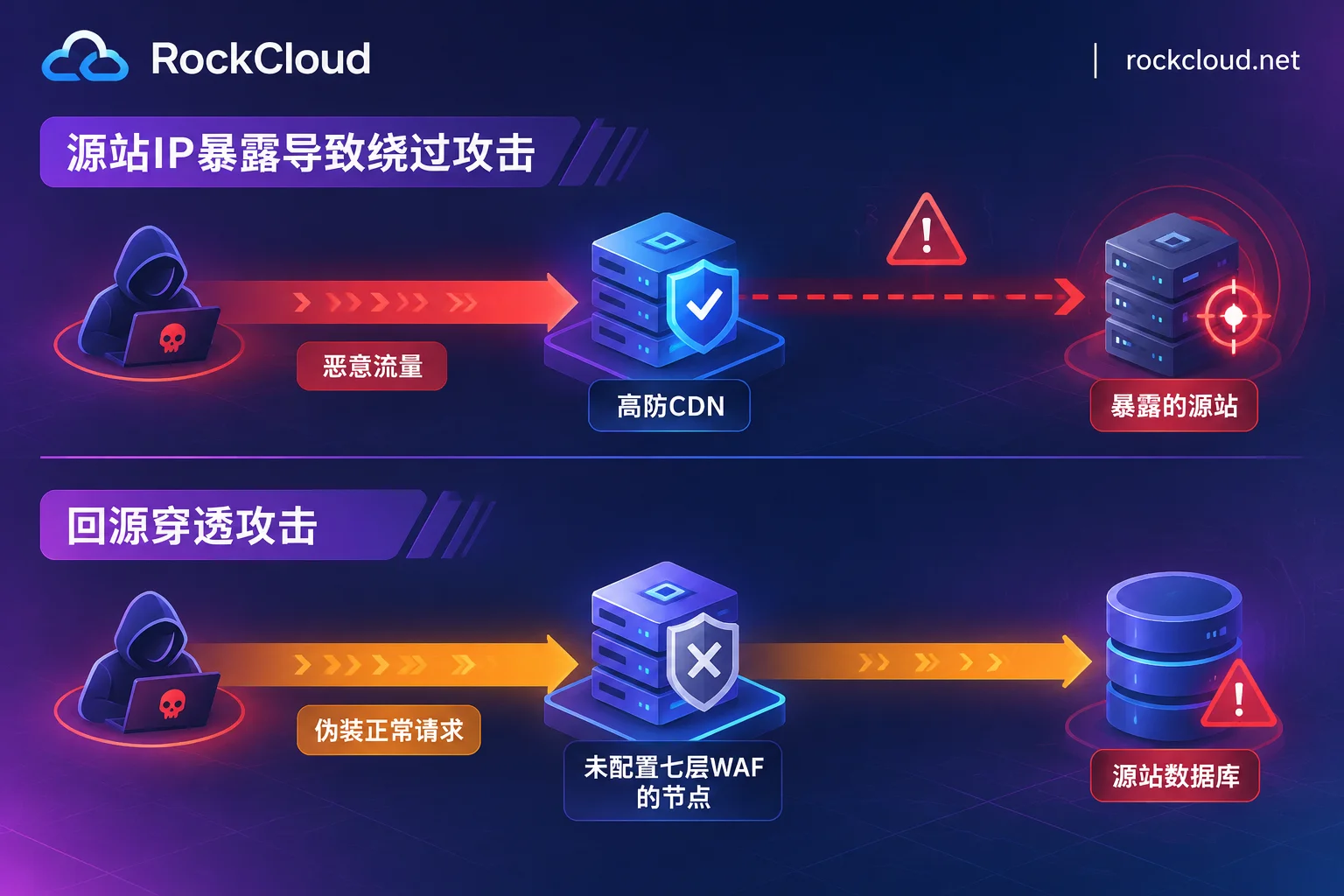
The core logic of a high-defense CDN is to act as a "stand-in" and "filter": it stands in front of the customer's own server or cloud host, all visitor requests first reach the edge nodes for scrubbing, and only clean business traffic is sent back to the origin. When the origin alarms, we can quickly determine the nature by two indicators:
- High-defense CDN console traffic is stable, but the origin server's NIC inbound bandwidth is maxed out (or cloud provider blackhole triggered):
This is a typical origin IP exposure (bypass attack). The attacker never accesses your domain, but obtains the real public IP of your server and directly initiates UDP Flood, SYN Flood, or sends HTTP requests directly to the origin IP. All edge scrubbing nodes are completely bypassed. - High-defense CDN console request volume surges, and back-to-origin bandwidth/origin CPU and database connections spike simultaneously:
This is a typical back-to-origin penetration (Layer 7 CC and malicious Bot penetration). Although the attack traffic passes through the CDN, due to lack of fine-grained Layer 7 scrubbing or improper cache policy configuration, massive random parameter requests are treated as normal dynamic requests and forwarded directly back to the origin (for an in-depth analysis of Layer 7 resource exhaustion, refer to "How to Defend Against CC Attacks: Dissecting Cache Penetration and Adaptive Long-Period Attacks, Building an Edge Defense-in-Depth Line That Withstands Attrition Warfare").
II. Why Can Attackers Still Find Your Real Origin IP After Using a High-Defense CDN?
Many operations personnel believe that "as long as the domain's A record is changed to the high-defense CNAME, the origin IP is automatically hidden." In fact, as long as this server has ever been "naked" on the public internet, or there are omissions in peripheral configurations, attackers can uncover the real IP through the following six common paths:
1. DNS Historical Resolution Record Archives (Most Common)
If the domain's A record was directly pointed to the origin IP during the initial launch, even if it was changed to CNAME high-defense CDN months later, various global DNS history query platforms still permanently store the initial resolution snapshot. Attackers only need to search the domain history to get the old origin IP in one second.
2. Omitted Subdomains and Test Environments
The main domain (e.g., www or api) is connected to the high-defense CDN, but subdomains such as test, dev, ftp, admin, or backup domains used internally for calls are still directly resolved via A records to the same origin server or IP range. Through automated subdomain enumeration tools, attackers can easily follow the trail.
3. Origin Server Sends Emails Directly to the Outside
If the business system directly calls SMTP on the origin server to send registration verification codes, billing notifications, or inquiry emails, the email header will clearly record the real outbound public IP of the sending server. An attacker only needs to trigger a registration email on the website, and the origin is immediately exposed.
4. SSL Certificate Transparency (CT) Logs and IP Default Site Scanning
The entire IPv4 address space is constantly polled by automated scanners. If your origin's port 443 is directly open to the internet and configured with an SSL certificate containing the business domain, scanners can precisely bind a specific IP to your domain by comparing certificate information with certificate transparency logs.
5. Business Program Actively Connects Outward (SSR / Webhook / Remote Fetch)
When a website supports "uploading avatars/fetching web pages via URL," calls external Webhooks, or has SSRF (Server-Side Request Forgery) vulnerabilities, an attacker only needs to pass in an external address they control, causing the origin server to actively initiate a request, and then intercept the real outbound IP of the origin in the receiving end's logs.
6. Hardcoded Web Source Code and Abnormal Error Messages
Frontend JS, CSS, and image resources use real IP direct links, or the backend PHP/Java/Node.js has Debug mode enabled, directly printing server NIC information and environment variables when an error page is triggered.
III. Building a "Zero-Bypass" Defense Line: Four Steps for Origin Stealth and Back-to-Origin Closure
To make the high-defense CDN truly effective, we must combine the "edge stand-in" with "origin closed loop" to ensure that any traffic not passing through the high-defense scrubbing nodes cannot reach the origin.
Step 1: Seamless CNAME Integration, Using Anycast Edge Network to Take Over the Entry
When integrating RockCloud High-Defense CDN, there is no need to modify the domain's NS servers; DNS resolution remains with the original provider. Operations only need to add a CNAME record in the original DNS console pointing to the assigned protection alias, enabling parallel operation of old and new links during the switch and zero business interruption.
After integration, global visitor requests are pulled to the nearest edge scrubbing node via the Anycast distributed network (for the specific pulling mechanism, see "How BGP Anycast Scrubbing Works: How Traffic Is Pulled to the Nearest Node, Hierarchically Scrubbed, and Injected Back to the Origin"), completely hiding the real origin IP from the outside.
Step 2: If Integrating During an Attack or If the Historical IP Has Been Exposed, the Origin IP Must Be Replaced Simultaneously
This is the most easily omitted yet most critical step.
If your business is urgently integrating a high-defense CDN during an attack, or if the origin IP has been directly resolved externally for a long time, then this IP is already in an "exposed" state. Simply adding a CNAME is not enough; you must apply to the cloud host provider for a new origin public IP at the same time as integrating the high-defense CDN, and update the back-to-origin address in the high-defense console, completely cutting off the attacker's historical intelligence. (If using overseas cloud hosts such as AWS, Alibaba Cloud International, or Tencent Cloud International as the origin, you can also quickly allocate and manage cloud resources through RockCloud International Cloud Recharge.)
Step 3: Strict Origin Firewall Closure, Only Allow High-Defense Back-to-Origin Nodes
After changing to a new IP, how to prevent global scanners from discovering the domain binding relationship again? The answer is origin whitelist closure.
In the origin server's security group or system firewall, set the business port to only allow access from RockCloud's back-to-origin node IP ranges, rejecting direct connection requests from all other public IPs. This way:
- When external scanners directly scan the origin IP, the port is silent or rejected, and SSL certificate fingerprints cannot be extracted;
- Even if an attacker guesses the IP range through some extreme method, their application-layer connections directly to the origin will be dropped at the underlying layer by the security group.

Step 4: Enable Free Fully Automated SSL and Email/Outbound Isolation
- Certificate Isolation: Directly use the free fully automated SSL in RockCloud General Security and Acceleration Features to complete certificate issuance and offloading at the edge nodes, avoiding direct exposure of origin certificates to public internet scans.
- Outbound Stripping: Switch business email sending to third-party email API services, prohibiting the origin from sending emails directly; functions involving remote image fetching or Webhooks should have outbound traffic through independent proxy nodes, achieving "the business origin only receives high-defense back-to-origin traffic and does not actively expose public outbound exits."
IV. Blocking "Frontal Penetration": Let DDoS, CC, and WAF Collaborate on the Same Link
Once the origin IP is completely hidden and closed, the attacker's only path is to directly confront the high-defense CDN's domain entry. At this point, to prevent malicious requests from overwhelming the backend database through the back-to-origin channel, the edge defense line needs integrated Layer 3/4 and Layer 7 interception capabilities:
- Same-Link DDoS + CC Collaborative Scrubbing:
In the RockCloud architecture, DDoS and CC defenses are deployed on the same request path, with no need for separate procurement or cross-platform chaining. Large network-layer traffic floods are directly diluted and absorbed at the Anycast edge, and high-frequency application-layer CC requests complete human verification and rate limiting locally at the node. - One-Click Enable Intelligent WEB Firewall (WAF):
For dynamic API abuse, SQL injection, XSS, file inclusion, and command injection attacks that attempt to penetrate the cache, you can enable the Intelligent WEB Firewall (WAF) with one click in the control panel. Based on the OWASP core rule set, the system uses machine learning models to dynamically identify unknown malicious requests and automated scripts not yet included in the rule base (for fine-grained control of login and payment interfaces, refer to "How to Do Bot Management: When AI Crawlers and Automated Scripts Flood Login and Payment Interfaces, How to Use Edge WAF for Fine-Grained Control"). When complex business interfaces require customized anti-penetration policies or exception allowlisting, the security technical team directly assists with configuration. - Anti-Penetration Solution for Non-HTTP Games and Custom Protocols:
If your business is not standard Web/API but a game business requiring TCP/UDP full protocol forwarding, ordinary website CDNs cannot proxy non-standard ports. In this case, you should use RockCloud Game Shield to encapsulate the game's non-HTTP protocols into private protocols, forward them through distributed edge nodes, and hide the origin; when a single node is attacked, it automatically switches to a high-defense node while keeping player connections uninterrupted. - Balancing Compliance-Free Acceleration and Avoiding Exorbitant Bills:
Many architects worry that stacking high-defense scrubbing and WAF will slow down normal access, or that they will be hit with high pay-as-you-go traffic bills due to attacks (see "What to Do When CDN Is Maliciously Abused and DDoS Attacks Result in Exorbitant Bills: Pay-as-You-Go Traps and High-Defense CDN Selection Guide"). RockCloud integrates acceleration and defense into a single package, supports HTTP/3, TLS 1.3 0-RTT, and custom cache rules, and can be combined with three-network direct-connect-to-China compliance-free CN2 China Acceleration; in terms of billing model, it uses monthly fixed peak billing, unlimited traffic, unlimited requests, with DDoS/CC defense, WAF, and SSL all included, completely eliminating worries about attack-induced bill explosions.
V. Pre- and Post-Integration Anti-Bypass Security Checklist
Whether you are migrating architecture or preparing to launch protection for a new business, it is recommended to check off each item in the following list (for more platform feature differences, see High-Defense CDN Selection Comparison):
- [ ] Full Domain Coverage: Have the main domain, API domain, static resource domain, and all subdomains still in use all been integrated into the high-defense CDN via CNAME?
- [ ] Retire Exposed IPs: Have the old origin IPs that were previously directly resolved to domains been replaced?
- [ ] Back-to-Origin Whitelist: Is the origin server security group configured to "only allow high-defense CDN back-to-origin node IPs" and block all other direct internet access?
- [ ] Outbound Channel Cleanup: Has local SMTP email sending on the origin been disabled? Are active outbound callback interfaces isolated?
- [ ] Layer 7 Policies Ready: Is the edge WAF enabled? Are custom anti-abuse rules for dynamic query interfaces and forced caching for static resources in effect?
If your business is currently under DDoS or CC attack, and the origin is repeatedly blackholed and urgently needs emergency isolation and defense reinforcement, you can immediately contact the security team via Contact Us (Security Response) or the official Telegram (@rockclouds) for emergency integration support and free test specification evaluation.