RockCloud-基石云安全-官方博客
In the daily operations of game businesses, the threats faced by operations and security teams are no longer just single bandwidth saturation. From the recent attack-defense landscape in the industry, attackers' focus is shifting from peripheral official websites and download sites to the underlying communication links that support core gameplay—using automated tools to capture and reverse-engineer client packets, locking onto TCP/UDP ports used for login gateways, room matching, real-time battles, and state synchronization, and then launching hybrid DDoS and slow exhaustion attacks that mimic protocol characteristics.
Many teams have found that after integrating conventional web protection, although official websites and HTTP login interfaces remain stable, game lobbies still frequently lag, and players in matches collectively disconnect. The core reason behind this is: the core interactions of games heavily rely on non-HTTP protocols and custom long connections, and traditional layer-7 web proxies cannot directly parse and carry these traffic flows.
Previously, in "How to Do Game DDoS Protection During New Game Launches and Major Promotions: A Defense Guide Against Pulse Floods and Simulated Player Connections" and "Why Do All Players Disconnect When a Game Is Under DDoS Attack: How Game Shield Achieves Node Switching Without Disconnection", we discussed operational defense lines during special periods and disconnection switching mechanisms, respectively. This article takes a different perspective, delving into the underlying communication protocol layer to dissect how Game Shield uses "private protocol encapsulation" and "TCP/UDP full-protocol forwarding" to fundamentally cut off probing and attacks against non-standard ports.
I. Why Are TCP/UDP Non-HTTP Protocols in Games Most Likely to Become a Breakthrough Point?
The network architecture of a modern online game (whether mobile, PC, card, or casual competitive application) is typically a mix of multiple protocols. In addition to HTTP/HTTPS protocols used for announcement retrieval, store display, and update package distribution, the real-time interaction modules that truly determine player retention are almost entirely built on custom TCP or UDP protocols.
When this part of the business is directly exposed to the public internet or only mounted behind a regular single-point high-defense IP, it often faces three dilemmas:
- Obvious communication characteristics, extremely easy to capture and reverse-engineer
Attackers only need to run packet capture tools on an emulator or terminal device to easily obtain the target IP, port number, and handshake characteristics without deep obfuscation that the client connects to. Once the port is exposed, targeted SYN Flood, UDP reflection amplification, or empty connection exhaustion attacks follow. - Fragile long connection state, slight jitter causes disconnection
HTTP requests are stateless; a failed request can be resolved by refreshing or retrying. However, in-game state synchronization, frame synchronization, and lobby heartbeat maintenance rely on long connections. Once the nodes carrying these protocols encounter pulse-style traffic impacts, even a few seconds of packet loss will trigger client timeout reconnections, which manifests to players as "everyone teleporting" or "being kicked back to the login screen." - Traditional CDN cannot carry non-standard protocols
Standard web CDNs are designed for web traffic on ports 80/443 and do not have the capability to transparently forward and scrub arbitrary ports and arbitrary TCP/UDP protocols. Forcing all traffic into a single protection channel not only causes protocol incompatibility but also leads to severe latency degradation.
II. The Core Defense Line of Game Shield: Private Protocol Encapsulation and Distributed Edge Forwarding
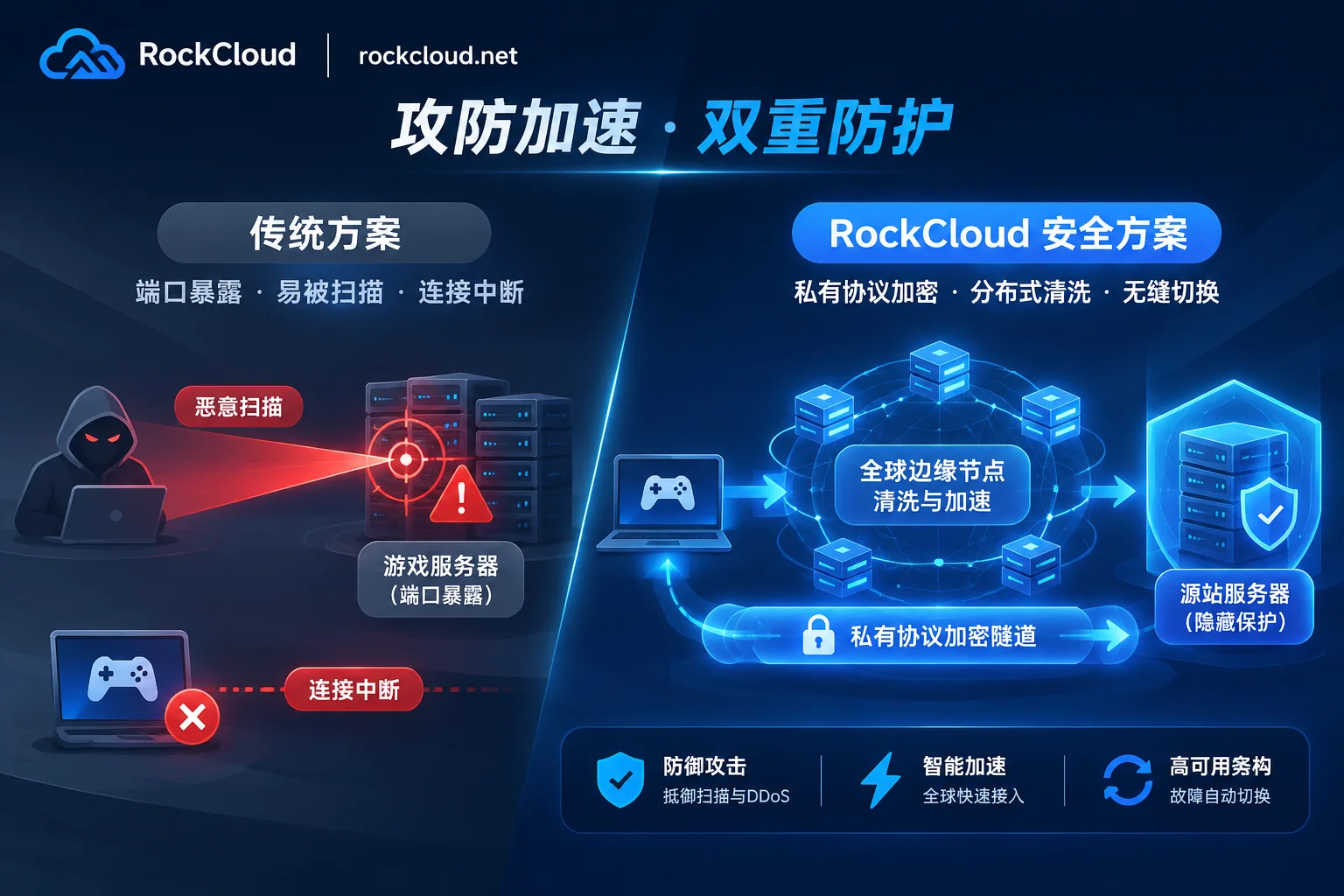
To solve the problem of non-HTTP protocols being exposed, RockCloud Game Shield adopts a defense-in-depth mechanism different from traditional high-defense IPs, focusing on "protocol stealth" and "distributed scheduling."
1. Private Protocol Encapsulation for Non-HTTP Protocols
Targeting the custom communication logic unique to games, RockCloud Game Shield performs private protocol encapsulation on the game's non-HTTP protocols. When traffic is transmitted over the network, external attackers cannot identify through conventional port scanning or simple traffic sniffing whether this is a login gateway or a battle server interface of a certain game.
This encapsulation mechanism establishes a protected communication barrier between the client and edge nodes, significantly raising the reverse-engineering cost for black and gray industries to analyze communication logic and forge fake player handshake packets.
2. TCP/UDP Full-Protocol Forwarding and Complete Origin Stealth
For game businesses requiring TCP/UDP full-protocol forwarding, after integrating Game Shield, all client requests are no longer sent directly to the origin server but first enter RockCloud's distributed edge nodes nearby. After the edge nodes complete protocol processing and traffic scrubbing, they forward clean business data to the backend origin server.
Under this architecture:
- Origin IP completely hidden: What is exposed externally is always the distributed edge nodes. The customer's existing servers or cloud hosts continue to be safely hidden behind the scenes as origin servers, with no need to migrate business or change server providers.
- Node switching without disconnection when a node is attacked: When an edge node encounters a large-traffic attack, the system automatically schedules and switches traffic to other high-defense nodes, maintaining existing connections during the switch to prevent players from being forcibly kicked out of matches during intense battles.
III. Practical Architecture: How to Split Modules by Protocol and Build a Complete Game Defense Line?
In actual deployment, we do not recommend putting all game modules into the same protection product. As emphasized in "Should Game Servers Choose High-Defense IP or High-Defense CDN: Split Modules by Protocol, Layered Access", the most reasonable and cost-effective approach is "split by protocol, layered protection."
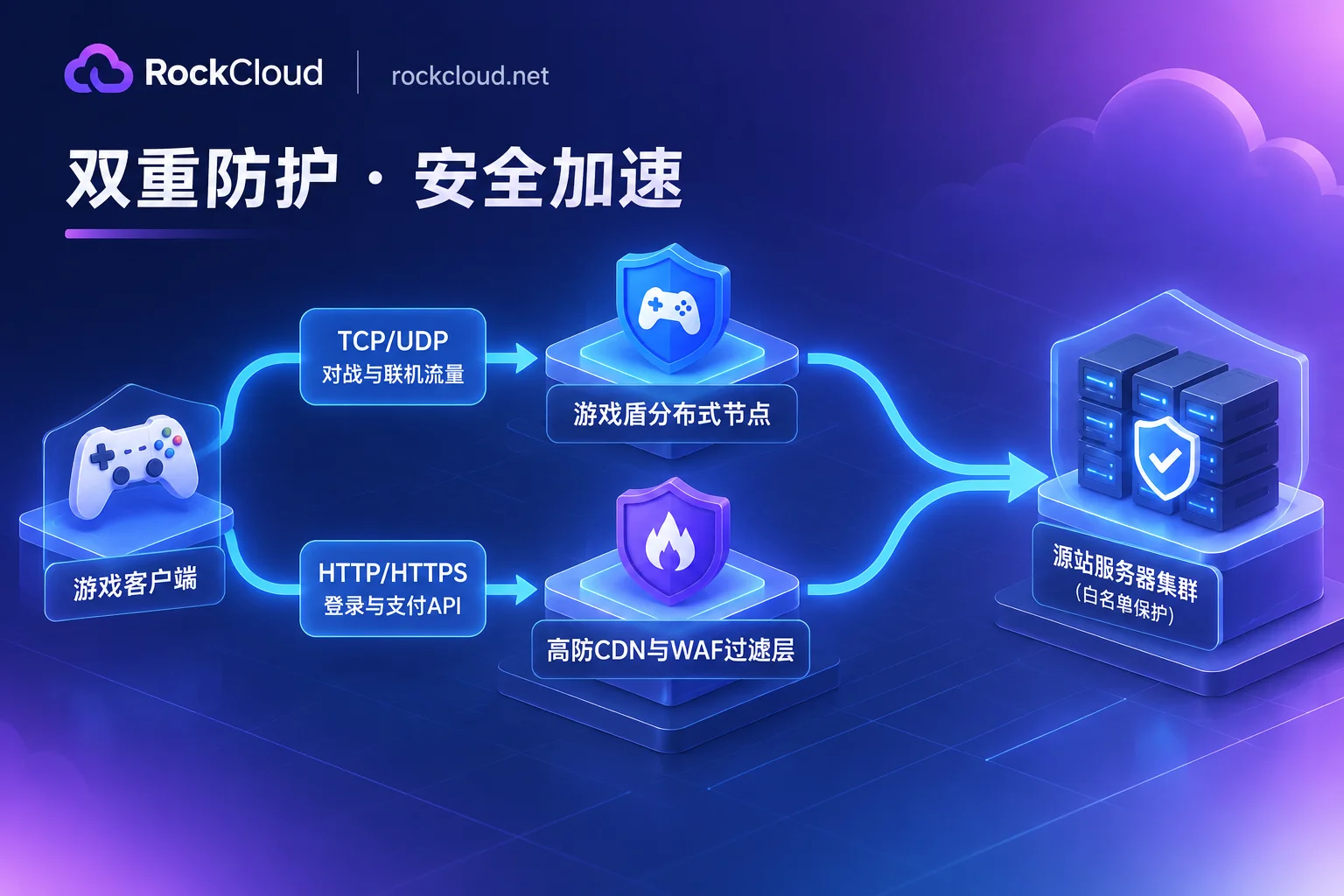
Combined with RockCloud's product system, a mature game security and acceleration architecture is typically deployed across the following four layers:
Layer 1: Lobby, Battles, and Real-Time Multiplayer (TCP/UDP) — Access Game Shield
For core modules such as card games, real-time competition, MMO multiplayer, and built-in IM chat that require TCP/UDP full-protocol forwarding, access directly through Game Shield. Use private protocol encapsulation to hide communication characteristics and rely on distributed edge nodes to absorb DDoS impacts against long connection ports.
Layer 2: Official Website, Login API, and Payment Callbacks (HTTP/HTTPS) — Access High-Defense CDN + WAF
Game account registration, OAuth login, recharge payment interfaces, and promotional landing pages are essentially standard web and API businesses. This traffic only needs a CNAME record added at the existing DNS provider to quickly access RockCloud High-Defense CDN, without modifying NS, achieving smooth parallel operation of old and new links.
At the same time, enable the Intelligent WEB Firewall (WAF) with one click in the control panel. The system uses the OWASP core rule set to intercept SQL injection, XSS, malicious scripts, and scanner probes, and combines machine learning to identify new malicious requests not included in the rule base (such as high-concurrency interface brushing against login and payment interfaces). If custom rules or exception allowances are needed for specific game interfaces, RockCloud's security technical team can assist directly with configuration.
Layer 3: Hot Update Packages and Promotional Video Distribution — Access Global CDN and Video CDN
During new version releases or major promotions, massive client patch downloads and promotional CG playback can easily saturate origin bandwidth. By accessing Global CDN Acceleration (supporting HTTP/3, TLS 1.3 0-RTT, Brotli compression, and custom cache rules) or Video CDN, static resources and audio/video streams can be offloaded to edge nodes, and with anti-leech, security tokens, and signed URL features, update packages are prevented from malicious hotlinking.
Layer 4: Cross-Border Going Global and Low-Latency Optimization Around Mainland China
For businesses with servers deployed overseas (e.g., AWS, GCP, Alibaba Cloud International cloud hosts opened without enterprise verification via RockCloud International Cloud Agency Top-up) but needing to serve players in mainland China or multiple global regions:
- CN2 China Acceleration can be added, accessing from Hong Kong, Japan, South Korea, Singapore, and other nodes around China, and returning to China directly through Telecom CN2 GIA, Unicom AS9929, and Mobile CMI three-network direct connections, significantly reducing cross-border multiplayer latency without ICP filing.
- If promotional domains are blocked on social platforms or in certain regions, Blocking and Pollution Recovery services can be used for DNS pollution scrubbing and WeChat/QQ blocking recovery, achieving in-place recovery of promotional conversions without changing domains through seamless 301 redirects.
(For more architecture designs for specific business forms, please refer to the card game, IM, and APP specialized solutions in RockCloud Industry Solutions, or visit the Selection Comparison Page to learn about differences from traditional high-defense servers.)
IV. Origin Closure and Daily Operations Pitfall Avoidance Guide
Even after integrating Game Shield and High-Defense CDN, if there are omissions in the origin's own security policies, attackers may still bypass front-end protection to directly attack backend servers (for details, see "Will Origin IP Still Be Exposed After High-Defense CDN Integration: Five Leakage Paths, Closure Order, and Post-Exposure Handling"). Before and after launch, operations teams must complete the following checks:
- When integrating during an ongoing attack, the origin IP must be changed simultaneously
If the business is urgently integrating protection during an attack, it means the original origin IP has been recorded by attackers. At this time, after integrating Game Shield or High-Defense CDN, the public IP of the origin server must be changed simultaneously; otherwise, attack traffic will still bypass edge nodes and directly hit the origin. - Strictly close the origin firewall and only allow back-to-origin nodes
In the origin server's security group or firewall, configure a strict whitelist policy to only allow RockCloud's back-to-origin node IP ranges to access business ports, denying all direct probing and connection requests from other public IPs. - Make good use of real-time monitoring and automated alerts
Through the General Control Panel Features provided by RockCloud, operations personnel can view traffic and bandwidth reports at any time, search network logs, and enable Telegram real-time data push. Once abnormal traffic fluctuations occur, the team can receive notifications and intervene in troubleshooting immediately. - Say goodbye to anxiety over sky-high traffic bills
The game industry is a disaster area for traffic extortion, and pay-per-traffic models can easily generate high bills after a large attack. RockCloud's Package Billing Model defaults to monthly billing by fixed peak, with unlimited traffic and request counts. Acceleration and defense are included in the same link and the same package, with DDoS/CC defense, WAF, and free fully automated SSL all included, no separate purchases required, making security budgets fully controllable.
Conclusion
Facing increasingly complex non-standard protocol attacks and high-frequency extortion, relying solely on stacking single-machine bandwidth is no longer sustainable. By using Game Shield's private protocol encapsulation and TCP/UDP full-protocol forwarding to protect core interaction links, and cooperating with High-Defense CDN and Intelligent WAF to safeguard web interfaces, a modern game defense system that is "impenetrable, uninterruptible, and keeps the origin hidden" can truly be established.
If you wish to verify the actual latency and protection performance of your game business after integration, please contact customer service to apply for a free test (first confirm business specifications and protocol types with customer service); if your game server is currently under attack and urgently needs immediate integration to stop the bleeding, please immediately contact us via the RockCloud Contact Page ("Security Response" channel) or directly click the official Telegram (@rockclouds) for emergency response support.