RockCloud-基石云安全-官方博客
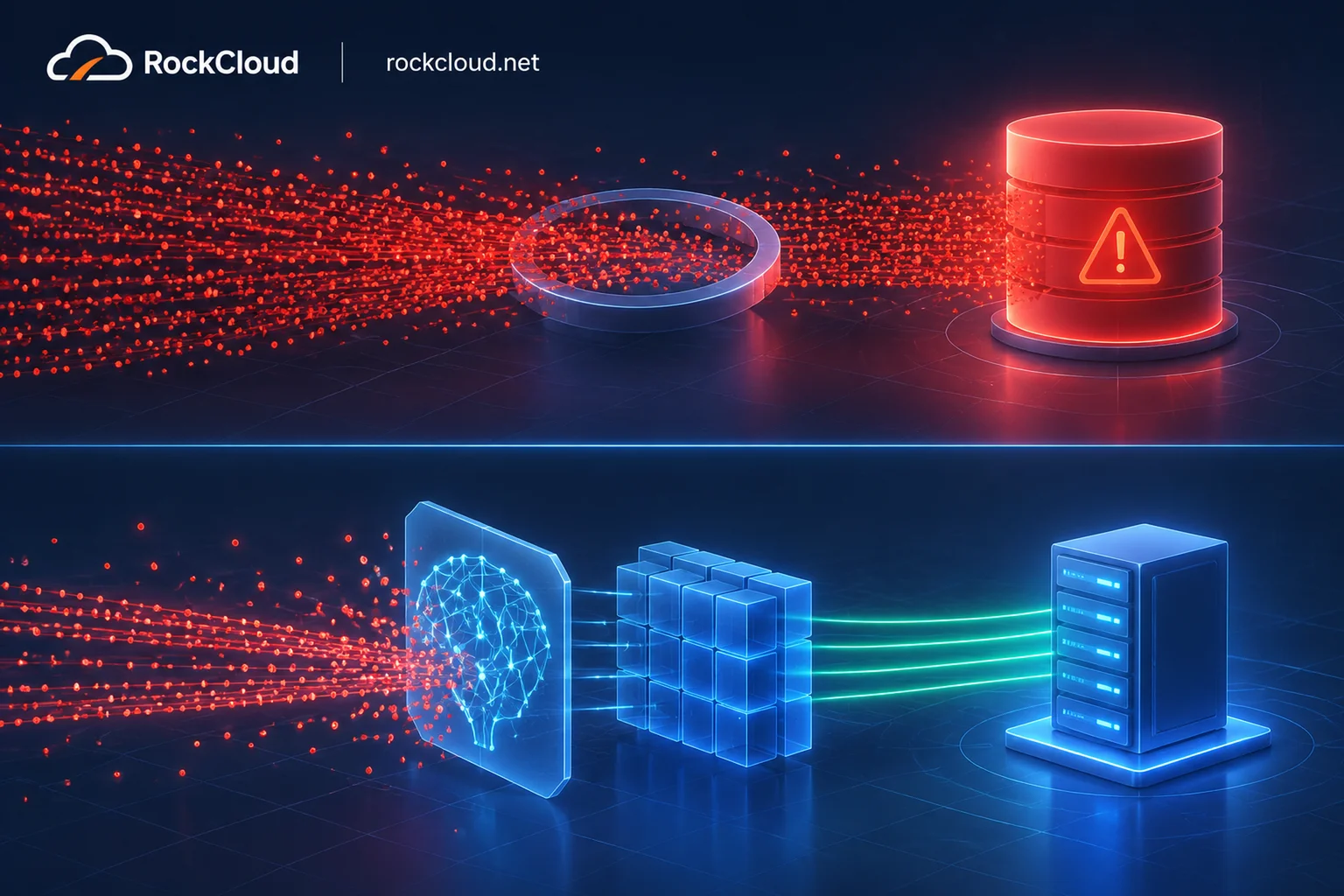
Many business owners and operations engineers have all experienced this helpless moment: an ordinary CDN is already layered in front of the server, and strict single-IP access rate limits are written into Nginx (limit_req), yet as soon as an organized CC attack (Challenge Collapsar, i.e., a layer 7 HTTP/HTTPS application-layer denial-of-service attack) hits, the origin server's CPU, database connection pool, and even AI inference queue still spike to full within minutes, and normal users see widespread 502 or 504 timeouts on pages.
Entering the second half of 2026, the tactics of application-layer CC attacks have clearly shifted—no longer simply competing on instantaneous bandwidth, but specifically targeting a business's cache blind spots, compute bottlenecks, and billing statements to wage a protracted war of attrition. To achieve CC defense for a modern business, you can no longer rely on passive firefighting such as "manually blocking IPs after an incident and temporarily enabling site-wide CAPTCHAs"; instead, you need to rebuild a defense-in-depth line starting from the very first hop where traffic enters the edge node.
1. The New Normal of CC Attacks in 2026: Swarming, Cache Penetration, and Multi-Day Attrition Warfare
From attack-and-defense data and real incident postmortems recently disclosed by multiple security organizations worldwide, we can see that current layer 7 CC attacks exhibit three notable characteristics:
- "Swarm tactics" have become mainstream, with highly dense attack frequency: According to Cloudflare's Q3 2026 DDoS threat report, attackers are shifting from single ultra-large-scale floods to short, high-frequency "swarm-style" strikes. In a single quarter alone, its network mitigated 14.4 million HTTP DDoS attacks, with the global network averaging more than 8,200 attacks per hour.
- Layer 4 attacks are pulse-based; layer 7 attacks are protracted wars of attrition: In its H1 2026 attack trends report, DDoS-Guard pointed out that 95% of network-layer (L3/L4) and transport-layer attacks last less than a few minutes; but application-layer (L7) trends are exactly the opposite—ultra-long-cycle application-layer attacks lasting more than 24 hours surged by 380%, and the total volume of layer 7 events climbed sharply quarter over quarter. Attackers have realized that sustaining precise HTTP requests at a moderate level for days on end is far more effective at crippling a target company than a few minutes of high-bandwidth flooding.
- Targeted cache penetration and signature randomization: The well-known developer documentation platform Read the Docs disclosed in September 2026 a postmortem of a complex application-layer attack lasting nearly ten days—during peak periods the platform withstood more than 5.5 million requests per minute (about 100 times its daily baseline). This traffic came from millions of distinct IPs across hundreds of autonomous systems (ASNs) worldwide. It not only systematically randomized HTTP request headers and TLS handshake signatures, but also deliberately issued requests against paths that bypass caching, and rapidly adapted and mutated based on the defender's blocking strategy, causing traditional single-IP rate limiting to provide only partial mitigation.
This also explains why websites, e-commerce payments, live streaming, and the AI service businesses that have surged in recent years often find new CC attacks so troublesome: as long as even a small portion of dynamic requests that penetrate the cache leak through to the origin, the expensive backend database queries or model compute are quickly drained.
2. Why Can't "Ordinary CDN + Nginx Rate Limiting" Stop New CC Attacks?
When helping customers troubleshoot production incidents, we found that traditional architectures typically fail in succession at the following three points when facing the attacks described above:
1. The cache is easily penetrated, and the ordinary CDN degrades into a "back-to-origin loudspeaker"
The original design purpose of an ordinary acceleration CDN is to distribute static images, scripts, and fixed web pages. Attackers only need to grab the site's search box, filter query pages, login authentication endpoints, or append randomly generated query parameters to normal URLs to force a cache miss. At this point, the ordinary CDN not only fails to offload pressure, but instead leverages its high-quality persistent connections to the origin to rapidly forward massive malicious requests to the origin server.
2. Cross-network distributed requests + dynamic signature mutation render static rate limiting useless
When attack traffic is spread across millions of residential proxy and cloud host IPs, a single IP may send only a few requests per minute—well within the threshold of a normal human user (for details on low-frequency slow-rate abuse of dynamic endpoints, see "How to Defend API and Dynamic Endpoint CC Attacks: Handling Low-Frequency Slow-Rate, Residential Proxies, and High-Concurrency API Abuse"). If operations forcibly lowers the single-IP threshold, a large number of real users behind corporate office networks, campus networks, or mobile carrier NAT egresses will be mistakenly blocked en masse; and if blocking is based on a fixed User-Agent or a single header, automated attack scripts can rotate signatures within minutes.
3. Long-cycle tug-of-war simultaneously breaks "operations energy" and "pay-as-you-go budgets"
When a CC attack lasts five or even ten days, enterprises without a dedicated security operations team fall into a state of exhaustion—woken by alerts late at night and repeatedly hand-writing rules to troubleshoot. More fatal is the financial risk: many cloud vendors split CDN, DDoS protection, and WAF into separate billing modules, and WAF and CDN are billed by "per ten thousand HTTP requests" or back-to-origin traffic. With millions of requests per minute for a week straight, even if the origin barely stays up, the month-end request-count bill can be enough to devour business profits (see "What to Do When CDN Malicious Abuse and DDoS Attacks Produce Sky-High Bills").
3. Building a Defense-in-Depth CC Defense System: A Four-Step Architecture from Edge Admission to Origin Lockdown
The core logic of truly robust CC defense is "keep compute consumption at the distributed edge, hand rule-based confrontation to machine learning and expert collaboration, and lock protection costs within a fixed budget." Relying on RockCloud's security acceleration network placed in front of customers' existing servers or cloud hosts, the above challenges can be solved end-to-end through a four-layer architecture:

Layer 1: Edge custom caching and signed access to cut off invalid back-to-origin traffic
The first step in stopping cache-penetration CC is to reduce invalid forwarding from edge nodes to the origin.
- Fine-grained caching and back-to-origin protection: Through the custom caching rules of RockCloud global CDN acceleration, businesses can control caching policies based on actual paths and filter out invalid back-to-origin traffic caused by irrelevant random parameters; at the same time, configure back-to-origin retries and backup origin rules to ensure continuity of normal business requests under high-load fluctuations. The underlying layer supports HTTP/3, TLS 1.3 0-RTT, and Brotli compression, ensuring real users' loading speed while enabling high-intensity security inspection.
- Pre-admission control: Combined with the security tokens and signed URLs, anti-hotlinking, and IP and region blacklists/whitelists in the general security features, perform pre-verification for audio/video streams, download packages, and high-consumption query paths. For businesses that clearly serve only specific countries or regions, directly block abnormal request sources from irrelevant regions at the edge; forged requests without valid signatures are discarded at the edge and never reach the origin at all.
Layer 2: Anycast same-path scrubbing + machine-learning WAF to identify unknown mutated traffic
Many attackers like to combine "layer 4 UDP/SYN floods + layer 7 adaptive CC" to test the handoff latency between a defender's different security components.
- DDoS and CC same-path scrubbing: After onboarding RockCloud high-defense CDN and DDoS/CC defense, the Anycast distributed scrubbing network absorbs traffic nearby at global edges, and layer 4 DDoS scrubbing and layer 7 CC defense run on the same request path, with no need to purchase separately or chain products across vendors.
- Dual identification via rule sets + machine learning: After enabling the intelligent WEB firewall (WAF) with one click in the control panel, the system first precisely blocks scanners, known bots, malicious scripts, and accompanying intrusion behaviors such as SQL injection and XSS through the OWASP core rule set; for new mutated CC requests with randomized headers that the rule set has not yet recorded, the WAF machine-learning engine then analyzes abnormal request patterns in real time and dynamically blocks them.
- Security technical team assists with tuning: For complex scenarios prone to false positives—such as payment callbacks, proprietary app APIs, or AI streaming output—you don't need to stay up all night trial-and-error testing regular expressions yourself—RockCloud's custom rules and exception allowlists can be configured with the assistance of the security technical team, stabilizing the block rate while protecting normal client conversion rates.
Layer 3: CNAME smooth onboarding and origin whitelist lockdown to seal off bypass paths
No matter how powerful the edge scrubbing, if the origin's real IP is exposed on the public internet, attackers can still bypass the domain and hit the server IP directly.
- Smooth everyday onboarding (without changing NS): RockCloud requires no new server purchase—your existing server or cloud host continues to serve as the origin (if you use overseas cloud hosts such as AWS, GCP, Azure, or Alibaba Cloud International, you can also pair with international cloud top-up, which requires no corporate verification and supports USDT settlement, for unified management). Onboarding only requires adding a CNAME record; there is no need to change the domain's NS, DNS stays with the original provider, and old and new paths run in parallel during the switch for a seamless business transition.
- Emergency onboarding during an attack and strict lockdown: If the business is currently under attack and needs emergency protection, besides switching to CNAME to hide the origin IP, be sure to simultaneously change the origin server's public IP, and configure the origin security group/firewall to allow access requests only from RockCloud back-to-origin nodes, completely closing the direct-connection backdoor (for the complete stop-the-bleeding steps, see "DDoS Attack Incoming: RockCloud Emergency Response Manual").
- Additional note: The above high-defense CDN + WAF architecture applies to HTTP/HTTPS-based websites, app APIs, payments, live streaming, and AI services; if your business is a client game requiring full TCP/UDP protocol forwarding, then when facing high-frequency connection-based attacks you should choose a game shield solution with proprietary protocol encapsulation and seamless node switching capabilities.
Layer 4: Fixed-peak billing and real-time push so even a ten-day war of attrition is easy to account for
In a protracted CC war of attrition, what ultimately matters is cost certainty and operational observability.
- Unlimited traffic, unlimited request count: RockCloud's plan billing model is billed monthly by fixed peak by default, with no limit on traffic and HTTP request counts. Global acceleration, DDoS/CC defense, intelligent WAF, and free fully automated SSL are all included in the same plan and the same path, with no separate add-on purchase needed for defense (CN2 mainland acceleration dedicated lines and anti-hijacking are billed separately on demand). Even if you encounter weeks-long high-concurrency CC request flooding, no sky-high excess request bill will be generated.
- Lightweight on-call and real-time insight: The control panel provides detailed traffic and bandwidth reports, network logs, bulk operations for multiple domains, and API endpoints, and supports real-time Telegram data push. Operations and business owners no longer need to guard a monitoring wall 24/7—they can check scrubbing status and origin health levels anytime from their phones.
4. CC Defense Self-Check List Before and After Launch
Whether you are hardening your defense lines before a major promotion or new business launch, or planning to replace your existing protection solution (see the selection comparison page to understand architectural differences from traditional high-defense servers and mainstream cloud vendors), it is recommended to check the following five points one by one:
| Check dimension | Risk symptom | Recommended action |
|---|---|---|
| Origin exposure surface | Historical DNS records have leaked the real origin IP, and the origin has ports 80/443 open to the entire internet | Onboard a high-defense CDN to hide the origin IP; if already leaked or currently under attack, change the origin IP and allow only back-to-origin nodes |
| Cache penetration risk | Search pages, non-static lists, or URLs with random parameters hit the database directly every time | Configure edge custom caching rules and enable signed URL and anti-hotlinking verification for protected resources |
| Adaptive mutation confrontation | Relying only on Nginx single-IP rate limiting or a static UA blacklist, which fails as soon as a distributed proxy pool appears | Enable intelligent WAF (OWASP rule set + machine-learning identification) and have the security team assist with fine-tuning custom rules |
| Protection path complexity | Acceleration, DDoS scrubbing, and WAF belong to different vendors, with many forwarding layers and difficult troubleshooting | Adopt a high-defense CDN integrating acceleration with DDoS/CC/WAF on the same path, onboarded via CNAME without changing the original domain's NS |
| Extreme bill control | Postpaid by traffic or per ten thousand HTTPS requests, facing the risk of bankruptcy from malicious flooding | Choose a monthly plan billed by fixed peak with unlimited traffic and request counts to lock in the upper limit of the security budget |
Conclusion
When AI-automated scripts and cross-regional proxy networks turn layer 7 CC attacks into all-weather "background noise," it is no longer worthwhile to rely on the origin to tough it out or to piece together scattered rate-limiting plugins. Only by moving cache offloading, machine-learning identification, and distributed scrubbing forward to the edge network in a unified way can backend R&D and operations teams truly refocus their energy on business growth.
If you would like to evaluate protection solutions for specific scenarios such as websites, WEB APIs, online payments, live streaming, or AI services, visit RockCloud Industry Solutions for architecture details, or contact online customer service to discuss business specifications and apply for a free trial; if your online business is currently under CC or mixed DDoS attack and needs immediate stop-the-bleeding onboarding, please directly call the emergency security team for rapid onboarding assistance via the contact page (security response) or the official Telegram (@rockclouds).