RockCloud-基石云安全-官方博客
In 2026, multiple global cybersecurity monitoring reports have raised red flags in succession: according to the 2026 Bad Bot Report released by Imperva, automated traffic on the internet has exceeded 53%, surpassing real human traffic for the second consecutive year, with malicious bots accounting for 40% of total traffic. Meanwhile, in DataDome's 2026 Bot and Agent Security Report, an even more troubling figure has emerged for operations and business leaders—malicious automated traffic is growing at an annual rate of 124%, 80% of new AI Agents do not properly declare their identity, and malicious scripts disguised as well-known AI assistants (such as ChatGPT-like User-Agents) successfully bypassed the interception defenses of nearly 80% of websites in testing.
Today's "Bot management" is no longer the simple task it was a few years ago—writing a few lines in Nginx Disallow or banning a handful of data center IP ranges. If our earlier discussion on When AI Crawlers and Automated Scripts Flood Login and Payment APIs, How to Use Edge WAF for Fine-Grained Traffic Control addressed "credential stuffing and payment fraud prevention" on core transaction paths, what most enterprises face today is the more covert and widespread site-wide data bleeding, the SEO false-positive dilemma, and invisible cloud bill overruns.
1. Three Major New Bot Management Pain Points in 2026: Not Crashing Your Site, But Draining Your Profits
Traditional DDoS attacks aim to bring servers down, while modern advanced malicious bots aim to "parasitize" normal business flows. In recent customer investigations, we found that businesses commonly get stuck at the following three blind spots in Bot management:
1. "Wolf in Sheep's Clothing" Identity Spoofing and Low-Frequency Commercial Espionage
In the past, crawlers had obvious signatures, and scanners carried fixed tool fingerprints. Now, malicious actors extensively use headless browsers and residential proxies to disguise malicious data-scraping scripts as Googlebot, Baiduspider, or even popular AI retrieval assistants. They no longer launch brute-force attacks at tens of thousands of requests per second; instead, they quietly strip e-commerce platforms of real-time price comparison data, ticketing inventory, exclusive industry intelligence, or AI service Q&A libraries 24/7 at a reading pace close to that of real humans. Looking at origin CPU load alone, nothing seems amiss, but the company's core trade secrets and content assets have already been looted.
2. SEO Collapse and Legitimate User Loss Caused by "One-Size-Fits-All" Interception
To stop pervasive crawlers, many operations teams try enabling high-intensity global verification or aggressive rate limiting. The result is often "killing eight hundred enemies while losing a thousand of your own": search engine spiders that genuinely bring organic traffic cannot execute complex client-side interactions, causing site indexing snapshots to go blank en masse and organic search traffic to plummet; or real overseas users trigger strict policies due to network jitter and are frequently blocked by pop-ups, directly abandoning purchases. This phenomenon mirrors the pattern revealed in Practical Architecture for Addressing High False-Positive Pain Points in WAF Protection—defense without fine-grained tuning often harms the business itself first.
3. The Security Bill Assassin Under "Per-Request / Per-VAU Billing"
This is the invisible trap that procurement and finance leaders are most likely to fall into this year. Although many mainstream cloud providers offer basic protection, their CDN origin-pull traffic, WAF request counts, and even advanced Bot management modules themselves (such as billing by valid request count or active access units) are usage-based.
When more than half of all internet traffic is automated scripts, even if security devices block 90% of malicious bots at the edge, the remaining probe requests—or the detection invocation fees the protection module itself incurs for massive junk requests—will still add up to a jaw-dropping bill at the end of the month. As we warned in What to Do When CDN Malicious Leeching and DDoS Attacks Produce Sky-High Bills, usage-based pricing in an era of rampant automated traffic can easily turn defense itself into a financial black hole.

2. The Breakthrough Approach: Building a Four-in-One Edge Bot Defense Line of "Cleansing, Identification, Authentication, and Cost Control"
To escape the vicious cycle of "can't stop them, dare not block them, can't afford it," Bot management must be decoupled from the origin code layer and moved forward to an edge network with massive bandwidth redundancy and intelligent analysis capabilities. Based on RockCloud's product suite, you can rebuild your defense line with a lightweight yet rigorous combination:
Layer 1: CNAME Seamless Onboarding and Complete Origin Concealment to Cut Off Bypass Paths
The prerequisite for any fine-grained Bot identification strategy is that "all traffic must pass through the security gate." If attack scripts find the origin's real IP through historical DNS records and send requests directly, edge Bot management becomes useless.
- Rapid deployment without changing NS: Onboarding to RockCloud High-Defense CDN only requires adding a CNAME record at your existing DNS provider. There is no need to migrate domain resolution authority, the old and new paths run in parallel during the switch, and there is zero business interruption.
- Origin concealment and bypass prevention: After traffic is routed to the nearest Anycast distributed node, the origin IP is completely hidden. Combined with origin firewall configuration (only allowing RockCloud origin-pull node IP ranges), the possibility of malicious bots bypassing the edge to scan the origin directly is completely eliminated (for detailed configuration, see Breaking Down Origin IP Leakage Paths and Anti-Bypass Origin-Pull Architecture).
Layer 2: OWASP Ruleset + Machine Learning to Precisely Catch Disguised Bots
Facing spoofed User-Agents and slowly mutating automated tools, static blacklists alone are far from enough. After enabling the Intelligent Web Application Firewall (WAF) with one click in the control panel, requests undergo dual screening at the edge:
- Instant blocking of known threats: Relying on the built-in OWASP core ruleset, known malicious scanners, automated vulnerability probing scripts, SQL injection, and malicious file inclusion requests are filtered directly at the edge, denying automated tools any chance to probe system weaknesses.
- Machine learning dynamic identification of unknown crawlers: For newly mutated bots not yet in the ruleset, low-frequency scraping scripts, and anomalous requests disguised as legitimate identities, the WAF uses machine learning models to continuously analyze request characteristics and access patterns, automatically identifying and blocking malicious requests that deviate from normal human behavior baselines.
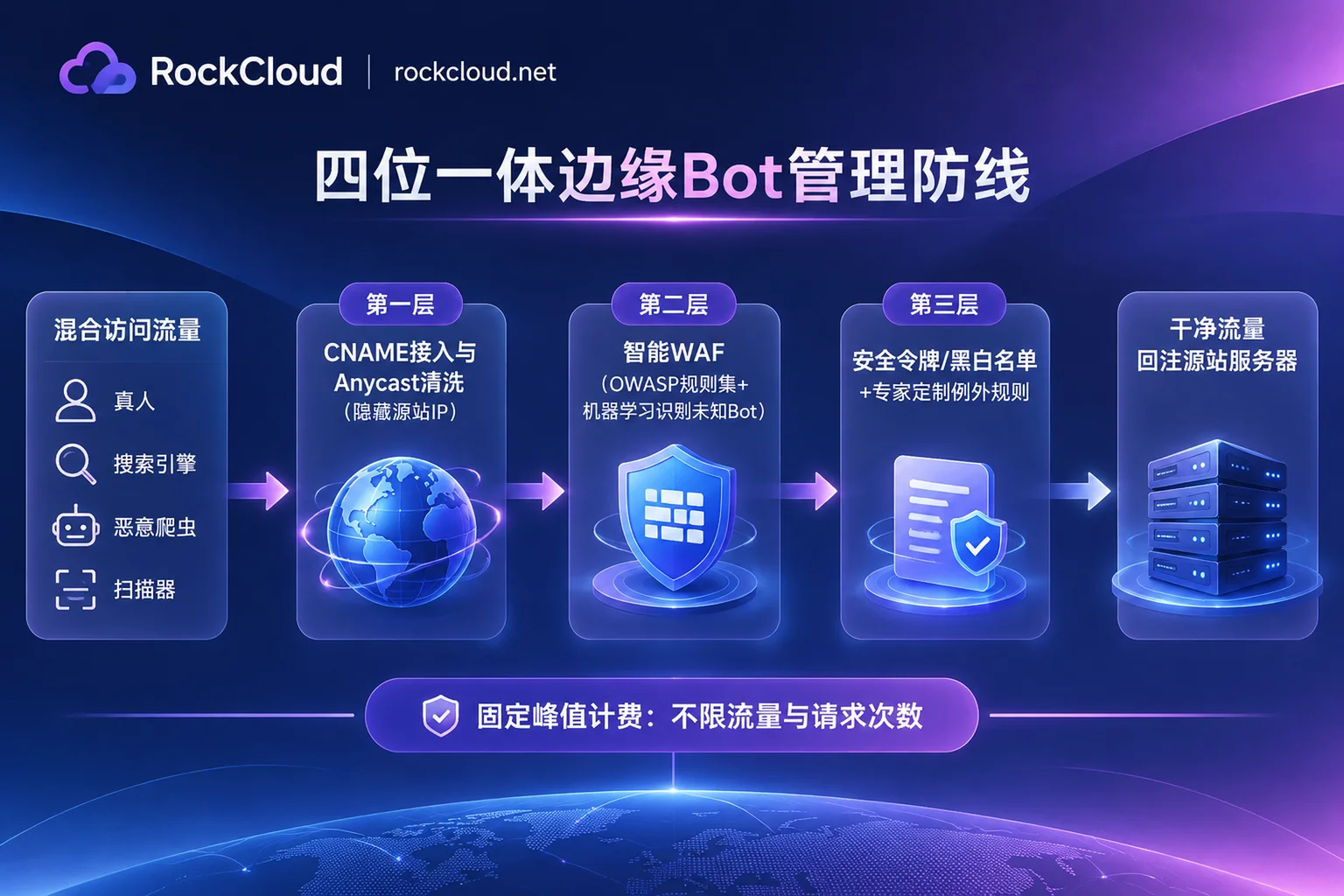
Layer 3: Edge Universal Authentication + Security Expert-Assisted Tuning for "Zero False-Positive" Allowlisting
How do you ensure malicious crawlers are blocked without harming search engine spiders, partner webhook callbacks, or real overseas customers?
- Static resource and core API authentication: Using RockCloud's Universal Security and Access Control features, you can enable hotlink protection, security tokens, and signed URLs for high-value static resources, audio/video streams, or critical download paths, and combine IP and region blacklists/whitelists to reject anomalous automated access from non-target business regions directly at the edge (for deeper API protection, see Building Fine-Grained API Defense Against AI Crawlers and DDoS).
- Expert team-assisted custom rules: No need for operations staff to stay up late studying complex regex syntax. At RockCloud, custom rules and exception allowlist policies are configured with assistance from a professional security technical team. Whether it's precisely verifying and allowing genuine search engine spiders to protect SEO, or customizing anti-abuse policies for specific business APIs, real experts have your back, completely ending the "enable protection, get false positives" dilemma. Meanwhile, the control panel supports network log queries and real-time Telegram data push, keeping you informed of edge interception activity at all times.
Layer 4: What About Automated Scripts on Non-Standard TCP/UDP Protocols?
In scenarios such as online gaming, mobile games, or customized clients, malicious actors' "gold-farming studios" and cheat scripts often do not use standard HTTP/HTTPS protocols; instead, they launch bulk automated connections and protocol abuse directly against TCP/UDP ports.
For such non-Web-layer automated attacks, the Game Shield solution can be adopted: non-HTTP protocols are encapsulated in private protocols and forwarded through distributed edge nodes with the origin hidden. Even if an edge node suffers a mixed attack of studio scripts and high-volume traffic, the system can switch to a high-defense node within seconds while keeping player connections uninterrupted, cutting off malicious script probing paths at the transport layer.
3. Crunching the Financial Numbers: Why Bot Management Must Choose "Unlimited Traffic and Requests"?
Once the technical architecture is in place, procurement and business leaders care most about cost controllability. With automated traffic exceeding half of all internet traffic today, choosing a protection solution billed by traffic or request count is tantamount to handing budget control to malicious actors' script switches.
RockCloud's billing model is designed to be extremely friendly to high-concurrency businesses that are prone to crawler harassment:
- Fixed peak billing with unlimited traffic and requests: Plans are billed monthly by default. Within the agreed bandwidth peak specification, no matter how many billions of probe requests malicious bots send or how many TB of cleansing traffic is generated, no additional traffic fees or request-count fees are charged.
- Acceleration and full defense combined, no hidden unbundling: Within the same plan and the same request path, global CDN acceleration, DDoS and CC defense, intelligent WAF (including scanner and bot detection), and free fully automated SSL are all included. There is no separate usage-based charge for WAF or Bot protection modules (you can also use our selection comparison to see the intuitive differences in architecture and cost structure between us and AWS, Cloudflare, and traditional high-defense servers).
- Flexible, compliant business support: Contract quotes are supported, and payment via USDT or USD is convenient; if your origin is hosted on an overseas public cloud, you can also pair it with our international cloud account opening and top-up service (covering AWS, GCP, Alibaba Cloud International, etc., without tedious corporate identity verification procedures, with USDT payment), achieving one-stop procurement and cost coordination for origin cloud hosts and edge high-defense CDN.
Conclusion: Turn the Edge Into the "Watershed" for Automated Traffic
As AI Agents and automated crawlers become the "majority" of the internet, enterprise network perimeters can no longer remain in an extreme state of being wide open or crudely blocked. A mature Bot management system should silently wash away the noise of scanners and data-stealing crawlers at the edge, letting real customers and beneficial ecosystem traffic flow smoothly to the origin, while keeping financial statements far from usage-based billing shocks.
If you're unsure which protection specification suits your current business, feel free to contact customer service to confirm the specification and apply for a free trial; if your website, API, or application is currently suffering from malicious crawler scraping, CC API abuse, or hybrid attacks causing origin load spikes and business lag, please immediately reach out through the Security Response Contact Page or directly contact the official Telegram (@rockclouds). Our security emergency team will assist you in quickly completing CNAME onboarding and policy tuning to stop the bleeding and protect your business at the earliest opportunity.