RockCloud-基石云安全-官方博客
The latest global DDoS threat intelligence data, disclosed in early November 2026, has sounded a new alarm for the operations and security leads of every internet business: DDoS attacks are completely moving away from the "behemoth era" of simply competing over peak numbers and shifting fully toward high-frequency, short-burst, multi-point concurrent "Swarm Tactics."
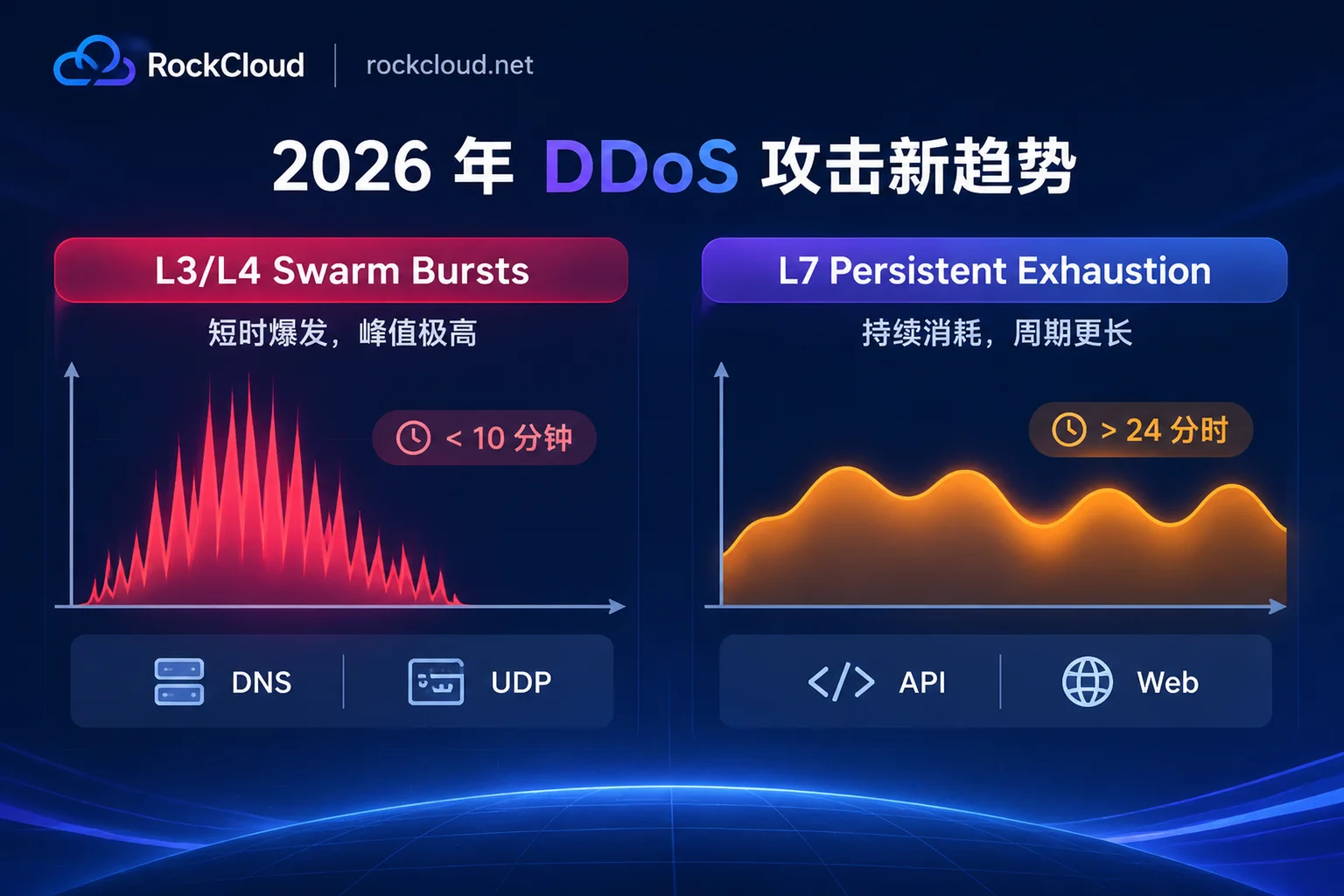
According to the Q3 2026 DDoS Threat Report just released by Cloudflare, after international law enforcement agencies jointly dismantled four major IoT botnets—including Aisuru and KimWolf—earlier this year, ultra-large-scale attacks exceeding 1 Tbps fell by nearly 69% quarter over quarter. In stark contrast, however, short-burst attacks lasting under 10 minutes with bandwidth below 1 Gbps surged 208% year over year. The global network now absorbs more than 8,200 network-layer DDoS attacks per hour on average—equivalent to one attack every 0.44 seconds.
At the same time, the "polarization" of attack vectors and durations has reached unprecedented levels:
- Abrupt shifts in network-layer (L3/L4) protocols: Attackers quickly abandoned CLDAP reflection, which is now widely blocked (down 99.5% quarter over quarter), and instead launched stealthier connectionless protocol raids, driving a 215% surge in DNS amplification attacks and a 122% increase in generic UDP flood attacks.
- Extreme elongation at the application layer (L7): Combining 2026 observation data from NETSCOUT and DDoS-Guard, while as many as 96% of network-layer attacks end in a flash within 10 minutes, ultra-long-cycle resource-exhaustion attacks at the application layer (HTTP/HTTPS/API) lasting more than 24 hours surged 380%, and many are mixed with real consumer IP traffic driven by residential proxies.
When "L3/L4 swarm blitzes that end the battle within 10 minutes" and "L7 slow-burn exhaustion measured in days" slam into your servers at the same time, the traditional DDoS defense approach is failing on a large scale. This article combines this latest attack-defense trend to break down why your business is actually more likely to be crippled under "small-traffic, high-frequency" attacks, and how to build a truly exhaustion-resistant, always-on defense line for websites, apps, APIs, payments, AI services, and gaming businesses.
I. Why Are "Under 1 Gbps, Under 10 Minutes" Swarm Attacks Actually More Lethal?
When many business leaders see the data that "98% of attacks are below 1 Gbps and 96% last under 10 minutes," their first reaction is often relief—believing that this magnitude simply cannot penetrate data centers with defenses in the hundreds of Gbps. In reality, however, this is precisely the precision-strike strategy attackers have evolved after rigorous economic calculation (measures of effectiveness, MOE):
1. Targeting the Time Gap of "On-Demand Pulling" and "Manual Switching"
If a company, to save costs, normally runs exposed or uses only an ordinary acceleration CDN, and then waits for monitoring alerts to trigger before manually changing DNS or waiting for a traditional scrubbing center to take 3–5 minutes to identify and pull traffic (for the differences in switching time across methods, see our previous analysis: How Long Does It Take for High-Defense Route Switching to Take Effect: DNS Changes Take Minutes to Hours, BGP Pulling Takes Seconds, Always-On Access Requires No Temporary Switching), then against a pulse attack that lasts only 3–8 minutes, by the time your defense takes effect, the attack is already over—but your origin's connection table is already full, your database is already deadlocked, and all your online users have already dropped offline. Attackers only need to launch a 3-minute mercenary-style pulse (Booter/Stresser) every half hour to keep you in an endless loop of "crash—restart—crash again" all day long.
2. 1 Gbps Is Enough to Crush an Unhidden Origin and Stateful Devices
For the vast majority of cloud hosts, load balancers, or stateful firewalls directly exposed to the public internet, you do not need 1 Tbps—just a few hundred Mbps of high-packets-per-second (PPS) SYN Flood or burst UDP fragments is enough to exhaust NIC queues and connection tracking tables (Conntrack), or even directly trigger the cloud provider's data center blackhole policy. Once blackholed, even if the attack lasted only 2 minutes, the cloud host IP may remain blocked for hours.
3. Layer 7 "Boiling the Frog" Mixed with Residential Proxies
While swarm pulses disrupt the operations team's visibility, Layer 7 CC attacks against login endpoints, payment gateways, and AI inference APIs continue silently in the background for days. These requests are mixed into real business traffic, with extremely low per-IP request rates. Traditional static rate-limiting rules based on fixed thresholds (such as 5-minute sliding-window statistics) simply cannot trigger, yet once aggregated at the origin, they can directly max out CPU and compute bills.
II. Breaking Out of the Swarm Era: Four Core Capabilities Modern DDoS Defense Must Have
Facing the highly industrialized, automated, and high-frequency attack landscape of 2026, enterprises can no longer pin their hopes on "switching routes after an incident" or "buying a high-defense package on the fly." A DDoS defense system truly suited to the current threat landscape must simultaneously satisfy the following four conditions in both architecture and commercial model:
1. Always-On Anycast Distributed Edge Scrubbing (Eliminating Response Lag)
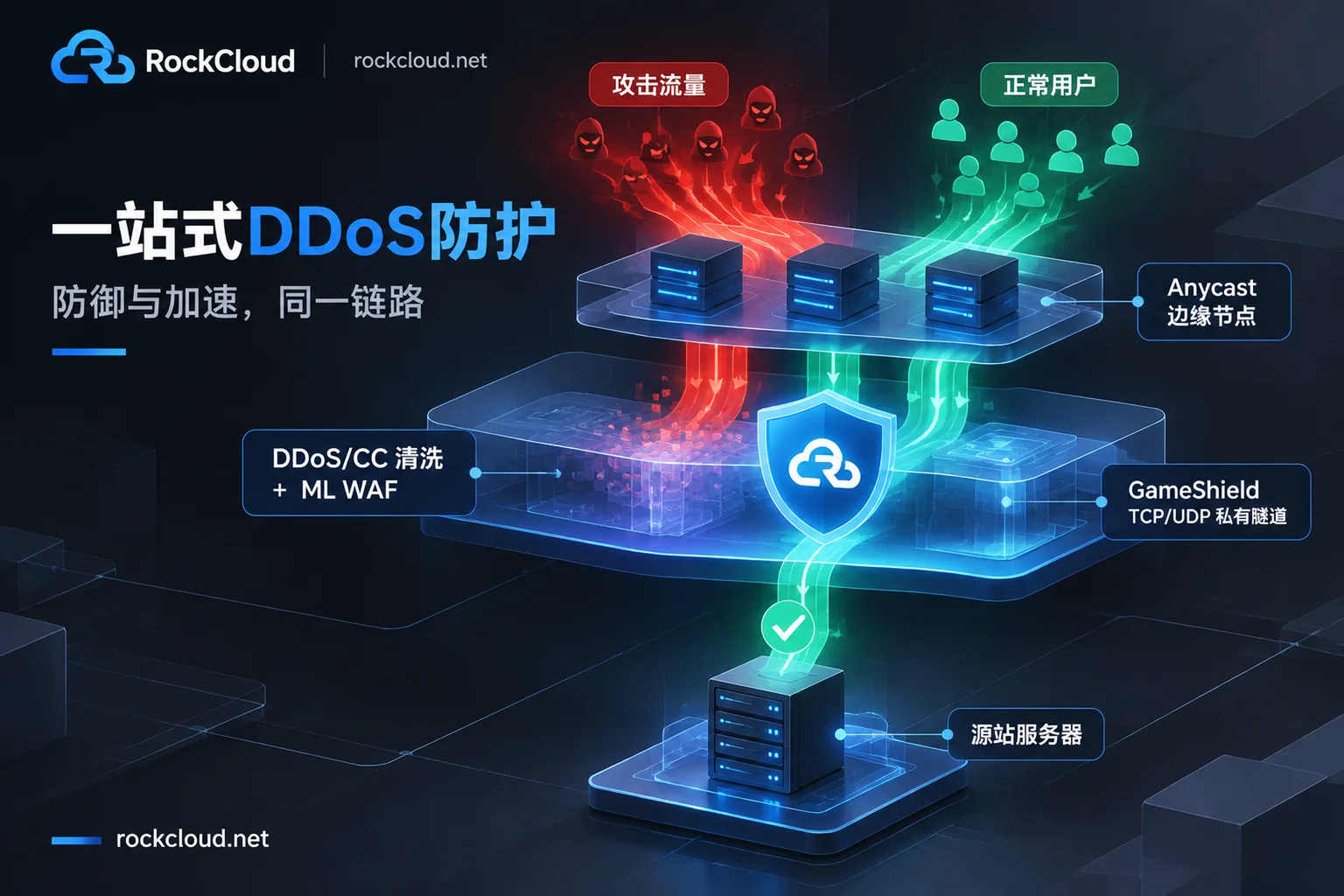
The only correct answer to minute-scale pulse attacks is to keep business traffic on an edge network with scrubbing capabilities 365 days a year. Take RockCloud High-Defense CDN and DDoS/CC Defense as an example; it uses an Anycast distributed scrubbing architecture at its foundation (for how it works, see How BGP Anycast Scrubbing Works: How Traffic Is Pulled to the Nearest Node, Scrubbed in Layers, and Injected Back to the Origin).
- When botnets around the world launch swarm raids, attack traffic is absorbed and blocked at the nearest edge node and never converges on central nodes, let alone reaches the customer's origin servers.
- DDoS and CC defense are completed on the same request path, with no detour between a network-layer scrubbing center and an application-layer gateway, and no several-minute vacuum of "detect first, then divert." Second-scale burst pulse traffic is stripped away the moment it reaches the edge.
2. Machine-Learning-Driven Intelligent WAF (Countering Residential Proxies and Mutating CC)
Against L7 slow-burn exhaustion and API abuse lasting more than 24 hours, static rules are no longer sufficient. RockCloud's Intelligent Web Application Firewall (WAF) can be enabled with one click in the control panel and adopts a dual-engine architecture of "OWASP Core Rule Set + Machine Learning":
- Baseline defense: Comprehensive coverage of SQL injection, XSS, file inclusion, command injection, malicious scripts, and identification of known scanners and bots.
- Intelligent evolution: Machine learning analyzes request characteristics in real time to accurately identify new mutated malicious requests and automated scripts not yet included in the rule library (for more details on long-cycle Layer 7 confrontation, see How to Do CC Defense: Deconstructing Cache Penetration and Adaptive Long-Cycle Attacks to Build an Edge-in-Depth Defense Line That Withstands Exhaustion Warfare).
- Expert support: For complex business interfaces (such as payment callbacks and specific app signature requests), the RockCloud security technical team assists in configuring custom rules and exception allowlisting, completely eliminating the embarrassment of "killing normal clients as soon as high-defense is enabled."
3. Private Protocol Encapsulation for the UDP Surge and Non-HTTP Businesses
In Q3 this year, generic UDP floods rose 122%, posing a severe threat to online games, IM instant messaging, and real-time voice businesses that rely heavily on custom TCP/UDP port communication. Standard web CDNs cannot handle non-HTTP protocols, while directly exposing ports makes them highly vulnerable to being overwhelmed by UDP reflection.
For this, RockCloud Game Shield provides a dedicated architectural solution:
- Private protocol encapsulation for games' non-HTTP protocols, supporting full TCP/UDP protocol forwarding, relayed through distributed edge nodes, and completely hiding the origin IP.
- When an edge node comes under high-intensity pulse attack, the system automatically switches traffic to a high-defense node while keeping existing player connections unbroken (further reading: Why Do All Players Drop When a Game Is Hit by DDoS: How the Game Shield Switches Nodes Without Disconnecting).
4. A Billing Model of "Fixed Peak, Unmetered Traffic and Requests" (Preventing Sky-High Bills)
In the face of swarm attacks and the 380% surge in long-cycle L7 attacks, many enterprises are killed not by the attack itself but by the sky-high bills from traditional cloud providers' "traffic-based billing" or "HTTP request-count-based billing" (see What to Do When CDN Malicious Abuse and DDoS Attacks Produce Sky-High Bills: Pay-As-You-Go Traps and High-Defense CDN Selection Guide).
To help customers completely lock down their security budgets, RockCloud's billing model insists on a more transparent and exhaustion-resistant approach:
- Billed by fixed peak, with unmetered traffic and unmetered requests: No matter how many hundreds of millions of HTTP requests an attacker sends within 24 hours, or how many waves of UDP pulses they launch, as long as it is within the package specifications, no additional traffic fees or request overage fees will be incurred.
- Acceleration and defense combined: Global CDN acceleration, DDoS/CC defense, intelligent WAF, and free fully automated SSL are all included in the same package and the same link—no need to procure and piece them together separately.
III. Targeted Protection Guides for Four High-Risk Industry Scenarios
In 2026, attack targets are spreading from traditional media and government/enterprise sectors to consumer services, financial payments, AI infrastructure, and the pan-entertainment industry. For different business types, you can refer to RockCloud Industry Solutions for targeted deployment:
| Business Scenario | Core Threats in 2026 | RockCloud Recommended Protection Combination | Core Benefits and Architectural Advantages |
|---|---|---|---|
| AI Services and Web APIs | Compute-exhausting CC, high-frequency endpoint scraping, short-pulse DDoS disrupting streaming responses | High-Defense CDN + Intelligent WAF + Global Acceleration Network | Machine learning blocks anomalous bots, supports HTTP/3 and TLS 1.3 0-RTT to reduce API latency, unmetered requests prevent both compute and CDN bills from exploding |
| Financial Payments and E-Commerce Websites | Ransom DDoS (RDDoS), residential proxy credential stuffing, cross-border peak-hour lag | High-Defense CDN + CN2 China Acceleration + Pollution Blocking and Recovery | Telecom CN2 GIA / Unicom AS9929 / Mobile CMI tri-network direct return to China (ICP filing exempt), balancing financial-grade low latency with high-intensity DDoS resistance, preventing domain hijacking and pollution |
| Online Games and Board/Card IM | UDP flood surge (+122%), frequent disconnections caused by high-frequency short pulses, TCP connection exhaustion | Game Shield + International Cloud Origin Hosting | Full TCP/UDP private encapsulation, completely hiding the origin, automatic second-level node switching when attacked without disconnecting players |
| Live Streaming and Short Videos | Pulse extortion during broadcast peak hours, malicious bandwidth abuse, push/pull stream interruption | Video CDN + High-Defense Foundation | Supports full RTMP/RTSP/HLS/DASH/CMAF protocol push/pull streaming, built-in security tokens, hotlink protection, and Multi-DRM content protection, unafraid of traffic abuse |
💡 Additional Advice on Infrastructure and International Clouds:
RockCloud does not sell underlying physical servers. Your existing servers or cloud hosts can continue to be used as origins, with RockCloud acting as a solid shield in front of the origin. If you are using or plan to migrate your origin to a major overseas cloud provider, you can also directly use the RockCloud International Cloud Top-Up Service to set up free accounts and top up AWS, Azure, GCP, Alibaba Cloud International, Huawei Cloud International, and Tencent Cloud International—no enterprise verification or cumbersome real-name procedures required, USDT payments supported—seamlessly working with our high-defense CDN and Game Shield.
IV. Practical Implementation: How to Quickly Adopt DDoS Defense Without Disrupting Business?
Whether for proactive architectural upgrades or urgent damage control while currently under swarm-style attack, adopting a high-defense system should not become a massive project lasting weeks. Combining RockCloud Platform General Features with standard SOPs, you can quickly complete the defense loop in the following three steps:
Step 1: Smooth CNAME Onboarding, Old and New Links in Parallel (Zero-Downtime Switching)
Many operations teams resist switching to high-defense because they fear that changing a domain's NS records will cause brief resolution failures or lose complex subdomain configurations. Onboarding to RockCloud requires no NS record changes at all:
- Your DNS resolution stays with your existing domain service provider.
- Simply add a CNAME record in your original DNS backend pointing to the edge node assigned by RockCloud.
- During the switch, the old and new links work in parallel. Combined with the platform's built-in free fully automated SSL certificates, global users transition smoothly to the high-defense link, achieving "zero-perception" seamless onboarding.
Step 2: The Iron Rule of "Change IP + Lock Down Origin" When Under Attack
If you are already under attack before onboarding, it means your origin's real IP has already leaked. In this case, if you merely put a high-defense CDN in front without handling the origin, attackers will still bypass the CDN and directly bombard your origin IP (for in-depth troubleshooting, see Why Does Traffic Still Break Through After Onboarding to High-Defense CDN? Deconstructing Origin IP Leak Paths and Anti-Bypass Back-to-Origin Architecture).
The correct emergency onboarding posture is:
- While configuring CNAME onboarding to high-defense, apply to your hosting provider to change the origin's public IP.
- Configure allowlist policies in the origin firewall or security group to allow only RockCloud's back-to-origin node IP ranges and deny direct access from any other public IP.
- In this way, external scanners and botnets completely lose their target, and all traffic must pass through RockCloud edge nodes' scrubbing and WAF filtering before returning to the origin.
Step 3: Enable Fine-Grained Monitoring and Real-Time Alerts
After onboarding is complete, the operations team can view traffic and bandwidth reports and detailed network logs in real time on the RockCloud control panel, with support for multi-domain batch operations, API automation calls, and team member permission collaboration. More practically, you can directly bind Telegram real-time data push, so any sudden traffic fluctuations or blocking events are pushed to the operations group immediately, giving you true peace of mind.
Conclusion: Make Defense a Daily Foundation, Not a Firefighting Crew in a Crisis
When the global DDoS attack frequency reaches once every 0.44 seconds and short-pulse swarm attacks soar 208%, cybersecurity has changed from an "occasional black swan event" into the "daily background noise" of internet business. In such an environment, leaders still agonizing over the differences between vendors' solutions may want to check our High-Defense Selection Comparison Guide to intuitively compare RockCloud with Alibaba Cloud, Cloudflare, AWS, Sudun, and traditional high-defense servers in terms of onboarding flexibility, return-to-China routes, and billing certainty.
- If you want to verify the defense line's effectiveness in advance: Welcome to visit the Pricing and Packages page for details, and contact customer service to confirm specifications and apply for a free trial (contract quotes and USDT / USD payments supported).
- If your business is under DDoS/CC attack right now and urgently needs damage control: Don't lose users while waiting! Please immediately visit the RockCloud Contact page (select the "Security Response" channel) or contact the emergency expert team directly via Telegram: https://t.me/rockclouds. We will help you pull traffic in seconds and quickly restore normal business operations!