RockCloud-基石云安全-官方博客
In recent cybersecurity attack-defense drills and security assessments, a sharp question has been brought to the table: Why do enterprises still get breached by new vulnerabilities or mutated payloads even though they have deployed a WAF (Web Application Firewall) to protect their core business?
According to the "2026 WAF Security Assessment Report" released by Check Point and recently disclosed security incidents such as the ModSecurity filename parsing bypass (CVE-2026-104269), modern web attacks have moved away from the early rough stage of "hitting regex rules with public scripts". Attackers are widely exploiting payload padding evasion, chunked transfer encoding mutation, and AI-assisted generation of 0day logic vulnerabilities to launch precise breaches targeting the architectural weaknesses of traditional signature-based WAFs.
For those responsible for websites, apps, APIs, payment, and AI services, as well as operations teams, re-examining the existing WAF protection architecture and resolving the contradiction between "cannot defend against mutated attacks" and "strict defense leading to false positives against normal users" has become an urgent task to ensure business continuity.
I. What "Dimensional Strikes" Are Traditional Static Rule WAFs Facing?
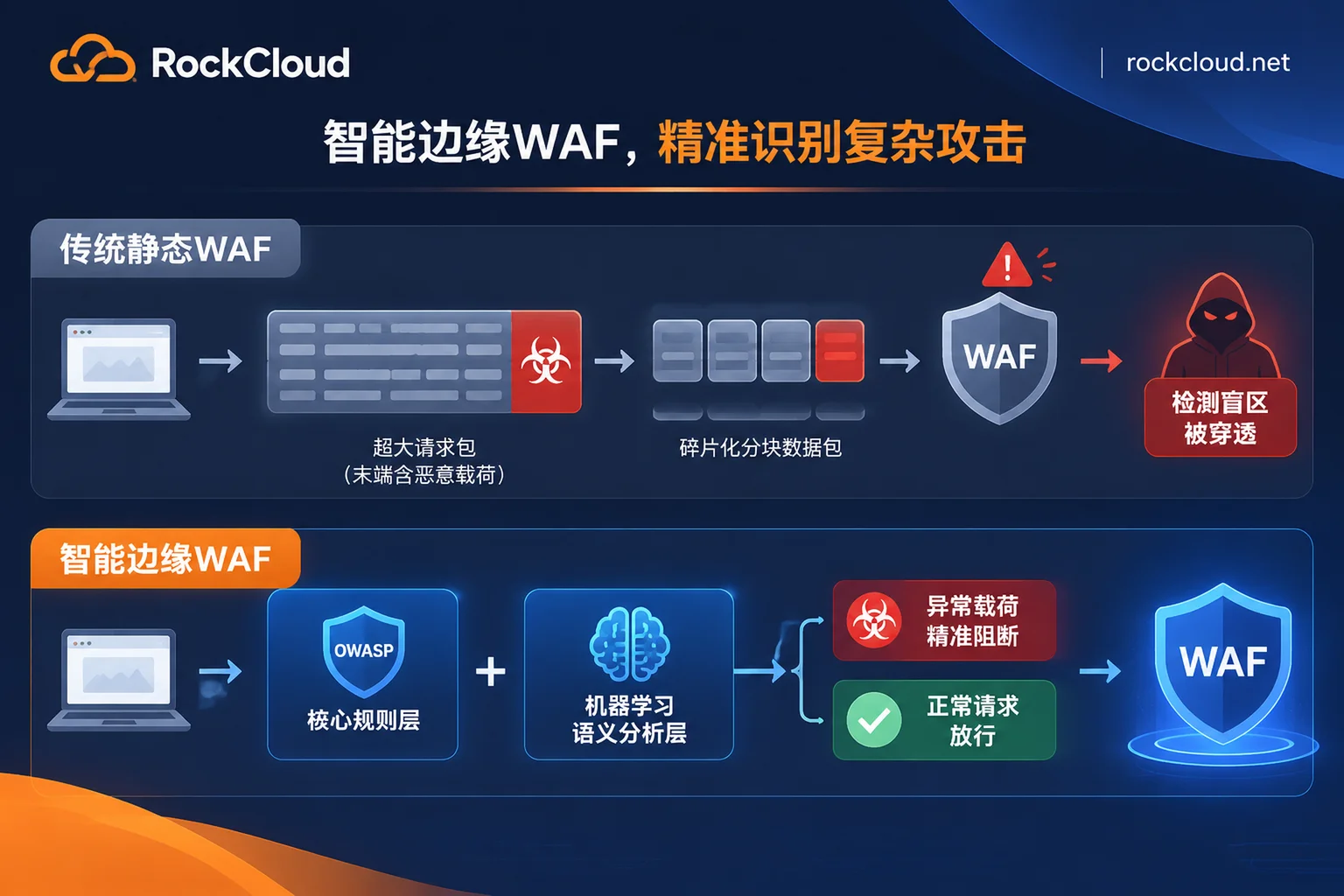
For a long time, many enterprises equated WAF protection with "installing an open-source ModSecurity module on Nginx" or "purchasing a cloud WAF with basic rules enabled by default". However, under the current threat landscape, a protection model relying solely on static regular expressions (Regex) and known signature databases is exposing three fatal blind spots:
1. Padding Evasion and Buffer Overflow Bypass
To balance processing performance, many traditional WAFs set a hard upper limit on the detection buffer for a single HTTP request body (usually between 8KB and 128KB). When attackers craft attack requests targeting application frameworks (such as component vulnerabilities like React2Shell), they insert a large amount of harmless junk characters as "padding" before the actual malicious code. When the request size exceeds the WAF's detection threshold, traditional WAFs often face a dilemma: either allow it directly to avoid blocking large file uploads, letting malicious payloads penetrate; or block all large requests indiscriminately, directly paralyzing normal rich text submissions, image uploads, or complex JSON APIs.
2. Protocol Parsing Differences and Chunked Transfer Mutation
Web servers (origin servers) and front-end WAFs often have minor parsing differences when handling HTTP protocol edge specifications. For example, in chunked transfer encoding or multipart form upload scenarios, attackers insert special comment characters, malformed line breaks, or encoding obfuscation to split SQL injection, XSS cross-site scripting, or malicious trojans into fragments. Static rule sets cannot match complete signatures in fragmented traffic, while the origin backend can automatically reassemble and execute them normally, thus achieving "stealth" penetration.
3. AI-Driven 0day Vulnerabilities and Signatureless Mutated Attacks
As generative AI is used by black and gray industries for automated vulnerability discovery and payload variant generation, attack code can undergo thousands of syntactically equivalent mutations in seconds. Unknown malicious requests that have not yet been included in the CVE vulnerability database and have no fixed signature features can easily bypass traditional firewalls that only recognize "dead rules". This is why we repeatedly emphasize in "Beyond DDoS: Why Does Your Business Need a Smarter 'Layer 7 Defense'?" that Layer 7 security must evolve from "rigid signature comparison" to "intelligent semantic and behavioral recognition".
II. The Real Pain Point of Operations: Walking a Tightrope Between "Missed Detection and Breach" and "False Positives and Lost Orders"
In actual business operations, the criterion for judging whether a WAF protection solution is excellent has never been just "how many attacks were intercepted", but the balance between true positive rate and false positive rate.
Many operations teams have experienced such nightmares:
- Increase sensitivity: After setting the WAF rule set to "Strict" mode, the security report looks good, but then customer service starts receiving a flood of complaints—overseas users cannot complete payment callbacks, APP clients submitting comments with special symbols are directly blocked with 403, and operations staff frequently encounter errors when publishing rich text articles in the backend.
- Lower sensitivity or tire of writing whitelists: To preserve business conversion rates, operations have to temporarily disable core rules or stay up late troubleshooting logs and writing regex to allow passage. Once the rules are written too broadly, attackers immediately exploit the allowed gap to dump databases or implant backdoors; and if using a self-built open-source WAF, when the underlying components themselves expose bypass vulnerabilities (such as the recently frequent Multipart parsing vulnerabilities), the team often lacks the energy to complete network-wide patch upgrades within the 48-hour golden window.
True enterprise-grade WAF protection should not force business teams to make a single choice between "security" and "availability".
III. Four Core Pillars for Building a Modern WAF Protection System
Facing highly mutated web threats and complex business API requirements, RockCloud (Jishi Cloud) deeply integrates the Smart WEB Firewall (WAF) into global distributed edge nodes, helping enterprises escape the traditional protection trap through a four-layer architecture of "baseline rules + machine learning + expert hosting + link fusion".
1. OWASP Core Rule Set as the Foundation, Machine Learning Captures Unknown Mutations
A reliable defense line first needs a solid foundation. RockCloud Smart WAF supports one-click activation in the control panel and fully adopts the OWASP Core Rule Set (CRS) at the bottom layer, providing millisecond-level precise interception of SQL injection, XSS cross-site scripting, file inclusion, command injection, malicious script uploads, as well as common vulnerability scanners and malicious bots.
More importantly, for the payload mutation, obfuscation bypass, and 0day attacks mentioned earlier, RockCloud introduces a machine learning identification engine on top of the classic rule set. Through continuous training on massive normal business traffic and attack contexts, the system can identify "malicious requests not yet included in the rule set" from multiple dimensions such as request structure, parameter anomaly, and invocation behavior, and block them at the edge before new vulnerabilities are publicly named and signatures extracted. (For refined confrontation against automated scripts and crawlers, you can read further "How to Implement Bot Management: When AI Crawlers and Automated Scripts Flood Login and Payment APIs, How to Use Edge WAF for Fine-grained Traffic Control").
2. Security Technical Team Assists in Tuning, Completely Saying Goodbye to "False Positive Anxiety"
No matter how smart an automated engine is, when facing vastly different private API logic, special third-party payment callbacks, or complex backend management operations of enterprises, it needs customized tuning that fits the business.
Unlike many public cloud vendors that leave complex rule configuration entirely to customers, RockCloud's custom rules and exception allow policies are configured with the assistance of a professional security technical team. When your business launches new APIs or encounters special business traffic that needs to be allowed, operations staff do not need to delve into obscure rule syntax themselves. Security experts will assist in completing precise exception allowances and custom proprietary protection policies based on network logs and traffic reports in the control panel, ensuring "block hackers, allow customers".
3. DDoS/CC and WAF Integrated on the Same Link, Leaving No Gap for Compound Attacks
In real attack-defense confrontations, attackers rarely use a single method. A common tactic is: first launch large-traffic DDoS or high-concurrency CC attacks to consume defender resources and create an alert storm, while mingling WAF bypass payloads in the flood for precise kills; or directly scan and probe the real IP of the origin server, bypassing the cloud WAF to directly breach the backend server.
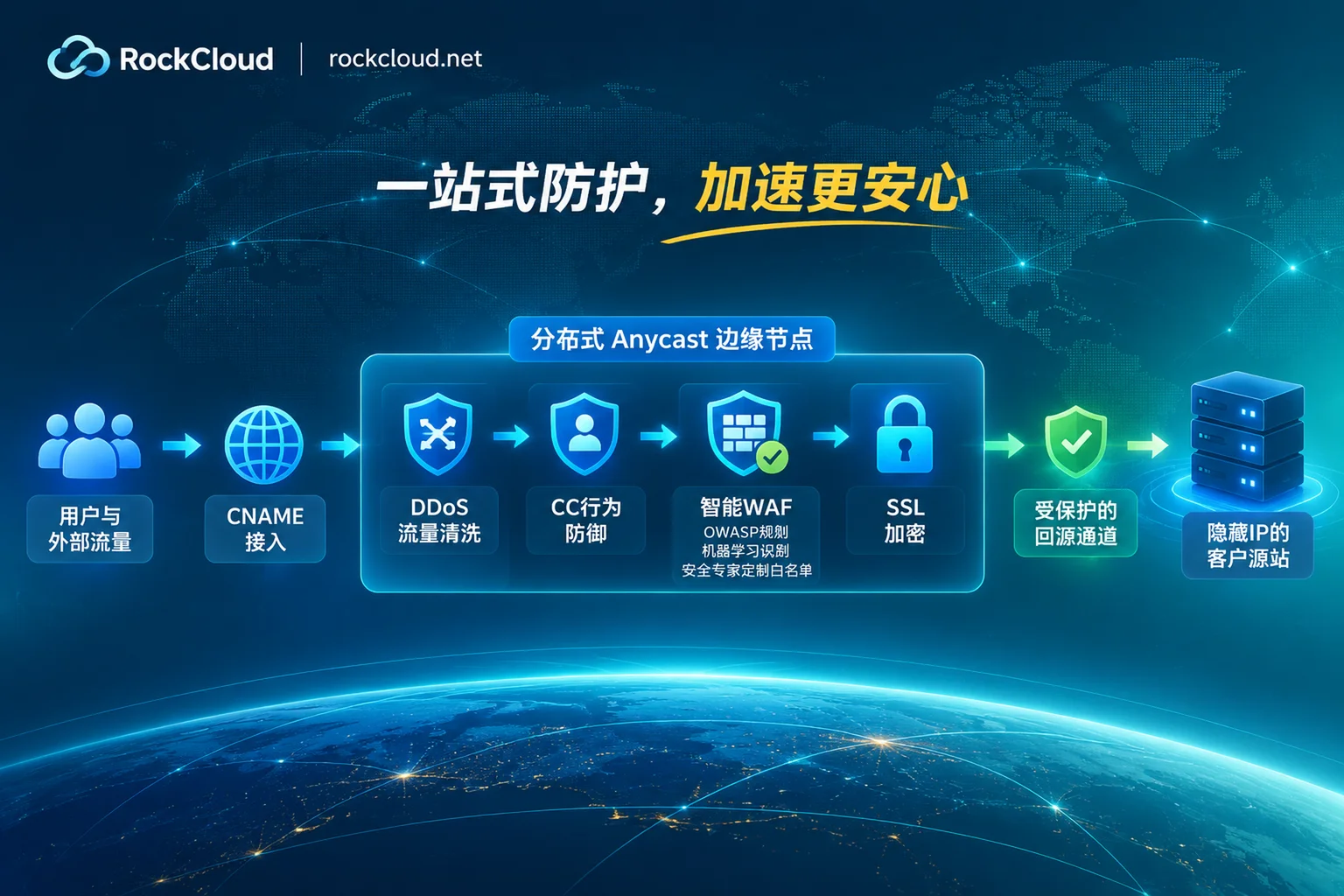
In RockCloud's high-defense CDN and DDoS/CC defense architecture, Anycast distributed DDoS cleaning, CC defense, and intelligent WAF are on the same request path:
- No separate purchase and chaining required: After traffic enters the edge node, it sequentially undergoes large-traffic cleaning, high-frequency CC behavior identification, and Layer 7 WAF deep inspection, which not only eliminates the latency stacking caused by chaining multiple vendor products but also avoids fragmented security policies.
- Strictly prevent origin bypass: Simply add a CNAME record to complete access (no need to modify NS, DNS remains with the original service provider, and old and new links run in parallel during switching). After access, the origin IP is completely hidden; if emergency access is needed during an attack, cooperate with synchronously changing the origin IP and configure the origin firewall to only allow RockCloud origin-pull nodes (see "Why Does Accessing High-Defense CDN Still Get Breached? Deconstructing Origin IP Leakage Paths and Anti-Bypass Origin-Pull Architecture"), completely sealing off the attacker's path to bypass the WAF and directly connect to the origin.
4. Fixed Peak Billing, Immune to "Sky-High Bills" from Malicious Traffic Floods
In the WAF and API security field, major cloud vendors are upgrading functional modules, but this is often accompanied by complex bills based on QPS (queries per second), processed request count (Request), or cleaned traffic. Once encountering continuous automated vulnerability scanning, large-volume payload padding attacks, or API high-frequency interface flooding, although the WAF blocks the attacks, enterprises may receive a staggering bill for excess traffic and requests.
RockCloud adheres to transparency and predictability in its billing model: Packages are billed monthly by default, based on fixed peak values, with unlimited traffic and request counts. Acceleration and defense are integrated into the same package, including DDoS/CC defense, intelligent WAF, and free fully automated SSL certificates, with no separate additional payment for defense modules. No matter how many billions of malicious requests external scanners and attack scripts initiate, your security budget remains locked within a controllable range.
IV. WAF Protection Implementation Recommendations for Different Business Scenarios
When deploying a security defense line in front of your existing servers or cloud hosts, you can combine and harden according to business forms with RockCloud's general and industry solution capabilities:
- Websites, independent sites, and corporate portals: Enable intelligent WAF and free fully automated SSL with one click in the control panel; use multi-domain batch operations to uniformly manage certificates and security policies; for backend management paths (such as
/admin,/wp-login), combine IP and region black/whitelist functions to only allow office IP access, fundamentally preventing backend brute force and 0day probing. - APP backend, WEB API, and payment interfaces: In addition to enabling WAF's OWASP rules and machine learning protection, it is recommended to enable security tokens and signed URLs to verify the legitimacy of core API requests; also enable Telegram real-time data push so the operations team can stay informed of abnormal interception dynamics.
- Cross-border overseas and circum-China access business: If the origin is overseas but needs to serve mainland China users, or the business requires extremely fast global response, you can overlay Global CDN Acceleration or CN2 China Acceleration Dedicated Line (Telecom CN2 GIA, Unicom AS9929, Mobile CMI three-network direct return to China, circum-China nodes access without ICP filing) while enabling WAF protection, achieving both HTTP/3 extreme speed access and high-intensity Layer 7 protection on a single link.
- TCP/UDP non-HTTP protocol game business: It should be noted that WAF is specifically designed for HTTP/HTTPS Layer 7 web and API traffic; if your game business includes a large amount of non-HTTP private TCP/UDP protocol communication, it is recommended to use Game Shield for private protocol encapsulation and distributed node seamless switching, while handing lobby login and payment web interfaces to WAF for protection, achieving full-stack coverage.
Conclusion
When attackers have already used automated mutation tools and AI-assisted vulnerability discovery, enterprise web security defense lines must not remain in the old era of "install an open-source plugin and enable a set of default rules". Truly effective WAF protection should be a dynamic immune system that is pre-positioned at the business edge, combines OWASP standard specifications with machine learning evolution capabilities, and has a professional security team backing tuning.
If you are selecting a security architecture (welcome to view RockCloud's selection comparison with mainstream cloud vendors and traditional high-defense), or wish to verify the interception effect and zero false positive performance of intelligent WAF in real business environments, you can contact online customer service at any time to determine specifications and apply for a free test.
Suffering from web vulnerability attacks, malicious scanning, or CC floods and need immediate access to protection?
Please immediately seek emergency support through the Contact Page (Security Response Team) or directly click Telegram Online Customer Service (@rockclouds). We will assist you in quickly completing CNAME seamless access and custom rule interception to immediately restore smooth business operations.