RockCloud-基石云安全-官方博客
For operations managers of websites, apps, APIs, games, and payment businesses, the most suffocating moment is when the monitoring dashboard suddenly turns all red: bandwidth instantly maxed out, database connection pool exhausted, and then a text message from the cloud provider arrives: "Public IP has triggered blackhole policy."
In the past, many teams' understanding of DDoS emergency response was still stuck at "detect anomaly—submit ticket—troubleshoot signature—temporarily add bandwidth." However, the latest global attack-defense data shows that this step-by-step traditional emergency model has completely failed. If you cannot outrun the attacker's automated scripts at the architecture level, a few minutes of attack pulses are enough to plunge your business into hours of paralysis.
This article combines the latest industrialized DDoS attack landscape to explain why most teams repeatedly stumble during "fireline emergency rescue," and provides a practical implementation path from minute-level bleeding stop and recovery to blocking secondary counterattacks.
I. Why has traditional "firefighting" DDoS emergency response completely failed?
If you review recent security incidents, you will find that attackers' tactics have evolved in three extremely fatal ways, directly piercing conventional manual response defenses:
1. "10-minute pulse" versus "hours-long cloud blackhole"
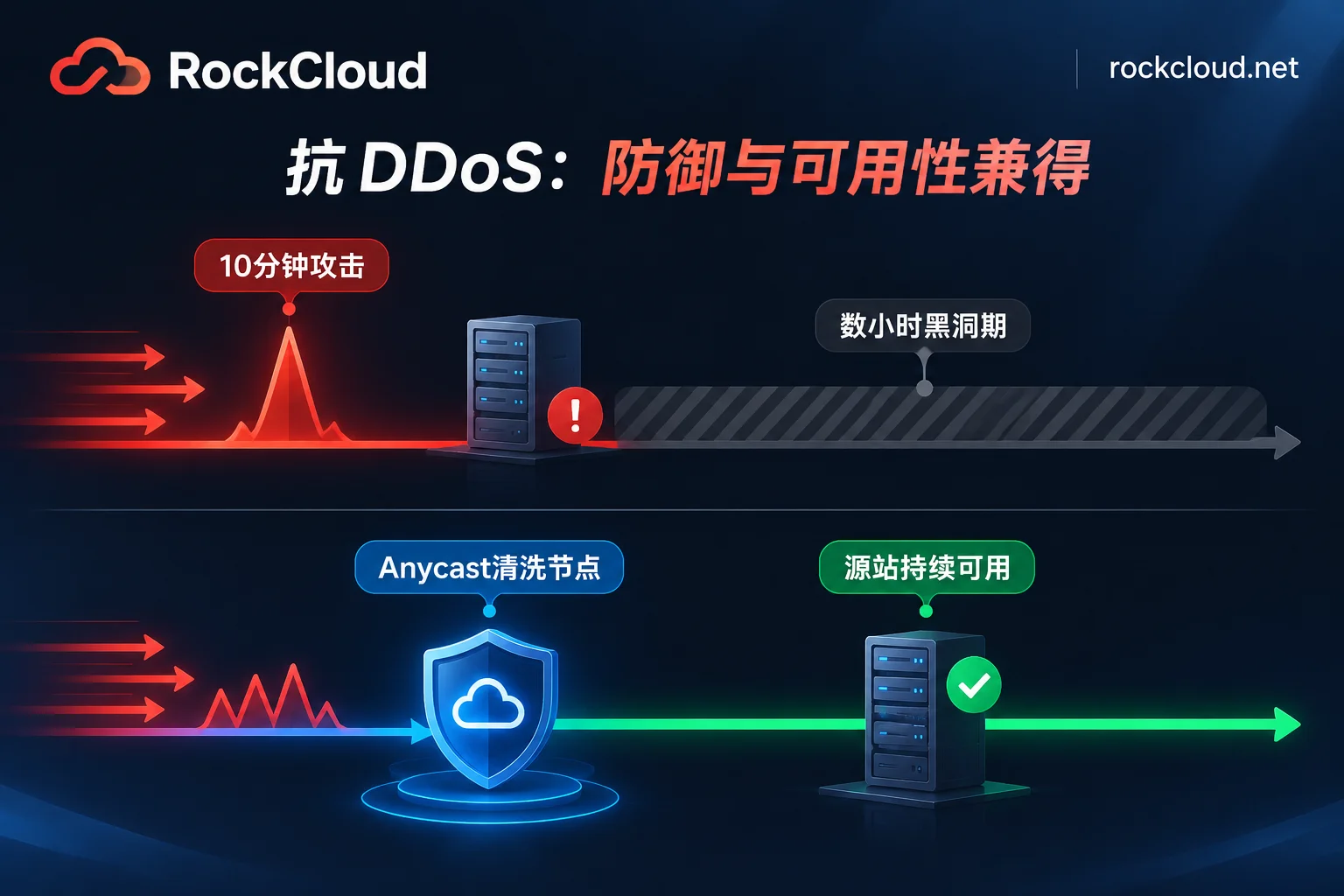
According to the report "Observations on Cloud Attack and Defense Industry in the AI Era—DDoS Attack Trends and Defense Evolution" jointly released by the China Academy of Information and Communications Technology and security agencies, DDoS attacks have fully entered the industrialization stage, with 82% of network-layer attacks ending quickly within 10 minutes; another global monitoring data points out that up to 89% to 95% of L3/L4 attacks last only a few minutes.
Why do attackers strike so briefly? Because they have accurately calculated the cloud provider's "blackhole mechanism." When a pulse flood breaches the basic protection threshold of a cloud host within one or two minutes, the cloud platform will immediately pull that public IP into blackhole to protect itself, blocking all external communication. Attackers only need to pay a few minutes of traffic cost to exchange for a "blackhole blocking period" of 30 minutes to 24 hours on the target source site. By the time you open your computer to troubleshoot, the attack traffic has long retreated, leaving you with only the source IP that has been firmly blocked by the cloud provider.
2. Over 70% probability of "secondary counterattack" and multi-vector variation
Do not think that surviving the first wave or waiting for the blackhole to automatically unblock means everything is fine. SentinelOne's "2026 DDoS Attack Statistics and Trends" points out that over 70% of attacked enterprises will be hit again, with each initial incident averaging 2.8 subsequent attacks; at the same time, about one-third of attacked targets are accompanied by extortion threats (RDDoS).
More troublesome is that the first probe is often just a bait. Industry reports show that currently 70.97% of attacks use multi-vector composite patterns, and application-layer (L7) "long-cycle attrition warfare" lasting over 24 hours has surged by 380%. Attackers are accustomed to first using UDP/SYN reflection floods to test your bandwidth bottom line. Once they find you have access to basic traffic scrubbing, they immediately switch within minutes to layer-7 CC attacks or slow exhaustion attacks targeting login, payment, and query interfaces.
3. "Suicidal operations" during emergency line switching
Under extreme anxiety of business interruption, operations teams are highly prone to three fatal mistakes when temporarily accessing external protection:
- Blindly modifying domain NS records: Attempting to access protection by changing DNS providers, but subject to the long propagation period of global DNS recursive caches (see "How long does high-defense line switching take to take effect: DNS change takes minutes to hours, BGP traction in seconds, always-on access does not require temporary switching"), business is completely halted during the hours of waiting for propagation.
- Running naked with an already exposed source IP: Directly pointing the high-defense CDN to the old source IP under attack without replacing the source public IP. Attackers bypass the CDN and directly bomb the source IP, rendering protection useless.
- Pay-as-you-go causing "sky-high bills" secondary disaster: Enabling cloud protection billed by traffic or requests in an emergency. As a result, although business recovers, at the end of the month you receive a huge scrubbing bill far exceeding business profits.
II. Golden bleeding-stop period: How to restore business via the shortest path when under attack?
When business already shows lag, packet loss, or even the source site entering blackhole, every minute of downtime causes real order loss and user churn. Compared to reading lengthy troubleshooting documents from scratch (for basic theory, see "DDoS Attack Incoming: Don't Let Business Collapse in "Waiting for Response," RockCloud Emergency Response Manual"), fireline self-rescue must follow the four-step iron law: "change IP, lock origin, fast switch traffic, full interception."
Taking the emergency practice of accessing RockCloud (Jishi Cloud) as an example, the standard fireline takeover process is as follows:
Step 1: Immediately enable a new source IP and lock down the origin whitelist (core prerequisite)
If the source site is under attack, it means your real source IP has been completely exposed in the attacker's scanning list (for leakage paths, see "Why is high-defense CDN still breached? Deconstructing source IP leakage paths and anti-bypass origin architecture").
- Action: If your cloud host has entered blackhole, do not wait for unblocking. Immediately bind a new elastic public IP to the server in the existing cloud provider console (or switch the load balancer to a new IP), and replace the source IP synchronously.
- Firewall lockdown: Before the new IP provides external services, immediately configure policies in the server security group or local firewall—the source site only allows RockCloud's origin node IP ranges, denying direct access from any other public IP. Thus even if attackers continue scanning, they cannot directly reach your server.
- (Note: If your origin is deployed on AWS, Azure, GCP, or Alibaba Cloud International, Tencent Cloud International, Huawei Cloud International, and you encounter emergency scaling of new IPs but insufficient account balance or stuck in real-name verification, you can quickly recharge and open an account directly with USDT via the RockCloud International Cloud Top-up channel, without enterprise verification procedures, and complete source whitening in sync with high-defense CDN.)
Step 2: Without changing NS, add a CNAME to achieve parallel switching between old and new links
To make protection take effect as quickly as possible, absolutely do not touch the domain's NS (Name Server) records during emergency response.
- Action: Keep the original DNS resolution provider unchanged; simply modify the business domain's A record in the original DNS console to point to the CNAME address assigned by RockCloud High-Defense CDN.
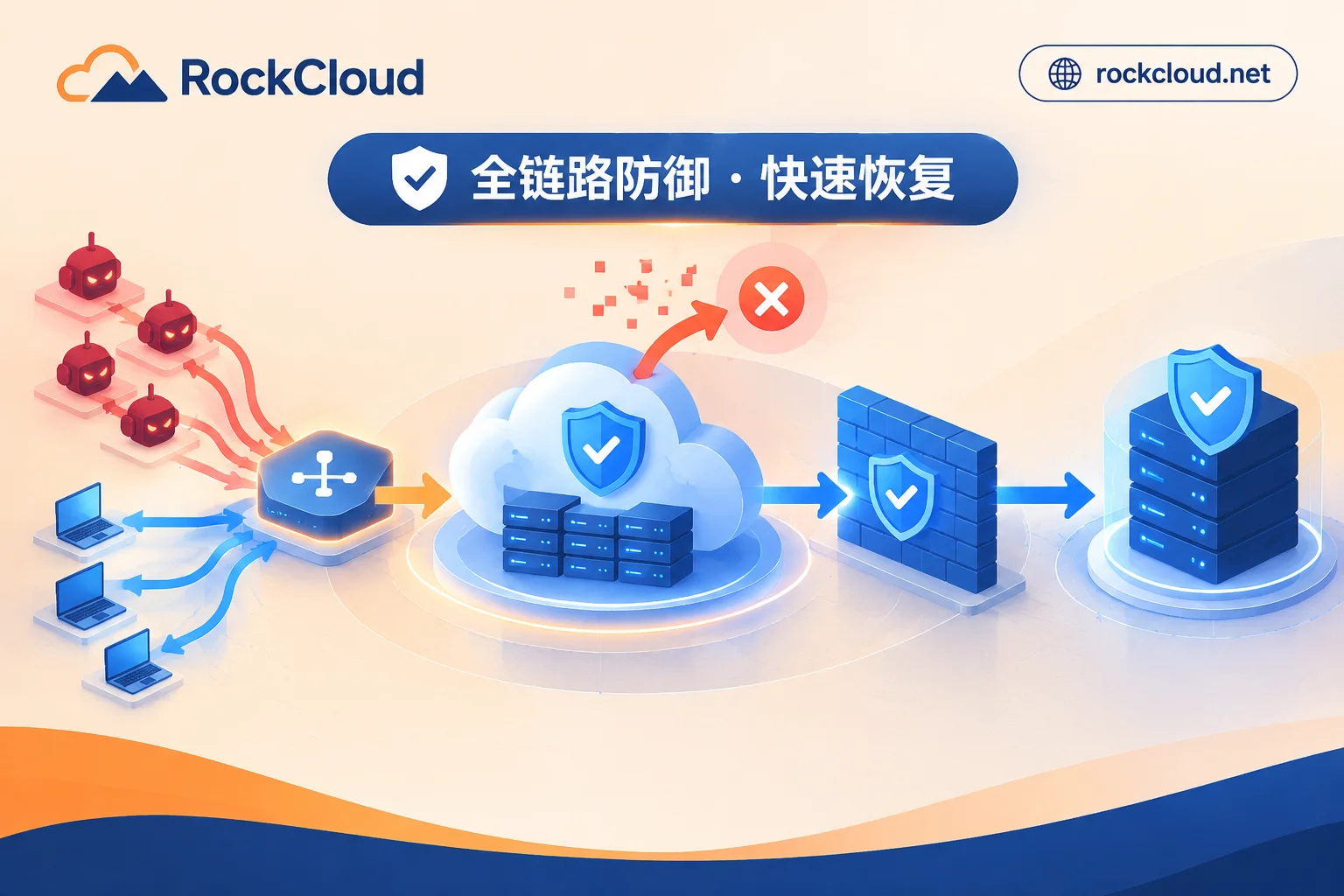
- Architecture advantage: CNAME access supports parallel old and new links. Since no top-level domain NS change is involved, local DNS refresh is extremely fast, and normal user requests worldwide will smoothly transition to the Anycast distributed scrubbing network as records refresh, achieving imperceptible traffic switching and complete hiding of the source IP.
Step 3: L3/L4 and L7 same-path scrubbing, one-click enable intelligent WAF to block variations
After traffic switching is complete, the first wave of large-scale flooding will be absorbed nearby by Anycast edge nodes. But as mentioned earlier, over 70% of attackers will immediately launch a second wave of variations, especially CC attacks and malicious bot scans mixed in normal HTTPS requests.
- Same-path integrated defense: In RockCloud's architecture, DDoS defense and CC defense are on the same request path, eliminating the need to separately purchase high-defense IP and WAF and then perform complex串联 configuration during an emergency.
- Second-level enablement of layer-7 rules: Operations personnel only need to one-click enable the Intelligent WEB Firewall (WAF) in the control panel. The system not only preloads the OWASP core rule set (automatically intercepting SQL injection, XSS, file inclusion, command injection, scanners, bots, etc.), but also calls machine learning models to identify in real time mutated malicious requests not yet in the rule base.
- Expert collaborative tuning: Facing complex CC attacks where attackers forge normal client fingerprints, if the operations team is unsure about interception thresholds (worried about false positives on normal payment callbacks or API calls, see "How to do WAF protection: Practical architecture for block padding bypass, 0day mutations, and high false-positive pain points"), RockCloud's security technical team can directly assist in configuring custom rules and exception allowlisting, precisely stripping dirty traffic while ensuring core transaction links remain smooth.
Step 4: Specialized fireline takeover for non-HTTP games and TCP/UDP private protocols
If the attack target is not a website or Web API, but a PC game, mobile game, or long-connection instant messaging service using TCP/UDP private protocols, traditional Web CDN cannot handle such non-HTTP traffic.
- Action: For such businesses, directly choose GameShield during emergency access.
- Anti-counterattack mechanism: GameShield encapsulates the game's non-HTTP protocols into private protocols, forwards them via distributed edge nodes across all protocols, and hides the source. More critically, during the subsequent average 2.8 counterattack cycles, even if an edge node suffers a targeted saturation attack, GameShield can automatically switch to a high-defense node and keep the connection uninterrupted, completely ending the nightmare of "the entire server goes offline whenever hit" (for principles, see "Why do all players disconnect when a game is under DDoS attack: How GameShield switches nodes without disconnection").
III. Beware of composite连环 strikes: "secondary battlefields" easily overlooked in emergency response
In the 2026 attack-defense practice, up to 65% of DDoS attacks are bundled with extortion or other malicious sabotage. Many cross-border businesses, live streaming platforms, and Web3 applications targeting Asia-Pacific and mainland China users often encounter "DNS pollution and platform domain blocking" composite strikes while under DDoS traffic bombardment—that is, attackers simultaneously flood your servers and use malicious reports or pollution to make your domain inaccessible in specific regions or within WeChat/QQ.
If emergency response only focuses on scrubbing traffic, you will end up in a semi-paralyzed state where "server load drops, but domestic users still cannot open the website or access is extremely slow." Therefore, complete emergency recovery should simultaneously cover the following two dimensions:
- In-place recovery from blocking and pollution: For domain hijacking, DNS pollution, or WeChat/QQ blocking accompanying the attack, do not blindly change the primary domain in panic (this will completely zero out previous promotional traffic). Simultaneously enable the Blocking and Pollution Recovery solution, which restores normal access without changing the domain through server-side DNS pollution scrubbing and imperceptible 301 redirection technology.
- Rapid return-to-China route guarantee after scrubbing: Many overseas high-defense nodes experience severe detours and packet loss on cross-border return routes after enabling strict traffic scrubbing. For non-filing businesses targeting mainland China users, it is recommended to overlay CN2 China Acceleration network while accessing high-defense—accessing nearby from Hong Kong, Japan, South Korea, Singapore, and other China-surrounding nodes, with underlying Telecom CN2 GIA, Unicom AS9929, Mobile CMI three-network direct return dedicated lines, and combined with Global CDN Acceleration's HTTP/3 and TLS 1.3 0-RTT features, ensuring "fast" while "protected."
IV. From "passive firefighting" to "normal immunity": Calculating the economics of emergency vs. always-on
Why do many enterprises, knowing that DDoS threats are normalized, still choose to "find high-defense only after being hit"? The core reason often lies in cost concerns and architectural fragmentation—under the traditional model, buying CDN acceleration is one expense, and additionally deploying high-defense IP and WAF is another hefty budget; while choosing traffic-based cloud protection means constantly facing the risk of sky-high bills from attacks (see "What to do when CDN malicious hotlinking and DDoS attacks generate sky-high bills: Pay-as-you-go traps and high-defense CDN selection guide").
However, when 82% of attacks complete their harvest within 10 minutes and the human operations response limit is completely breached, the trial-and-error cost of "manually switching lines after being hit" far exceeds the investment in normalized protection. To escape the cycle of repeated firefighting, you need a foundation that combines "peacetime and wartime":
| Dimension | Traditional temporary firefighting mode (pay-as-you-go/fragmented procurement) | RockCloud always-on peacetime-wartime combined mode |
|---|---|---|
| Response time window | Detect blackhole ➔ submit ticket ➔ change NS/configure route (takes tens of minutes to hours, missing the 10-minute pulse interception window) | 0-second manual intervention, Anycast edge always-on scrubbing, millisecond-level automatic filtering of pulses and reflection floods |
| Protection link architecture | CDN acceleration, DDoS high-defense, WAF need separate procurement and串联, each extra forwarding layer adds latency | Acceleration and defense on the same link, within the same package, DDoS/CC defense, WAF, free fully automatic SSL all included |
| Billing controllability | Post-payment based on scrubbed traffic or request count, prone to runaway sky-high bills under sustained counterattacks | Monthly billing by fixed peak, unlimited traffic and requests, completely eliminating bill explosions caused by malicious hotlinking and attacks |
| Daily observability | Blind during attacks, need to download packets and manually analyze with Wireshark | Control panel provides real-time traffic/bandwidth reports and network logs, supports Telegram real-time data push and multi-domain batch operations |
By checking the RockCloud Billing and Package Description, you can see that using high-defense CDN as the standard entry point for daily business not only saves the hidden costs of separately purchasing WAF and SSL certificates, but more importantly, with a predictable fixed monthly fee, buys out the downtime risk and billing anxiety caused by sudden pulse attacks and连环 counterattacks. For high-bandwidth scenarios such as streaming media, you can also directly combine with Video CDN featuring security tokens, IP/region blocking, and Multi-DRM protection, achieving the integration of content distribution and security defense.
Conclusion: Under attack right now? Launch the emergency channel immediately
Facing industrialized, high-frequency, composite modern DDoS attacks, time is the only lifeline for business. Whether you are responsible for e-commerce websites, financial payment APIs, online live streaming, chess and card games, going-global games, or emerging AI services and Web3 platforms (for more vertical architectures, see Solutions by Industry and Mainstream Vendor Selection Comparison), you should not let core assets bleed during lengthy "ticket queuing" and "blackhole countdown."
- If your business is currently under DDoS/CC attack and urgently needs fireline access to stop the bleeding:
Please skip the regular consultation process and immediately go to the RockCloud Contact Page (select the "Security Response" channel, handled by a dedicated team for attack emergency response), or directly call our security engineers via the official Telegram emergency channel https://t.me/rockclouds. We will assist you in completing source IP hiding, seamless CNAME traffic switching, and WAF custom rule deployment as soon as possible. - If you want to complete defense reinforcement before the next attack wave:
Welcome to contact online customer service to determine business specifications and apply for a free test, supporting convenient settlement in USDT or USD. With a lightweight CNAME access, build an always-on, uninterrupted cornerstone defense for your core business.