 RockCloud-基石云安全-官方博客
First Answer: How to Choose High-Protection CDN? Six Criteria Should Be Checked Before Nominal Peaks
How to choose a high-protection CDN? First, look at six criteria: cleaning trigger latency, node distribution and single-node capacity, layer 7 rule granularity, origin return and origin protection, false positive rate and pass-through channels, and who owns over-peak handling; nominal defense peaks are just an entry threshold. The reason response speed is prioritized over peaks is that Radware's Q1 2026 threat analysis report shows a 168.2% year-over-year increase in network-layer DDoS attacks, and most ultra-large traffic attacks have been compressed to under 5 minutes, some even under 60 seconds. This means the response chain from anomaly detection to cleaning activation is more critical than the intimidating defense peak on the quote.
Before discussing specific criteria, let's establish a consensus: What's the difference between high-protection CDN and ordinary CDN? Ordinary CDN solves content distribution and acceleration; nodes close to users and high cache hit rates suffice. High-protection CDN must complete cleaning and filtering when traffic enters nodes, and the automation level of detection, scheduling, and handling directly determines business survival during attack windows. The six criteria below all revolve around this core difference.
What's on the Quote and What's Not: Four Gaps Beyond Nominal Defense Peaks
A typical high-protection CDN quote usually lists peak bandwidth, node count, and QPS limits—these three are most directly comparable but also most misleading. What truly determines business availability during an attack is often the four gaps missing from the quote:
| Common Quote Items | Typical Indication | Often Missing Info | Why It Matters |
|---|---|---|---|
| Defense Peak | Nominal Tbps/Gbps | Detection cycle and cleaning activation time | Attacks compressed to minute-level; being slow is as bad as no protection |
| Node Count | "XX nodes globally" | Single-node capacity and scheduling logic | Total capacity ≠ available capacity; traffic may bottleneck at a single node |
| QPS/Concurrency Limit | Nominal value | Rule customization boundaries | Composite attacks need free customization by interface, parameter, fingerprint |
| Service Level | 7×24 manual response | Over-peak handling and trigger conditions | Exceeding package leads to scaling, rate limiting, or banning—impacting cost and availability |
Ask sales to fill in the four right columns in writing; anything not filled is a risk item.
Criterion 1: How Long from Anomaly Detection to Cleaning Activation
This is the top priority criterion for choosing a high-protection CDN in the current environment. The Radware Q1 2026 threat analysis report specifically highlights the "DDoS time compression" phenomenon: attacks no longer last hours for you to discover; they strike within minutes or even tens of seconds. The old manual alarm, console traffic graph review, and DNS switch chain completely fail within such short attack windows, relying instead on automated handling in DDoS emergency response mechanisms.
Verification Method:
- Request the vendor to provide written documentation of detection sampling cycle and cleaning trigger latency, not just verbal "second-level" promises; configure a test domain during POC, intentionally trigger traffic anomalies, and compare attack start timestamp with rule activation timestamp.
- Confirm whether cleaning is automatically triggered or requires a ticket.
Unqualified Signals: Only promising "7×24 manual response"; cannot explain detection sampling cycle; requires customer to submit a ticket before cleaning starts.
Criterion 2: Node Distribution and Single-Node Capacity
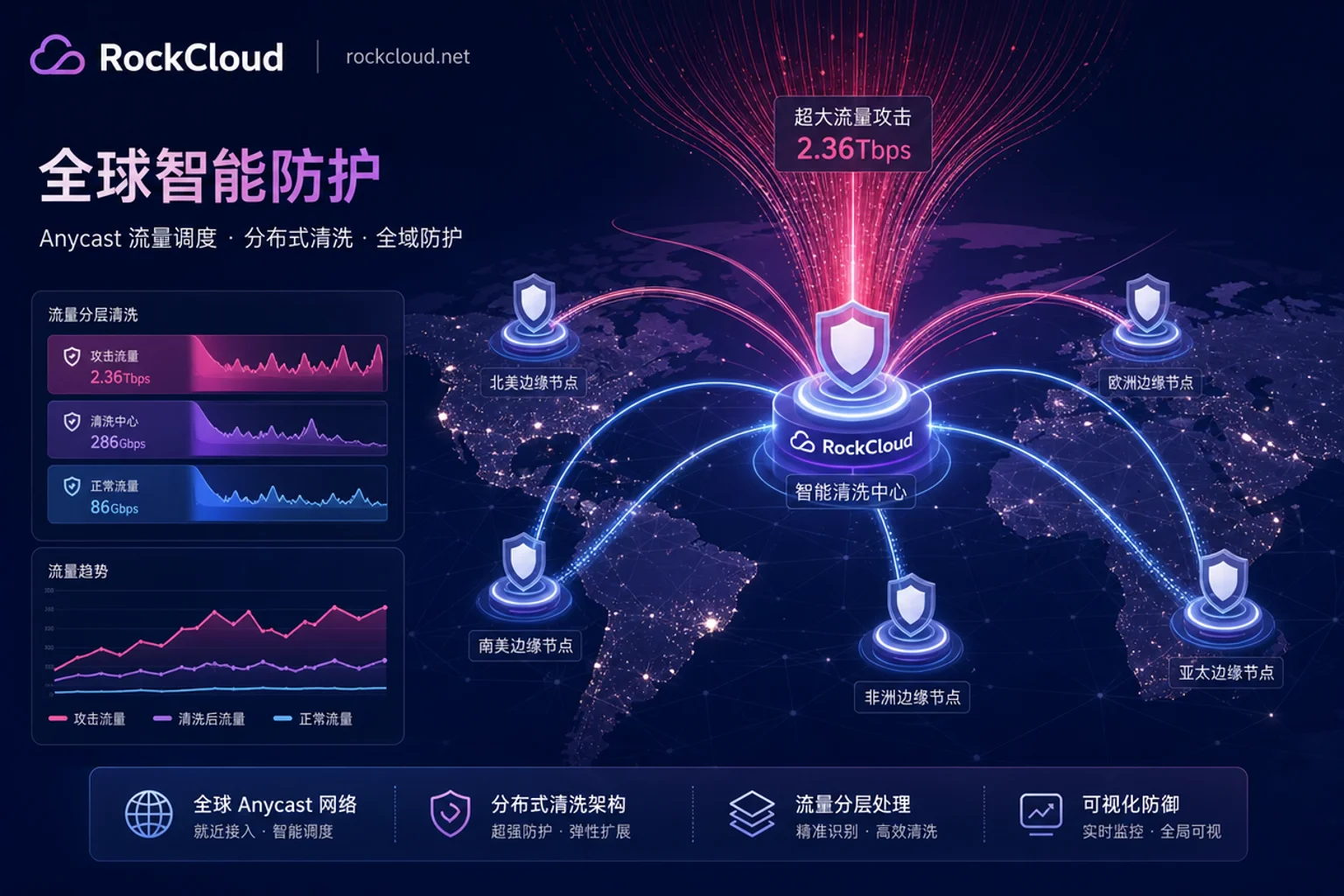
Cloudflare's H1 2026 report shows a 519% quarter-over-quarter spike in DDoS attacks over 1 Tbps, with DNS amplification and CLDAP reflection as primary vectors. At this scale, total capacity doesn't equal available capacity—if your business traffic is routed to a node with insufficient capacity, even the vendor's entire network bandwidth won't help.
Verification Method:
- Verify actual access nodes in the target business region, not the total "hundreds of nodes worldwide"; ask for single-node bandwidth and nearest-node scheduling logic.
- Use monitoring tools in different regions to confirm whether DNS resolution lands near users.
Here I'll answer two common procurement questions: Can a high-protection CDN defend against 1T+ attacks? It depends on single-node capacity and Anycast distribution, not total bandwidth. Are node count or single-node bandwidth more important? Node count ensures coverage; single-node bandwidth ensures survival under sudden impact—both are essential. Also learn about differences between high-protection IP and high-protection CDN and differences and selection between BGP high-protection and single-line high-protection for comprehensive evaluation.
Criterion 3: Layer 7 Rule Granularity and Customization
Behind 1Tbps pulse traffic often lie composite attacks of layer 4 floods and layer 7 application attacks. Beyond layer 4 cleaning, confirm whether the vendor supports rule combinations by URL path, request parameters, headers, and client fingerprints; whether it supports rate limiting, human-machine verification levels, and grayscale rollback mechanisms for rule changes.
Verification Method: During POC, have vendor engineers configure a rule for a real business interface on-site, observe activation time, log detail, and whether misconfigurations can be quickly rolled back.
Unqualified Signals: Only fixed rule templates provided by the vendor, no customization based on business characteristics.
Criterion 4: Origin Return Link and Origin Protection Closed-Loop
After integrating a high-protection CDN, the origin may still be exposed: historical DNS records, subdomain enumeration, email headers, and direct IP scanning are common paths attackers use to find the origin. During selection, confirm whether the vendor provides a complete origin protection closed-loop.
Verification Method: Check if it supports origin IP whitelist, encrypted origin return, and direct connection interception; use external scanning tools to confirm if the origin is still directly accessible.
Unqualified Signals: Only hides the domain, does not provide origin IP whitelist or encrypted origin return; cannot explain handling of historical DNS records.
Criterion 5: False Positive Rate and Pass-Through Channels
Every high-protection CDN has false positives; claiming zero false positives is itself a red flag. The key isn't whether false positives occur, but the speed of discovery and recovery after they do. How to handle false positives should be tested during POC.
Verification Method: Gradually shift some real business traffic to the high-protection CDN, compare normal request blocking logs and business conversion data before and after; test the latency of whitelist and emergency pass-through activation, and confirm whether operation permissions are on the operations side, not just the vendor.
Unqualified Signals: Cannot provide a grayscale traffic shift plan; pass-through operations require a ticket and exceed minute-level latency.
Criterion 6: Who Owns Over-Peak, Banning, and Recovery Disposal Rights
When traffic momentarily exceeds the purchased package peak, vendor handling differs greatly: some auto-scale elastically, some rate limit to maintain baseline, some temporarily ban. This is also the real answer to "how much per month"—price differences often hide in over-peak clauses.
Verification Method: In the contract or SLA, explicitly require: conditions triggering over-peak, notification method and time limit, temporary actions (scale/limit/ban), recovery process, and billing method for over-peak traffic.
Unqualified Signals: Sales verbally promise "no downtime over peak," but no corresponding clause in the contract.
Six Criteria Comparison Table and Unqualified Signal Quick Reference
Breaking down how to choose a high-protection CDN into actionable steps, here's the quick-reference table.
| Criterion | Self-Test Method | Written Commitment Required from Vendor | Unqualified Signal |
|---|---|---|---|
| Cleaning trigger latency | Trigger anomaly on test domain, compare timestamps | Detection sampling cycle and cleaning trigger latency | Manual response, ticket trigger |
| Node distribution and capacity | Check regional nodes, cross-region DNS resolution | Single-node bandwidth and scheduling logic | Only mentions global total nodes |
| Layer 7 rule granularity | Configure real interface rules on-site | Rule customization boundaries and rollback mechanism | Only preset templates |
| Origin return and origin protection | External scan of origin direct access | Whitelist and encryption for origin return | Only hides domain, no IP whitelist |
| False positives and pass-through | Grayscale traffic shift, test pass-through latency | False positive alert and pass-through operation permissions | Claims zero false positives, pass-through via ticket |
| Over-peak disposal | Verify contract and SLA clauses | Over-peak trigger conditions and billing method | Verbal promises, no contract clause |
Comparison Example: How RockCloud High-Protection CDN Aligns with These Six Criteria
The six criteria above are a general selection methodology, applicable to evaluating any vendor. As a reference, see how RockCloud High-Protection CDN aligns:
- Cleaning trigger latency and node distribution: Uses edge cleaning and automated handling to reduce manual intervention; Anycast-based global node distribution, with nearest-node scheduling to share ultra-large traffic impact. Specific activation latency and single-node capacity should be tested during POC.
- Layer 7 rule granularity: Smart WAF supports interface-level rule configuration, allowing combined filtering conditions based on business characteristics; during POC, you can request on-site configuration for real interfaces.
- Origin return and origin protection: Provides origin protection and origin return control; specific whitelist and encryption mechanisms can be confirmed with technical support before integration.
- False positives, pass-through, and over-peak handling: Supports grayscale traffic shift and rule debugging; false positive handling paths should be verified with real business traffic during trial; technical support can assist in discussing custom security rules. Over-peak billing and handling terms are subject to the contract—please verify each clause before signing.
The above capability alignments are directional and do not constitute commitments to specific peaks, node counts, or activation seconds. Please test on your own business using the methods described.
Pre-Signing Question Checklist for Service Providers
How to choose a high-protection CDN ultimately boils down to whether you can get these answers. Copy this list directly into your POC test sheet, ask and record each item:
- What are the detection sampling cycle and cleaning trigger latency? Can you provide written documentation?
- Is cleaning automatically triggered or does it require a ticket? What triggering methods are supported?
- What are the access nodes in my business region? What is the single-node bandwidth?
- What customization dimensions does layer 7 protection support? Can I combine URL, parameters, headers, and fingerprints?
- What origin protection mechanisms are supported? Do you have origin IP whitelist, encrypted origin return, and direct connection interception?
- What are the channels for false positive alerts and emergency pass-through? Who holds operation permissions?
- What actions are taken when exceeding package peak? Scaling, rate limiting, or banning?
- How long are attack logs and reports retained? Can they be exported?
How to test defense peaks? Use traffic below the package peak for step testing, observe cleaning trigger thresholds and activation time, rather than pursuing real attack scale—security testing itself may be misjudged as an attack. How long does cleaning take to activate? Directly stress test in a test environment and compare timestamps; differences in detection cycles between vendors are far greater than differences in cleaning backend efficiency.
FAQ
What is the difference between high-protection CDN and ordinary CDN?
Ordinary CDN solves content distribution distance; nodes near users and cache hits suffice. High-protection CDN adds traffic cleaning capabilities on top of distribution, detecting and filtering DDoS attacks, and includes origin protection, origin return control, and other security mechanisms. During selection, focus on cleaning detection chains and rule customization capabilities. For more systematic mechanisms, refer to DDoS defense and traffic cleaning system.
How much does high-protection CDN cost per month? How to choose between monthly and pay-as-you-go?
The monthly fee is just the surface; real cost depends on over-peak handling clauses: whether over-peak in monthly packages is rate limiting or elastic scaling, and whether pay-as-you-go unit prices include cleaning fees—these are key cost differences. Include estimated over-peak costs in your comparison.
Can high-protection CDN defend against 1T+ attacks?
It depends on single-node capacity and Anycast distribution logic, not total network bandwidth. If 1Tbps+ traffic concentrates on a single node, any vendor can be overwhelmed. Before signing, require vendors to specify single-node capacity and scheduling strategies, and test in your own business region.
How long does high-protection CDN take to activate cleaning?
Attack durations are commonly compressed to 5 minutes or even 60 seconds (as referenced earlier), so cleaning must activate within seconds to be effective. During POC, trigger anomalies on a test domain and compare attack start timestamp with rule activation timestamp to measure actual latency. Reject manual ticket-triggered solutions.
What happens if high-protection CDN false positives block normal users?
During selection, prioritize three capabilities: whitelist mechanism, emergency pass-through channel, and false positive alerts. During POC, use grayscale traffic shift to compare blocking ratios of normal requests and verify actual time from detecting false positives to restoring pass-through. Every solution has false positives; the key is recovery speed.
Will the origin still be exposed after integrating high-protection CDN?
Possibly. Historical DNS records, subdomains, and email headers are exposure paths. After integration, enable origin IP whitelist, encrypted origin return, and direct connection interception, and periodically scan externally to check if the origin is still directly accessible.




Comments(0)