 RockCloud-基石云安全-官方博客
The application of BGP Anycast technology in DDoS mitigation essentially distributes inbound traffic to multiple edge nodes geographically, avoiding bottlenecks in the return link and a single mitigation center. It does not equal mitigation capability itself. However, whether a provider's claimed Anycast capability is genuine can be verified through three self-testable links: inbound route announcement, edge local drop, and node removal and convergence latency. Based on Cloudflare's May 2026 updated reference architecture and official CISA alerts, this article provides specific verification actions and criteria.
Conclusion First: Anycast Solves Only Three Things in the DDoS Mitigation Chain
The core of BGP Anycast technology in DDoS mitigation is to distribute attack traffic to multiple edge nodes for local absorption, avoiding bottlenecks in the return link and a single mitigation center; it itself is not the mitigation capability. The May 2026 Cloudflare reference architecture clearly states that using BGP Anycast route broadcasts can distribute inbound traffic to global edge nodes, combined with XDP/eBPF architecture to achieve second-level automated stateless mitigation at the edge. This implementation is part of Cloudflare's Magic Transit reference architecture (May 2026 update) and is a vendor-specific solution; it does not imply that all providers have equivalent edge mitigation. Acceptance should still follow the three-step self-test below. For massive traffic attacks, distributed absorption points are more critical than stacking single-point capacity.
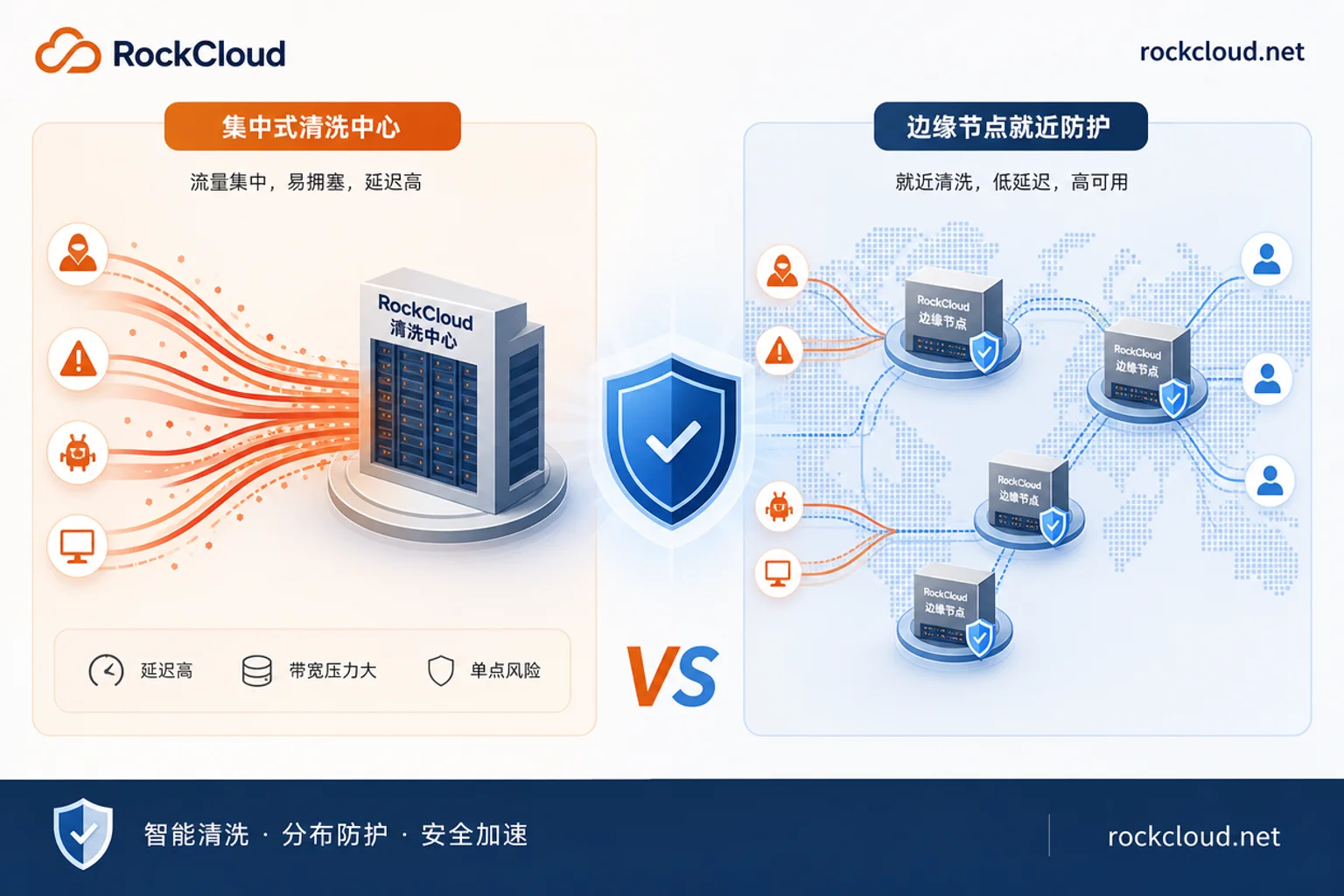
Path A vs Path B: Traffic Flow Differences Between Centralized Redirection and Anycast Local Absorption
Traditional centralized mitigation (Path A) redirects attack traffic to a few mitigation centers, which filter and then reinject to the origin. Traffic must detour to specific regions, causing higher latency. In contrast, Anycast (Path B) has multiple edge nodes announcing the same prefix simultaneously, so traffic is automatically absorbed locally. Attack packets are dropped at the edge, and clean traffic goes directly to the origin, reducing detour hops. This answers "what is the difference between anycast and unicast mitigation": unicast mitigation is "redirect to center," while Anycast mitigation is "absorb locally."
From a latency perspective, which is lower: anycast mitigation or redirect to a mitigation center? Typically Anycast is lower because traffic does not need to detour to a centralized mitigation center, but the actual latency depends on edge node coverage and routing policies. The table below compares key differences. If an attack has already occurred, refer to the handling sequence in DDoS emergency response; also refer to differences between high-defense IP and high-defense CDN for further selection:
| Comparison | Centralized Redirection | Anycast Local Absorption |
|---|---|---|
| Traffic flow | Redirect to few centers, then reinject | Distributed to multiple edges, processed locally |
| Latency impact | More detour hops, higher latency | Local absorption, lower latency |
| Link bottleneck | Return link prone to congestion | Edge links distributed, lower bottleneck probability |
| Suitable scenarios | Scenarios with strict compliance requirements | Massive traffic, global business |
Why the Link Bottlenecks Before Mitigation Devices Under Massive Traffic
According to CISA alert, connectionless UDP protocols (such as DNS, NTP, SSDP, CLDAP) lack source address verification and are easily spoofed for reflection amplification attacks, generating tens to hundreds of times traffic amplification. Such attacks first saturate the ingress and return link bandwidth, not the mitigation device's processing capacity. Therefore, distributing absorption points is more effective than stacking single-point capacity—this is the core reason BGP Anycast technology is prioritized in high-defense selection in 2026.
Verification Step 1: Confirm Inbound Route Is Announced by Multiple Nodes
The first step to verify whether BGP Anycast technology in DDoS mitigation is real is to confirm that the inbound route is announced by multiple nodes. You can use RIPE Atlas probes or execute mtr -rwzc 20 目标IP and traceroute -A 目标IP on cloud hosts in different regions, recording the second-to-last hop AS number and city; then query the same prefix's upstream AS count and AS-Path via bgp.he.net's prefix page, RIPEstat's routing-status, or Route Views/RIS. Observation metrics: whether the second-to-last hop AS/city differs across regions, and whether the same prefix has more than one upstream AS.
Non-compliant signals:
- All regions converge to the same egress city, indicating possible single-point plus GRE reinjection.
- The prefix is announced by only one upstream, lacking multi-site announcement.
- The provider only offers GRE tunnel reinjection but claims Anycast.
Is it normal for multi-site pings to the same IP to have large latency differences? If it is true Anycast, latency differences across regions are normal because traffic connects to different edge nodes locally; but if all regions have similar and high latency, traffic may be redirected to a central point.
Verification Step 2: Attack Traffic Dropped Locally at Edge or Redirected to Mitigation Center
The second step is to observe whether attack traffic is dropped at the edge. You can compare RTT and packet loss distribution from multiple probing points during a controlled stress test, ask the provider for edge node drop and hit statistics, and check if clean traffic paths become longer.
Non-compliant signals: When the attack begins, all regions' latency rises simultaneously, indicating traffic is redirected to a central point; if paths become longer after mitigation, detours may be occurring.
Verification Step 3: BGP Anycast Convergence Time and TCP Connection Stability
The third step is to verify node removal and route convergence latency, which relates to "how long does BGP Anycast convergence take" and "can Anycast nodes cause TCP connection interruption." Method: During a stress test, actively request removal of a node in a region, record when multiple probing points become reachable again, observe whether TCP long-lived connections and TLS sessions reconnect, and how stateful services (login states, uploads, WebSocket) behave. Convergence time depends on upstream policies and propagation; unverified numbers should not be trusted. If prolonged interruption or frequent connection resets occur during removal, session state may be poorly maintained between nodes.

Three-Step Verification Comparison Table and Non-Compliant Signal Quick Reference
The table below summarizes the three-step verification actions for BGP Anycast technology in DDoS mitigation and can be used directly as an acceptance checklist:
| Step | Verification Action | Required Materials | Compliant Signal | Non-Compliant Signal |
|---|---|---|---|---|
| 1. Route Announcement | Multi-site traceroute, query RIR | Prefix announcement list | Different nodes visible from different regions | All regions converge to same egress |
| 2. Edge Local Drop | Stress test comparing RTT and packet loss | Edge node drop statistics | Only some regions affected during attack | All regions' latency rises simultaneously |
| 3. Convergence Latency | Node removal test | Removal drill records | Quick recovery, connections mostly maintained | Prolonged interruption or connection resets |
If an attack has already occurred, refer to the handling sequence in DDoS emergency response, and refer to differences between high-defense IP and high-defense CDN for additional selection basis.
What Anycast Cannot Solve: Application-Layer Detection, Session Persistence, and Origin Exposure
BGP Anycast technology only affects traffic landing points and bearing; it cannot identify realistic Bots, API business logic abuse, or slow connection exhaustion, nor can it automatically eliminate source exposure caused by historical DNS records, email egress, or unrecovered IPs. Therefore, complementary application-layer protection and session consistency design are needed. You can refer to the selection approach in how to choose high-defense CDN, combined with differences and selection between BGP high-defense and single-line high-defense, to confirm whether additional protection is needed.
RockCloud's Position in Edge Bearing and Origin Protection
After clarifying verification methods, let's see how RockCloud's Anycast global network and high-defense CDN fit: its Anycast global network corresponds to the first step of multi-site announcement, high-defense CDN edge filtering corresponds to the second step of local drop, and WAF and CC defense correspond to application-layer detection that Anycast cannot cover. During contract signing, you can request materials such as prefix announcement sources, multi-site probe reports, and removal drill records from the provider.
FAQs
How to Judge Whether an IP Is Anycast?
Use multi-site traceroute. If different regions show different AS and geographic IPs in the last few hops, it is typically Anycast; if all regions converge to the same AS and geographic location, it may be unicast.
Can Anycast Nodes Cause TCP Connection Interruption?
If sessions are not synchronized during node switch, TCP resets may occur. However, mature Anycast solutions strive to maintain session consistency; you can verify by observing whether connections reconnect during node removal.
Is It Normal for Multi-Site Pings to the Same IP to Have Large Latency Differences?
Yes. True Anycast nodes are geographically distributed, so local access causes latency differences; but if all latencies are high and similar, traffic may be centrally redirected.
Which Has Lower Latency: Anycast Mitigation or Redirect to Mitigation Center?
Usually Anycast is lower because it absorbs traffic locally and reduces detours. But the actual latency depends on node coverage and routing policies, requiring real testing.
Do We Need to Keep a Centralized Mitigation Center Simultaneously?
Whether to keep a centralized mitigation center depends on business geographic distribution, compliance requirements, and existing access methods. Anycast affects traffic landing points and bearing; mitigation effect still depends on edge filtering capability, so you cannot decide solely based on whether Anycast is used.




Comments(0)