 RockCloud-基石云安全-官方博客
Origin hiding is a layered defense mechanism, not a single operation. Many teams' first reaction is to change the IP, but if you don't clarify which layer the problem lies in, changing the IP simply re-exposes the same exposure. In August 2026, official documentation continued to update origin pull authentication guidelines, pointing directly to the common industry misconception of "origin knocked offline" even after mounting a CDN. The five progressive layers each have their role: exposure cleanup reduces the chance of discovery, DNS layer lockdown eliminates bypass entries, network layer whitelisting provides basic isolation, transport layer mTLS enables deterministic blocking, and edge capacity defends against volumetric floods.
When Your Origin Is Directly Attacked, Ask These Three Questions First
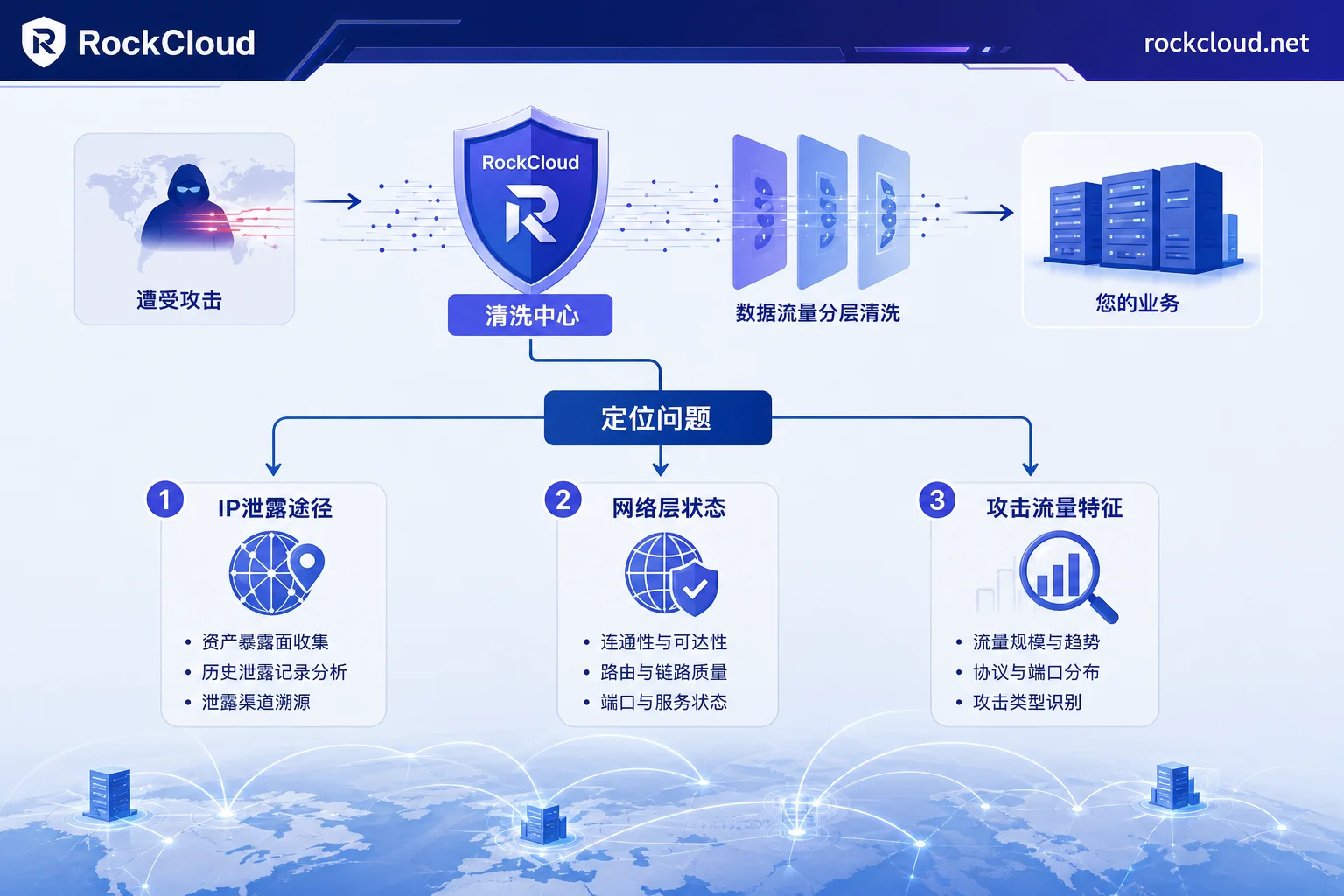
When facing a direct attack on your origin, blindly adjusting architecture often fails. Instead, use a decision tree to locate the root cause. First, determine how the origin IP was leaked: was it discovered by third parties through historical DNS, certificate transparency logs, email records, or scanning of test subdomains, or does a subdomain still directly resolve to the origin? Second, check the network layer state: does the origin only allow list the origin-pull IP ranges, or is it still openly exposing ports 80/443 to the public? Finally, analyze the attack traffic characteristics: is it application-layer requests, or volumetric floods that saturate the uplink?
These three branches point to subsequent exposure cleanup, network isolation, and edge capacity. For static sites, dynamic APIs, and non-HTTP services, failure symptoms vary, but the core logic is the same: only by accurately identifying the weak layer in your current defense system can you avoid wasting resources in the wrong direction.
Why Historical DNS, Certificate Transparency Logs, and Test Subdomains Speak for Your Origin
Exposure often arises from configuration oversights, not technical flaws. Historical DNS records before domain CDN onboarding are retained by third-party databases for a long time, becoming a source of intelligence for attackers. Certificate transparency logs publicly expose all issued subdomains; many teams overlook coverage for non-production environments like staging or admin panels, causing these subdomains to point directly to the real origin IP. Additionally, MX and SPF records for email, as well as separate IP-based services not behind the CDN, can leak underlying infrastructure information.
Self-checks should focus on full asset inventory: enumerate all subdomains and check whether each resolves to edge node IP ranges; verify if any subdomains in certificate names are not behind the CDN; confirm whether outbound mail services share the same physical machine or IP as web services. The core value of this layer is to reduce the probability of active discovery, falling under passive defense; it cannot directly block already-initiated connection requests.
DNS Layer Lockdown: Eliminate A Records Still Pointing to the Origin One by One
The rigor of the DNS layer determines how closed your origin entry points are. The primary task is to switch all externally facing subdomains to CDN CNAME records, ensuring traffic goes through edge nodes. Second, for non-public subdomains like admin panels, monitoring probes, or canary releases, remove them from public DNS resolution entirely or switch to private resolution only accessible internally. Also, narrow wildcard resolution to prevent unknown subdomains from automatically resolving to the origin IP.
When verifying, rely on the authoritative DNS record list, comparing each record's resolution ownership one by one, rather than memory or partial screenshots. After CDN onboarding, perform a second review to confirm no records fall back to the origin. A typical symptom of failure at this layer is that the main site works fine, but an obscure test subdomain is hit by scanners, leading to the need for emergency response and fix steps after origin IP leak and causing the origin's bandwidth to be exhausted or service to go down.
Network Layer Origin Whitelisting: Allow Only Origin-Pull Egress IPs, Takes Effect Before IP Change
CISA and FBI's 2024 official guidance clearly states that single-machine local bandwidth cannot withstand distributed volumetric and protocol floods; cloud high-protection CDN or scrubbing networks must front-end absorb traffic, and enforce strict network-layer isolation on the origin. This means the origin's security group or host firewall should only allow access from CDN edge origin-pull IP ranges, denying all other source addresses.
When implementing, ensure the whitelist covers the full set of origin-pull egress IP ranges and establish a mechanism to update as they change. SSH, database, and management ports should be separately restricted to office egress IPs or jump hosts. Even with whitelists configured, direct attacks may still occur due to incomplete IP ranges, conflicts between cloud security group and host firewall rules, or sidelined services listening on public ports.
| Protection Layer | Responsibility and Capability Boundary | Typical Failure Scenario |
|---|---|---|
| Edge Capacity | RockCloud High-Protection CDN and Origin Shield handle traffic at the edge and provide fixed origin-pull egress IPs | Fixed egress not enabled, leading to whitelist failure due to frequent IP changes |
| Origin Isolation | Origin side maintains security group/firewall whitelists, allowing only edge IPs | Missing some origin-pull IP ranges, or mistakenly opening 80/443 to the public |
| Port Control | Business ports and admin ports (SSH/DB) handled separately; admin ports strictly not exposed to the public | Business whitelist active but admin port exposed, leading to host compromise |
The table above provides initial troubleshooting directions; specific actions require log analysis. For overall architecture design, refer to practices in CDN security acceleration.
mTLS Origin Pull: Make Origin Respond Only to Handshakes with Edge Certificates
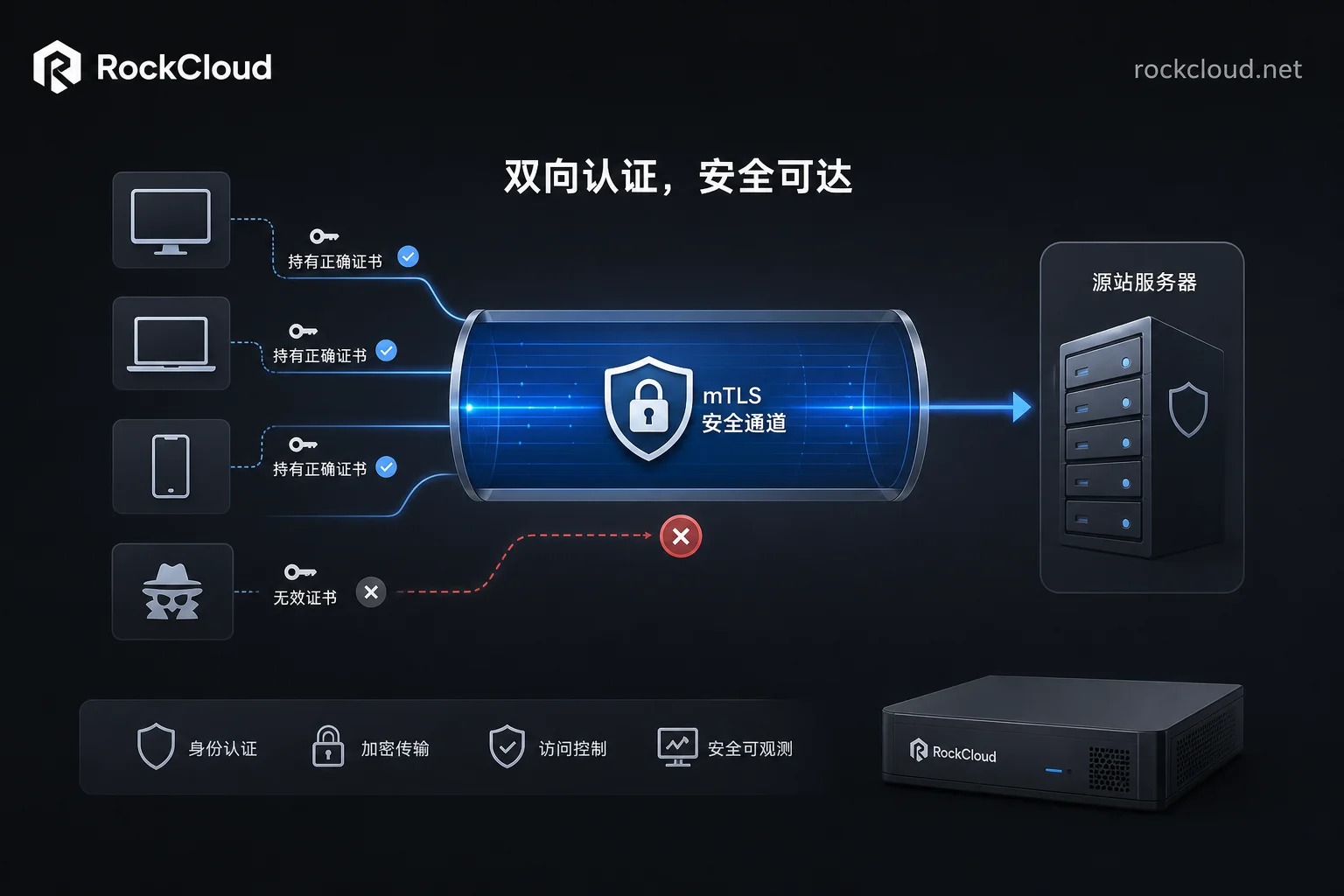
If whitelisting is an IP-layer gate, mTLS (mutual TLS) is the identity verification of the connection itself. Authenticated Origin Pulls (AOP) require the client to provide a specific private certificate during the TLS handshake, ensuring the origin only responds to requests from legitimate CDN edge nodes. Even if attackers discover the real origin IP, they cannot forge a client certificate signed by a trusted CA, so they are rejected during the handshake, effectively blocking direct connections that bypass the CDN.
The configuration approach is to enable client certificate verification on the origin web server (e.g., NGINX) and specify a list of trusted CAs. Connections that fail verification do not enter the business processing flow. Before going live, verify on a staging domain or during off-peak hours to avoid mistakenly rejecting health checks or monitoring origin pulls from outside the edge. Note: whitelisting defends against IP spoofing, while authentication defends against connections from non-expected clients even if the source IP is legitimate; they are complementary, not substitutes. Specific configuration details for client certificate verification should strictly follow the official documentation of your server and CDN provider.
Even with Hiding Done, Edge Capacity Is Still Needed: Floods Hit Links, Not Apps
The first four layers mainly solve "being found" and "being directly connected." However, when facing ultra-large volumetric network attacks, without edge capacity, the origin still goes down. Volumetric floods fill the data center's ingress bandwidth and network device queues before traffic even reaches the web server, rendering whitelists, rate limiting, and authentication on the origin ineffective. Official guidance emphasizes fronting scrubbing in the cloud's distributed network.
According to third-party threat reports, ultra-large attacks have become the norm, with reflection amplification remaining the primary vector. Therefore, the traditional approach of sizing defense resources based on single-machine peak bandwidth is no longer viable. The clear division of responsibilities: the first four layers reduce the likelihood of being discovered and directly attacked; the fifth layer determines survival under massive traffic. If sudden large traffic occurs, quickly assess the seamless high-protection CDN onboarding process to buy buffer time.
Symptoms of Failure Across the Five Layers and Pre-Launch Verification Checklist
To ensure the effectiveness of your origin hiding strategy, execute the following verification checklist. Re-run this checklist after every architecture adjustment or domain change.
- Enumerate all subdomains and confirm resolution ownership: Use common tools to query all subdomain resolutions. Failure symptom: obscure subdomain gets scanned and the whole machine is taken down.
- Check certificate names and email-related records: Verify if all domains in CT logs are behind the CDN. Failure symptom: after changing IP, it is quickly found again.
- Test non-origin-pull direct connectivity: From a residential broadband or non-whitelisted IP, attempt to access the origin IP's ports 80/443. Failure symptom: you can retrieve the same content as the main site.
- Test with spoofed Host header: Craft a request with a proper domain in the Host header and send it directly to the origin IP. Failure symptom: the origin returns business data normally.
- After enabling authentication, verify handshake rejection: Use curl without a client certificate to access the origin's HTTPS port. Failure symptom: connection succeeds, or health checks report errors.
FAQ
After onboarding a high-protection CDN, can the origin IP still be exposed?
Yes, CDN onboarding does not guarantee absolute invisibility of the origin IP. If historical DNS records are not cleaned, test subdomain resolutions are not consolidated, or strict network-layer whitelisting is not configured, attackers can still obtain the real IP via reconnaissance. Hiding focuses on increasing discovery cost, not physical isolation.
How can I check if my origin IP is exposed?
You can verify by querying historical DNS resolution databases, searching certificate transparency logs for subdomains, checking email SPF/MX record associated IPs, and using a non-CDN network environment to directly ping or telnet candidate origin IPs. If any channel connects and returns business content, it is considered exposed.
Why am I still directly attacked when the security group is configured?
First, check if the whitelist covers the CDN provider's latest full set of origin-pull IP ranges. Next, investigate if there are priority conflicts between cloud security group and OS firewall rules. Finally, confirm if any sidelined services not managed by the CDN (e.g., internal API gateways) are listening on public ports.
How to enforce mTLS on an NGINX origin?
On the origin server (e.g., NGINX/Apache), configure SSL client certificate verification directives, load the CA public key file provided by the CDN, and set the verification mode to require. Also ensure the CDN console has Authenticated Origin Pulls enabled and the corresponding client private key is deployed on edge nodes.
Why am I still attacked after changing the IP once?
This usually means exposure cleanup was incomplete. The old IP may have been indexed in historical DNS caches or scanner fingerprint databases, or the new IP's subnet characteristics, TTL settings, or even hardcoded links in the website source code leaked the new address. If the source of leakage is not severed, simply changing the IP only delays attacks.
It is recommended to first run the checklist in this article for exposure and direct-connect self-checks before deciding to change IP; if you confirm you already have whitelist and authentication conditions but lack edge capacity and fixed origin-pull egress, consider integrating with RockCloud's High-Protection CDN and Origin Shield capabilities.




Comments(0)