 RockCloud-基石云安全-官方博客
Choosing CDN security acceleration requires focusing on the division of labor across three layers: network-layer capacity absorption, complete request buffering, and Layer-7 rules with human-machine verification. Each handles a specific segment and cannot replace the others. On the acceleration side, look at edge access, cache hit ratio, and origin pull convergence; on the security side, look at where the edge can make decisions. Breaking down these two chains helps explain why some sites with high bandwidth still get taken down, while others with low traffic crawl.
First, consider a timely data point: according to Cloudflare's 2026 H1 threat report, ultra-large network-layer attacks exceeding 1 Tbps surged 519% quarter-over-quarter in Q2, with DNS Flood accounting for 40%, and 90.6% of attacks lasting less than 10 minutes. This short-pulse reflection flood is precisely the weakness of fixed-bandwidth hard-hitting models.
What Does CDN Security Acceleration Accelerate and Cleanse?
The acceleration side and the security side are two separate decision chains that cannot replace each other. Understanding this is the prerequisite for selection. The "security" in CDN security acceleration is not just a filter on acceleration capabilities; it means the edge nodes perform decision-making on your behalf before traffic reaches the origin.
The acceleration side handles edge access, cache hits, and origin pull convergence: users access content from the nearest node, and if the cache hits, it returns directly; only misses go to the origin. The security side handles decision-making on traffic patterns and request patterns: how much traffic should be absorbed at which layer, and what types of requests might be malicious half-open connections.
Judging whether a CDN is qualified is not about how many Tbps it claims to mitigate, but about at which layer it makes decisions, and whether there is an independent convergence point before the origin.
Why Does Purchasing by Bandwidth Peak Miscalculate Ingress Capacity?
Many teams habitually ask "How many Gbps can you handle?" and then buy based on peak bandwidth. But attack patterns in H1 2026 have changed: attacks over 1 Tbps surged 519% quarter-over-quarter, and 90.6% of attacks end within 10 minutes. This means even if you buy larger fixed bandwidth, you are paying for a year-long bill just to handle "millisecond pulses."
Such attacks are mostly DNS Floods and reflection amplification, with sudden traffic spikes. Single-point hard-hitting inevitably fails. The correct approach is to distribute traffic across multiple global ingress points, so each hop bears only a small portion, rather than resisting at a single entry.
How Far Does Network-Layer Capacity Absorption with Anycast Dispersion Go?
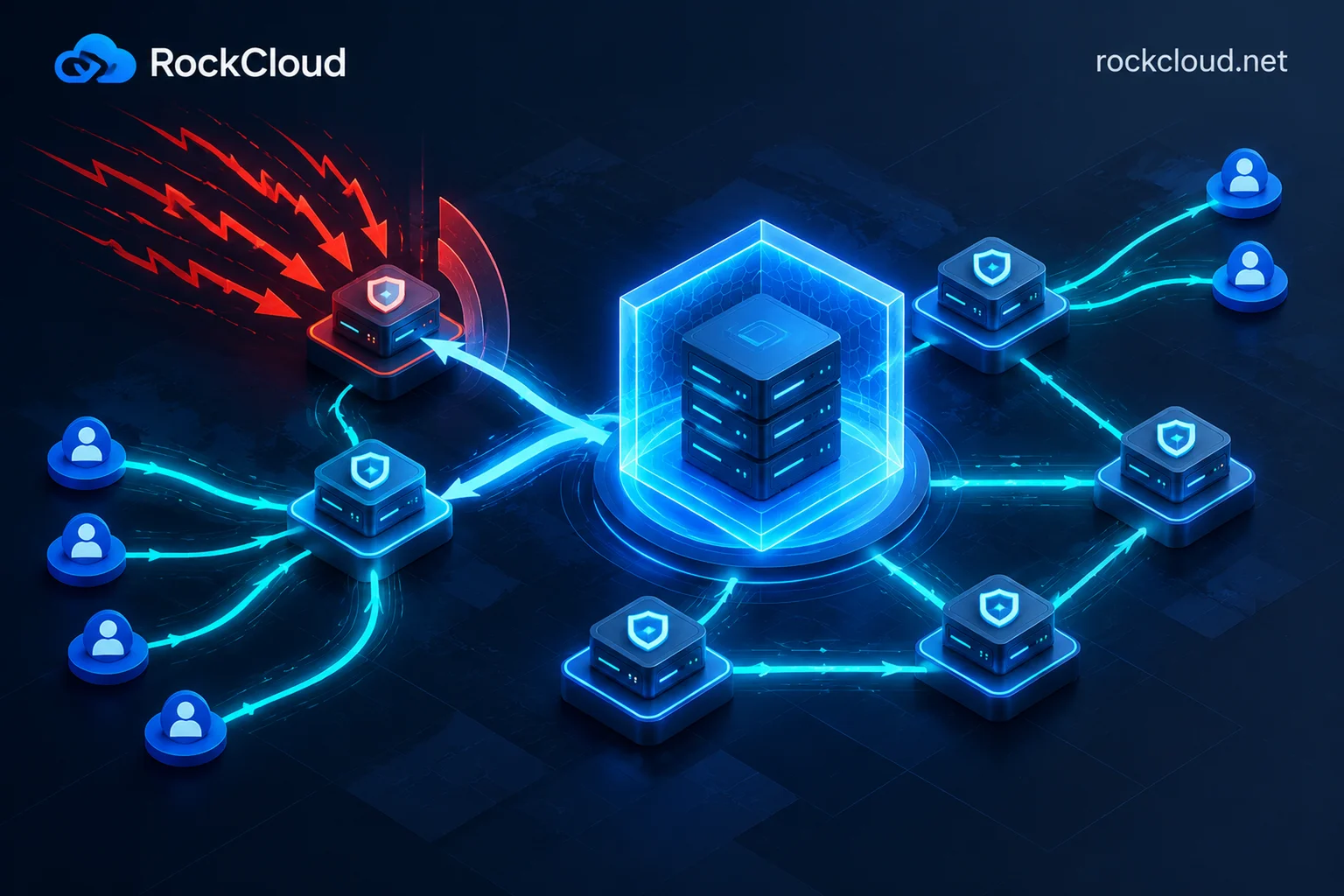
The network layer only looks at traffic volume and protocol characteristics; it cannot determine application-layer intent. A common mechanism for capacity absorption is Anycast—multiple PoPs announce the same IP prefix simultaneously, and attack traffic is routed to the nearest edge node, thus dispersed "geometrically." This way, ultra-large traffic is diluted near the attack source, barely affecting the origin.
But this layer only handles "high volume." If the attack is slow or low-volume, the network layer is oblivious, requiring the next layer.
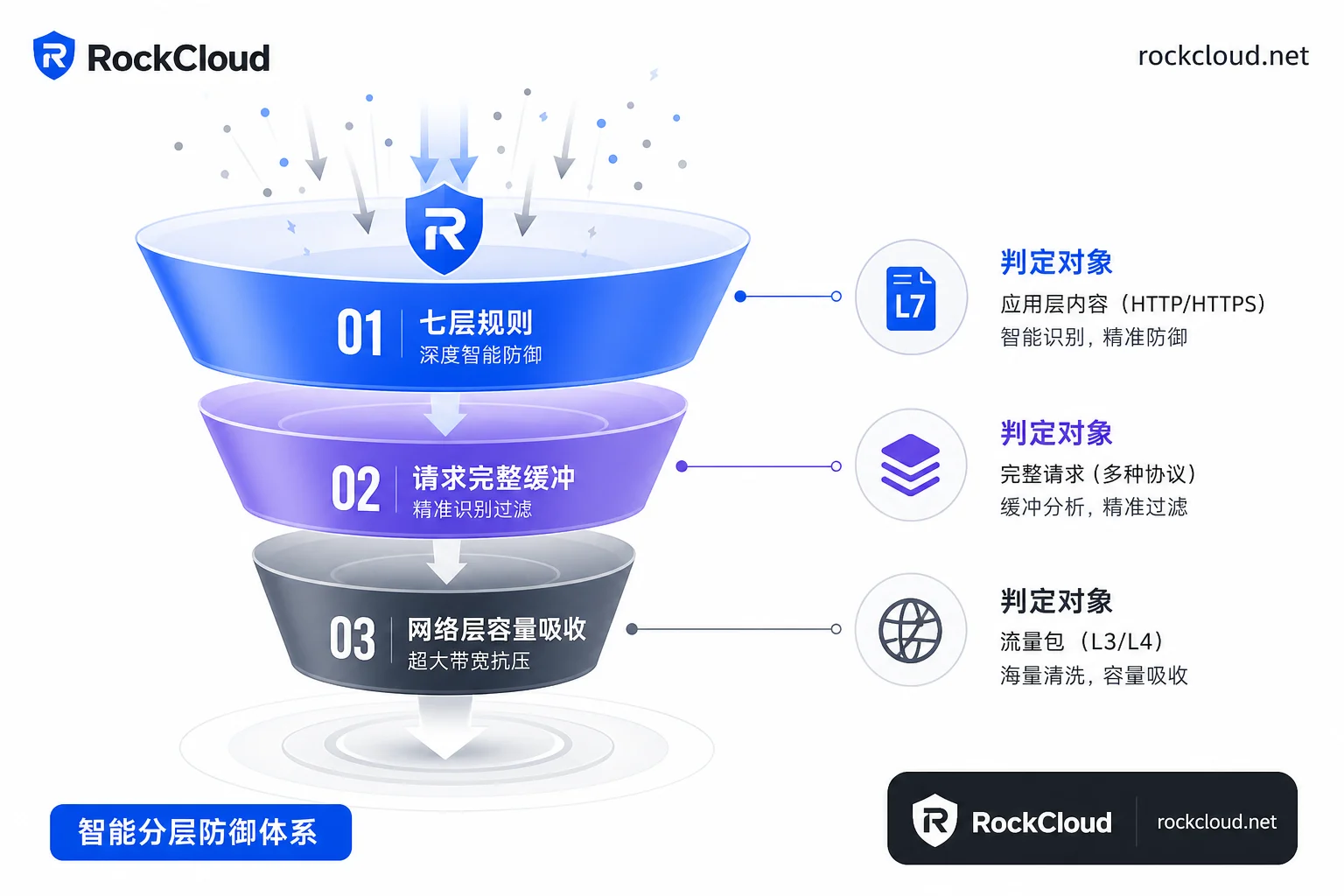
How Does Complete Request Buffering Block Slow Connections Before Origin Pull?
Slow attacks like Slowloris do not rely on high volume but send incomplete HTTP request headers or partial bodies at extremely low rates, maintaining many long-lived connections and exhausting the origin's thread pool. Since requests are never fully submitted, regular access logs might not record anomalies in time—this is their stealth.
The countermeasure is request buffering: the edge node fully receives and assembles the client request headers and body, and only then initiates an origin connection. Connections that send slowly or drop midway are released after timeout at the edge. Thus, slow attacks are blocked before origin pull, and the origin bandwidth might remain completely unaffected.
What Layer-7 Rules and Human-Machine Verification Can and Cannot Block
Beyond request buffering, Layer-7 rules assess request semantics and behavior: rate limiting, human-machine verification, URI pattern matching, etc., can block many scanners and low-frequency CC. But limits must be honestly defined: realistic bots (e.g., scripts with real browser fingerprints) and low-frequency high-value API abuse are difficult to fully identify with rules alone. Such attacks require business risk control and longer-term behavioral analysis, not something CDN can solve alone.
How to Read the Three Metrics: Cache Hit Ratio, Origin Pull Concurrency, and Origin Pull Bandwidth
From the acceleration side, three metrics are worth monitoring in the console: cache hit ratio, origin pull concurrency, and origin pull bandwidth. Higher cache hit ratio means fewer origin pulls; lower origin pull concurrency means more stable origin; origin pull bandwidth reflects the actual traffic hitting the origin.
Here, the key lies in centralized convergence layers (like Origin Shield): when different regional edge nodes miss on the same resource, origin-side request merging collapses massive concurrency into a few origin requests, preventing "thundering herd" effects. So these three metrics are not just about acceleration; they are also about security—origin pull concurrency is the most direct indicator of the origin's exposure to attacks.
Comparison of Three-Layer Decision Capabilities and Typical Phenomena After Misses
The table below aligns the capabilities of the three layers for fault diagnosis.
| Decision Layer | Decision Target | What It Misses | Miss Phenomena |
|---|---|---|---|
| Network-layer capacity absorption | Traffic volume, protocol characteristics | Application-layer business intent | Bandwidth saturated, origin packet loss |
| Complete request buffering | HTTP message integrity, connection rate | Malicious payloads within fully submitted normal requests | Origin thread pool full, but bandwidth normal |
| Layer-7 rules & human-machine verification | Request URI, frequency, client behavior | Realistic bots, low-frequency high-value abuse | CPU spike, hard to attribute in logs |
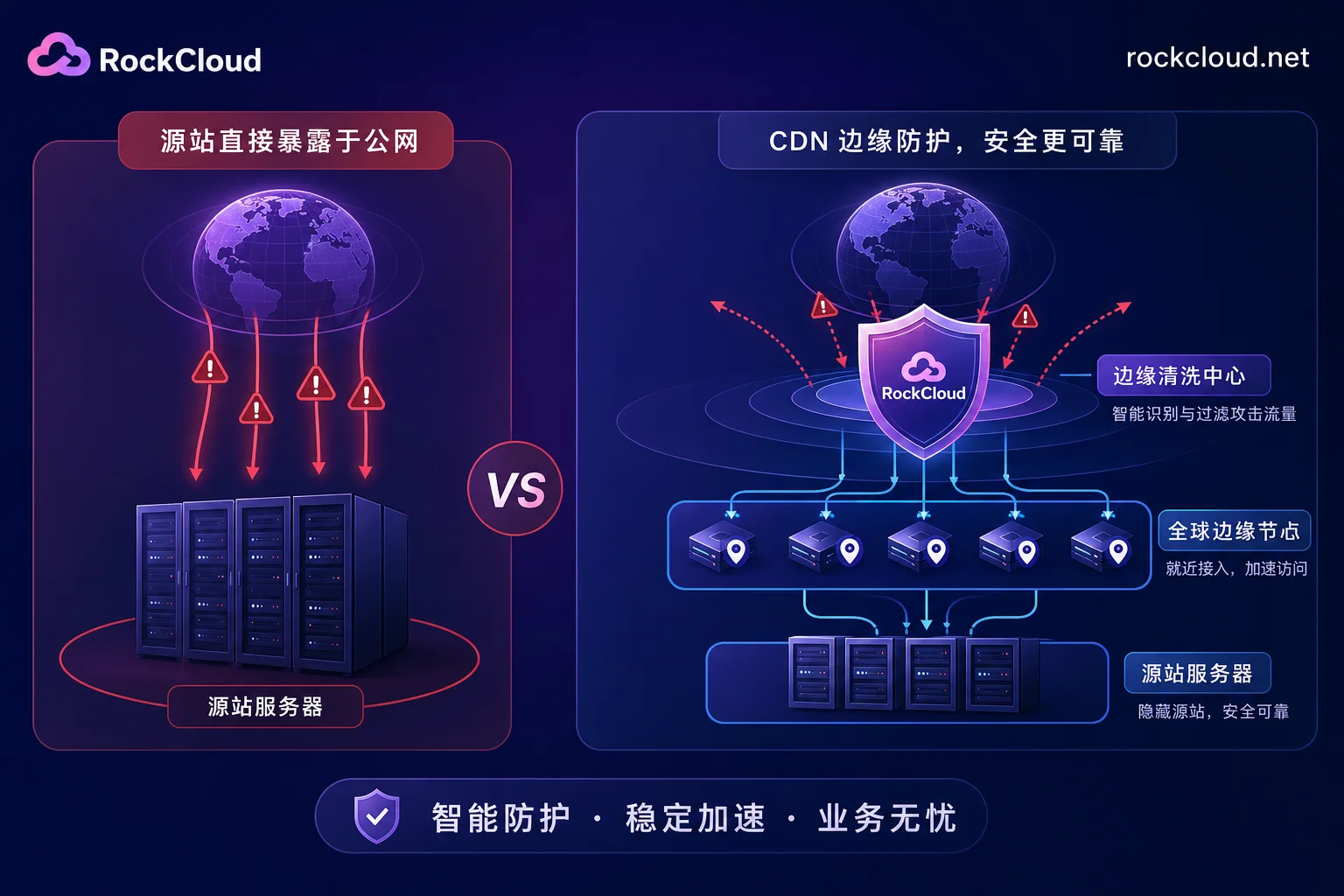
Two Root Causes for Direct Attacks After Enabling CDN: Exposure and Unconverged Origin Pull
If the origin is still attacked after enabling CDN, it often is not that the CDN is poor, but that the origin is bypassed. According to Hydrolix's 2026 practice analysis, attackers often locate the origin's real IP via historical DNS records, subdomains, full internet scans, or email server headers, then launch direct attacks.
If you check historical DNS records, you might find the origin IP was exposed long ago. Then, no matter how strong your edge protection, it will be bypassed. For a systematic approach to this, see how to prevent origin real IP exposure.
Another root cause is unconverged origin pull: the firewall does not restrict only CDN origin IP ranges, or two-way authentication credentials are not configured, mixing trusted edge traffic with attack direct traffic. This is like having a security door but leaving the back door open. Emergency response and remediation steps after origin IP leakage can help quickly narrow the exposure.
Segmenting by Business Type: Sites & APIs, Games with Custom Protocols, Hybrid Deployments
No single solution fits all businesses perfectly; segmentation is required.
Pure HTTP(S) businesses (websites, APIs) should prioritize request buffering and origin pull convergence, and enable caching convergence layers. Games with custom protocols (non-HTTP) require Layer-4 transport paths, not pure Layer-7 rules. Hybrid businesses must separate traffic by protocol and port, using different strategies.
Pre-Implementation Checklist
Finally, list the questions to ask the provider before selection to avoid disputes later.
- Does the edge node perform complete request buffering?
- Is a centralized origin convergence layer (Origin Shield) provided? How are origin IP ranges and authentication credentials issued and updated?
- Are non-HTTP ports (e.g., UDP, custom TCP) supported for cleansing? Which path do they take?
- Are cache hit ratio, origin pull concurrency, and origin pull bandwidth observable in the console?
- Does the origin firewall policy restrict only origin IP ranges? Is two-way authentication enabled?
FAQ
Can a high-defense CDN prevent CC attacks?
Yes, but with boundaries. High-defense CDNs can block many CC attacks based on slow connections and frequency characteristics via edge request buffering and Layer-7 rules. However, realistic bots and low-frequency high-value abuse require business risk control and cannot be completely mitigated by CDN rules alone. Referencing Cloudflare's H1 2026 report, 90.6% of attacks are short pulses, which are precisely handled by edge buffering.
What should I do if the origin is still attacked after enabling CDN?
First, check if the origin IP is exposed by examining historical DNS records, subdomains, and email headers; then confirm whether the origin firewall only allows CDN origin IP ranges. If the issue persists, consider enabling products with edge request buffering and origin protection, such as RockCloud high-defense CDN. Its request buffering assembles messages at the edge, and origin protection focuses on origin pull convergence, but it does not replace your origin-side firewall policies and exposure cleaning.
What is the difference between CDN acceleration and high-defense CDN?
The boundary lies in the level of decision-making. CDN acceleration mainly handles edge access, caching, and origin convergence, focusing on cache hit ratio and origin bandwidth. High-defense CDN adds network-layer capacity absorption, request buffering, and Layer-7 rules. For example, on caching strategy, acceleration focuses on improving hit ratio; high-defense CDN cache strategy optimization to reduce origin pressure can serve as a reference.
Can high-defense IP and high-defense CDN be used together?
Yes, but note the division of labor. High-defense IP protects IP-layer traffic, suitable for Layer-4 attacks; high-defense CDN is stronger at Layer-7 and request buffering. When used together, traffic goes to high-defense IP first then to origin, which may affect CDN edge continuity and cache effectiveness. Testing is needed to confirm user edge access remains effective.
Why is the website still inaccessible with sufficient CDN bandwidth?
If bandwidth is sufficient but the site is inaccessible, it is likely because the origin connection pool is full or CPU is exhausted. Slow CC does not consume bandwidth but occupies threads; in such cases, bandwidth looks normal, but origin pull concurrency may spike. It is recommended to check origin connection logs and whether request buffering is enabled, rather than increasing bandwidth.
In summary, first use the three-layer decision comparison table to self-check the current CDN configuration, focusing on whether origin pull is converged. There is no one-size-fits-all solution for CDN security acceleration, but by moving decision points forward and cleaning up exposure, most cases of "sufficient bandwidth but inaccessible" and "direct origin attacks" can be clearly attributed.


Comments(0)