 RockCloud-基石云安全-官方博客
The pros and cons of blocking overseas UDP traffic on overseas high-defense IP are stark: the advantage is that it can cut off the vast majority of reflection amplification attacks before the inbound link is saturated, with immediate effect and no need for business modification; the disadvantage is that it indiscriminately disrupts DNS queries, QUIC/HTTP3 connections, gaming custom protocols, and UDP tunnels, and is completely ineffective against domestic reflection sources, TCP-layer, and Layer 7 attacks. The changing attack landscape in the first half of 2026 has made this trade-off a frequent topic in daily operations: Cloudflare's threat report released in August 2026 shows that ultra-large attacks exceeding 1 Tbps surged 519% quarter-over-quarter in Q2, DNS-related attacks accounted for 34.3% of network-layer attacks, and CLDAP reflection attacks jumped 580% quarter-over-quarter.
First, Determine: Is It a UDP Reflection Amplification Attack or Direct Attack on Your Own UDP Protocol?
Before blocking, confirm the attack type. Look for three characteristics: whether source ports are concentrated, whether source IPs are dispersed, and whether packet lengths are consistent.
- If attack traffic source ports are heavily concentrated on known reflection ports like 53 (DNS), 389 (CLDAP), 123 (NTP), with source IPs dispersed across the internet but all open services, and packet lengths highly consistent, it's a typical UDP reflection amplification attack.
- If attack traffic targets your business's own ports and packet lengths resemble real business packets, it's likely a direct protocol attack. In this case, blocking overseas UDP may be useless and could harm legitimate traffic.
If you misjudge, the blocking action will miss the mark. NTP reflection is a common type; for the principle, refer to NTP Reflection Amplification Attack Principle and Defense Solutions.
What Blocking Overseas UDP Immediately Solves: Inbound Bandwidth, Amplification Factor, and Source IP Spoofing
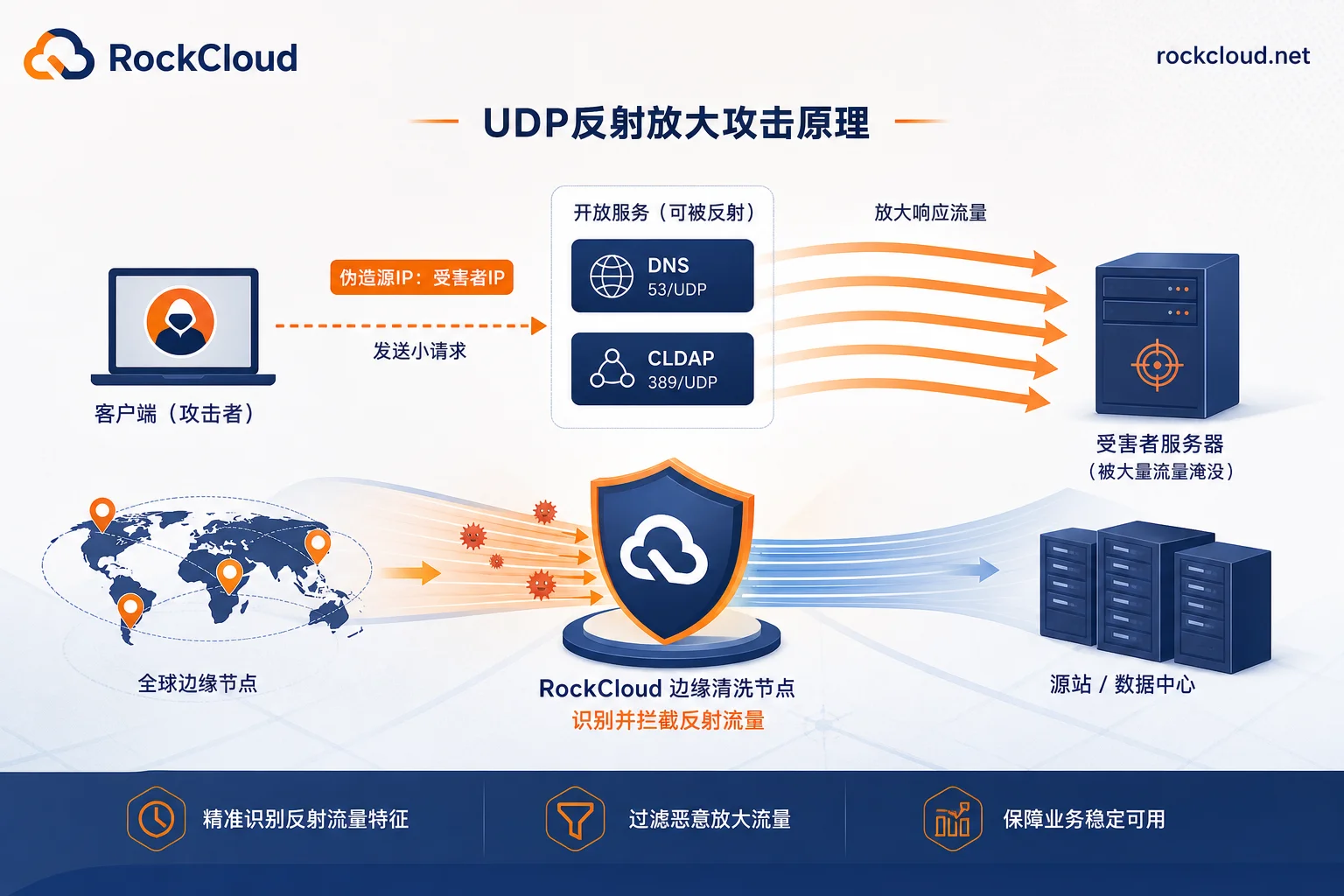
Blocking overseas UDP is effective due to two characteristics of UDP: connectionless and no source IP verification. Attackers can spoof the victim's IP and send requests to open services across the internet, creating reflection amplification. CLDAP (source port 389) typically amplifies 56-70 times, while DNS (source port 53) typically amplifies 28-54 times. These amplification factors are general ranges from public security resources and vary with the actual response size of the reflected service, not measurements from a specific attack. Amplification occurs in inbound bandwidth; even the strongest origin server CPU cannot save a saturated link.
At this point, dropping packets by protocol at the upstream is the only rapid mitigation that doesn't depend on per-IP identification.
The Cost List: How DNS, QUIC/HTTP3, Gaming Protocols, VPN, NTP, and Real-Time Audio/Video Will Be Affected
Blocking all overseas UDP has side effects on UDP-dependent services. Here are the specific symptoms:
- DNS resolution: External DNS recursive queries fail or time out, breaking the resolution chain; website domain names cannot be resolved.
- QUIC/HTTP3: HTTP/3 is based on QUIC (RFC 9000). If UDP is blocked, connections can't be established; browsers time out and fall back to TCP+TLS, increasing handshake RTT and causing more lag on weak networks.
- Gaming protocols: Custom UDP sync packets in games are dropped, causing player teleportation and disconnects. This is the most common scenario where ops ask if blocking UDP affects gaming; the answer is generally yes for real-time competitive games.
- VPN tunnels: UDP-based tunnels like WireGuard stop working, interrupting remote work.
- NTP time sync: Failed time sync can cause certificate validation and authentication issues.
- Real-time audio/video: Media streams are interrupted, dropping meetings and live streams.
Four Trade-offs: Full Block of Overseas UDP, Block by Source Port, Rate-Limit by Packet Length, and Session-Based Filtering
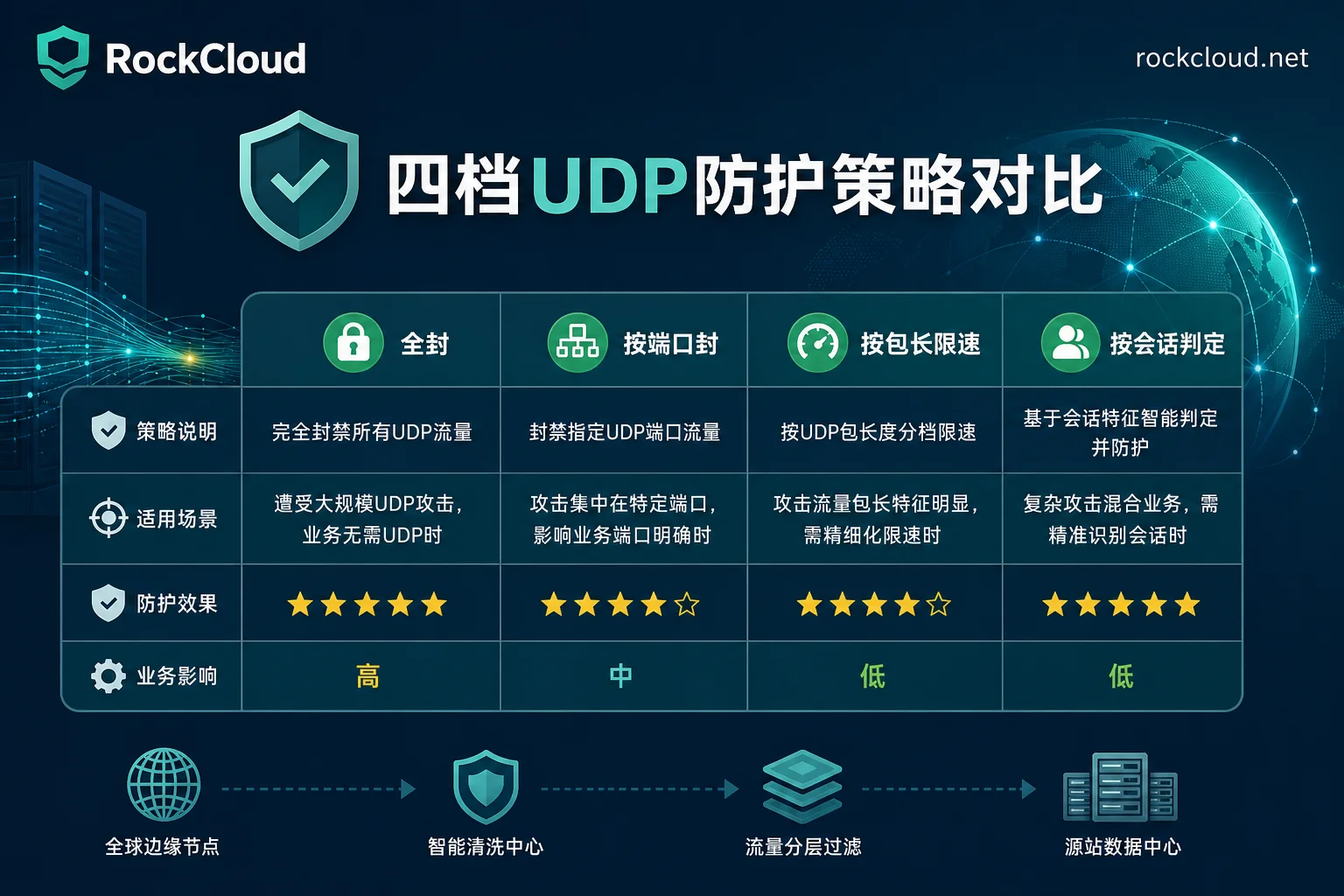
Breaking down the pros and cons of blocking overseas UDP on overseas high-defense IP into specific strategies yields four tiers: mainstream high-defense and CDN vendors generally offer precise rules like reflection source port filtering and UDP payload/length whitelists in Layer 4 protection configurations, rather than just a full UDP drop switch. The following table compares the four strategies:
| Strategy | Coverage | Collateral Damage | Speed | Maintenance Cost | Applicable Scenario |
|---|---|---|---|---|---|
| Block all overseas UDP | All inbound UDP from overseas | High, disrupts all UDP services | Immediate | Low | No UDP services, and can accept HTTP/3 downgrade |
| Block by source port (53/389/123, etc.) | Traffic from reflection source ports | Low, only affects corresponding services | Minutes | Medium | Clear reflection source ports, no conflict with services |
| Rate-limit by packet length | UDP packets exceeding threshold | Medium, may affect large-packet services | Minutes | Medium-High | Stable packet length characteristics for business |
| Session-based filtering | UDP attacks without session state | Low | Seconds | High | Have UDP services requiring fine-grained protection |
The trigger conditions for each tier: source port blocking applies when source port 53/123/389/11211 accounts for more than 80% of packets in captures; packet length rate-limiting applies when business packet length distribution is concentrated and distinguishable from attack packets; session-based filtering applies to custom UDP protocols with reference to outbound sessions.
Which Services Can Safely Block All, and Which Will Be Cut Off Immediately
The executable boundary: pure HTTP/HTTPS sites that do not rely on external outbound UDP and can accept HTTP/3 downgrade are low risk; real-time gaming, real-time audio/video, UDP VPN gateways, and self-hosted recursive DNS are cut off immediately.
Regarding whether you can block overseas UDP but keep domestic traffic—it's feasible by region, but be aware of two blind spots: domestic reflection sources (e.g., compromised domestic servers) can still launch reflection attacks; and outbound users accessing your services will be affected because their inbound traffic also comes from overseas.
A More Granular Approach Than a One-Size-Fits-All Block: Move UDP Detection and Dropping to the Edge
Protocol detection and dropping should be performed at edge nodes with large inbound bandwidth capacity, not at the origin firewall. If dropped at the origin, the link bandwidth is already saturated, and the drop action yields no benefit. Using BGP Anycast in DDoS Mitigation to distribute attack traffic across multiple scrubbing nodes can share bandwidth pressure and enable tiered scrubbing.
How RockCloud Fits in Edge Scrubbing and UDP Protocol Carriage, and Its Boundaries
RockCloud's edge scrubbing leverages an Anycast global network to distribute and absorb reflection traffic at the edge; its Game Shield provides Layer 4 carriage and detection for custom UDP protocols to avoid blanket drops; and its High-Defense CDN handles HTTP/HTTPS traffic, forming a division of labor. But the boundary must be clear: edge scrubbing cannot replace origin IP concealment, nor can it defend against direct attacks when the origin IP is leaked. This should be combined with How to Prevent Origin IP Exposure. Specific rules need to be fine-tuned based on business protocol characteristics. For related defense ideas, refer to Game Server DDoS Defense Architecture Design.
Pre- and Post-Blocking Verification Checklist: How to Ensure No Collateral Damage to Real Users
Before and after blocking, use the following checklist to minimize collateral damage:
- Before blocking, capture packets to preserve attack samples and normal business packet length distribution.
- After blocking, verify separately: external DNS resolution, HTTP/3 negotiation results, game client login and in-game latency, VPN tunnel handshake, NTP offset.
- Compare business success rates and connection setup times before and after blocking.
- Set rollback conditions and observation windows; roll back immediately if collateral damage occurs.
Evaluating the pros and cons of blocking overseas UDP on overseas high-defense IP ultimately comes down to this collateral damage checklist. No configuration guarantees zero collateral damage; a rollback path must be reserved.
First follow the detection steps to confirm the attack type, then choose the least-impact disposal method from the four tiers and keep a rollback window. Blocking UDP is a stopgap measure, not an architectural solution. If your custom UDP protocol business cannot tolerate the cost of a full block, discuss edge scrubbing and Game Shield protocol carriage options with the RockCloud technical team.
FAQ
Does blocking UDP on high-defense IP affect gaming?
Yes. Games typically use custom UDP protocols for state synchronization; after blocking, sync packets are dropped, causing teleportation and disconnects. It's recommended to use Game Shield to carry and filter UDP protocols instead of a blanket block.
Will DNS resolution fail after high-defense blocks UDP ports?
Yes. External DNS recursive queries rely on UDP port 53; after blocking, resolution will time out or fail. If you provide DNS services to the public, you cannot block port 53.
Can UDP reflection attacks only be stopped by blocking ports?
No. Besides blocking source ports, you can rate-limit by packet length, filter by session state, or deploy Anycast edge scrubbing. Choose a more precise method based on your business.
Will a website slow down if QUIC is blocked?
Yes. Blocking UDP causes browser HTTP/3 connection attempts to time out, then fall back to TCP+TLS, increasing handshake RTT, with more noticeable lag on weak networks.
How to troubleshoot packet loss of custom UDP protocol by high-defense?
First capture packets to compare packet length and rate before and after blocking to confirm if it matches attack patterns; then check if scrubbing rules mistakenly match business packets; finally, discuss with your provider to adjust UDP whitelist or Game Shield policies.


Comments(0)