RockCloud-基石云安全-官方博客
Conclusion first: A no-ICP CDN itself will not cause Baidu or Google to directly refuse your website. Whether it's Google Search or Baidu Search, the core prerequisite for determining whether a page can be indexed is whether crawlers can stably obtain the complete HTTP 200 body content, whether the page response speed meets standards, and whether the content has indexing value—it does not use "whether a mainland China ICP filing number is attached" as the sole technical threshold.
So why do many webmasters quickly find that after applying a no-ICP CDN, Baidu's index volume declines and Google Search Console (GSC) errors increase? The reason is often not the words "no-ICP," but pitfalls in node route quality, WAF security policies, caching rules, and IP purity. Below, we break down the problem clearly according to the actual troubleshooting order.
1. Don't blindly switch nodes first: use the symptom comparison table to locate the real bottleneck
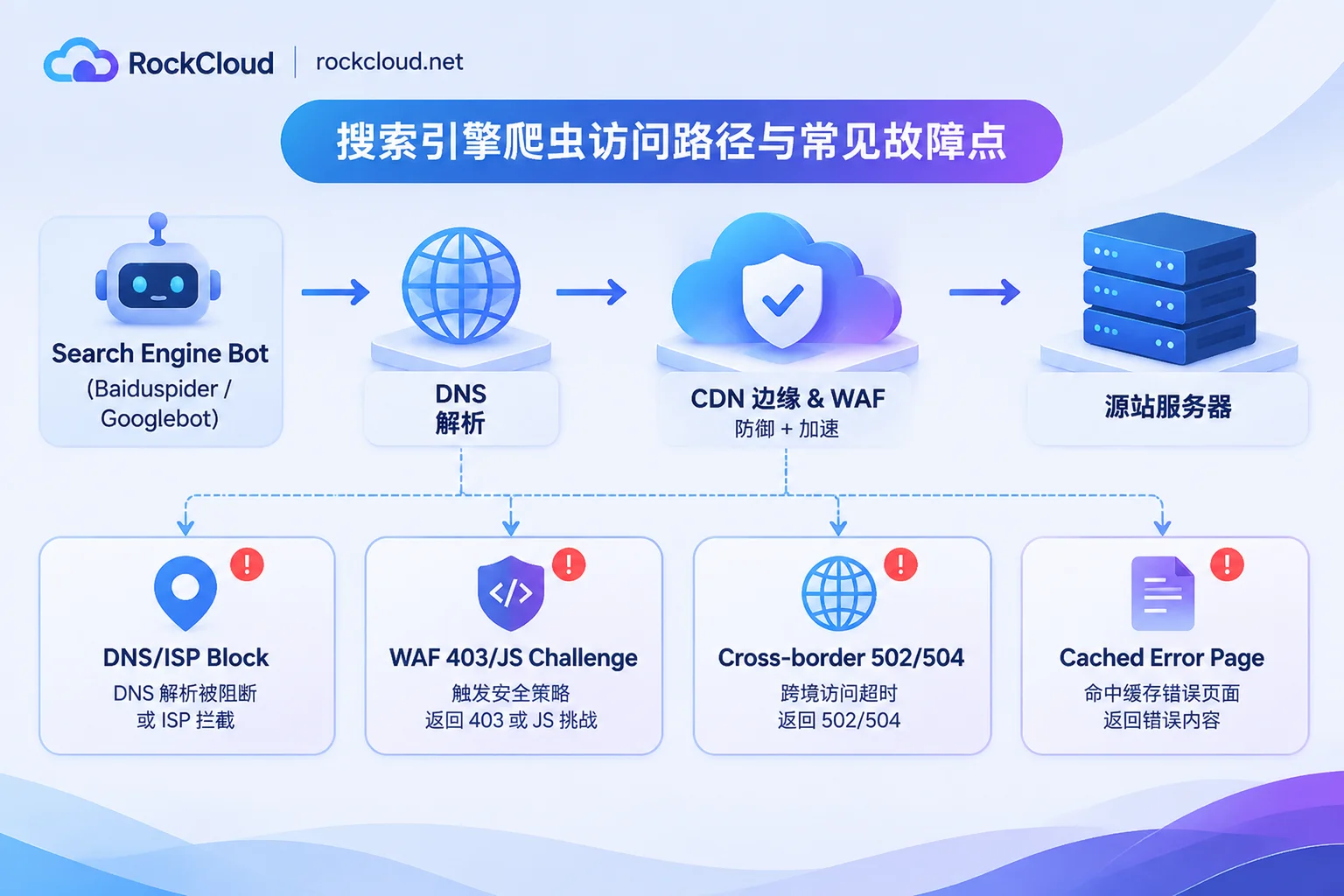
When you notice a decrease in indexing, the worst thing to do is frequently change CDNs or directly switch back to the origin server IP (which easily exposes the real server). It is recommended to first check Baidu Search Resource Platform's "Crawl Diagnostics" and GSC's "URL Inspection" to confirm exactly where the crawler is stuck:
| Symptom You See | Items to Check First | Common Misjudgment |
|---|---|---|
| Almost no crawler visits in logs | DNS resolution reachability, regional blocking/pollution, Robots rules, Sitemap entry | Assume page quality is too poor to be crawled |
| Crawler requests frequently return 403 or 429 | WAF protection policies, CC rate-limiting thresholds, bot blocking rules | Mistakenly believe the origin server is down |
| Returns 200 but indexed page becomes a verification prompt | CDN has JS challenge (5-second shield), CAPTCHA, or Cookie verification enabled | See status code 200 and assume crawling is normal |
| Returns 502 / 504 or connection timeout | Cross-border back-to-origin packet loss, peak-hour congestion, timeout between origin and edge nodes | Assume switching to a free CDN will fix it |
| Crawling is normal but indexing declines or rankings drop | Error pages cached, HTTPS redirect chain anomalies, duplicate pages and content quality | Attribute to "no-ICP" based on timing coincidence alone |
2. Five common pitfalls causing index loss with no-ICP CDN and their solutions
1. WAF and anti-CC policies block search engine crawlers
This is the most common cause of index loss. To prevent scraping or CC attacks, many webmasters directly enable site-wide "JS challenge," "5-second shield," or strict concurrent rate limiting on ordinary no-ICP CDNs. Browser users can wait a few seconds and click verification to pass, but most search engine crawlers do not fully execute such interactive verification.
As a result, Baidu Spider or Googlebot either directly receives 403 / 429, or receives HTML of a "checking your browser" challenge page, causing indexed content to be cleared.
The correct approach is not to "disable protection site-wide for SEO"—that would quickly bring down the origin server under malicious crawlers and CC traffic; nor should you crudely allow access based solely on the User-Agent string, because scanners and malicious scripts on the market all forge Baiduspider or Googlebot headers.
A more reliable approach is to use intelligent protection with fine-grained identification capabilities. For example, when integrating RockCloud's Intelligent WEB Firewall (WAF), you can enable protection with one click in the control panel: the system first uses the OWASP core rule set to block SQL injection, XSS, file inclusion, and common malicious scripts, then combines machine learning to identify anomalous bot requests not yet covered by the rule base; custom rules and exception allowances for specific search engine crawlers, API callbacks, or dynamic endpoints can be configured with assistance from the RockCloud security technical team, ensuring real crawlers can crawl smoothly while maintaining business security.
2. Ordinary cross-border public network routing causes packet loss, and Baidu Spider frequently times out
Google's crawler mainly initiates crawls from overseas data centers and is usually friendly to overseas nodes; but Baidu Spider is mainly located in mainland China data centers. If the no-ICP CDN uses ordinary international public bandwidth (or even routes through Europe and America before returning to Asia-Pacific), once peak-hour congestion or submarine cable jitter occurs, Baidu Spider will frequently encounter high TTFB, TCP connection resets, or 502 / 504 timeouts during the crawl window. After several consecutive crawl failures, search engines will reduce crawl quotas or even clear existing indexes.
Regarding why overseas nodes experience high latency and packet loss toward mainland China, we have provided a detailed breakdown in "Why No-ICP CDN Is Slow to Access in China: Return Routes, High-Defense Scrubbing, and NS-Free Access Solutions".
If your core traffic and Baidu SEO needs are in mainland China, when selecting a solution, don't just look at "nodes not in mainland China"; also consider the return and access routes from edge nodes to mainland China. For example, RockCloud's no-ICP CDN accesses through Hong Kong, Japan, South Korea, Singapore, and other China-surrounding nodes, providing CN2 China acceleration (Telecom CN2 GIA, Unicom AS9929, Mobile CMI three-network direct return to China) without ICP filing; at the same time, at the global CDN acceleration level, it supports HTTP/3, TLS 1.3 0-RTT, and Brotli compression, and allows custom back-to-origin retry and backup origin rules—even if a single origin server occasionally jitters, the status code returned to crawlers can be preserved through backup origins and retry mechanisms.
3. Shared node IPs are polluted or regionally blocked, and crawlers cannot connect at all
Some low-cost no-ICP CDNs mix many sites of different natures into the same shared IP pool. As long as a gray site in the same pool triggers violation handling, the entire node IP segment may be blacklisted or rate-limited by carriers in some regions of China, or the domain itself may trigger DNS pollution and regional blocking. At this time, you may see the website as completely normal via an overseas proxy, but Baidu Spider frequently fails when initiating requests from within China.
When troubleshooting this layer, it is recommended to directly check the CDN console's network logs and compare the real status codes from different regions and carriers (for specific log locating steps, refer to "How to Read Traffic and Network Logs in CDN Console: From Dashboard Anomalies to Single Request"). If you confirm that the domain has regional blocking, DNS pollution, or is blocked within WeChat/QQ, don't rush to abandon an old domain that has accumulated authority and backlinks; you can refer to "How to Recover from Domain Blocking: Distinguish DNS Pollution, Carrier Blocking, and WeChat/QQ Blocking First, Recover Without Changing Domain" to distinguish the blocking layer, or directly use RockCloud's blocking and pollution recovery solution for DNS pollution cleaning and seamless 301 recovery to preserve existing search assets.
4. Error status codes are cached, or SSL/canonical paths have gaps
After integrating a CDN, there are two hidden technical issues that directly harm indexing:
- Error page caching: The origin server briefly restarted and returned 502 or 404. If CDN caching rules do not isolate this, error pages are cached as static resources at edge nodes, and for the next few hours all visiting crawlers will fetch error pages.
- SSL certificate and back-to-origin protocol anomalies: Failure to renew a free certificate, or encryption protocol mismatch between edge nodes and origin, directly triggers crawl interruption and affects search trust.
During configuration, be sure to enable automated certificate issuance and renewal (such as the free fully automated SSL built into RockCloud's general features), and refine caching policies for static and dynamic routes in the CDN feature panel to avoid writing temporary errors or dynamic responses with authentication parameters into public caches.
5. DDoS/CC attacks overwhelm or overage shutdown, and the website goes "offline"
For unregistered overseas businesses, cross-border e-commerce, or independent tool sites, once industry competition is fierce and encounters peer scanning or CC attacks, an ordinary unprotected no-ICP CDN either has nodes knocked out or the billing based on traffic/request count instantly spirals out of control, triggering suspension due to arrears. For search engines, continuous site-wide unavailability for 24–48 hours is often the beginning of large-scale index loss.
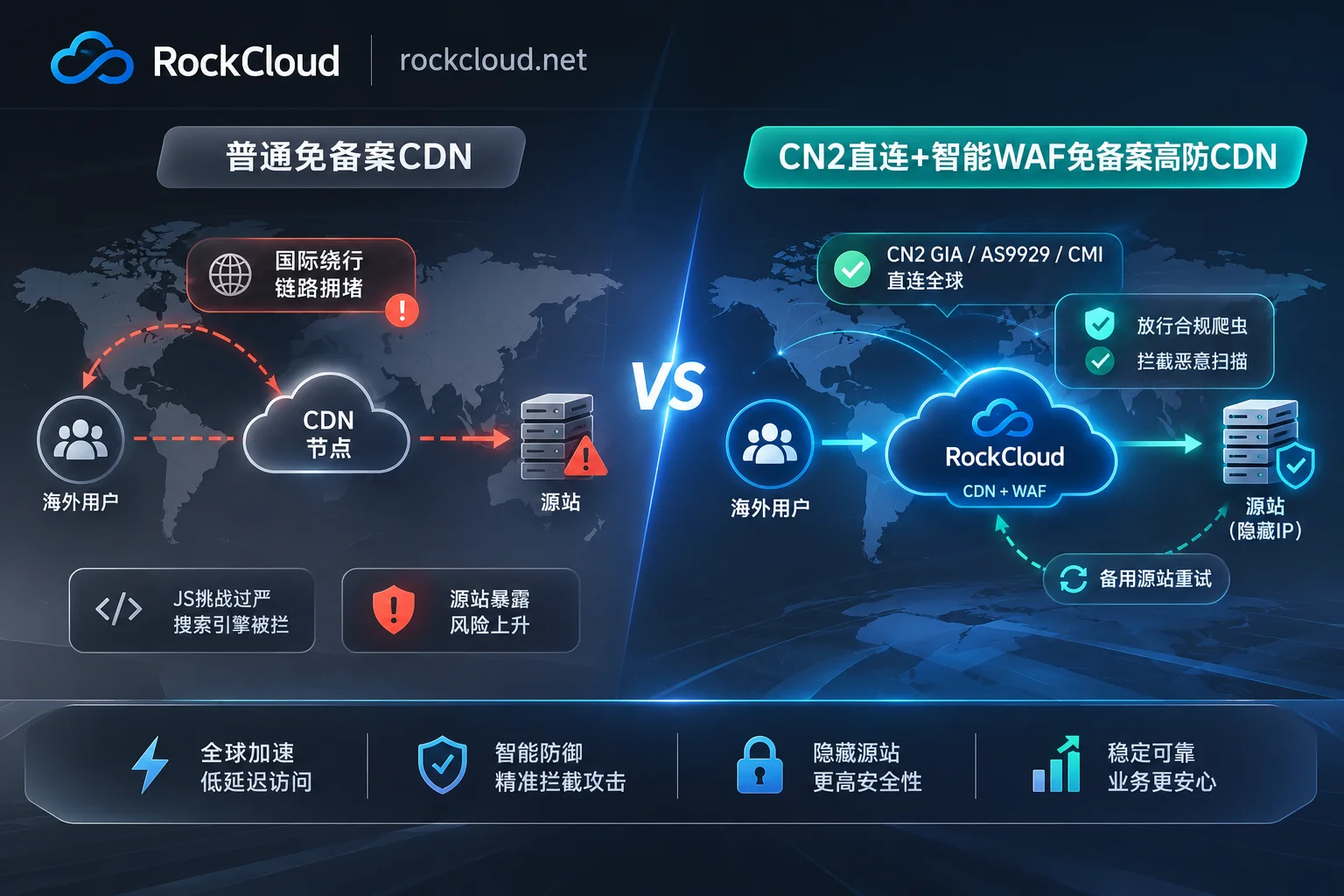
Therefore, for sites vulnerable to attacks, it is recommended to consider "acceleration, attack defense, and controllable billing" in the same architecture. RockCloud's high-defense CDN uses Anycast distributed scrubbing, with DDoS and CC defense on the same request path, hiding the origin server's real IP after integration; and in package billing, it defaults to monthly billing at a fixed peak, with unlimited traffic and requests (DDoS/CC defense, WAF, and SSL are all included, no separate purchase required; CN2 mainland acceleration dedicated line and anti-hijacking are billed separately as needed). This way, you won't spend extra money when crawlers crawl frequently, nor will the network suddenly go down during an attack and cause ranking loss.
3. Four-step SEO acceptance checklist after adjusting or migrating a no-ICP CDN
If you are planning to troubleshoot your existing configuration or replace an old service that is causing lag and false blocking (for switching details, refer to "No-ICP CDN Migration and Secondary Selection Guide: Saying Goodbye to Peak-Hour Lag, False API Blocking, and Hidden Renewal Bills"), it is recommended to follow these four steps for launch acceptance:
- Smooth parallel switch without changing NS: Try to choose a solution that only requires adding a
CNAMErecord to access and retains the original DNS provider, so that old and new links can be verified in parallel and avoid resolution gaps during NS changes. - Allow verification and actual crawl testing: Immediately after integration, perform a single-page crawl test in Baidu Search Resource Platform and GSC to confirm that the returned HTTP status code is
200, the response body is complete, and there is no verification page code; then check CDN network logs to confirm crawler requests are not mistakenly blocked by WAF. - Lock down origin server to prevent bypass: After traffic switching is stable, allow only CDN back-to-origin node IPs in the origin firewall; if the origin server was exposed or under attack before migration, be sure to change the origin IP simultaneously.
- Enable real-time anomaly alerts: Enable Telegram real-time data push and traffic/bandwidth reports in the RockCloud control panel, so that when there is a surge of 5xx in a region or an abnormal plunge in crawler traffic, you can intervene and locate the issue immediately.
If you are unsure whether your current business is "slow due to routing" or "mistakenly blocked," or if you are looking for a no-ICP solution that balances three-network direct connection and high-defense scrubbing, you can first visit the RockCloud contact page or official Telegram (@rockclouds) to confirm specifications with technical support and apply for a free test, test the real crawl link first before full switching.