 RockCloud-基石云安全-官方博客
According to the latest 2026 cyber threat analysis reports from security firm Radware and Security Boulevard, application-layer DDoS (Web/CC attacks) have shown an unprecedented and dramatic growth trend. Data shows that in Q1 2026, the number of Web DDoS attacks surged 187.1% year-over-year, and Layer 7 DDoS attacks have increased by 104% over the past two years.
More alarmingly for security teams, hacker organizations' attack strategies are undergoing an "industrialized" transformation: traditional brute-force traffic flooding is gradually decreasing, replaced by highly disguised, low-frequency, and computationally expensive precision CC attacks.
Attack Morphology Evolution: Why Can Traditional Thresholds Not Block Modern CC Attacks?
CC (Challenge Collapsar) attacks primarily operate at Layer 7 (Application Layer) of the OSI model. In the latest threat monitoring, attackers have shifted their focus to business interfaces that consume the most backend resources, such as search queries, complex APIs, authentication, and dynamic report exports.
Key characteristics of this new type of CC attack include:
- Low-frequency requests and human-like behavior: Attackers use automated botnets to mimic real browser and HTTP protocol behavior, dispersing request frequency to bypass simple single-IP rate limiting.
- High computational cost asymmetry: The cost of initiating one HTTP/HTTPS request is extremely low, but triggering database queries or complex computation logic on the origin server is costly. A small number of coordinated requests can quickly fill the origin connection pool and spike CPU usage.
- Bypassing static WAF rules: Many requests carry legitimate HTTP headers and cookies, making them hard to identify with static signature libraries, leading to false positives or missed detections with conventional defense strategies.
For enterprise operations and security engineers, when the origin server faces such attacks directly, a common scenario is "network bandwidth not full, but application services unresponsive."
Defense Strategies Against Precision Application-Layer Attacks
The key to defending against modern CC attacks lies in shifting from simple "traffic threshold blocking" to "edge identification and layered mitigation."
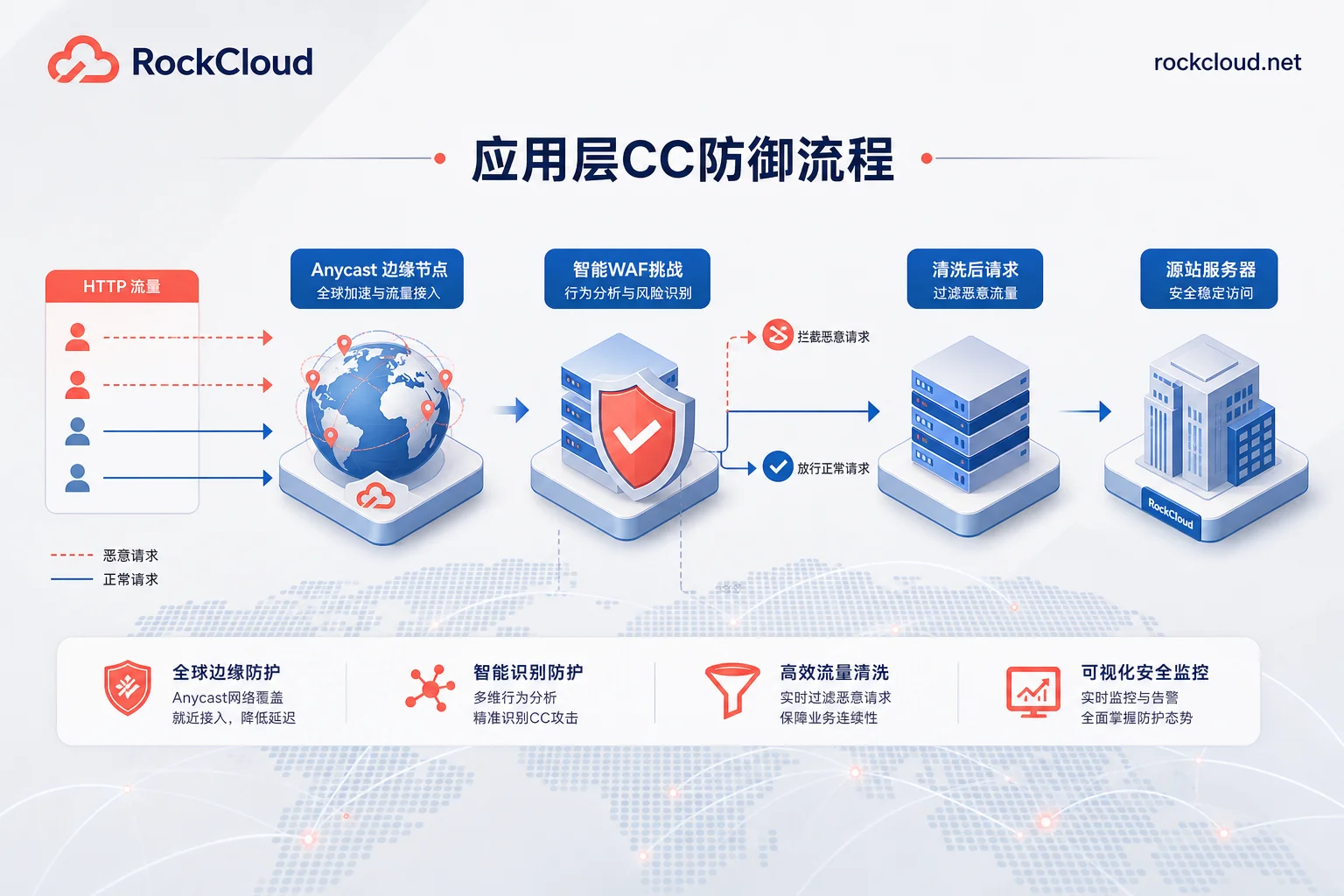
1. Edge Node Pre-cleaning and Cache Offloading
Move the defense front to the network edge. Use high-defense CDN nodes to handle all HTTP/HTTPS requests, maximizing static resource caching at edge nodes to reduce origin server concurrency pressure. For dynamic requests that cannot be cached, edge nodes perform unified protocol compliance checks.
2. Intelligent Dynamic Verification and Behavior Analysis
Relying solely on single QPS rate limiting can easily harm legitimate users. Modern CC defense needs to combine the human-machine recognition capabilities of intelligent WAF, using JavaScript challenges, browser fingerprint verification, and behavioral analysis of request context to automatically identify and block abnormal request patterns.
3. Origin Server Hiding and Access Control
Once the origin server IP is exposed, any edge protection is rendered useless. Enterprises must set strict access control lists (ACLs) via firewalls, allowing only authorized protection node IPs to access the origin server, and enable origin protection policies.
RockCloud Architecture and Selection Considerations
For security needs in complex application layer environments, enterprises often need to balance business acceleration and security cleaning capabilities when selecting infrastructure.
RockCloud (Cornerstone Cloud) publicly offers high-defense CDN, DDoS and CC protection, intelligent WAF, game shield, Anycast global network acceleration, CN2 China direct line, caching and logging services, and provides security rules and technical support for complex businesses.
In dealing with high-concurrency CC attack scenarios, by switching domain resolution to high-defense CDN edge nodes, traffic can be quickly diverted and filtered at the edge. Combined with intelligent WAF's multi-dimensional rule engine and logging services, security operations personnel can analyze threat characteristics in real time and implement fine-grained protection rules for specific interfaces.
Reader Interaction and Operations Self-Check Suggestions
Faced with increasingly complex Layer 7 threats, does your business system have sufficient elasticity? We recommend operations teams conduct the following self-checks:
- Check 1: Has the real IP of the origin server been exposed through historical DNS resolution or secondary domain names?
- Check 2: Do high-energy API interfaces (e.g., login, search) have targeted behavior verification and rate limiting mechanisms?
- Check 3: When under a low-and-slow attack, can your current WAF rules quickly adjust dynamically and block based on characteristics?
If your enterprise is evaluating or upgrading application-layer protection solutions, consider referring to RockCloud's edge security and acceleration deployment architecture to build a more robust cloud defense barrier for core businesses.




Comments(0)