 RockCloud-基石云安全-官方博客
With the rapid evolution of automation tools and AI technology, cyberattacks are undergoing an unprecedented “industrialization” transformation. Attackers no longer rely solely on sheer traffic bombardment but combine AI scripts to launch stealthy application-layer (Layer 7) CC attacks and multi-vector hybrid attacks. For enterprise operations, SRE, and security teams, maintaining service continuity under high concurrency and intensive attacks has become a core challenge of infrastructure. High-defense CDN, through Anycast distributed edge scrubbing, smart WAF rules, and origin hiding strategies, builds a highly elastic defense line, ensuring business access acceleration while scrubbing malicious traffic.
2026 DDoS Threat Landscape: AI-Driven and Industrialized Layer 7 Attacks
Recent industry research shows that the scale and automation of DDoS attacks are rapidly increasing. In a security advisory published by cybersecurity firm NETSCOUT in July 2026, it was noted that driven by high-traffic IoT botnets and AI technology, internet-scale DDoS threats continue to show trends of high frequency and complexity, placing stringent demands on infrastructure capacity reserves and automated responses.
Combined with public research reports from Akamai and Cloudflare, the current attack landscape exhibits the following characteristics:
- Surge in application-layer (Layer 7) attacks: Attackers are shifting to HTTP/HTTPS requests and API calls that mimic real user behavior, making traditional fixed IP blocking and simple rate limiting prone to false positives or ineffective prevention.
- Increase in prolonged sustained attacks: Attacks are no longer limited to minutes of sudden traffic; multi-day or even multi-week obfuscated attacks are common, continuously consuming origin computing resources and bandwidth costs.
- Multi-vector full-chain coverage: Attackers often simultaneously launch Layer 3/4 UDP/TCP floods and Layer 7 dynamic request bombardments, attempting to breach a single defense layer.
This industrialization of threats directly impacts enterprises: it can lead to service unavailability, customer loss, and exorbitant bills due to origin bandwidth spikes.
Protection Principles and Core Technologies of High-Defense CDN
Traditional single-point high-defense servers or hardware firewalls are prone to ingress bandwidth congestion when facing TB-level traffic surges; and when facing massive forged CC requests, origin CPU and database connection pools can easily max out. The advantage of high-defense CDN lies in extending the defense focus to the network edge:
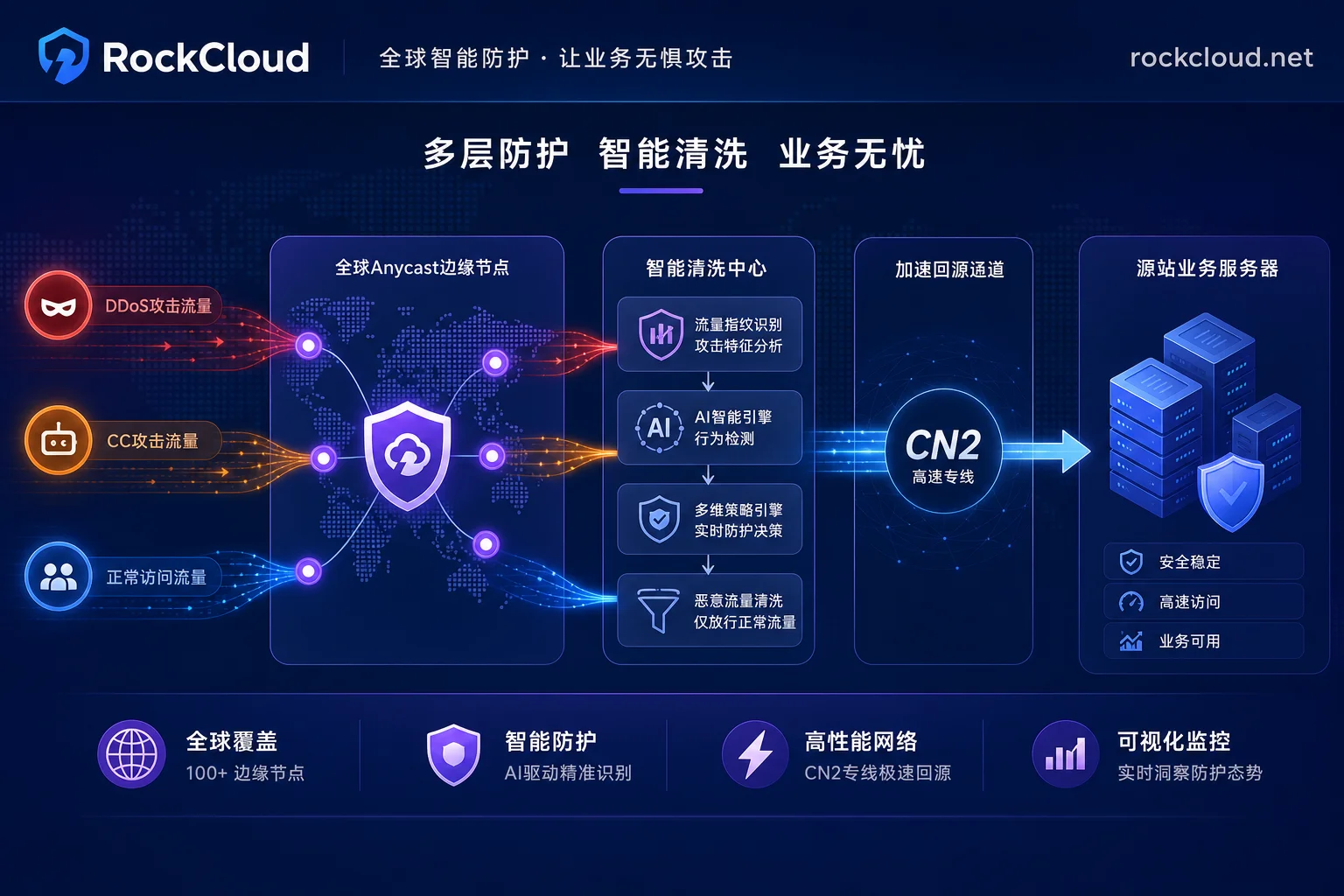
- Anycast global distributed scrubbing: Leveraging Anycast BGP routing technology, attack traffic from around the world is distributed to various edge scrubbing centers, avoiding single-point bandwidth bottlenecks.
- Smart WAF and behavioral analysis: Using human-machine identification and dynamic rule engines, malicious crawlers, abnormal API calls, and forged HTTP/HTTPS requests are intercepted at edge nodes, ensuring clean traffic back to the origin.
- Origin hiding and cache offloading: High-defense CDN hides the real origin IP and efficiently caches static resources at the edge, significantly reducing origin load while improving end-user access speed.
Building a Solid Defense: RockCloud's High-Defense CDN Practice in Complex Scenarios
Addressing the increasingly complex DDoS and CC attack environment, RockCloud builds a one-stop high-defense CDN and security protection solution covering network to application layers for enterprises. The platform relies on an Anycast global network acceleration architecture and smart WAF engine to quickly identify and scrub large-scale DDoS surges at the edge, while providing granular CC defense for API interfaces and complex application services.
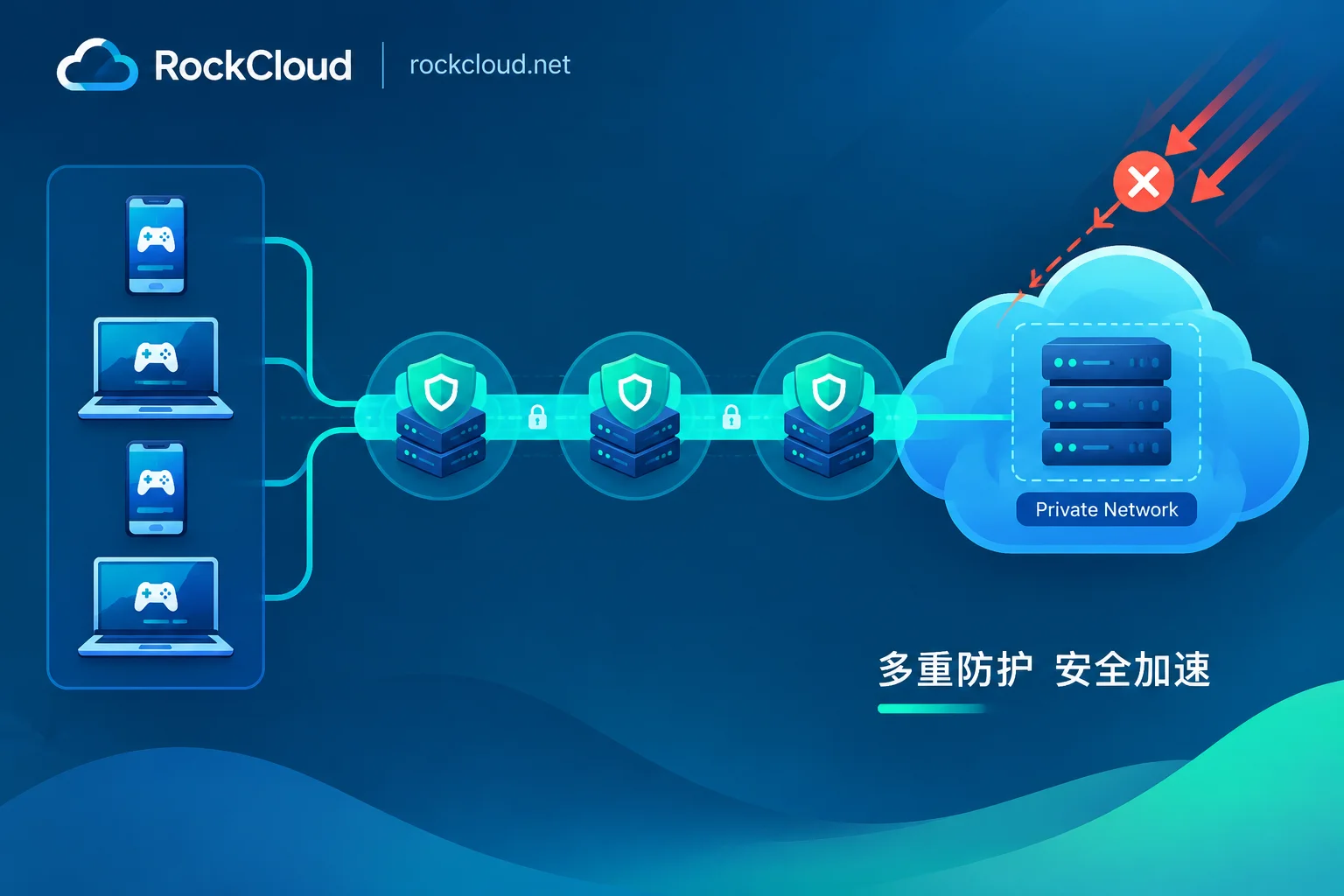
In actual business deployment, RockCloud supports integration with CN2 China direct line acceleration and edge caching strategies, not only resisting traffic-based attacks but also improving latency bottlenecks for cross-border services and domestic access. For highly sensitive businesses such as gaming, finance, and SaaS platforms, combined with game shield and custom security rules, security teams can flexibly adjust protection strategies based on specific business scenarios, achieving a balance between security defense and access performance.
Enterprise High-Defense CDN Selection and Deployment Checklist
To help operations and security teams better evaluate defense capabilities, it is recommended to focus on the following dimensions when selecting and deploying high-defense CDN:
- Scrubbing capacity and node distribution: Whether the protection reserve can withstand ultra-large traffic attacks, and whether node coverage meets the acceleration requirements of core user groups.
- Layer 7 granular protection: Whether the WAF supports deep inspection and dynamic validation of complex API parameters, custom headers, and encrypted traffic (TLS/HTTPS).
- Frictionless business and high availability: Whether legitimate user access latency and request success rate are affected when scrubbing is triggered, and whether a robust origin hiding mechanism exists.
- Logging and visual analytics: Whether real-time attack logs, scrubbing details, and automated alerts are provided to facilitate security teams in traceability and rule optimization.
Addressing Security Challenges: RockCloud Expert Support and Service Experience
With the proliferation of automated attack methods, enterprise network security has shifted from “passive patching” to “edge protection and elastic defense.” RockCloud offers comprehensive high-defense CDN, DDoS, and CC defense solutions for enterprises and internet businesses with high-security needs. If your business is plagued by malicious traffic or you are planning a network acceleration architecture, learn about the customized protection testing and technical support provided by the RockCloud team to build a stable and reliable security barrier for your business.



Comments(0)