 RockCloud-基石云安全-官方博客
For websites, APIs, or game servers deployed overseas, mainland users may find daytime performance acceptable, but come 8 PM things start stuttering—a classic scenario. Most people's first instinct is to "switch to CN2," but before doing so, two things need confirmation: where exactly the slowdown occurs, and which kind of CN2 you're planning to buy. Without clearing these up, it's common to pay GIA prices and get GT performance.
Here's how to proceed, following the actual troubleshooting order.
Step 1: Confirm the Bottleneck Is in the International Segment
Lines only fix transmission problems, not application-layer issues. Before buying a line, run a segment-by-segment diagnosis—it costs almost nothing.
- Look at time patterns. If latency and packet loss are normal during the day but degrade noticeably from 20:00 to 23:00, that points to backbone congestion—switching lines can help. If latency is high all day with obvious routing detours (e.g., going through Europe before coming back), that's a routing issue, also within the line's remit.
- Check the difference between ping and TTFB. If ICMP latency is stable in a reasonable range but the first byte of a page takes two to three seconds, the problem is likely at the origin server or database; switching lines only saves tens of milliseconds.
- See which hop shows packet loss. Run
mtr -rwbzc 100 你的服务器IPfrom a mainland client. Loss that starts at some intermediate hop and continues to the destination is significant; loss appearing only at one hop and then recovering is usually that router rate-limiting ICMP replies, not real loss. Only sustained loss to the endpoint matters.
Once you confirm it's an international transmission issue, proceed.
Step 2: Distinguish GT from GIA Using AS Numbers and Route Segments
China Telecom's international egress isn't a single network. The traditional 163 backbone (ChinaNet, AS4134) has routes beginning with 202.97. It offers large capacity and low cost but is a public thoroughfare with high packet loss during peak hours. CN2 (AS4809) is a separate next-generation network based on MPLS with high-priority QoS queues; its nodes typically start with 59.43, designed for low-latency, low-jitter cross-border transmission.
Products labeled CN2 on the market fall into two tiers:
- CN2 GT (Global Transit) is only half CN2. International segments go over AS4809, but domestic provincial access and aggregation segments revert to the 163 backbone, showing
202.97nodes in the route. This means during peak 163 congestion, you're still affected, just with fewer detours than pure 163. - CN2 GIA (Global Internet Access) is end-to-end CN2. From provincial nodes to international egress, everything stays within AS4809 (route segments primarily
59.43). It offers dedicated return paths and higher QoS priority, resulting in more stable packet loss and jitter during peak hours.
To tell them apart: if any China hop in a traceroute shows 202.97 segments, it's not full GIA. Only when all domestic hops show 59.43 can you confirm GIA.
The price gap also comes from this—GIA egress bandwidth is limited and costly; if a price is significantly lower than typical "GIA," treat it as GT or one-way CN2 until verified.
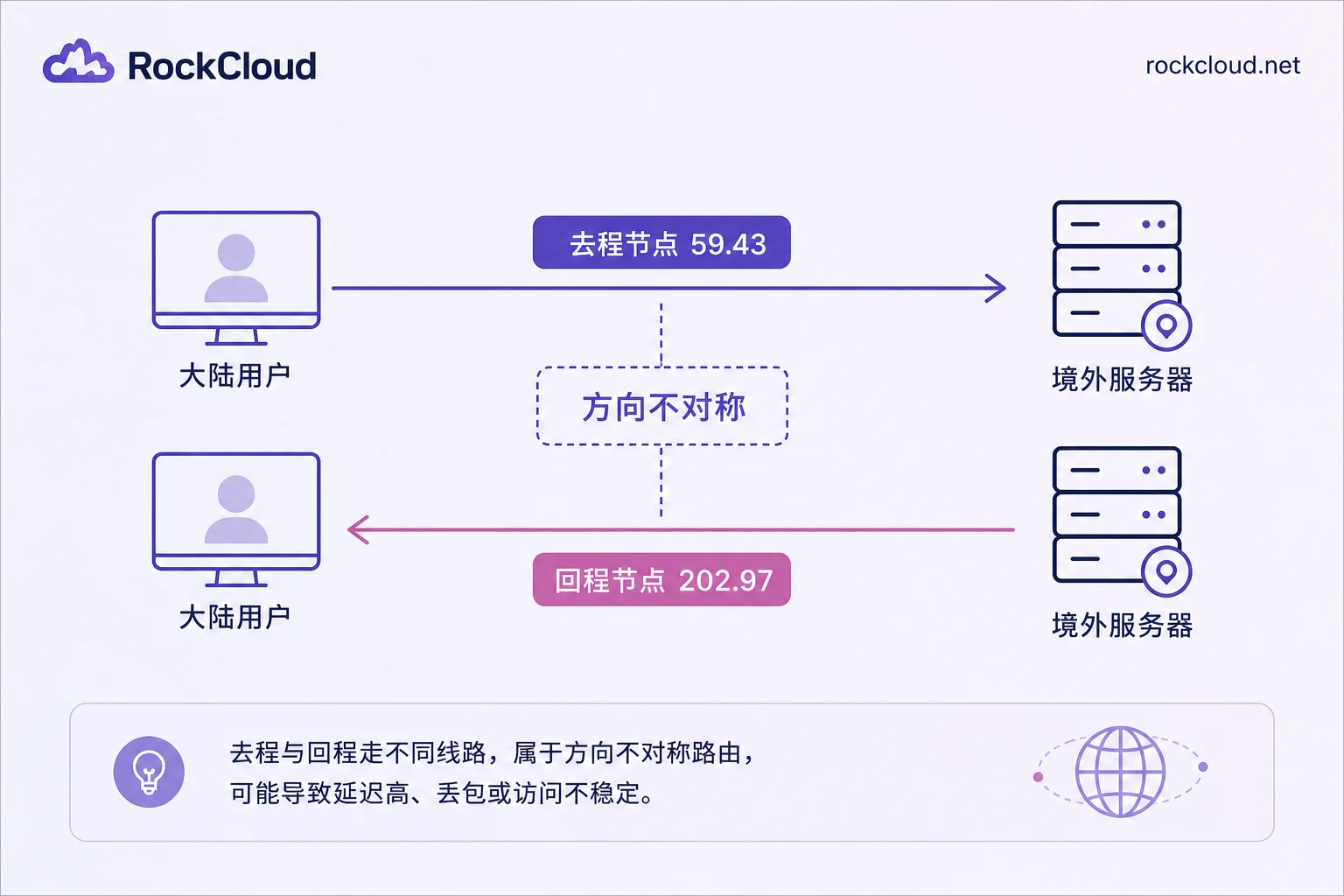
Step 3: The Return Path Deserves More Testing Than the Outbound
This step is most often skipped and most prone to pitfalls.
User experience depends mainly on downlink: webpage content, video streams, game frame sync packets—most data flows from the overseas server to mainland clients. This direction is called the return path. Running traceroute from your computer to the server tests the outbound. The two directions can route differently; indeed, there are products that offer "CN2 outbound, but return path served by regular 163." Some vendors use outbound traceroute screenshots as selling points.
Correct testing methods:
- Reverse test from the server. Log into the overseas server and run
mtr -rwbzc 100 大陆IPagainst a set of mainland Telecom, Unicom, and Mobile IPs. Check whether the first hops entering China use59.43or202.97. This is direct evidence. - Use mainland Looking Glass or third-party route lookups to trace from various Chinese provinces back to the target IP for cross-validation.
Doing this during a trial period is more useful than reading any spec sheet. Asking the provider for test IPs and running your own tests is a basic step before signing.
Step 4: Don't Assume Telecom Performance Applies to Unicom and Mobile
CN2 GIA is a China Telecom product; its optimization is for Telecom users. Unicom and Mobile users traverse their own international interconnect policies:
- Unicom side commonly uses AS9929 (premium network) and AS4837 (regular international egress), with significant quality differences.
- Mobile side goes through the CMI/CMIN2 system with its own overseas interconnection strategy.
If the provider only implemented Telecom GIA without return path adaptation or BGP tuning for Unicom and Mobile, non-Telecom users may experience cross-network detours and much higher latency than Telecom users. If your audience includes a significant share of Unicom and Mobile users, you must test per carrier. These three-carrier integration routing strategies vary widely by data center and must be empirically tested—not judged from a landing page.
Step 5: Set Acceptance Criteria, Don't Just Look at Average Latency
During the test period, collect data on these metrics, especially during peak hours:
- Time-segmented sampling: Cover at least 10:00, 15:00, 21:00, and 23:00, each with continuous sampling for ten minutes or more. CN2's value mainly shows during peak hours; daytime data isn't discriminating.
- Jitter, not just average: For games, voice, and real-time APIs, latency fluctuating from 60ms to 200ms is worse than a stable 120ms. Look at standard deviation and maximums.
- Packet loss: Sustained loss to the destination above 1% noticeably impacts TCP throughput.
- TCP retransmission rate: Monitor retransmission counters with
netstat -son the server; this is closer to real business impact than ICMP. - Business-side metrics: Time to first byte, large file download speed, long-connection drop counts—ultimately these are decisive.
Step 6: CN2 Lines Themselves Can't Withstand Large-Scale DDoS Attacks
This is often overlooked in selection. CN2 egress bandwidth is limited and costly; line products typically don't include large-scale scrubbing redundancy. Once hit with tens to hundreds of Gbps, the likely outcome isn't to absorb but to get rate-limited or blackholed upstream—the more expensive the line, the faster the carrier is to blackhole, since they don't want attacks eating valuable bandwidth. Your business still goes down, and you still pay for CN2 during the outage.
So for attack-prone services, architect three things separately but connected: edge nodes cache and handle user connections, a scrubbing layer filters attack traffic, and the CN2 link carries only clean traffic across borders. That way, attack traffic is dealt with before it hits the expensive CN2 segment, and acceleration resources are used only for real users.
In practice, watch two cost items: whether acceleration and protection are on the same link or require separate purchases, and billing—fixed peak bandwidth with unlimited traffic versus per-traffic billing can cause very different bills during attacks or traffic spikes. RockCloud's CN2 China Acceleration routes directly across three networks without ICP filing, with acceleration and DDoS/CC protection on the same link for a single fee, billed on fixed peak bandwidth with no traffic cap. You can apply for a test IP and run the return-path and three-carrier tests per Steps 3 and 4 before deciding.
When Full GIA Is Unnecessary
Not every business needs the most expensive tier:
- Static-content-heavy sites (images, JS/CSS, download files): If cache hit ratios are high, most user requests never leave the country; investing in caching yields more than investing in lines.
- Asynchronous tasks, admin backends, low-frequency APIs: These aren't sensitive to tens of milliseconds; GT or even optimized 163 suffices.
- Real-time multiplayer games, voice/video, payment callbacks, trading APIs: These are sensitive to jitter and loss; a dropped long connection is a business incident. Only these warrant the premium for full GIA and three-carrier adaptation.
First determine which part of your traffic truly needs low jitter, then decide where to allocate budget. After offloading static traffic to the edge, the real bandwidth requiring CN2 is often much smaller than your initial estimate, easing cost pressure.
Further reading: CN2 GIA vs CN2 GT Performance and Latency: A 4-Step Practical Test, How to Choose US CN2 Servers: Return Path Routing and Peak-Hour Packet Loss, How to Choose Hong Kong CN2 Servers: 6 Criteria to Verify Before Signing, Global Acceleration Network: Route Verification and Capacity Boundaries for Cross-Border Speedup.




Comments(0)