 RockCloud-基石云安全-官方博客
Which is better depends on three things: where your users are, whether your business is latency-sensitive, and your bandwidth budget. Here is the conclusion first:
- Users are mainly in mainland China and your business is sensitive to latency and lag (gaming, financial trading, audio/video interaction, API endpoints, no-ICP-filing website hosting): choose CN2, preferably CN2 GIA.
- Users are mainly in Hong Kong, Macau, Taiwan, Southeast Asia, Europe, or the US; or your business is mainly high-bandwidth downloads and static asset distribution with a tight budget: international BGP is more cost-effective.
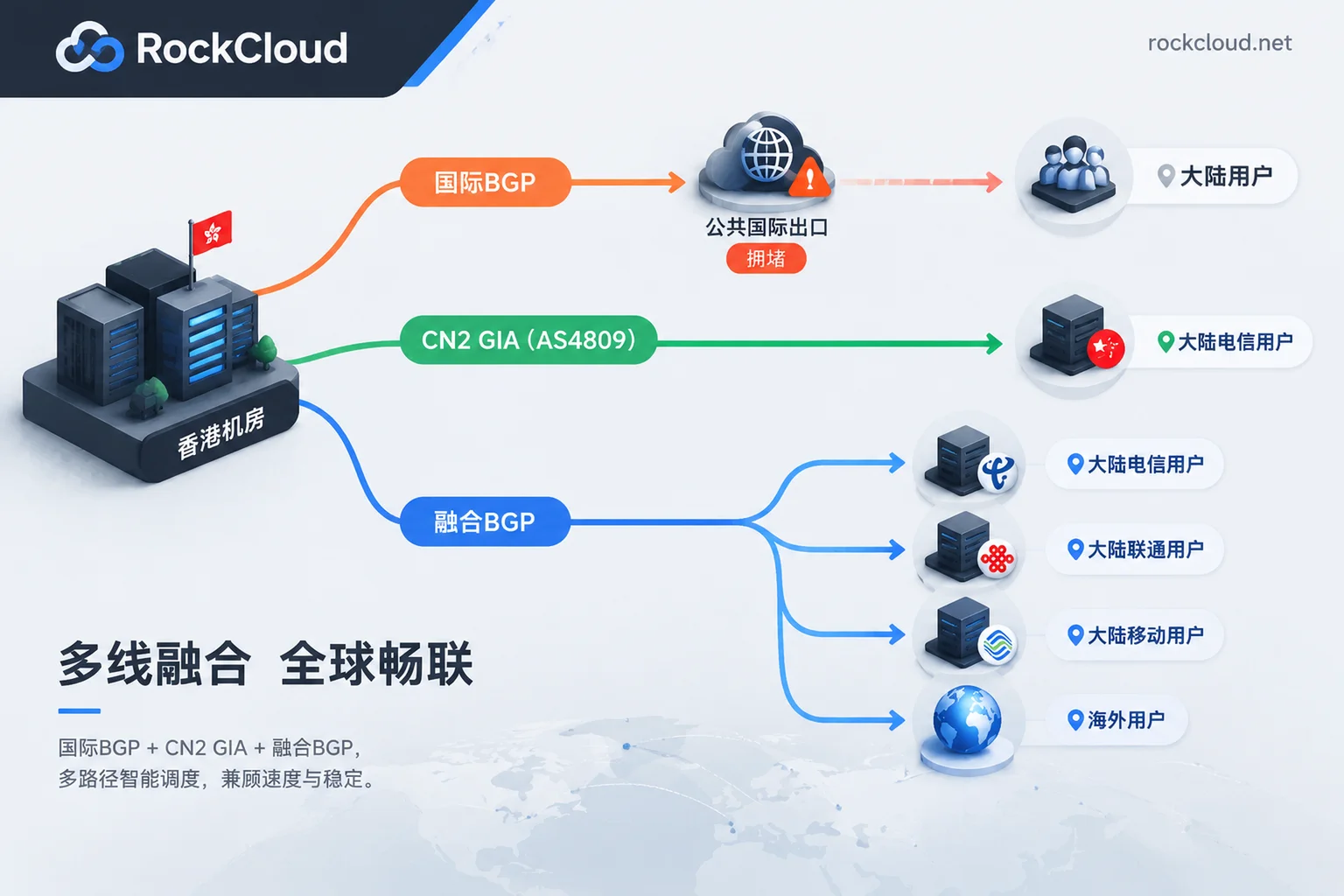
- You need to serve both mainland three-network users and overseas users, and cannot tolerate single-line outages: choose a converged line that uses BGP to combine CN2 and multi-network direct connections.
The following explains why this split makes sense and what to verify before purchasing.
First Clarify: These Two Names Are Not on the Same Layer
BGP (Border Gateway Protocol) is a routing protocol. After a data center connects to multiple upstream carriers, it uses BGP to announce the same IP externally, and routers automatically select routes; if one upstream fails, traffic switches to another line. It answers "how routes are selected and how many upstreams there are," but does not specify who the upstreams are.
CN2 is China Telecom's next-generation carrier network, with autonomous system number AS4809. This is a premium backbone built by China Telecom for cross-border services, with a quality-of-service level higher than the ordinary backbone. It answers "which physical link the data travels over."
So the two do not conflict. What the market calls "Hong Kong BGP" mostly refers to international BGP: connecting to Hong Kong local internet exchange (HKIX) and international carriers such as HE, NTT, and Telia, with return traffic to mainland China going through public international exits. Many optimized lines instead use BGP to announce multiple links such as CN2 GIA, China Unicom, and China Mobile direct connections together. When you see the word "BGP," first ask which upstreams are included and which link is used for return traffic to mainland China; otherwise, you cannot compare.
The Differences Mainly Show Up in Three Areas
1. Mainland User Experience During Evening Peak
This is where the gap is largest. International BGP returning to mainland China must pass through public international exits. When cross-border backbones are congested during evening peak, commonly cited data shows mainland latency above 80–200ms, with packet loss fluctuating between 5% and 20%. Bidirectional CN2 GIA has dedicated cross-border bandwidth and higher scheduling priority, with fewer hops back to China. Commonly cited data shows latency to mainland China around 20–50ms, lower along the southern coast, and packet loss during evening peak usually below 0.5%.
These numbers vary by data center, city, and carrier, so they can only serve as order-of-magnitude references. Use your own tests in the target region as the standard. For regional reference values and acceptance criteria, see What Is a Normal Latency for Hong Kong CN2 Servers.
Also note: during the day, speed tests on the two lines may be similar. The difference often only appears between 8 PM and 11 PM, so testing must cover that period.
2. Overseas User Coverage
CN2 mainly optimizes the Hong Kong-to-mainland direction. When users are in Southeast Asia, Europe, or the US, CN2 has basically no acceleration advantage. International BGP connects to more international carriers and has sufficient interconnection with exchanges, so overseas coverage and routing redundancy are actually better.
3. Cost and Bandwidth
CN2 GIA cross-border bandwidth is scarce, and the price per Mbps is significantly higher than international BGP. For the same budget, international BGP can buy much more bandwidth. For high-traffic services such as large file downloads and video-on-demand, routing everything over CN2 would be very expensive.
Choose by Business Type
| Business Scenario | Recommended Line | Basis for Judgment |
|---|---|---|
| Users mainly in mainland China; gaming, trading, real-time audio/video, API | CN2 GIA, or an optimized line that includes CN2 GIA | Experience depends on evening peak latency and packet loss |
| Users mainly in mainland China; display or content sites not sensitive to latency | First test a lower-tier CN2 or optimized line; upgrade if evening peak performance is insufficient | Control cost first, then decide based on test results |
| Users mainly in Hong Kong, Macau, Taiwan, Southeast Asia, Europe, or the US | International BGP | CN2 has no advantage overseas; international BGP has broader coverage |
| High-traffic downloads and static asset distribution with a limited budget | International BGP; if there are many mainland users, put interactive parts on an optimized line separately | Put high bandwidth on the lower-unit-price line |
| Both mainland three-network users and overseas users; high availability required | Multi-line BGP converged with CN2 and China Unicom/China Mobile direct connections | CN2 belongs to China Telecom's network; Unicom and Mobile users need direct connections to fill the gap, and multiple upstreams also prevent single-line outages |
The price and evening peak performance of CN2 GIA and CN2 GT differ considerably. If the budget is limited, you can test both and then decide which to use. For the difference between the two, see What Is the Difference Between CN2 GIA and CN2 GT.
Five Things to Verify Before Purchasing
- Is it really CN2? Use traceroute to check whether the route contains AS4809 and nodes starting with 59.43. Test both outbound and return paths; lines that use CN2 in only one direction are common. For the method, see How to Tell Whether It Is a Real CN2 Line.
- Is it GIA or GT? This should be clearly stated in the contract or line description.
- Test during evening peak. From the province where target users are located, test separately with China Telecom, China Unicom, and China Mobile for several consecutive evening peaks. If packet loss is detected, follow What to Do About Hong Kong CN2 Server Packet Loss During Evening Peak to troubleshoot whether it is a local machine issue or a line issue.
- Ask for the upstream list behind "BGP." Which international carriers are included, and are there direct connections to mainland three networks? If it only says "BGP multi-line" without listing upstreams, there is no way to compare with others.
- Clarify the billing method. CN2 bandwidth has a high unit price; confirm whether billing is by bandwidth or by traffic, then estimate monthly cost based on business peak.
If the Server Is Already Purchased, Can Mainland Access Still Be Improved?
Lines follow the data center. If the origin server is already in an international BGP data center, or is not in Hong Kong at all, and you want to improve mainland access, you can add a CN2 acceleration layer in front of the origin: users first connect to an acceleration node, and the node then pulls from the origin. This avoids migrating the server.
RockCloud's CN2 China Acceleration uses three-network direct connections and does not require ICP filing. Acceleration and DDoS/CC protection are completed on the same link, with only one fee, billed by fixed peak and with unlimited traffic. It is recommended to first apply for a test through Plans and Free Testing, and sign the contract only after your own users' evening peak tests meet the standard. If your Hong Kong business also faces attack risks, you can also read Do Hong Kong Servers Need High-Protection.




Comments(0)