 RockCloud-基石云安全-官方博客
If you've just typed "DDoS protection" into the search box, chances are you're grappling with one question: Are the free basic protections from cloud providers, server firewalls, or free CDNs enough? Do I really need to pay for high-defense?
Here's the conclusion upfront: For personal blogs, internal test environments, or showcase sites with little competition, free DDoS protection is usually sufficient. But as soon as your website has user logins, payment callbacks, public APIs, or your business loses orders if down for an hour, free solutions will eventually fail. There are only two reasons:
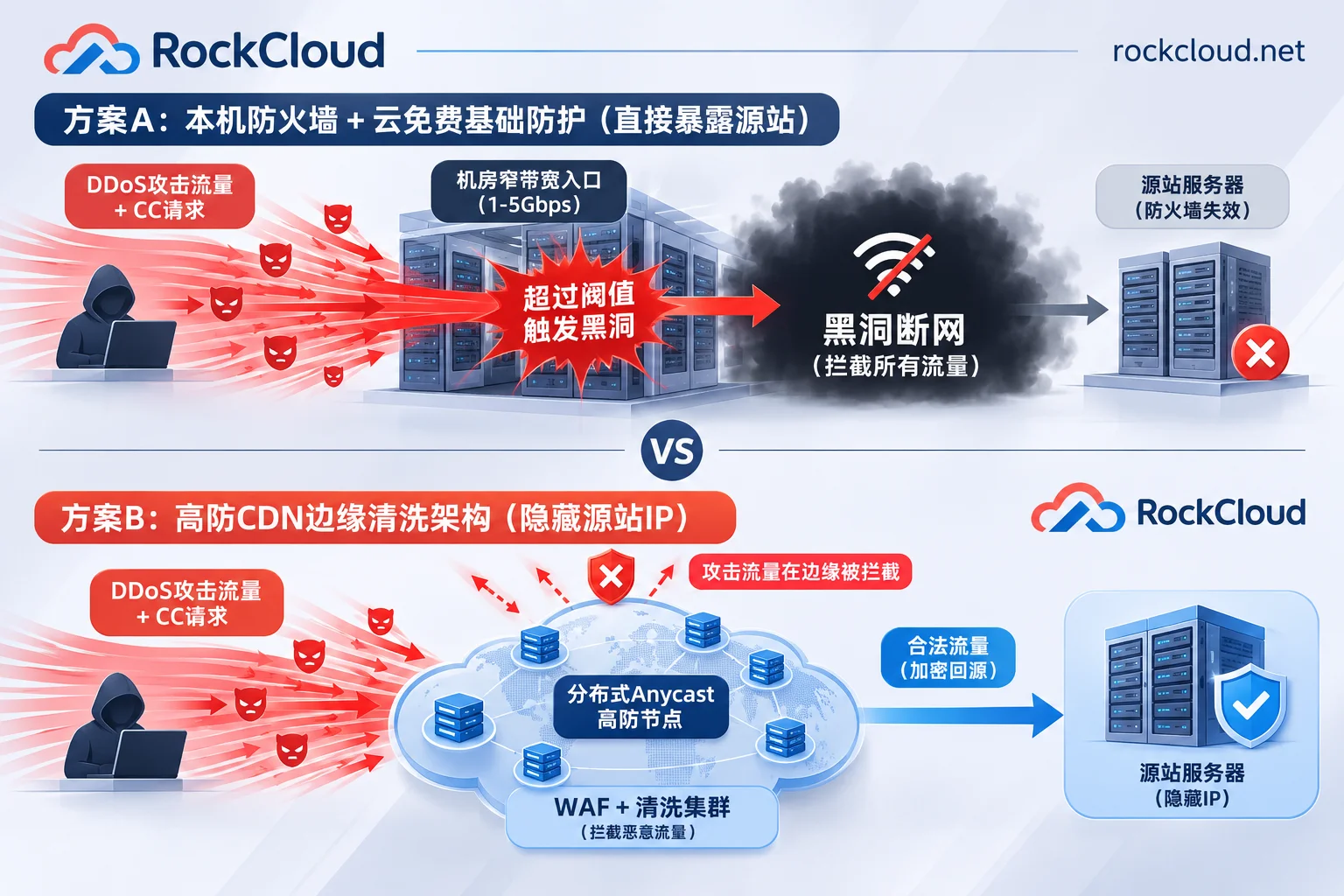
- Free basic protection from cloud providers has extremely low limits (commonly 1-5 Gbps). Exceeding it triggers a "blackhole" that cuts off all network access for 30 minutes to 24 hours, and it does not protect against Layer 7 CC attacks by default.
- The firewall, security groups, and rate-limiting rules you configure on your server have no chance to execute once the data center bandwidth is saturated by external flood traffic.
Below, we'll explain in depth why ordinary protection can't hold up, the new attack trends in 2026, which scenarios require paid protection, and the most common billing pitfalls when buying high-defense.
1. Why "Local Firewall + Free Cloud Protection" Still Fails
Many sysadmins and site owners wonder when they first get hit: I've enabled iptables / nftables on the server, configured cloud security group ACLs, added limit_req rate limiting in Nginx, and the cloud console says "Free DDoS Basic Protection Enabled." So why does the server instantly become unreachable?
1. Local firewalls and ACLs can't stop traffic that's already blocked before it reaches the door.
The core of volumetric DDoS attacks (like UDP Flood, SYN Flood) is not to break into your system, but to fill up the server's uplink pipe with massive junk packets. A simple example: your cloud host's outbound bandwidth is 100 Mbps or 1 Gbps. When 5 Gbps of junk traffic comes in, the data has already clogged the road while traversing the ISP backbone and data center switches. Local firewalls and ACLs are "inside the door"; the road outside is already paralyzed, and no amount of sealing inside will help.
2. The truth about cloud providers' "free basic protection": low limits, no CC protection, blackhole on excess
Public clouds don't offer unlimited free DDoS mitigation because when ISPs bill cloud providers for total bandwidth, they don't exclude attack traffic. Therefore, free basic protection from major cloud providers has very hard boundaries:
- Extremely low defense limits: For example, Alibaba Cloud's free DDoS Basic Protection ranges from 500 Mbps to 5 Gbps; Tencent Cloud's default basic protection does not exceed 2 Gbps; and overseas and Hong Kong/Taiwan nodes are often even lower—for instance, Baidu AI Cloud explicitly states that the blackhole threshold for the Hong Kong region is only 1 Gbps (5 Gbps for mainland China and Singapore).
- Blackhole on excess: Once attack traffic exceeds the blackhole threshold, the cloud provider, to maintain network stability for other tenants in the same data center, will directly drop all traffic destined for your server IP at the ISP side (i.e., "blackhole blocking"). The duration is typically 30 minutes to 24 hours and cannot be manually lifted by the user immediately. For attackers, even a few Gbps of traffic to push your machine into blackhole achieves their goal.
- No protection against Layer 7 CC attacks: Free basic protection mainly targets network and transport layer (L3/L4) floods and explicitly does not support mitigating HTTP Flood / CC attacks. Attackers can simply use proxy IPs to hammer your login, search, or dynamic endpoints with high concurrency, dragging down your database and CPU without ever triggering the basic protection threshold.
3. Hidden shortcomings of free CDNs: detour latency and protocol limitations
Many people think of using free CDNs like Cloudflare Free to hide origin IPs and absorb HTTP/HTTPS layer pressure. For pure static overseas sites, this is indeed cost-effective, but in mainland China and Asia-Pacific commercial scenarios, it often hits three obstacles:
- Severe detours for mainland China access: Free nodes usually lack optimized return routes for mainland China, and packet loss and high latency during peak hours directly impact real user conversion.
- Cannot protect non-Web protocols: Free CDNs only proxy HTTP/HTTPS ports. If you run game servers, IM long connections, or custom TCP/UDP ports, you can't integrate them at all.
- Lack of fine-grained strategies for high-intensity CC attacks: When facing slow or high-frequency API hammering that mimics normal browsers, the free tier often struggles with "either can't block it, or kills normal users and API callbacks along with it."
2. Why "Making Do" Used to Work but Is More Easily Broken This Year
If you think "small businesses don't get attacked normally, I'll deal with it when it happens," the threat data for 2026 might break that complacency:
- Attacks are becoming more frequent and "short, fast, and swarm-like": Cloudflare monitored and mitigated 18.2 million network-layer DDoS attacks in Q3 2026 (up 208% year-over-year, averaging over 8,200 per hour), with 96% of network-layer attacks lasting less than 10 minutes and peaking below 1 Gbps. Attackers no longer just send large floods for hours; they use high-frequency pulses to probe your alert response and blackhole mechanisms, specifically targeting Hong Kong/overseas low-threshold hosts or dynamic endpoints.
- Application-layer (Web/API) and direct-path floods surge: Radware's "Global Threat Analysis Report for H1 2026" shows that Web DDoS attacks increased by 110.6% year-over-year in H1 2026, with a single monitored customer facing an average of 110 network-layer attacks per day; meanwhile, attack methods have clearly shifted from traditional reflection/amplification to direct-path stateless UDP floods (accounting for 73% of scrubbed packets).
- Ultra-high traffic limits continue to rise: NETSCOUT ATLAS monitored over 9.14 million DDoS attacks globally in H1 2026, with attacks exceeding 1 Tbps surging by 1,286% year-over-year. Standalone or local hardware protection can hardly cope with ISP uplink congestion independently, and cloud scrubbing centers are now handling 68% of global protection demand.
In short: "Waiting to be blackholed and then buying protection temporarily, waiting for recovery" no longer works under high-frequency pulses and mixed CC attacks—the truly effective strategy is to keep scrubbing nodes permanently in front of your business and completely hide your origin IP.
3. Four Business Tiers: Should You Save Money with Free or Buy Paid High-Defense?
Before budgeting, identify your business type and downtime loss:
| Business Type | Is Free Enough? | Recommended Protection Architecture | Selection and Cost Considerations |
|---|---|---|---|
| Personal blog / internal test site / non-monetized showcase page | Sufficient | Cloud provider free basic protection + regular backups + enable local firewall/simple rate limiting | If occasionally scanned into blackhole, lower DNS TTL and wait for unblocking; no need to blindly buy expensive guaranteed high-defense |
| SMB Web/SaaS with logins, forms, APIs | Not sufficient (easily killed by CC or blackholed at low thresholds) | High-defense CDN + built-in WAF (manages both L3/L4 scrubbing and L7 CC protection) | Focus on whether CC and WAF are bundled in the same package, and whether billing is by fixed peak to avoid bills exploding with attack traffic |
| ICP-free business targeting mainland China/Asia-Pacific users | Not sufficient (free overseas CDNs prone to packet loss during peak hours) | High-defense CDN with China-surrounding nodes + CN2 three-network direct acceleration | Confirm integration does not require changing your original DNS provider (supports CNAME), and that scrubbing back-to-origin uses CN2 GIA / AS9929 / CMI optimized routes |
| Non-HTTP or high-adversarial businesses like game battles, live streaming, payments, IM | Completely insufficient | Game Shield (full TCP/UDP protocol encapsulation and forwarding) or dedicated high-defense solutions for video/payment | Ordinary CDNs cannot handle non-standard TCP/UDP ports; ensure that when a single node is attacked, it can switch to high-defense nodes without disconnection |
If you want to further distinguish the boundaries between ordinary acceleration CDNs and high-defense CDNs, refer to our detailed breakdown: What's the difference between high-defense CDN and ordinary CDN? When do you need high-defense CDN?.
4. The 3 Most Common Billing and Architecture Pitfalls When Buying Paid High-Defense
Many enterprises don't fail to buy high-defense; they buy it but either lose control of bills or still get breached after integration. Before signing, be sure to check these three points:
Pitfall 1: Ignoring "elastic billing" and "per-incident full protection" bill shockers
When buying high-defense, don't just look at the base monthly fee. Always ask: "How are charges calculated after exceeding the guaranteed level? Does scrubbing traffic during an attack count?"
- In public cloud high-defense systems, billing is often composed of multiple independent modules. For example, Alibaba Cloud adjusted the elastic 95th percentile billing strategy for some high-defense products in 2026, where daily 95th percentile elastic bandwidth can generate additional post-paid bills during excess attacks.
- Tencent Cloud EdgeOne DDoS High-Defense Practical Edition is priced at $1,300/month but includes only 2 full protections per month; the unlimited Premium Edition costs up to $5,000/month (mainland China protection extension pack adds $700/month, and the right to rate-limit or blackhole under sustained attacks is still reserved).
- AWS Shield Advanced requires a 1-year subscription commitment, starting at $3,000/month, plus outbound data transfer fees.
For SMBs, if an attacker deliberately sends excess pulses for a day, the elastic bill could be several times more than the server itself.
Pitfall 2: Buying DDoS, CC, WAF, and acceleration separately doubles costs and causes finger-pointing
Many users buy L3/L4 high-defense IPs only to find that CC protection requires an additional WAF rule package, and SSL certificates or overseas acceleration require another CDN. Chaining two proxies not only increases time-to-first-byte but also makes it hard to locate which layer failed during a mixed attack. When selecting, we recommend directly checking Do you need to buy CC protection separately? Differences from DDoS high-defense and WAF, and selection guide to avoid pitfalls, and prioritizing integrated full-link solutions.
Pitfall 3: Integrating high-defense but failing to hide origin IP, allowing attackers to bypass and hit the server directly
This is the most common and most frustrating mistake. You pay for a high-defense CDN, but old DNS records, mail servers, subdomains, or historical SSL certificates have leaked your origin's real IP, or your origin server firewall doesn't restrict access to only high-defense back-to-origin node IPs. As a result, attackers don't hit your domain at all; they directly scan your origin IP with tens of Gbps, rendering the high-defense useless. For troubleshooting origin leaks, we recommend checking: Why does traffic still get through after integrating high-defense CDN? Deconstructing origin IP leak paths and anti-bypass back-to-origin architecture.
5. Implementation: Building a "No Disconnection, No Origin Leak" DDoS Defense Line at Controllable Cost
Now that you understand "when to save and when you must protect," you can proceed with this most reliable deployment path:
1. Replace bare-metal exposure with high-defense CDN, merging DDoS, CC, and acceleration into one link
If you need to simultaneously solve "resist volumetric floods + prevent CC API hammering + hide origin IP + cross-region acceleration," you can directly adopt the cloud DDoS protection and high-defense CDN solution provided by RockCloud:
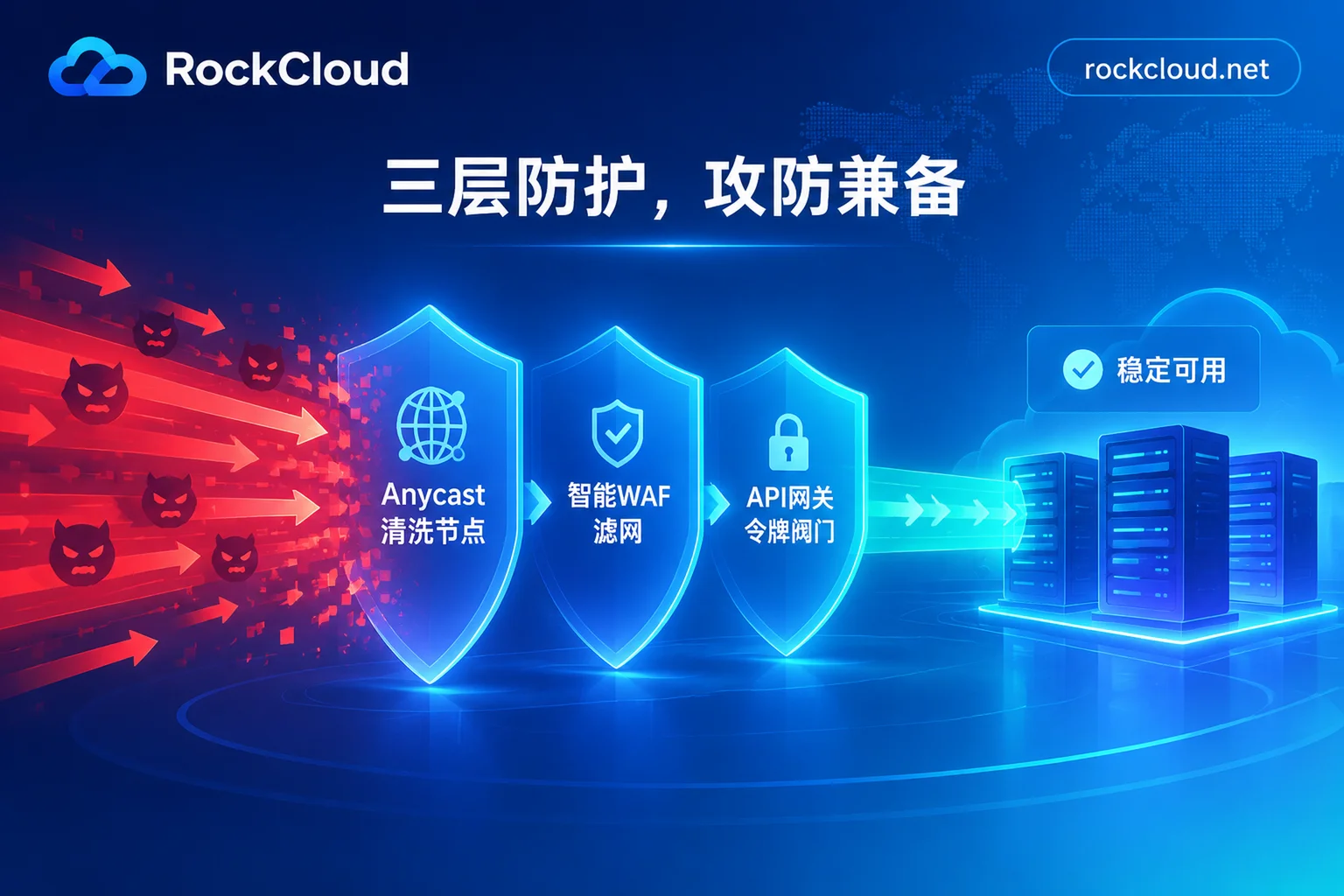
- Full-link integration, no separate billing: Uses Anycast distributed edge nodes to scrub traffic and hide origin IP; DDoS protection, CC protection, intelligent WAF (with built-in OWASP core rule set and machine learning anomaly detection), and fully automated SSL certificates are all in the same request path and the same package, so you don't need to buy separate products for CC or basic security features.
- Fixed peak monthly billing, unlimited traffic and requests: RockCloud high-defense CDN packages default to monthly billing by fixed peak, with unlimited total traffic and requests, structurally avoiding the risk of "sky-high elastic bills from attacks" (specific defense specifications, testing, and pricing are subject to official website or customer service confirmation).
- No NS change, smooth integration with one CNAME: Keep your original domain DNS provider; just add a CNAME record to integrate. Old and new links can switch in parallel without business interruption. If targeting mainland China users and wanting ICP-free integration, you can optionally use Hong Kong, Japan, Korea, Singapore and other China-surrounding nodes with CN2 GIA / AS9929 / CMI three-network direct return dedicated lines (Learn about CN2 China acceleration solution).
2. Non-Web / gaming business: don't force ordinary high-defense CDN
If you are protecting PC games, mobile games, board games, or custom TCP/UDP long-connection protocols, ordinary high-defense CDNs cannot cover non-HTTP ports. For such scenarios, use RockCloud Game Shield (View Game Shield solution), which hides the origin through client private protocol encapsulation and distributed edge node full-protocol forwarding. Even if a single edge node is attacked, it can automatically switch to a high-defense node, keeping players connected without interruption.
3. Go-live and emergency self-check checklist (4 steps to closure)
Regardless of which provider you choose, after integrating protection, be sure to complete these 4 steps for it to truly take effect:
- If integrating while under attack, you must change the origin IP first: If your origin IP is already exposed and an attack is ongoing, simply changing the CNAME is often insufficient. You must simultaneously assign a new public IP to the existing server before integrating scrubbing (for emergency steps, refer to Website under large traffic attack: integration order and key points for quickly mounting CDN).
- Lock down origin firewall with back-to-origin whitelist: In cloud security groups or local firewalls, only allow high-defense CDN back-to-origin node IP ranges and deny direct access to origin Web/business ports from other public IPs.
- Close irrelevant ports and leak sources: Check whether the origin still has direct mail sending, FTP, or subdomains not going through the proxy open, to prevent them from becoming backdoors that leak the origin IP.
- Test before going live with production business: With providers like RockCloud that support evaluating by business specifications, you can contact customer service to determine the appropriate tier and apply for a free test before formal purchase (View pricing and testing instructions). If your business is currently under a large traffic attack and needs emergency mitigation, you can directly contact the security team via the RockCloud security response contact page or official Telegram (
https://t.me/rockclouds) for assistance.