RockCloud-基石云安全-官方博客
Conclusion first: CC protection usually doesn't need to be purchased separately, but when selecting a plan you must keep an eye on one thing—whether DDoS scrubbing, CC protection, and WAF run on the same request path and are included in the same package.
Many operations and business managers search for "CC protection" often because their website bandwidth isn't maxed out, but server CPU and database connection pools suddenly spike to 100%, or they just bought "high defense" only to find that CC attacks still paralyze the page. If you break down the solutions on the market, you'll find that frequent pitfalls are often not because the defense is completely useless, but because "network-layer DDoS," "application-layer CC," and "Web Application Firewall (WAF)" are treated as things that can be arbitrarily purchased separately and substitute for each other. As a result, either high-frequency attacks directly trigger blackholing, or you get stabbed in the back by elastic QPS and origin-traffic bills, or strict policies block normal users and search engine spiders together.
1. What do CC Protection, DDoS High Defense, and WAF each handle?
From the time traffic enters the network until it reaches server code, these three work at completely different layers. Buying only one layer makes it easy for attackers to bypass from another layer:
| Protection Capability | Main Layer | Threat Characteristics Intercepted | Shortcomings When Relying on It Alone |
|---|---|---|---|
| DDoS High Defense (L3/L4) | Network layer / Transport layer | SYN Flood, UDP Flood, ICMP Flood and other ultra-large traffic and connection floods | Weak at identifying CC requests that have completed TCP handshake and disguised as normal HTTP/HTTPS access; many packages focus on scrubbing bandwidth, and even set CC as a limited quota or extra charge item |
| CC Protection (L7) | Application layer (HTTP/HTTPS) | High-frequency login/search/order API flooding, slow connection occupation, fake browsers or proxy pools consuming origin computing power | If the underlying layer lacks sufficient scrubbing capacity to withstand large traffic concurrency, high-frequency CC will still push the entrance into blackhole; rules too coarse easily cause false positives on normal visitors and API calls |
| Intelligent WAF (L7) | Application layer (semantics and rules) | SQL injection, XSS, command injection, scanners, malicious scripts, and Bot automated requests | Many cloud WAFs bill by QPS and business bandwidth tiers; when facing massive traffic floods, they themselves need front-end DDoS high defense as a backstop, otherwise the network will still go down |
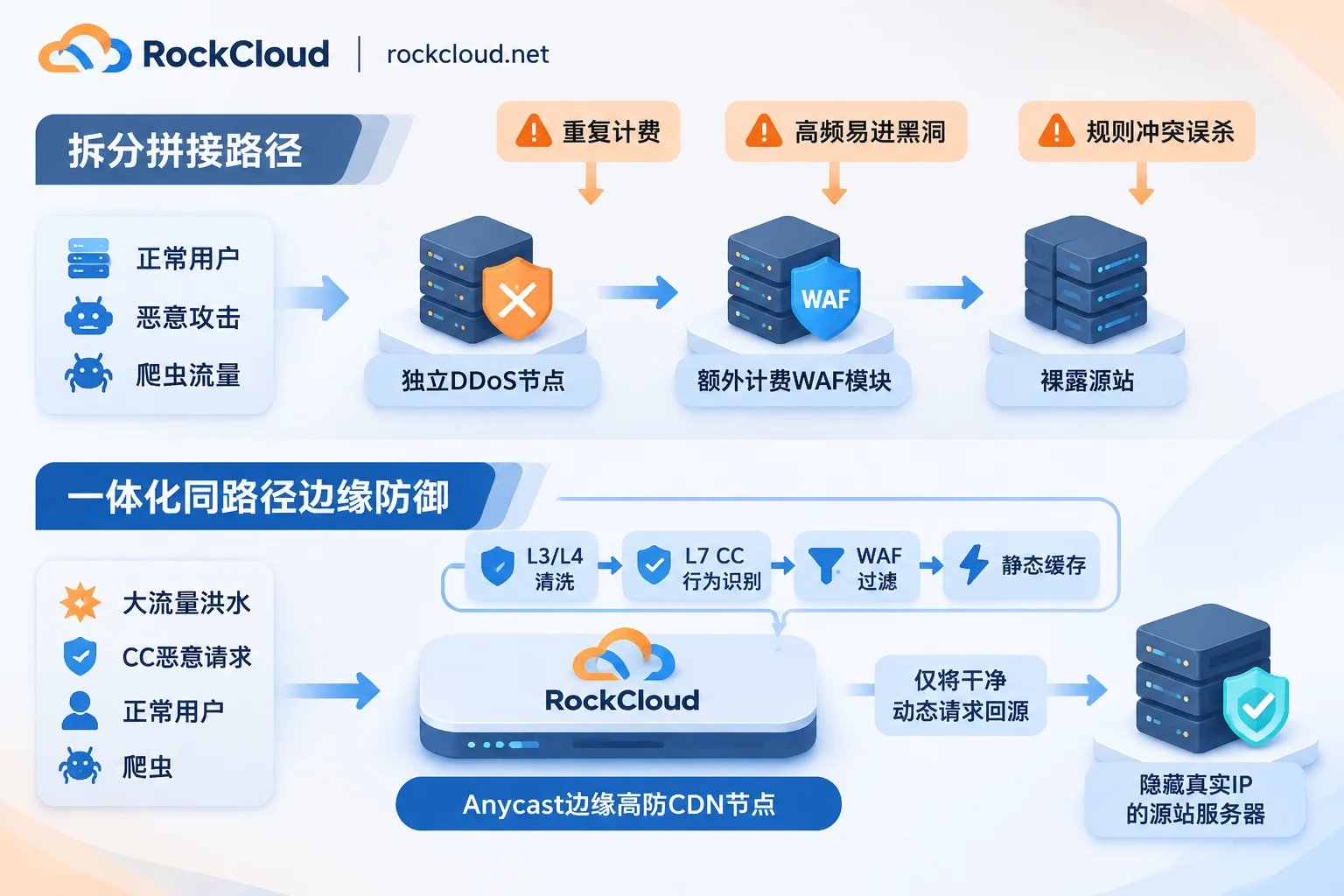
This also explains why "buying each separately" often causes problems: if you split DDoS high defense, WAF, and local rate limiting into two or three systems to piece together, not only do you have to switch between multiple consoles to troubleshoot rule conflicts during on-call duty, but more dangerously, during mixed attacks—after letting through seemingly normal TCP connections, the WAF behind may be bypassed due to exceeding QPS limits or dragged into blackhole by high traffic. A truly resilient solution completes distributed DDoS scrubbing, CC frequency and behavior identification, WAF semantic filtering, and static resource caching on the same edge request path at the same time.
2. The 4 Most Common Pitfalls When Choosing CC Protection
When comparing quotes and solution descriptions from various vendors, these four pitfalls most often cause wasted money:
1. The "high defense package" looks cheap, but DDoS and CC are billed separately
Many traditional high-defense products on the market use multi-layer billing: base guaranteed bandwidth fee + daily elastic peak fee after exceeding the guarantee + business origin bandwidth fee, and even CC protection rule packages, API security, and full logs are charged separately. Some cloud WAFs also limit the QPS specifications included with an instance; beyond that, you need to buy expansion packs per thousand QPS or settle elastic QPS fees daily. When not under attack, the bill is stable, but once competitors or automated scripts hammer hundreds of thousands of QPS for several consecutive days, the bill will explode along with alerts.
2. Only looking at "how many G it defends," without confirming whether overseas or dynamic APIs are covered for CC
"100G / 500G high defense" refers to network-layer scrubbing reserves, not that application-layer CC can withstand the same scale of request concurrency. Some data centers or overseas protection lines only do basic restrictions on CC protection, and even make CC an optional item; others only rely on simple static caching to "make do," and as long as attackers add random parameters to URLs (e.g., ?t=12345) to penetrate the cache, requests directly hit the origin database.
3. Turning on CC protection makes the whole site pop up sliders, causing false positives on normal users and SEO spiders
Many people, anxious from CC attacks, directly enable strict limit_req on the origin Nginx, or force "5-second shield / JS challenge" site-wide on the CDN. Common consequences include three:
- Nginx not configured for real IP passthrough: After connecting a proxy or CDN without correctly extracting request headers such as
X-Forwarded-For, the server treats all visitors as the same origin node IP for rate limiting, causing false positives site-wide within seconds. - Native App and Webhook callbacks crash: Mobile client APIs and third-party payment callbacks cannot execute web JS challenges or slider captchas at all, directly returning 403/503 and causing dropped orders (refer to the troubleshooting approach in 《How to Whitelist Payment Callbacks Blocked by WAF》).
- Search engine crawling plummets: Baidu and Google crawlers do not go through full browser interaction; forcing site-wide human verification directly leads to decreased indexing and rankings (see 《Does Using a No-ICP CDN Affect Baidu and Google Indexing?》).
4. Protection is in front, but origin IP is not hidden or closed off
Even if you buy strong CC protection, as long as attackers find your real server IP through historical DNS records, email headers, or subdomains, they can completely bypass the defense layer and connect directly to the origin. For the complete closure path on this point, you can self-check against 《Why Does It Still Get Breached After Connecting to High-Defense CDN?》.
3. How to Choose CC Protection for Different Business Scenarios?
Before selecting, you don't need to blindly max out the highest tier; matching according to business architecture saves the most budget:
- Pure static display sites, low-frequency corporate official websites
When there are almost no database queries or complex login APIs, host HTML, images, and scripts all in edge cache, coupled with basic rate limiting; most low-cost scripts can no longer penetrate the cache layer, and there's no need to heavily invest in complex architecture from the start. Commercial websites, e-commerce, APP backends, AI services, and WEB APIs
These businesses have many dynamic APIs (login, registration, search, ordering, large model dialogue streams), and are most afraid of low-frequency high-consumption slow CC and cache penetration, as well as triggering pay-as-you-go or QPS-based additional bills during attacks (for detailed protection of dynamic APIs, you can read further 《How to Do CC Defense for APIs and Dynamic Interfaces》).
If your core requirement is solving defense and acceleration together, with controllable budget, and without migrating your existing servers, you can directly consider RockCloud (基石云)'s CC Protection solution:- Same link, no separate purchase: RockCloud stands in front of the customer's existing servers or cloud hosts in the form of a high-defense CDN (it does not sell servers; the original origin remains), relying on Anycast distributed scrubbing to hide the origin IP, with DDoS and CC protection running on the same request path.
- Billed by fixed peak, no fear of malicious traffic causing sky-high bills: Packages are billed monthly by fixed peak by default, with unlimited traffic and requests; acceleration and protection are in the same package, DDoS/CC protection, intelligent WEB firewall (WAF), and fully automatic SSL are all included, with no separate payment for defense (CN2 mainland acceleration dedicated line and anti-hijacking are billed separately on demand).
- Intelligent WAF + manual exception release, reducing business false positives: In the control panel, you can enable the Intelligent WEB Firewall (WAF) with one click, combining OWASP core rule sets and machine learning to identify abnormal malicious requests not yet included in the rule base; for paths prone to false blocking such as payment callbacks and App-specific APIs, the security technical team can assist in configuring custom rules and exception releases.
- Zero-interruption access without changing NS: Access can be completed by simply adding a CNAME; DNS remains with the original provider, and old and new links run in parallel during switching; if there are many mainland Chinese visitors and no-ICP direct connection optimization is needed, you can also add on-demand CN2 China Acceleration with three-network direct connection.
- Game or real-time battle businesses requiring TCP/UDP full-protocol forwarding
High-defense CDN mainly targets HTTP/HTTPS Web and API scenarios. If your business is a non-HTTP protocol game server, don't force Web CC protection; instead, choose Game Shield, which encapsulates non-HTTP protocols as private protocols and forwards through distributed edge nodes, so that when a single node is attacked and switches to a high-defense node, player connections won't be interrupted.
Before finalizing a plan, it is recommended to first contact customer service to determine specifications based on business needs. Specific defense levels, node specifications, quotes, and free test arrangements are subject to the official website RockCloud Pricing and Solution Description.
4. 4-Step Implementation Checklist After Integrating CC Protection
No matter which provider's solution you ultimately use, after going live, be sure to spend half an hour checking these four things:
- Cache static resources as much as possible, don't let edge computing power go to waste: Keep images, CSS, JS, and cacheable list pages at edge nodes, letting the origin channel focus on serving real dynamic business requests (for configuration methods, refer to 《How to Optimize High-Defense CDN Cache Strategy to Reduce Origin Pressure》).
- Set thresholds by API tier, don't use one site-wide rule: Normal QPS varies greatly among homepage, search API, and login/SMS API; interactive challenges (such as JS verification/captcha) should only be placed on suspicious high-consumption paths, while API and callback interfaces prioritize signature, Token, and feature verification.
- Confirm "origin only allows back-to-origin nodes": If you are integrating urgently during an attack, be sure to simultaneously change the origin IP, and disable public direct connection in the origin firewall, only allowing scrubbing/CDN back-to-origin node IP ranges. For emergency integration, refer to 《Website Under Large Traffic Attack: Integration Order and Closure Points for Quickly Mounting CDN》, or directly contact the RockCloud Security Response Team / Telegram (https://t.me/rockclouds).
- Establish normal traffic baseline and alerts: After integration, first observe network logs and bandwidth curves for 3–7 days, recording normal peak QPS and connection counts; the RockCloud console supports traffic bandwidth reports, network log queries, and real-time Telegram data push, so when a single API's QPS abnormally rises, you can locate and handle it immediately.
Frequently Asked Questions (FAQ)
1. I already bought an ordinary cloud server (like Alibaba Cloud, AWS, Hong Kong VPS). Do I need to change servers to integrate CC protection?
No need. High-defense CDN services like RockCloud are a protection and acceleration layer in front of the customer's existing servers; your existing server continues to be used as the origin, with no need to rebuy servers or migrate the entire business codebase. Just add a CNAME record to start testing and switching.
2. After enabling CC protection, will it slow down normal users' access?
Under normal configuration, it not only won't noticeably slow down, but static resources may actually be faster after hitting edge cache. RockCloud's global CDN uses Anycast nearby access and latency-based automatic routing, supporting HTTP/3, TLS 1.3 0-RTT, and Brotli compression; what really causes slowdowns is often site-wide indiscriminate verification pop-ups or detoured back-to-origin links, which can be avoided with fine-grained path-based configuration.
3. If my domain and origin are currently paralyzed by CC attacks, is it too late to integrate now?
It's not too late, but the order must be correct: first add a CNAME to integrate the high-defense CDN, and immediately change the origin IP, and only allow back-to-origin node traffic on the new origin, completely taking the old IP offline. This immediately cuts off attackers' direct consumption of the origin, letting the scrubbing layer block malicious requests at the edge.