 RockCloud-基石云安全-官方博客
In recent security operations circles, what worries business owners and procurement teams more than "servers being blackholed" is waking up to find tens of thousands or even hundreds of thousands of yuan in CDN arrears bills added to their accounts overnight.
To remind users to avoid such financial risks, major cloud vendors have updated their "High Bill Risk Warning" and "Best Practices for Preventing Traffic Theft" documents. These documents clearly state: when a domain name experiences sudden high bandwidth and large traffic consumption due to malicious attacks or traffic theft, because CDN node resources are actually consumed, the resulting costs must be borne by the customer and cannot be waived or refunded.
Why does a CDN, originally meant to accelerate websites and save origin bandwidth, become a "money-devouring beast" when under attack? In an era of industrialized and high-frequency attacks, how should enterprises choose a high-defense CDN to fundamentally break the vicious cycle of "sky-high bills" and "business disconnection"?
I. New Attack Landscape in 2026: Second-Level Pulses and Mixed Traffic Theft Become the Norm
To understand why ordinary CDNs cannot withstand today's bill shocks, we must first see the evolution of current attack methods. According to multiple global threat intelligence data in the first half of 2026, cyber attacks have fully entered an industrialized phase of "severe cost asymmetry":
- Terabit-level traffic常态化 and second-level instantaneous flooding: In the first half of 2026, ultra-large-scale network-layer DDoS attacks exceeding 1 Tbps surged by over 500% quarter-over-quarter. More deadly is the "second-level ramp-up"—over 80% of network-layer attacks complete within 10 minutes, and many pulse attacks go from initiation to hundreds of Gbps in just a few seconds. The window for manual emergency response is almost zero.
- Encrypted application layer (HTTPS) and mixed attacks dominate: Large-traffic brute force is no longer the only method; over 70% of attacks manifest as mixed attacks interweaving network-layer flooding and application-layer CC. Attackers use AI-driven automation tools and massive proxy pools to launch HTTPS requests that closely resemble normal user behavior, specifically targeting large files, dynamic API endpoints, or audio/video streams for aggressive pulling (for handling specific scenarios, refer to our previous article What to Do When Video CDN Is Maliciously Stolen and DDoS Attacked).
Under such high-frequency, instantaneous, and high-concurrency impacts, ordinary CDNs that only have distribution capabilities without native scrubbing capabilities find themselves in an extremely awkward position.
II. The Dilemma of Ordinary Pay-As-You-Go CDNs: Either Bankruptcy or Disconnection
Many enterprises, when designing initial architectures, habitually purchase basic "pay-by-traffic (GB) or pay-by-actual-peak-bandwidth postpaid" ordinary CDNs, believing that adding a CDN secures the origin. However, in real attack-defense confrontations, this billing and architecture model has three fatal blind spots:
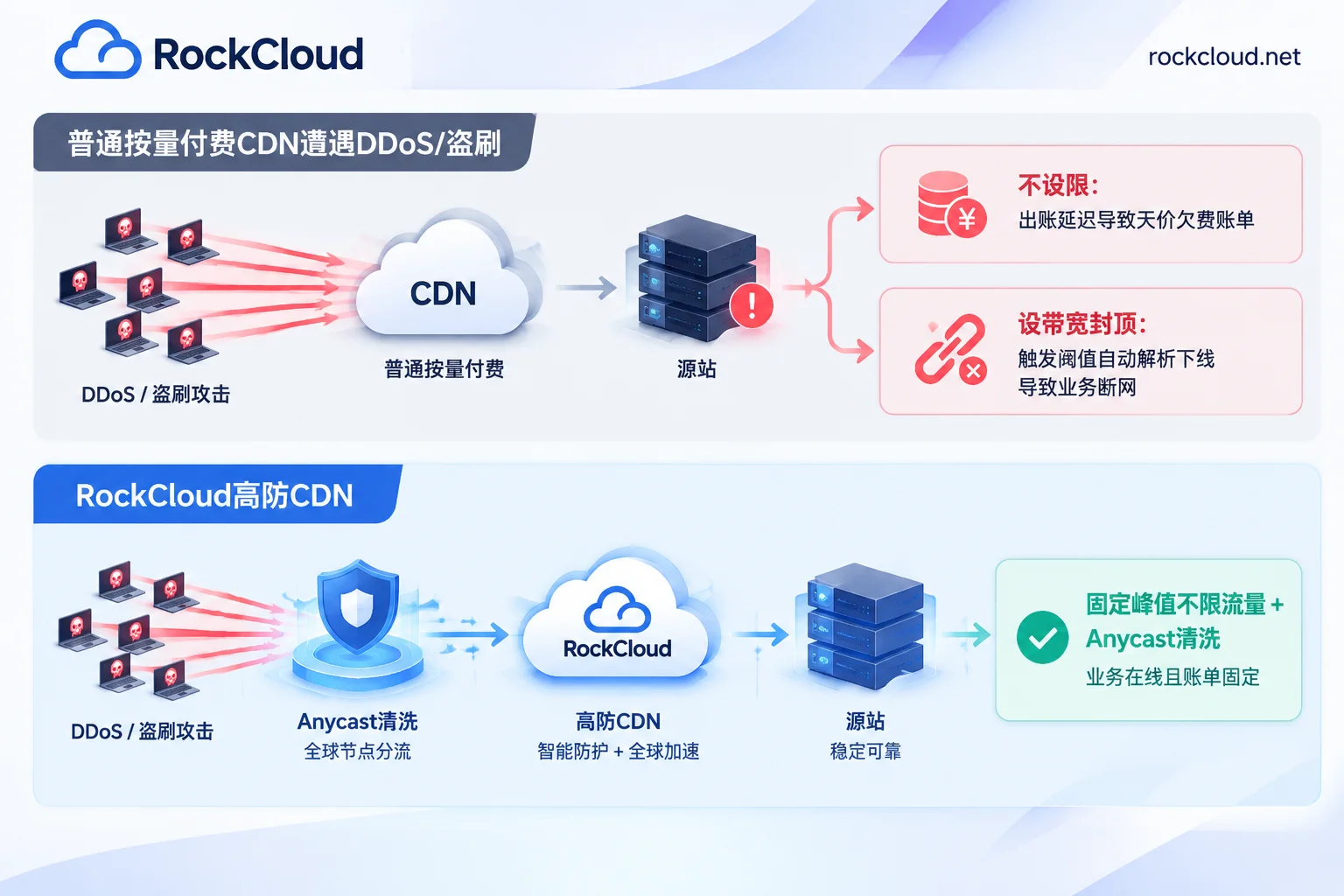
1. "Silent Bankruptcy" Caused by Billing Settlement Delays
Ordinary CDNs by default do not provide deep security scrubbing capabilities. When hackers launch massive requests to steal static resources or high-frequency API calls, CDN edge nodes faithfully respond to these malicious requests (or frequently fetch data from the origin). Because mainstream cloud vendors' pay-as-you-go billing typically has a processing delay of 3 to 4 hours, they cannot "stop service immediately when balance reaches zero." Often, by the time operations staff receive arrears alerts, a few hours of pulse attacks have already generated huge bills far exceeding the account balance.
2. "Bandwidth Cap" Equals Helping Hackers Complete DDoS
To prevent sky-high bills, traditional cloud vendors' core loss-mitigation advice is usually to configure "bandwidth caps (usage limits)" or "per-request rate limiting."
But upon closer inspection, the paradox becomes apparent: once bandwidth caps are enabled, when the average bandwidth within 1 or 5 minutes exceeds the preset threshold, the CDN provider will directly stop acceleration services and resolve the domain to an invalid address (such as offline). This means attackers only need to spend extremely low cost to fill your preset threshold, directly triggering the cloud vendor's disconnection mechanism, perfectly achieving "Denial of Service (DoS)" on behalf of the hackers.
3. Defense Components Sold Separately, Hidden Costs Out of Control
Under traditional cloud architectures, to plug this loophole, enterprises must pay extra for DDoS native protection packages, cloud WAF billed by request count (QPS/SeCU), or even separately purchase Bot management modules, on top of the ordinary CDN. Not only is the link lengthened, but once facing hundreds of thousands of CC attacks per second, the WAF's "per-request billing" and post-scrubbing "excess elastic protection fees" remain an unpredictable bottomless pit.
III. The Solution: Lock Down Risks with "Unlimited Traffic + Integrated Defense" High-Defense CDN
In response to the dual needs of "budget tightening and risk avoidance" commonly faced by procurement teams in 2026, more and more websites, apps, games, live streaming, and AI services are migrating their edge entry points to professional high-defense CDN platforms like RockCloud that adopt fixed-cost models and natively integrate scrubbing capabilities.
Compared to traditional "basic CDN + pay-as-you-go security add-ons" patchwork solutions, RockCloud fundamentally untangles the above dead knots from the billing foundation and network architecture:
1. Unlimited Traffic, Unlimited Requests, Financially Eliminating "Sky-High Bills"
Cost controllability is the first prerequisite for DDoS resistance. In RockCloud's package billing model, billing is by month and fixed peak by default, with completely unlimited traffic consumption and unlimited request counts.
More importantly, acceleration and security defense run on the same link and are included in the same package—DDoS defense, CC defense, intelligent WAF, and fully automatic SSL are all included, with no separate purchase required for defense. No matter how many billions of malicious CC requests attackers launch, or how many petabytes of traffic they try to steal via large file pulls, enterprises need not worry about unexpected excess traffic bills or per-request bills.
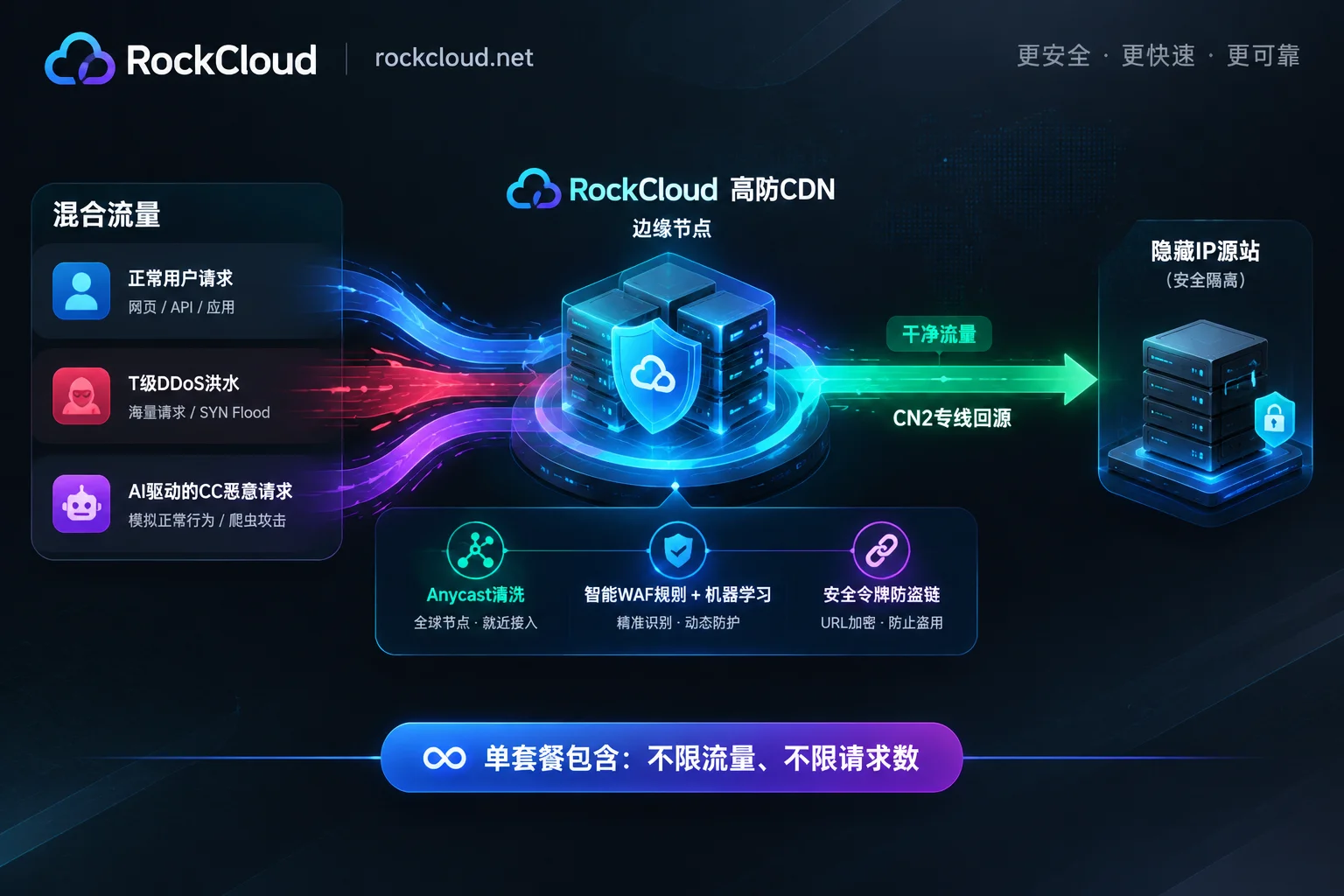
2. Anycast Distributed Scrubbing, DDoS and CC Intercepted on the Same Path
Facing second-level ramp-up mixed attacks, temporary line switching is simply too late (for details on switching time mechanisms, see How Long Does High-Defense Line Switching Take to Take Effect).
RockCloud adopts an Anycast distributed scrubbing architecture, placing the high-defense CDN permanently in front of the customer's existing origin servers or cloud hosts, completely hiding the origin's real IP (for how to prevent origin re-exposure after access, please refer to Will Origin IP Still Be Exposed After High-Defense CDN Access).
When large-traffic attacks occur, traffic is pulled to the nearest globally distributed edge nodes for absorption and filtering. DDoS network-layer scrubbing and layer-7 CC defense are completed synchronously on the same request path, without multiple cross-product forwarding, ensuring second-level response while avoiding origin bandwidth saturation.
3. One-Click Intelligent WAF and Fine-Grained Access Control
For highly disguised application-layer traffic theft and vulnerability probing, operations staff can enable the intelligent WEB firewall (WAF) with one click in the RockCloud control panel:
- Dual recognition engines: The底层 embeds the OWASP core rule set (precisely intercepting SQL injection, XSS, file inclusion, command injection, malicious scripts, and various scanners and bots), while the upper layer combines machine learning algorithms to analyze and intercept new variant malicious requests not yet in the rule base in real time (for details on slow-rate and proxy pool API abuse, see "How to Defend API and Dynamic Endpoint CC Attacks").
- Expert-assisted closure: No need for operations teams to stay up writing regex; custom protection rules and business-specific exceptions can be configured directly with assistance from RockCloud's security technical team.
- Full anti-theft toolbox: The platform natively provides security tokens and signed URLs, IP and region black/whitelists, anti-hotlinking and other general access control capabilities, combined with real-time traffic reports, network logs, and Telegram real-time data push in the control panel, keeping every abnormal fluctuation under control.
IV. Practical Advice for Business Integration and Smooth Migration
Whether your business currently runs in a self-built data center or is hosted on cloud platforms like AWS, Alibaba Cloud International, or Tencent Cloud International (RockCloud also offers international cloud account opening and top-up services without enterprise verification and supporting USDT payment, seamlessly complementing high-defense products), integrating a high-defense CDN does not require starting from scratch:
- Daily smooth integration (without changing NS): You do not need to change your existing DNS provider; simply add a CNAME record in your original DNS provider's console to complete integration. During the switch, old and new links run in parallel, achieving zero-perception transition.
Selection for specific business scenarios:
- ICP-free business for mainland China users: You can optionally add CN2 China acceleration dedicated line, accessing through Hong Kong, Japan, South Korea, Singapore and other China-surrounding nodes, using Telecom CN2 GIA, Unicom AS9929, Mobile CMI three-network direct return, balancing high-defense scrubbing and ultra-low latency.
- Native game business with non-HTTP protocols: If the business involves大量 TCP/UDP native protocol communication, you can use Game Shield for private protocol encapsulation and forwarding, achieving seamless switching when nodes are attacked without player disconnection.
- Emergency integration during an ongoing attack: If your website or API is currently under fierce attack, or your ordinary CDN bill is skyrocketing, immediately close the loop in the order of "first CNAME to high-defense -> simultaneously change origin IP -> origin firewall only allows high-defense back-to-origin node IPs" (for the complete operation checklist, see Website Under Large Traffic Attack: Quick CDN Mounting Order and Closure Points).
Conclusion
In today's highly industrialized DDoS and traffic theft landscape, security protection should not be a multiple-choice question of "protect the business or protect the budget." Rather than anxiously setting "disconnection caps" on ordinary pay-as-you-go CDNs, it is better to hand the entry point directly to a professional high-defense network with integrated architecture and capped costs.
If you wish to compare the defense architecture differences of different vendors, you can view our high-defense selection comparison; if you are currently facing attack troubles and need emergency loss mitigation, or wish to apply for a free test to verify actual defense effectiveness, please feel free to contact the RockCloud security response team via the contact page or official Telegram (@rockclouds).



Comments(0)