 RockCloud-基石云安全-官方博客
When the inbound traffic on the monitoring screen is steady and bandwidth utilization is even less than 5%, many operations personnel instinctively assume the network is still healthy. However, the backend server's CPU usage can instantly spike to 100%, database connection pools quickly dry up, and core API interfaces experience widespread timeouts. This type of attack, characterized by minimal traffic but devastating impact, is becoming a real challenge for many enterprises today.
In its latest security survey report released on July 21, 2026, Radware pointed out that due to business interruptions caused by application-layer attacks, the per-minute downtime cost has surged 23% year-over-year, averaging $7,530 (equivalent to over $450,000 per hour). More critically, the average recovery time for surveyed enterprises to respond to such incidents is as long as 2.8 hours. Faced with increasingly sophisticated attack methods, traditional approaches relying solely on brute-force IP blocking or bandwidth scaling are no longer effective. Optimizing CC defense mechanisms at the application layer has become urgently necessary.
Attack Paradigm Shift: Why Less Traffic Can Be More Lethal?
In the past, the focus of network attack defense was often on network-layer flooding, but attackers' technical strategies have fundamentally shifted. According to threat analysis data released by Akamai, application-layer denial-of-service (Layer 7 DDoS) attacks have surged 104% over the past two years, with attacks targeting APIs up 113% year-over-year. Attackers are no longer blindly pursuing bandwidth saturation of tens of Gbps but instead focus on efficiently consuming backend computing resources.
In recent attack simulations, attackers tend to precisely select backend paths with high computational overhead. Typical high-risk exposure surfaces include:
- Complex database queries and full-text search interfaces without effective caching;
- Report export functions involving large amounts of data splicing and file generation;
- Authentication processes requiring repeated password hash verification and token issuance;
- Shopping cart checkout and payment callback logic with high-frequency database reads and writes.
These interfaces inherently require significant server computing power and database connections. Attackers only need to initiate a few hundred well-camouflaged concurrent requests per second through a distributed network to precisely bring down the entire application system.
Three Logical Flaws in Traditional Defense Failure
Many teams still rely excessively on traditional infrastructure protection when configuring defense strategies, resulting in significant defense gaps when facing new application-layer attacks. In a technical review on July 22, 2026, Red Button pointed out that security incidents often stem from a disconnect between defense strategies and business logic, causing existing tools to fail to achieve their intended effectiveness.
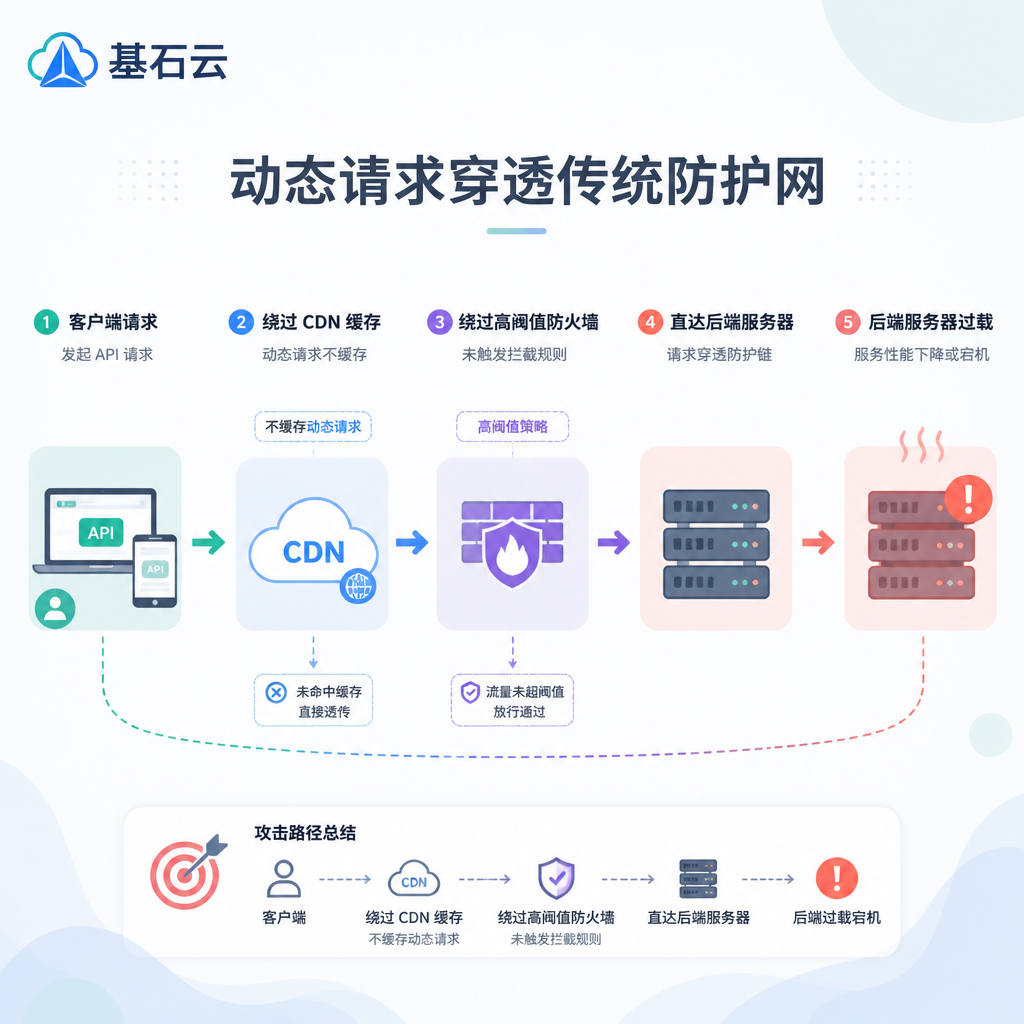
The first issue is the lack of cache coverage. Traditional CDNs are efficient at serving static images or HTML files, but API interfaces transmit mostly dynamic data, allowing these requests to pass directly through edge nodes to the origin server. Second is the failure of fixed requests-per-second (RPS) thresholds. To avoid blocking legitimate users, operations personnel often set high RPS limits, while attackers distribute requests across a vast pool of residential proxy IPs, with each IP's request frequency being very low, easily bypassing the threshold defense.
Furthermore, rigid signature-matching rules can no longer keep up. Modern automation tools can randomly rotate User-Agent strings, header parameters, and request paths, mimicking the behavior of real users. Without cross-referencing session context and behavioral characteristics at the application layer, static firewall rules can hardly distinguish between legitimate requests and malicious interference.
Three Core Evolution Paths for Building Multi-Dimensional CC Defense
To ensure business continuity under low-frequency, high-stealth application-layer attacks, enterprises need to shift their defense focus from "static blocking" to "dynamic governance." The key to establishing a high-density CC defense system lies in early intervention and precise traffic diversion before requests reach backend servers.
At the edge access side, establishing dynamic baselines based on access behavior is crucial. The high-defense architecture of ·Jishi Cloud· integrates intelligent behavioral analysis mechanisms at edge computing nodes, enabling real-time assessment of client session request context and computational cost ratios. Instead of making judgments solely based on absolute request frequency, it filters abnormal requests before they reach the origin server.
At the application and API interaction level, introducing adaptive rate limiting and human-machine verification is equally indispensable. For authentication and high-consumption query interfaces, independent strict rate-limiting policies should be established, combined with invisible human-machine challenges (JavaScript Challenges) to verify client legitimacy. Additionally, leveraging the distributed scrubbing network of ·Jishi Cloud· to isolate static resources from dynamic API traffic can maximize the reduction of backend server computational load.
Finally, elastic degradation and resource isolation at the origin server itself are often overlooked but essential last lines of defense. For non-core interfaces that consume significant computing power, rapid degradation or asynchronous processing should be supported under sudden high load, ensuring that core transaction flows and the main database remain unaffected.



Comments(0)