 RockCloud-基石云安全-官方博客
For game studios and publishers, new game public beta launches, major version updates, season settlements, or weekend tournaments are critical windows that determine retention and revenue. However, these highlight moments are often prime targets for attacks by hackers and competitors in the black market. For example, in mid-October 2026, the highly anticipated shooter title Gears of War: E-Day suffered continuous DDoS attacks during its first week of release, causing many players to be unable to log in normally or frequently disconnect during gameplay. The developer had to intervene urgently and continuously monitor and mitigate the attacks.
Why do even teams with ample budgets still find themselves passive in the face of DDoS when launching? Based on recent global security threat intelligence and real-world data, attack methods targeting games have undergone significant structural evolution. Effective game DDoS protection today can no longer rely on the old approach of "stacking bandwidth on a single machine"; instead, edge defenses must be redesigned to counter new attack characteristics.
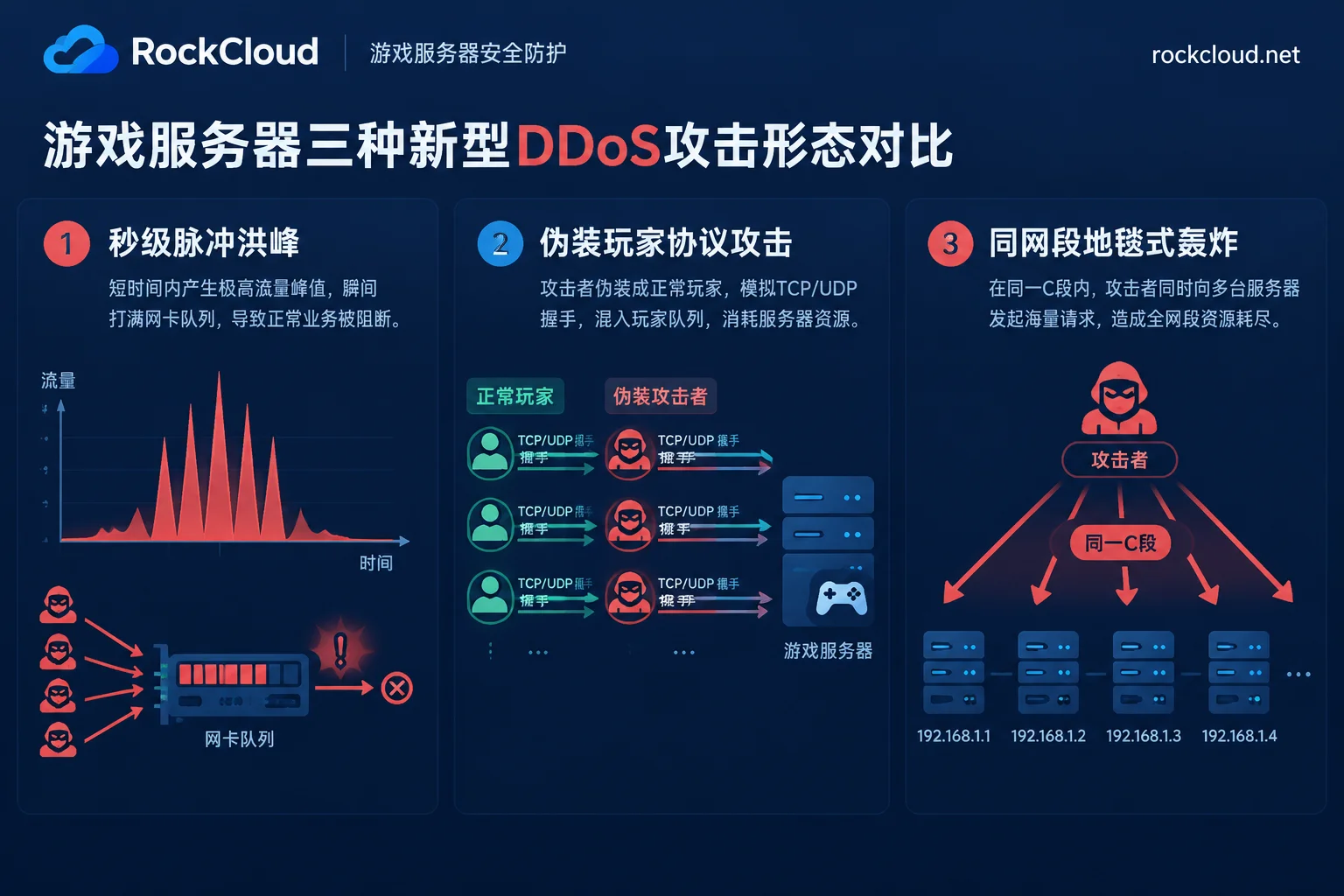
I. Three New Attack Pain Points Facing Game Servers Today
According to the recently released NETSCOUT 2026 First Half DDoS Threat Intelligence Report and the latest observations from Cloudflare and other organizations, the gaming industry has long been one of the top three most attacked industries. The attack strategies of the black market are no longer just simple long-duration traffic exhaustion; they exhibit the following three extremely challenging characteristics:
1. Second-Level Short Pulse Attacks and Reflected Floods
In the monitoring for the first half of 2026, ultra-large-scale attacks exceeding 1 Tbps surged by 519%, with DNS floods and CLDAP reflection amplification attacks accounting for a significant increase. Meanwhile, the proportion of "short pulse" hired attacks lasting one minute or even a few seconds has doubled compared to previous years.
For web services, a few seconds of lag can be resolved by a user refresh; but for real-time battles, MMOs, or board games, even a 30-second instantaneous congestion is enough to fill server NIC queues and connection tables, triggering instant disconnections for all players, reconnection storms, and even rollbacks. As for why game DDoS attacks cause all players to disconnect, the core lies in the zero tolerance of game long connections to packet loss and jitter.
2. Protocol-Layer Attacks Simulating Real Clients
Beyond brute-force high-volume attacks, application-layer and protocol-layer attacks (L7/special L4) that simulate legitimate player behavior are becoming increasingly sophisticated. Modern attack scripts no longer just send meaningless SYN or UDP garbage packets; instead, they leverage residential proxy networks to complete TCP handshakes fully, and even simulate custom handshake protocols and Challenge response packets of specific games, disguising themselves as normal players to occupy matchmaking queues and battle room computing resources. This traffic originates from real home broadband IPs, and traditional data center firewalls or simple iptables rules cannot distinguish it from real players.
3. Same-Subnet "Carpet Bombing"
Attackers no longer focus solely on a single IP; they launch sweeping attacks against the entire C-segment or subnet where the game server resides. Even if your individual server has basic protection, if a neighbor in the same data center or subnet is taken down, or upstream switch capacity is strained, your game business will also suffer collateral damage.
II. Four Core Design Principles for Effective Game DDoS Protection
Facing industrialized botnets that are extremely low-cost and readily rentable, game operations must adhere to four hard standards when planning protection architecture:
- Completely hide origin server IPs: As long as the real server IP of the game is exposed on the public internet, attackers can bypass peripheral filtering and directly hit the data center. For common vulnerabilities regarding origin server exposure, refer to Will Origin Server IPs Still Be Exposed After High-Defense CDN Integration? Five Leakage Paths and Closure Sequence.
- Split modules by protocol, dedicated for each purpose: The game's official website, login authentication, and hot update package downloads use HTTP/HTTPS protocols; while entering the game lobby and battle synchronization use custom TCP/UDP long connections. The traffic characteristics of the two are completely different. If you are still unsure how to split, we recommend reading Should Game Servers Choose High-Defense IP or High-Defense CDN: Split Modules by Protocol, Layered Access.
- Seamless switching without disconnection when nodes fail: Even the highest single-point defense has its limits; you must rely on distributed edge nodes to distribute pressure and smoothly transfer player connections when a single node is attacked.
- Controllable billing costs, no fear of sky-high bills from malicious刷: During game launches, it is very easy to encounter wheel battles lasting hours or even days. If you use cloud services with pay-per-traffic or pay-per-request post-billing, you may likely receive sky-high bills from malicious盗刷 and DDoS attacks.
III. RockCloud Full-Link Game Protection Practical Solution
To address the above pain points, RockCloud (基石云) does not sell underlying physical servers; instead, you keep your existing cloud hosts or physical machines as origin servers and deploy a distributed defense shield in front of the origin that integrates high-defense CDN and game shield. The implementation is divided into the following four steps:
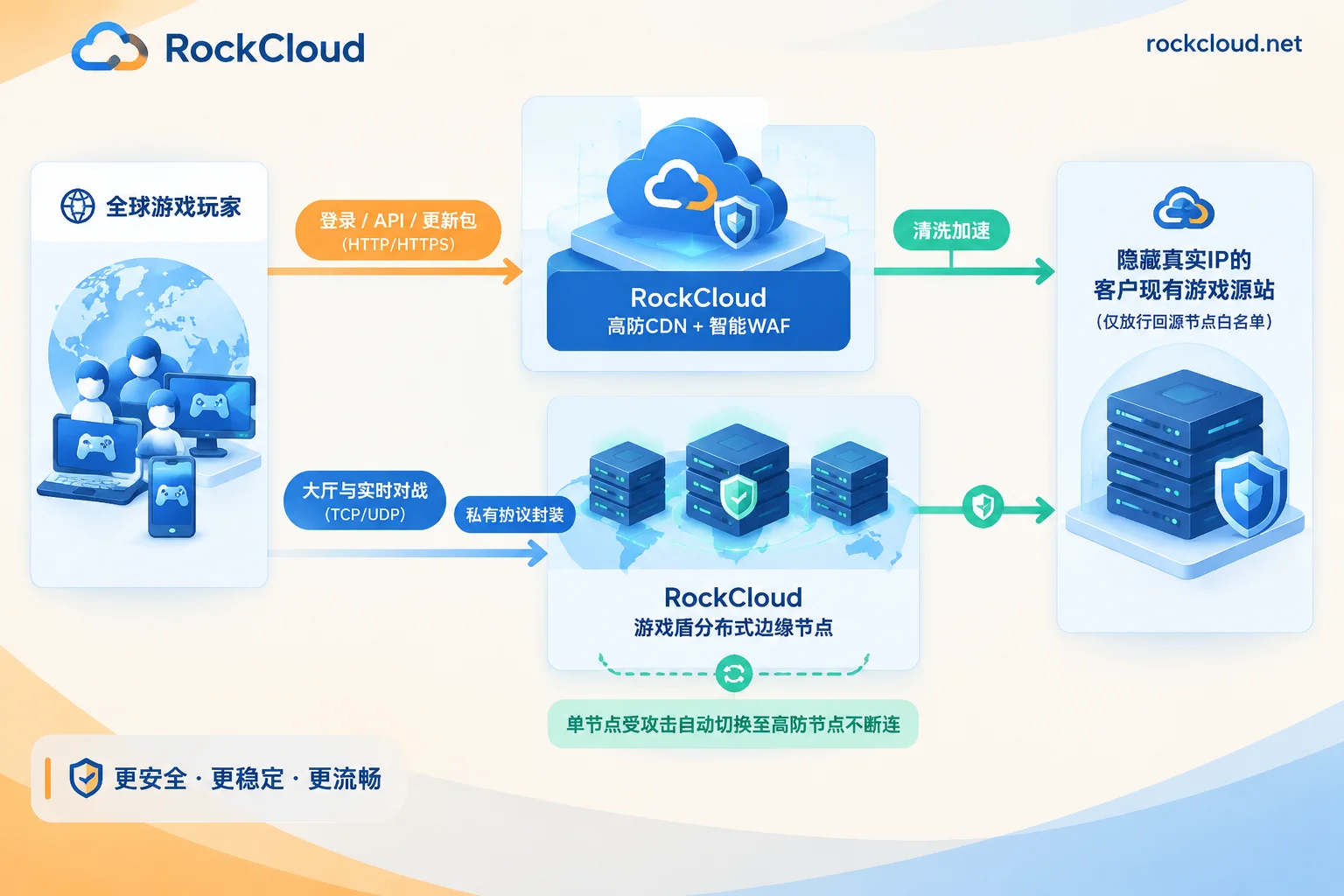
1. Battle Servers and Lobby (TCP/UDP): Access Game Shield, Private Protocol Encapsulation
For core game servers requiring full TCP/UDP protocol forwarding, access via RockCloud's game shield:
- Private protocol encapsulation: Encapsulate the game's non-HTTP protocols into private protocols, blocking at the protocol level any probing packets and malformed reflection packets from hackers simulating client handshakes.
- Distributed edge forwarding and origin hiding: Player traffic first enters the nearest distributed edge node, is cleaned, and then forwarded back to the origin server. The real origin IP is completely hidden behind the scenes.
- Switch nodes without disconnection when attacked: When an edge node encounters a sudden pulse attack, the system automatically switches traffic to a high-defense node, keeping players' existing game long connections uninterrupted, completely eliminating launch "crashes" and mass disconnections.
2. Login, Payment, API, and Update Packages (HTTP/HTTPS): High-Defense CDN + Intelligent WAF
For official websites, account login interfaces, recharge callback APIs, and large client patch distribution, simply add a CNAME record to access the high-defense CDN:
- Smooth access without changing NS: DNS resolution remains with your original provider; during switching, old and new links run in parallel without affecting existing online players.
- DDoS and CC cleaning on the same path + machine learning WAF: Anycast distributed cleaning directly absorbs large-traffic DDoS and high-frequency CC at the edge. DDoS and CC defense are on the same request path, so you don't need to purchase them separately. Meanwhile, enable the intelligent WEB firewall (WAF) with one click in the control panel. In addition to intercepting SQL injection, XSS, and malicious scripts via the OWASP core rule set, it uses machine learning to accurately identify new types of residential proxy API abuse not covered by the rule base. Custom rules and exception allowances can be configured directly with assistance from the security technical team.
- Global and three-network return acceleration: If game servers are deployed overseas or in Hong Kong to serve global and mainland Chinese players, you can combine global CDN acceleration with CN2 China acceleration (Telecom CN2 GIA, Unicom AS9929, Mobile CMI direct return, ring-China nodes access without ICP filing), balancing high-intensity defense with ultra-low battle latency.
3. Edge Promotion Layer: Anti-Domain Blocking and Multi-Cloud Collaboration
Many board game, casual, or Web3 games frequently encounter issues during user acquisition promotions, such as promotion links being inaccessible on social platforms or DNS hijacking by regional ISPs. To address this, you can simultaneously enable the blocking and pollution recovery service, which performs DNS pollution cleaning and domain unblocking recovery on platforms like WeChat, QQ, and regional ISPs, achieving seamless 301 redirects without changing promotion domains. If your underlying game origin runs on AWS, GCP, Alibaba Cloud International, or Tencent Cloud International, you can also directly use RockCloud's international cloud top-up service (no enterprise verification or real-name procedures required, supports USDT payment), integrating underlying cloud resources with the front-end game shield in one stop. For more segmented scenario architectures, refer to Solutions by Industry.
4. Billing Bottom Line: Fixed Peak Billing, Unlimited Traffic and Requests
To completely eliminate game operations' concerns that "defense is more expensive than attack," RockCloud adopts a transparent package billing model: by default, billed monthly at a fixed peak, with unlimited traffic and request counts. Acceleration and defense are on the same link and in the same package; DDoS/CC defense, WAF, and free fully automatic SSL are all included, with no separate purchases. The control panel also supports real-time Telegram data push, allowing operations teams to track attack peaks at any time. You can also visually compare architectural differences with traditional high-defense servers, Alibaba Cloud, Cloudflare, and other solutions on the selection comparison page.
IV. If You Are Currently Under Attack, How to Stop the Bleeding Urgently?
If your game has just launched or is in an event period and is currently suffering DDoS bombardment causing player disconnections, do not just perform forwarding at the DNS or client routing level and forget to close the origin. The correct emergency sequence is:
- Change origin IP: Since the old IP has entered the attacker's target library, while integrating the game shield and high-defense CDN, you must apply to your cloud host provider to change the origin public IP.
- Origin whitelist closure: Set strict policies in the origin firewall (security group), only allowing RockCloud's back-to-origin node IP ranges, and denying direct probing and connections from any other public IPs.
- Activate emergency response: If you need to race against time when configuring routing, protocol forwarding, or WAF custom rules, immediately contact us via Contact Us (select the "Security Response" attack emergency channel) or directly click the official Telegram customer service @rockclouds. The security technical team will assist you in quickly completing link switching and origin hardening; teams that have not yet launched can also contact customer service in advance to determine specifications and apply for free testing.




Comments(0)