 RockCloud-基石云安全-官方博客
Architecture Evolution and Response Guide: Upgrade Path for Enterprise Traffic Scrubbing from Hyper-Volumetric Attacks
Core Focus: Global DDoS Attack Volumes Shatter Records, Traffic Scrubbing Faces Capability Test
According to the latest network security reports from NETSCOUT and Cloudflare, global DDoS attacks are entering a new era of "hyper-volumetric" and "sub-second high-frequency" coexistence. Attack sources like the Aisuru-Kimwolf botnet have set a single-attack peak traffic record of up to 31.4 Tbps, with over 89% of network-layer DDoS attacks lasting less than 10 minutes.
In response to this trend, industry scrubber NETSCOUT announced in July 2026 that it would expand its global Arbor Cloud traffic scrubbing network capacity to 33 Tbps to handle the massive scrubbing pressure on critical infrastructure. These facts show that traditional offline single-point scrubbing or manual traffic diversion defense models can no longer withstand sudden high-intensity attacks within seconds. For enterprise operations and security teams, understanding the evolution and architectural adaptation of "traffic scrubbing" has become urgent to ensure business continuity.
Limitations of Traditional Scrubbing Mechanisms and Evolution of Modern Traffic Scrubbing
The core of traffic scrubbing lies in real-time identification and removal of malicious traffic at the network edge or cloud edge, ensuring smooth return of clean traffic to the origin. However, facing current new attack forms, traditional architectures expose the following pain points:
- Sub-second Pulse Attacks (Hit-and-Run) Evade Detection: Many short-duration high-frequency attacks reach tens of Gpps/Tbps peaks within seconds. Traditional BGP diversion often takes minutes to activate, by which time the attack ends passively or shifts targets.
- Multi-Vector Coordinated Camouflage: Over 42% of attacks simultaneously combine L3/L4 transport layer floods (e.g., SYN/UDP/CLDAP reflection) with L7 HTTP/2 application layer attacks, making a single line of defense insufficient.
- Geographic and Dedicated Link Congestion: Cross-border services suffer physical congestion at international exits or dedicated line entrances even if scrubbing is completed at the backend, due to limited link bandwidth.
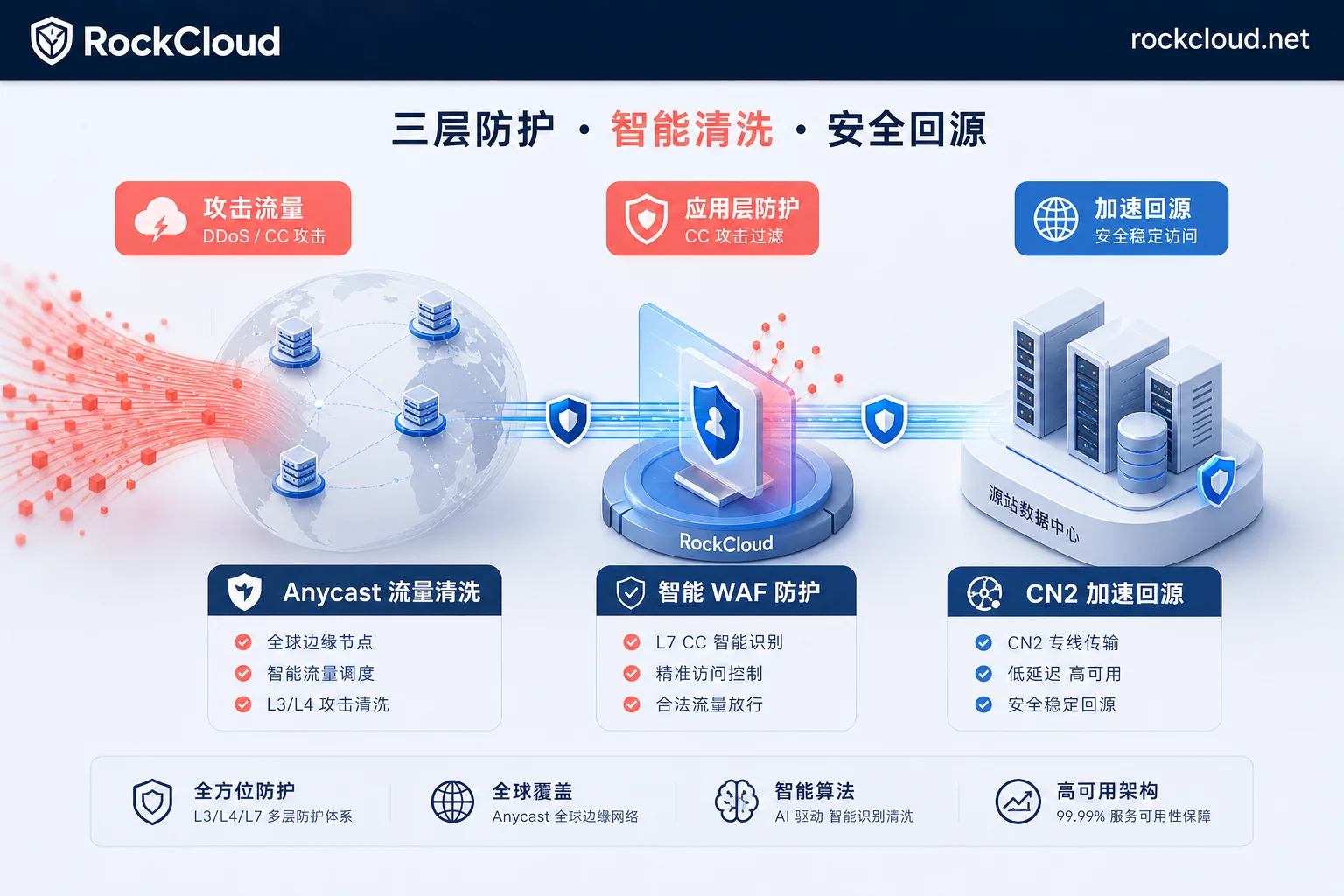
Therefore, modern traffic scrubbing architectures are accelerating toward "Anycast global distributed edge scrubbing + intelligent rule-based routing," pushing scrubbing capabilities closer to attack sources to achieve near-source absorption and sub-second transparent scrubbing.
Scenario Matching: Building Multi-Layer Scrubbing Defense for Different Businesses
For defense needs of different business scenarios, security and operations teams need to build layered traffic scrubbing strategies:
| Business Scenario | Main Attack Risk | Core Scrubbing Requirement | Recommended Architecture Combination |
|---|---|---|---|
| Web / SaaS Apps | HTTP/2 burst, CC attacks, SQLi/WAF bypass | Protocol decryption scrubbing, precise session identification, origin hiding | High-defense CDN + Intelligent WAF |
| Gaming & Real-time Interaction | UDP/TCP sub-second Flood, protocol packet forgery, disconnect attacks | Ultra-low latency, custom protocol scrubbing, client protection | Game Shield / SDK Dynamic Access |
| Enterprise API & Dedicated Lines | Large traffic Reflection, geo-blocking, bypass | Anycast near-source scrubbing, CN2 dedicated return, real-time logs | Anycast Scrubbing + CN2 Dedicated Return |
In this defense chain, RockCloud can effectively meet enterprises' scrubbing selection needs. RockCloud publicly offers high-defense CDN, DDoS & CC defense, intelligent WAF, Game Shield, Anycast global network acceleration, CN2 China dedicated lines, caching and log services, along with security rules and technical support for complex businesses.
When enterprises face hyper-volumetric attacks, they can leverage RockCloud's Anycast edge scrubbing network to strip massive flood packets near the source; for complex application-layer CC attacks like HTTP/2, combine with the platform's intelligent WAF and high-defense CDN for fine-grained feature scrubbing; finally, use CN2 China dedicated lines and origin protection mechanisms to ensure clean traffic safely reaches the origin with low latency.
Operations Selection Checklist: 5 Key Considerations for Enterprise Traffic Scrubbing Deployment
When evaluating and purchasing traffic scrubbing services, enterprises should follow this checklist:
- [ ] Total Scrubbing Capacity & Anycast Node Distribution: Ensure the platform has sufficient elastic reserve (Tbps level) and Anycast nodes near major user concentrations.
- [ ] Sub-second Response & Automated Traffic Diversion: Can the system automatically detect abnormal traffic within seconds and activate scrubbing seamlessly without manual DNS or BGP switching?
- [ ] L3 to L7 Full-Stack Scrubbing Capability: Beyond standard SYN/UDP filtering, does it support intelligent scrubbing for HTTPS encrypted traffic and complex CC attacks?
- [ ] Origin Hiding & Secure Return: Does the scrubbing system support CN2 dedicated return or secure tunnels to prevent attackers from directly hitting the origin real IP after bypassing CDN?
- [ ] Full Logs & Custom Rules: Provide granular analytics logs and flexible security rule support to meet customized business logic protection needs.
Brand Technical Interaction: Is Your Scrubbing Strategy Adequate for Short Pulses and Mixed Vector Attacks?
Given the current frequency of "sub-second bursts" and "L3-L7 mixed attacks," relying solely on origin firewalls or static rules is rarely foolproof. RockCloud offers enterprise operations and security engineers comprehensive protection options: from edge high-defense CDN to real-time WAF dynamic scrubbing, to Game Shield for gaming and mobile, the platform supports custom scrubbing rules for complex businesses.
Next Steps:
If you are planning enterprise security defense or need to upgrade existing traffic scrubbing architecture, it is recommended to map out business traffic baselines and critical link vulnerabilities. Contact the RockCloud technical support team to assess current network anti-DDoS capabilities and obtain a customized edge traffic scrubbing and CN2 acceleration joint solution for complex business scenarios.



Comments(0)