 RockCloud-基石云安全-官方博客
Standard CDNs Cannot Protect UDP Game Traffic
Most high-defense CDNs on the market can only proxy the two Layer 7 protocols HTTP and HTTPS, operating on ports 80 and 443. Game servers typically use the UDP protocol directly to transmit real-time data packets such as position, status, and operation commands. This traffic cannot be recognized, cached, or forwarded by standard CDNs. If you connect UDP services to a pure web CDN, the client simply cannot establish a connection with the origin server, let alone receive protection.
Layer 4 CDNs Can Proxy UDP, But With Three Limitations
A few CDN products have Layer 4 reverse proxy capabilities, able to forward raw TCP and UDP packets and scrub DDoS traffic at edge nodes. For example, Cloudflare Spectrum supports UDP proxy and protection on any port, but actual onboarding requires verifying these conditions:
High plan threshold: Custom UDP ports are usually limited to enterprise plans; standard plans often only open a few preset ports.
Forwarding hops increase latency: Layer 4 reverse proxying inserts CDN nodes between the client and origin. Each packet must go through bidirectional forwarding: "client → CDN edge → origin." For real-time competitive games requiring RTT below 50ms, the extra two hops introduce jitter and disconnection risks, especially on cross-border routes or during node scheduling switches.
Cannot block protocol-layer attacks: Layer 4 reverse proxies can only scrub volumetric DDoS at the network and transport layers (UDP Flood, amplification attacks). They are powerless against application-layer attacks such as fake logins or simulated operations using forged game protocol packets, because CDN nodes cannot understand custom business protocols.
If the game is not latency-sensitive (e.g., turn-based, slow-paced SLG) and attacks are mainly bandwidth saturation, a Layer 4 CDN can serve as an emergency solution. But fast-paced shooters, MOBAs, and fighting games usually cannot accept this latency cost.
Mainstream Defense for UDP Games: Game Shields and High-Defense IPs
Game Shield: SDK Encapsulation + Hidden Origin + Distributed Scheduling
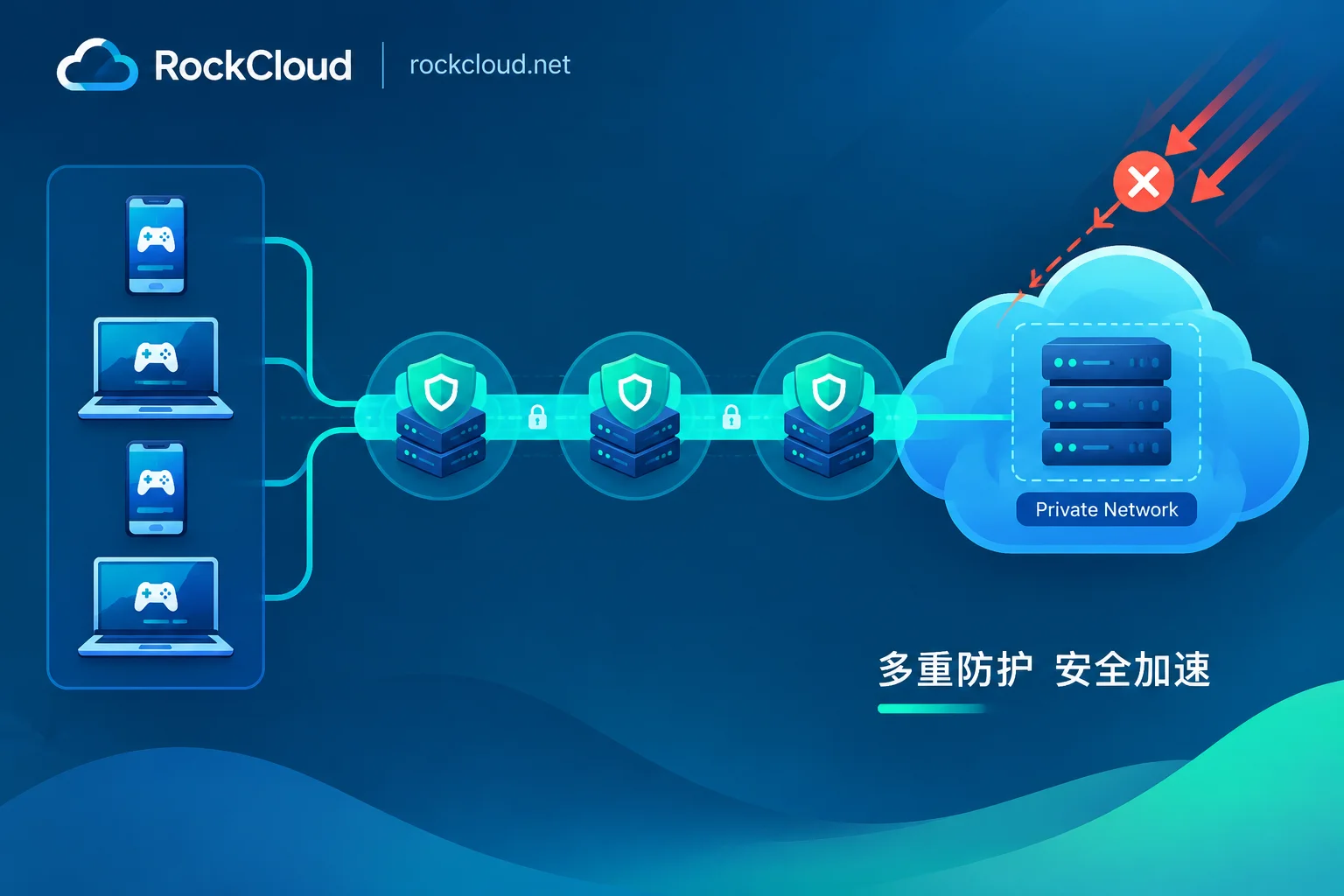
A game shield requires integrating an SDK into the client, encrypting and encapsulating UDP traffic through a proprietary protocol. Edge nodes receive the encrypted traffic, unpack, scrub, and forward it to the origin, completely hiding the origin's real IP. Under attack, the game shield uses distributed nodes for millisecond-level dynamic scheduling, automatically switching traffic from attacked nodes to clean nodes, with latency overhead typically kept within 5ms.
This solution blocks both network-layer DDoS and protocol-layer simulated attacks, because attackers cannot obtain the real IP and cannot forge business protocol packets inside the encrypted tunnel. It is suitable for mobile and PC games that can be repackaged to integrate an SDK.
Layer 4 High-Defense IP: BGP Scrubbing + Full-Port Support
Layer 4 high-defense IPs use BGP Anycast to pull UDP traffic to scrubbing centers, filtering out DDoS traffic and forwarding clean packets back to the origin. They support UDP traffic across the full port range, require no client modifications, and suit legacy PC games or standalone servers with hardcoded protocols that cannot integrate an SDK.
However, this approach has two risks: first, it cannot provide proprietary protocol encryption, so attackers can directly analyze the UDP packet structure to launch protocol-layer attacks; second, if the origin IP leaks through configuration files, communication logs, or social engineering, attackers can bypass the high-defense IP and hit the origin directly, immediately rendering protection useless.
Selection Criteria and Onboarding Sequence
First determine whether the client can be modified:
- Can integrate an SDK: Choose a game shield directly. It offers the deepest defense, lowest latency overhead, and complete origin IP invisibility. RockCloud's game shield supports TCP and UDP proprietary protocol encapsulation, distributed node scheduling, and free testing, billed by fixed peak with unlimited traffic.
- Cannot modify the client: Choose a Layer 4 high-defense IP. After onboarding, be sure to block all public direct-connect ports on the origin, allowing access only from the high-defense IP's back-to-origin segment, and rotate the origin IP regularly.
If you are currently under attack and bandwidth is saturated, the emergency sequence is:
- Immediately change the origin IP or temporarily close public ports to stop the bleeding.
- Simultaneously contact a game shield or high-defense IP provider to activate a test instance.
- After completing onboarding configuration, open the new IP or ports.
Standard CDNs cannot proxy UDP traffic. Layer 4 CDNs can forward it but are latency-sensitive and plan-restricted. After a game server is attacked, the mainstream selection is to judge based on client modification capability, choosing between a game shield's protocol encapsulation and a high-defense IP's transparent scrubbing.



Comments(0)