RockCloud-基石云安全-官方博客
To achieve game DDoS protection that simultaneously "withstands attacks, avoids ping spikes, doesn't wrongly ban legitimate players, and keeps bills under control," the key is not to rely on a single solution to handle all traffic, but to implement protocol-based layered access: delegate HTTP/HTTPS traffic such as official websites, hot updates, SDK login interfaces, and payment callbacks to a high-defense CDN; connect TCP/UDP long-connection services like battle servers, matchmaking servers, and voice rooms to a game shield for private protocol encapsulation and seamless multi-node scheduling; meanwhile, thoroughly hide and consolidate origin IPs, replace "one-size-fits-all single-IP rate limiting" with protocol features and edge encapsulation, and prioritize fixed-peak, unlimited-traffic billing architectures to lock down cost ceilings.
Many game development and operations teams have purchased protection, but instead encounter frequent player lag, mass disconnections of internet cafe players, and even the awkward situation where "protection bills cost more than the servers." Below, we break down the underlying causes of these high-frequency pain points and actionable solutions.
1. Why Do Games Still Experience Ping Spikes, Lag, or Even Mass Disconnections After Enabling Protection?
Ordinary websites can tolerate hundreds of milliseconds of loading fluctuations, but real-time battles, MMOs, and card games have almost zero tolerance for network jitter—once round-trip latency exceeds 100ms or continuous packet loss occurs, players will immediately experience skill casting lag, teleporting movement, or even disconnection from the entire match. Many projects experience degraded performance after enabling protection, usually due to the following three reasons:
- Forcing non-HTTP protocols into ordinary web protection
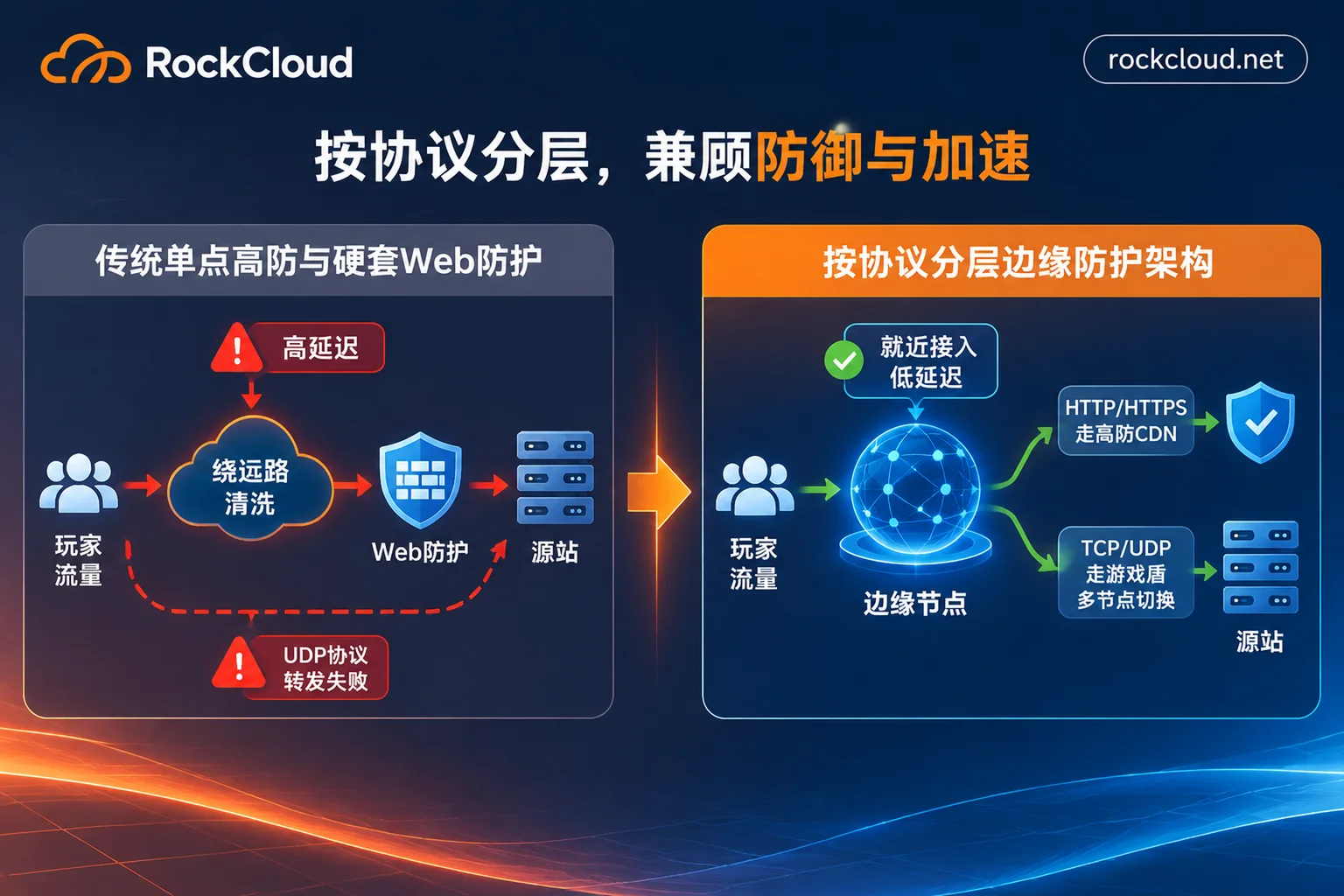
Game official websites, recharge pages, and account interfaces use HTTP/HTTPS, but the battle synchronization, room states, and voice communication that truly determine the feel use TCP/UDP long connections or non-standard ports. Pushing all services into a proxy layer that only supports web protocols not only fails to parse custom game packets but also causes frequent long connection resets. For architecture splitting, refer to the protocol division approach in Should Game Servers Choose High-Defense IP or High-Defense CDN. - Remote traffic scrubbing detours and "shared blackhole" collateral damage
Many traditional high-defense solutions deploy scrubbing centers in a few single-line or centralized data centers. Once defense scrubbing is triggered, originally direct player requests are routed to remote scrubbing centers and then back to the origin, increasing physical distance and cross-network congestion, causing latency to spike instantly. Worse, some low-cost high-defense solutions claim defense capacity that is actually "shared across the entire data center." When other tenants in the same data center are hit by large-traffic attacks and dragged into blackholes, your game servers will also be disconnected. - Inability to maintain sessions during node switching
Facing short pulse attacks lasting seconds to minutes, conventional layer-4 forwarding often requires clients to re-handshake and reconnect when the primary node is congested and switches to a backup node, directly causing a server-wide disconnection and reconnection storm. For more detailed mechanisms on how long connections stay online under attack, see Why Do Games Experience Mass Disconnections When Hit by DDoS Attacks.
2. Afraid to Enable Strict CC Protection? How to Solve False Bans for Internet Cafes, Universities, and Mobile NAT Players
When defending against CC attacks such as simulated logins, malicious room occupation, and high-frequency API calls, game operators' biggest headache is not "can't defend" but "strict settings cause false bans."
The reason is simple: hundreds or thousands of real players in internet cafes, university dormitories, and carrier-grade NAT (CGNAT) networks often share the same public egress IP. If the protection layer only relies on "banning when single IP requests/connections per second exceed a threshold" to block CC attacks, then as long as one machine in the same internet cafe runs a malicious script, all normal players in the entire cafe or dormitory building will be blacklisted and disconnected.
To eliminate false bans, defense strategies must be upgraded from "brutal IP banning" to two layers of precise verification:
- Web and login interface layer (HTTP/HTTPS): Replace simple rate limiting with rule sets and behavior recognition
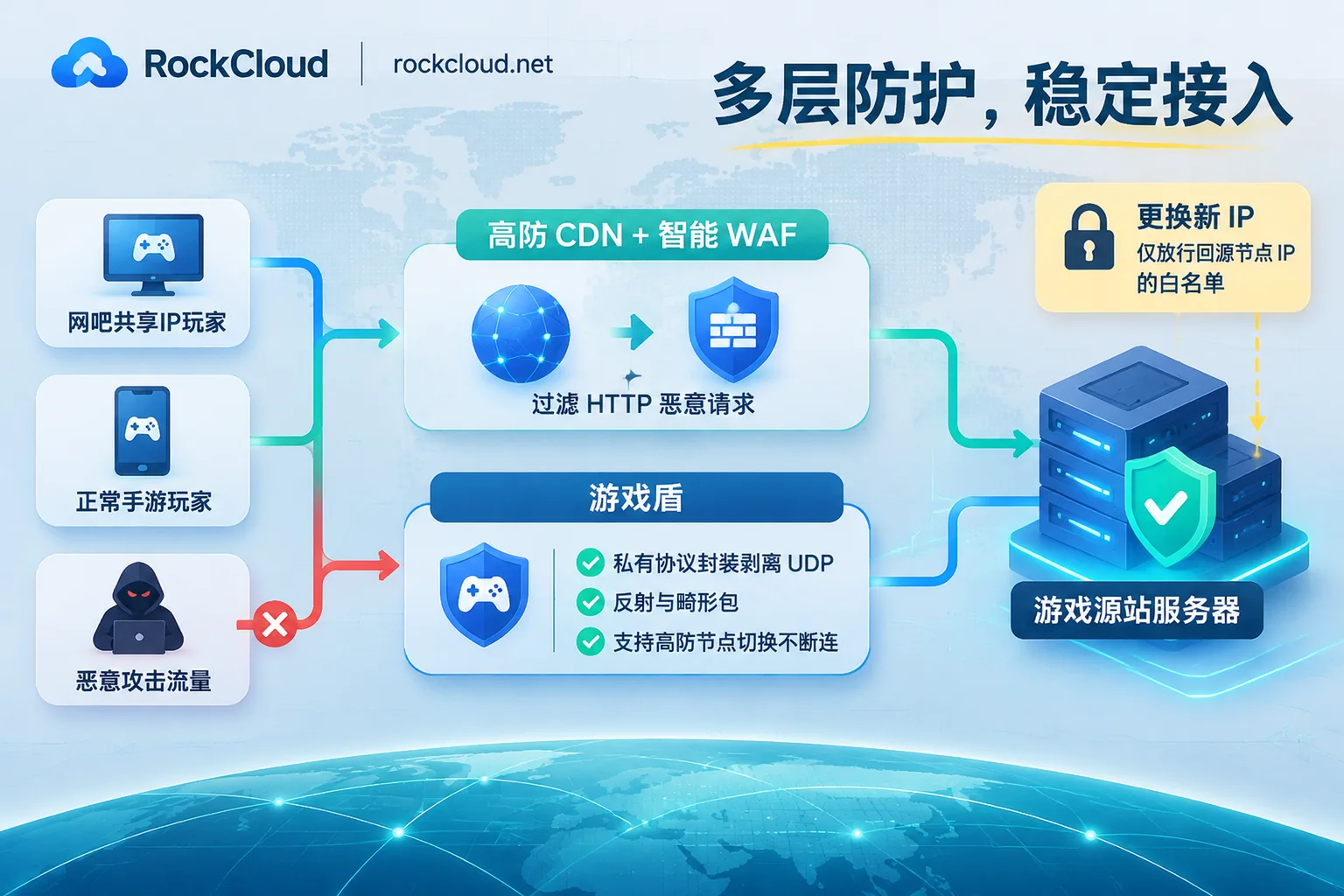
Login authentication, activity claims, hot updates, and API entrances are suitable for front-end intelligent Web Application Firewall (WAF) and edge CC scrubbing. For example, after enabling WAF with one click in the control panel, the OWASP core rule set blocks SQL injection, malicious scripts, and scanners, while machine learning identifies abnormal automated requests not yet included in the rule base; for potential false blocks on payment callback interfaces or fixed IPs of partners, the security technical team assists in configuring custom rules and precise exceptions, preserving business entrances without harming real players. - Battle and long connection layer (TCP/UDP): Use private protocol encapsulation to strip forged packets
For UDP reflection amplification or simulated connection attacks on battle servers, do not rely on data center firewalls to block source IP ranges; instead, establish a private protocol encapsulation channel between the client and edge nodes via the game shield. Only packets that match the game encapsulation handshake and protocol features are legally forwarded to the backend. External probe packets, malformed small packets, and unauthorized reflection traffic are discarded directly at distributed edge nodes, fundamentally avoiding false ban risks caused by shared egress IPs.
3. Practical Access Solution for Low Latency and No Disconnections: Layered Collaboration of High-Defense CDN + Game Shield
Without replacing the customer's existing cloud servers or dedicated servers (i.e., original servers continue as origin), an access architecture that balances low latency and attack resistance can be implemented in three steps:
1. Official Website, Update Packages, and API Entrances: CNAME Seamless Access to High-Defense CDN
Connect domains facing browsers and HTTP clients to RockCloud High-Defense CDN:
- No NS change, smooth switching: Simply add a CNAME record at the original DNS provider to complete access. During the switch, old and new links run in parallel, without affecting online players pulling update packages or recharging.
- Same-path defense for DDoS and CC: The edge uses Anycast distributed scrubbing and automatically hides origin IPs. DDoS traffic scrubbing, CC protection, and free automated SSL run on the same request path, eliminating the need for separate purchases.
- Back-to-China latency reduction for mainland Chinese players: If game origins are deployed in overseas regions around China such as Hong Kong, Japan, South Korea, or Singapore, you can add CN2 China Acceleration Dedicated Line, leveraging China Telecom CN2 GIA, China Unicom AS9929, and China Mobile CMI tri-network direct connections back to China, avoiding cross-network jitter during peak hours without requiring ICP filing.
2. TCP/UDP Real-Time Battle Servers and Lobby Servers: Deploy Game Shield Full-Protocol Forwarding
For non-HTTP service ports carrying match synchronization, real-time battles, and long-connection heartbeats, it is recommended to directly access RockCloud's Game DDoS Protection (Game Shield) solution:
- Full-protocol encapsulation forwarding: Supports TCP/UDP full-protocol forwarding, encapsulating game private communication protocols and scheduling transmission via distributed edge nodes. Attackers can only see edge access nodes and cannot detect real origin addresses.
- Smooth switching without disconnection when a single point is attacked: When an edge node suffers massive traffic impact, the system automatically schedules player sessions to healthy high-defense nodes for continued forwarding, keeping match connections uninterrupted and avoiding "server-wide disconnections upon attack." For more forwarding details, see How to Implement Game Shield Private Protocol Encapsulation and Full-Protocol Forwarding.
3. Origin Stealth and Back-to-Origin Consolidation (Essential for Emergency Access)
Many games are breached after launch not because protection nodes are insufficiently strong, but because the real origin IP was leaked during closed beta, through third-party interfaces, email notifications, or old DNS records, and attackers directly bypass protection to hit origin bandwidth.
If your business is under attack and needs emergency protection access, be sure to consolidate in the following order:
- Change the origin public IP: Once the original IP is exposed in underground attack lists, front-end protection alone cannot stop continuous attacks on the old IP;
- Origin firewall only allows back-to-origin nodes: In the origin server's security group or local firewall, deny all public direct connection requests from non-back-to-origin nodes;
- Direct security response for emergencies: If a large-scale attack is blocking server launch, you can directly contact the RockCloud Security Response Team or via official Telegram (https://t.me/rockclouds)协助同步切换与收口。
4. Procurement Pitfalls: Don't Get Sky-High Bills from "Base + Elastic Billing"
When comparing different protection solutions, many game teams only look at the monthly base price initially and ignore the billing structure most likely to cause budget overruns:
- Beware of the "base + daily elastic scrubbing" trap: Some traditional cloud high-defense solutions use low base bandwidth with high elastic daily billing. Once underground actors figure out the rules, they can trigger daily elastic bills by launching short pulse attacks for just a few dozen minutes each day. After a week of continuous attacks, costs may far exceed the cost of the game servers themselves.
- Beware of feature splitting: Some platforms split DDoS scrubbing, CC protection, WAF, and traffic bandwidth into four or five independent billing items. As soon as the game launches and traffic increases, bills multiply.
To control security costs during game operations, focus on billing transparency when selecting solutions. For example, RockCloud defaults to monthly, fixed-peak billing, with unlimited total traffic and requests, and network acceleration, DDoS/CC defense, WAF, and automated SSL all included in the same link and package, with no separate purchase for defense (CN2 mainland acceleration dedicated line and domain anti-hijacking are billed separately as needed). Since different game types have varying protocol complexity and peak requirements, for specific defense capacity, node distribution, and contract pricing, please refer to the RockCloud Billing Plan Page and confirm with customer service before applying for a free test.
Additionally, for teams deploying game origins and global servers simultaneously on AWS, Azure, GCP, Alibaba Cloud International, Huawei Cloud International, or Tencent Cloud International, you can combine with International Cloud Account Opening and Top-Up Services to uniformly use USDT for cloud resource account opening and top-up, and integrate with high-defense CDN and game shield.
5. 5-Point Practical Checklist Before Game Launch
Before official promotion or new version release, it is recommended that operations and development complete a final acceptance check against the following list:
- Complete separation of business ports: HTTP/HTTPS (official website, updates, recharge, API) use high-defense CDN; TCP/UDP (login, battle, voice) use game shield encapsulation forwarding.
- Zero origin exposure verification: Confirm that installation packages, configuration files, and historical DNS records no longer contain the real origin IP, and that the origin firewall is locked to only allow back-to-origin nodes.
- Multi-carrier latency and disconnection testing: During the test period, cover China Telecom, China Unicom, China Mobile, and overseas cross-region lines, and observe whether game matches remain connected during simulated node switching.
- Anti-false-ban strategies and whitelists in place: Confirm that payment callbacks, anti-addiction/real-name interfaces, and GM backend are configured with precise rules and whitelist exceptions.
- Monitoring and emergency alerts bound: Enable traffic bandwidth reports, network logs, and Telegram real-time data push in the RockCloud Control Panel to ensure the team can intervene immediately when abnormal traffic occurs.