 RockCloud-基石云安全-官方博客
Against the backdrop of evolving cybersecurity attacks and defenses, application-layer attack defense (Layer 7 Defense) is facing unprecedented challenges. Traditional Layer 3/4 traffic scrubbing can effectively block network-layer floods like Syn Flood and UDP amplification, but it often falls short when dealing with application-layer attacks disguised as legitimate user HTTP/HTTPS requests (HTTP Flood, CC attacks, API traffic abuse).
In its "Q1 2026 Network and Application-Layer Attack Trends Report," authoritative research firm Radware points out that Web DDoS (application-layer DDoS) attacks have grown explosively, with Q1 attack incidents surging 34.7% quarter-over-quarter and a staggering 187.1% year-over-year increase compared to Q1 2025 [2]. Meanwhile, Cloudflare's 2026 annual threat report also emphasizes that cyber threats are increasingly "industrialized," with automated bots and AI tools significantly lowering the barrier for attackers [3].
For SRE, network operations, and security teams, understanding the evolution of application-layer attacks and adjusting defense architectures accordingly has become a top priority for ensuring business continuity.
Three Core Evolutionary Characteristics of Application-Layer Attacks in 2026
Unlike the simple "high-concurrency endpoint hammering" of the past, today's application-layer attacks exhibit the following typical features [1, 2]:
- High Fidelity and Modern Tooling: Attackers extensively use headless browsers based on Selenium and Puppeteer, combined with millions of dynamic residential proxy IP networks, making requests nearly indistinguishable from real browsers in terms of JavaScript execution capability, TLS handshake fingerprints, and request headers [1].
- From "Bandwidth Overwhelm" to "Compute Consumption": Attackers no longer blindly pile up Requests Per Second (RPS) but precisely target the most compute-intensive nodes in business logic—such as search endpoints, complex SQL queries, image processing, or authentication interfaces. Even low attack traffic can saturate origin CPU and exhaust database connection pools [1].
- API Endpoints Become the Focal Point: The prevalence of microservices architecture has exposed a large number of API endpoints. Illegal calls and high-frequency bombardment against API logic, which lack the challenge of front-end page rendering, can often directly penetrate unprotected backend services [1, 3].
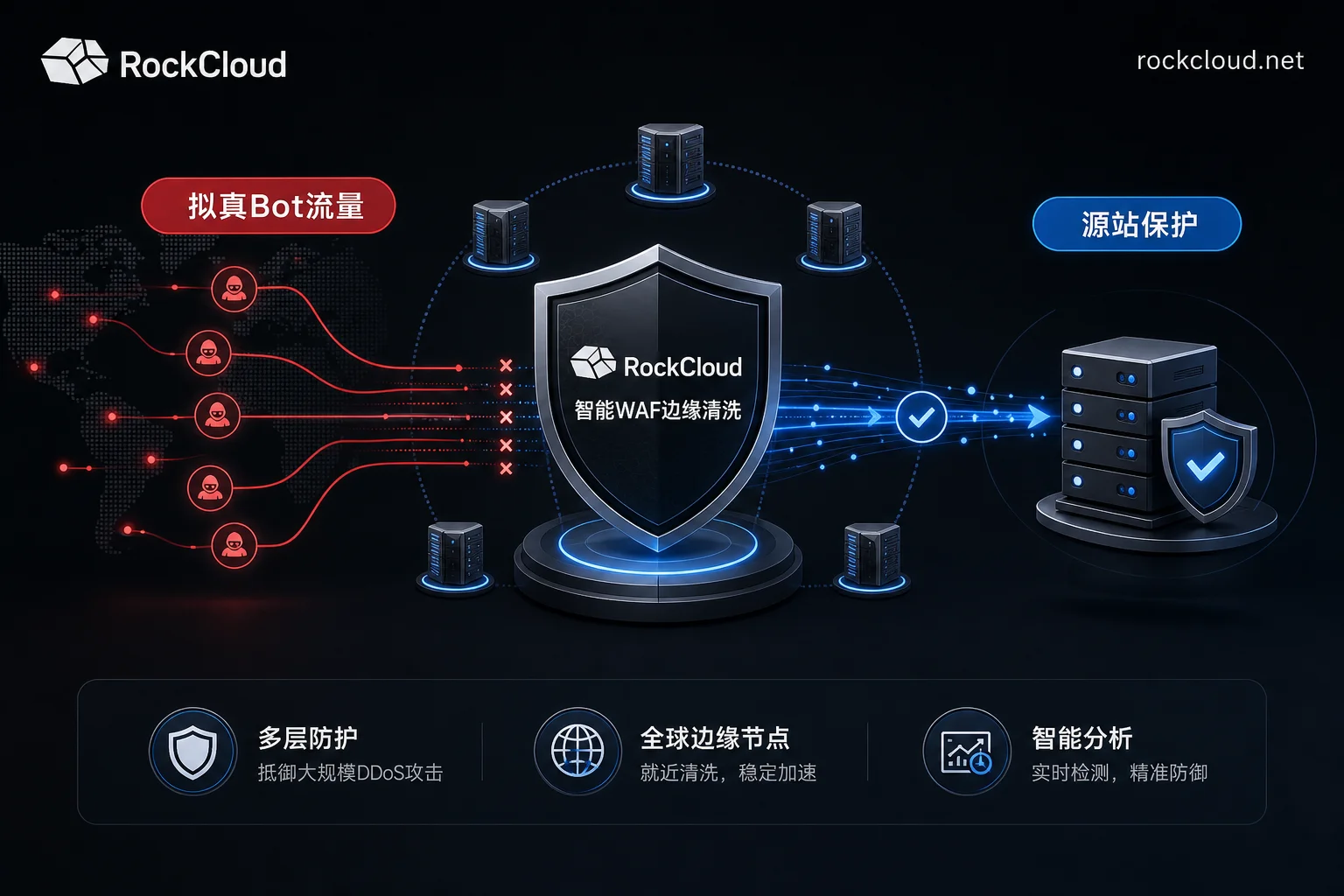
Why Do Traditional CDN and Generic WAF Frequently Fail?
A report by security consulting firm Red Button notes that in its security tests, 68% of enterprise defense failures stem from blind spots in CDN and WAF configurations [1]. Common failure reasons include:
- Rigid Static Rate Limiting Rules: Relying on fixed IP rate limits (e.g., 50 requests per second per IP). Faced with distributed realistic traffic spread across tens of thousands of residential IPs, the per-IP frequency is extremely low, and traditional thresholds fail to trigger alerts.
- Lack of Independent Defense Strategies for API Endpoints: Applying the same rules to web pages and dynamic API endpoints results in legitimate API calls being blocked due to missing cookies or specific request headers, or conversely, malicious bot requests being allowed through.
- Origin IP Leakage: Even if a high-protection CDN or WAF is deployed in front, if the origin IP has been exposed in DNS history records, subdomain resolutions, or mail server configurations, attackers can bypass edge defenses and directly cripple the origin server [1].
Building a Complete Architecture for Application-Layer Attack Defense
To achieve effective application-layer protection, enterprises must abandon the single-point defense mindset and build a layered defense chain of "edge scrubbing + intelligent identification + business hiding":
1. Edge Protocol Stack Scrubbing and TLS Fingerprint Verification
Before traffic reaches the origin, Anycast edge nodes complete HTTP/HTTP2 protocol compliance checks to block malformed or abnormal handshake requests. By verifying client TLS Client Hello fingerprints (such as JA3/JA4), it accurately distinguishes whether requests come from standard browsers or abnormal automated scripts.
2. Behavioral WAF and Dynamic Challenges
For realistic traffic that is difficult to identify solely by characteristics, intelligent WAF should provide dynamic verification mechanisms such as invisible JavaScript challenges and Turnstile CAPTCHA. Combined with contextual behavior analysis (e.g., access path order, request interval distribution), it distinguishes real users from bots.
3. Origin Architecture Hiding and Protect Back-to-Origin
Completely hide the origin IP, allowing back-to-origin traffic only from specific IP ranges of protection nodes (or configure mutual TLS authentication). At the same time, with caching strategies, staticize high-frequency read endpoints at edge nodes to reduce traffic that directly reaches the database.
RockCloud's Defense Practices in Complex Application-Layer Scenarios
To address increasingly sophisticated high-fidelity HTTP attacks and API bombardment, enterprises need underlying infrastructure with elastic scaling and flexible rule configuration.
RockCloud publicly provides high-protection CDN, DDoS and CC defense, intelligent WAF, game shield, Anycast global network acceleration, CN2 China direct connection, caching and log services, along with security rules and technical support for complex business scenarios.
In practical implementation:
- Web and API Businesses: By combining RockCloud's high-protection CDN with intelligent WAF, HTTPS decryption and protocol analysis can be completed in real time at edge nodes, enabling fine-grained dynamic rate limiting and intelligent bot challenges based on business paths, precisely filtering high-fidelity CC attacks without affecting the experience of legitimate users.
- Gaming and Low-Latency Applications: With RockCloud's game shield and Anycast global network acceleration, protection is pushed down to client SDKs and edge access points, enabling encrypted data transmission and origin hiding, completely avoiding origin IP exposure that could lead to back-to-origin paralysis.
- Cross-Border Acceleration and Log Observability: Combined with CN2 China direct connection and log services, operations teams can monitor application-layer QPS, HTTP status codes, and response time fluctuations in real time, quickly identifying potential business logic attacks and fine-tuning rules.
Operations Pitfall Checklist and Interactive Thinking
[Interactive Thinking]
Has your security team tested the performance of compute-intensive APIs against distributed residential IP attacks?
When each IP sends only 1 request per second but the total RPS reaches tens of thousands, can your WAF rules respond within 60 seconds?
Operations Checklist
- [ ] Scan historical DNS and subdomains to ensure no leftover records point to the real origin IP.
- [ ] Implement tiered rate limiting by endpoint importance, configuring stricter intelligent rate control for compute-intensive endpoints such as
/api/loginand/api/searchseparately from static files. - [ ] Enable edge JavaScript challenges to automatically issue invisible verification for high-risk regions or suspicious ASN sources.
- [ ] Enable real-time log analysis to monitor the correlation between 5xx status codes and database CPU utilization.
Action Recommendations
Facing continuously escalating application-layer threats, it is recommended that operations and security teams regularly organize application-layer defense drills to clarify dynamic API boundaries and origin hiding strategies. To enhance application protection capabilities and access experience in complex network environments, consider evaluating integrated solutions with edge scrubbing, intelligent WAF, and CN2 direct connection capabilities to build a solid security defense for your business.



Comments(0)