 RockCloud-基石云安全-官方博客
The first step in designing a game server DDoS defense architecture is not choosing defense bandwidth but splitting the four traffic types—login/lobby HTTP, matchmaking API, in-game UDP, and management plane—and assigning each to a layer that can properly judge it. In March 2026, Cloudflare launched programmable flow protection based on eBPF, and AWS released dedicated UDP DDoS protection for GameLift Servers, both pointing to the same conclusion: four-layer judgment is becoming more granular.
Login lobby, matchmaking API, in-game UDP, and management plane each present different attack symptoms and judgeable dimensions. Forcing in-game traffic through a layer-7 WAF that only understands HTTP semantics results in blanket rate limiting or blackholing; pushing login HTTP traffic to layer-4 scrubbing leaves bot verification helpless. The first step in architecture design is to confirm which layer is responsible for judging each traffic type.
Attack Surfaces of the Four Traffic Types
Login Lobby and Matchmaking API: High-concurrency HTTP requests, attack characteristics similar to CC, easily mistaken for peak-hour normal traffic. When the login server is attacked, connection count rises before CPU; the matchmaking API sees low-volume but high-value traffic, where repeated calls to interface logic can drag down service.
In-Game UDP: Bandwidth attacks mixed with malformed packets; self-developed private protocols lack standard headers, so traditional high-defense can only do coarse-grained handling based on source IP and packet length, with latency spikes often being the primary signal. To distinguish attack from version issues, observe whether latency spikes are periodic over the same time window and accompanied by increased packet loss.
Management Plane: Exposure means compromise; once management ports are scanned, attackers can bypass all traffic scrubbing.
Why Private UDP Protocols Are Hardest to Scrub
HTTP has Host, UA, Cookie, path, and other semantics for bot and rule-based judgments, while the packet headers of self-developed UDP protocols are defined by the client, leaving edge devices unable to parse them. Traditional approaches can only rate limit based on source IP, packet length, and frequency, at the cost of collateral damage to normal in-game traffic.
In 2026, Cloudflare's Programmable Flow Protection allows users to run custom filtering logic and stateful flow table validation at the edge, with microsecond-level packet handling via eBPF; that same year, AWS GameLift Servers introduced proactive UDP protection, shifting from passive response to proactive scrubbing of session-based multiplayer traffic. These two developments mark the evolution of private UDP scrubbing from "blunt rate limiting" to "fine-grained judgment," but it should be clear that this is an industry architecture direction, not a ready-made switch from any single vendor.
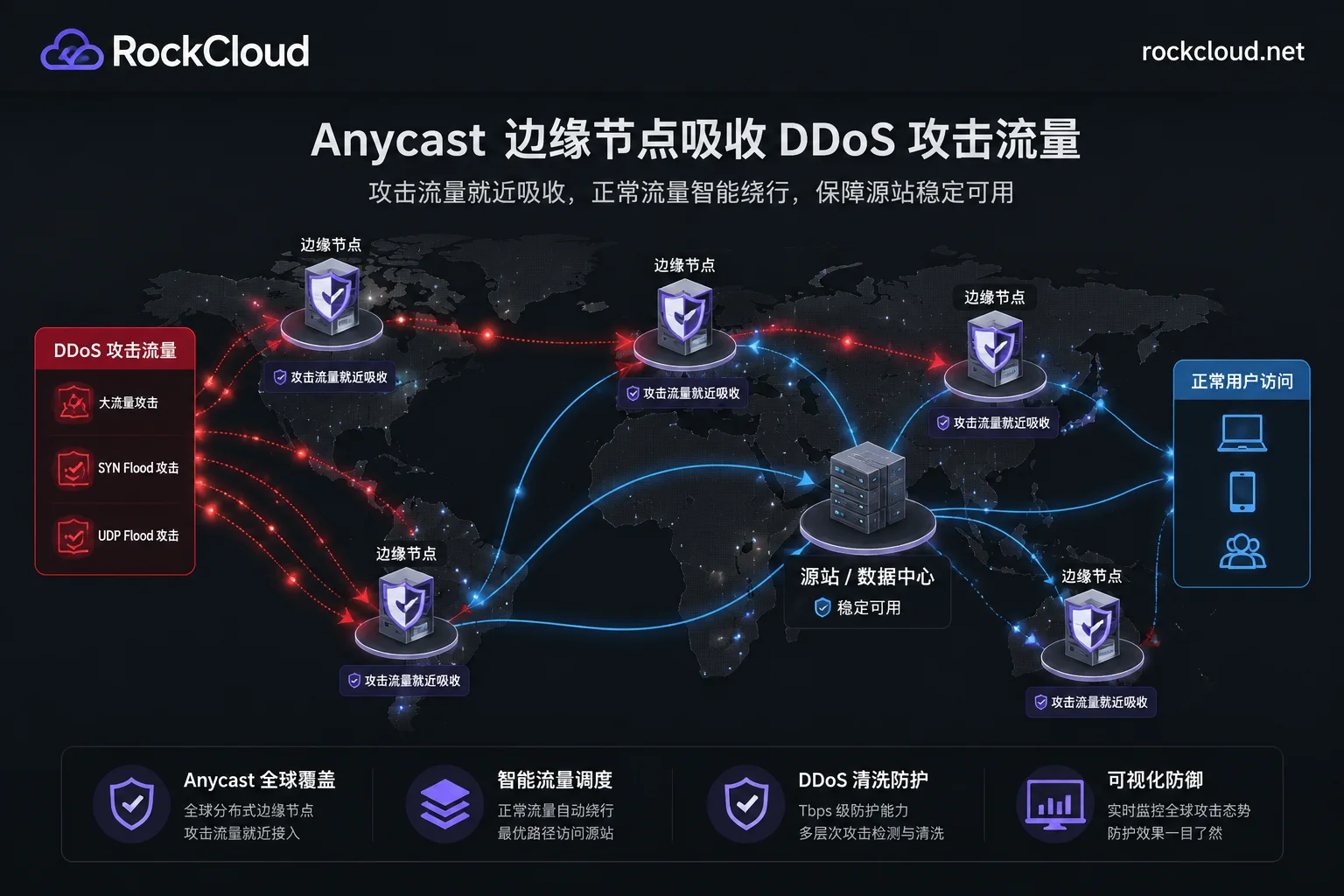
Layer 1: Anycast Edge Absorption
No matter how sophisticated the scrubbing strategy, if the link saturates first, nothing else matters. Anycast distributes inbound traffic across multiple edge nodes, absorbing attack traffic locally rather than funneling it to a single entry point, which is the premise for the four-layer division. For real players, nearby access also reduces normal latency, but the actual coverage of edge nodes must be verified during architecture design. For related technical principles, see our article: BGP Anycast Technology in DDoS Scrubbing.
Layer 2: Whether Self-Developed UDP Can Connect to High-Defense Depends on Layer-4 Judgment Capabilities
Available layer-4 judgment dimensions include: packet length distribution, sending frequency, handshake fingerprint, session state and flow table aging, and the boundaries of custom protocol field validation. For example, with a self-developed UDP protocol, if custom validation logic can run at the edge, you can maintain an index of key field legitimacy in the flow table and precisely rate limit abnormal traffic; otherwise, you're limited to preset templates.
So the real answer to "Can a self-developed UDP protocol connect to high-defense?" depends on whether the provider opens custom protocol validation capabilities, not merely whether they claim UDP scrubbing support. When verifying, request the granularity of rule customization from the provider and test in a gray environment with real client traffic.
Layer 3: Layer-7 Rules and Bot Verification for HTTP Surfaces (Login, Matchmaking)
HTTP interfaces like login, lobby, and matchmaking suit WAF rules and bot verification to distinguish real players from attack traffic. But to avoid false positives during login peaks, rate limiting priority should be: first limit single-IP connection count and concurrency, then request rate, and finally enable challenge-based verification (like CAPTCHA). Challenge verification should only apply to suspected abnormal traffic to avoid friction for normal players.
If the login server is under CC attack, follow this order: first observe connection count distribution; if abnormal concentration, enable connection-level rate limiting; if request rate is uneven, refine rate limiting rules per path.
Layer 4: How to Hide Game Server IP—Three Common Leak Paths
There are three common leak paths for game server IPs: client directly receives real IP at connection, historical DNS and certificate records, and shared egress between management plane and sidecar services. Building a source IP allowlist is a safety net, but once the IP leaks, the allowlist becomes ineffective.
A more practical hiding approach: clients only request the scheduling API to obtain a temporary session credential and scheduling address, with the scheduling side issuing the access address for this match at session establishment, never writing it into client config files or logs. However, this only shortens the exposure window of the real IP, not fully preventing packet capture, so allowlists and IP rotation remain necessary. Also, regularly clean historical DNS and certificate records and check whether the management plane shares egress with game servers. For a complete hiding solution, see How to Prevent Real Origin IP Exposure.
Four Mandatory Validations Before Adopting a Proxy Protocol
Whether game server DDoS defense architecture can be implemented depends on these four items being testable before signing. Before signing or scaling, use these four quantifiable metrics for acceptance, each with a clear pass line, and use your own stress test traffic and real clients for gray validation.
| Acceptance Item | Verification Method | Failure Signal |
|---|---|---|
| Latency Increase | Compare P95 latency before and after integration | P95 latency increase exceeds business-defined acceptable threshold, or percentile curve shows long-tail rise |
| Handshake Success Rate | Simulate real client handshake | Handshake success rate lower than baseline, or regular timeouts/reconnects |
| Over-capacity Handling | Stress test beyond contract peak and observe policy | Direct blackholing without negotiation window, or rate limiting without warning |
| Rule Customization Granularity | Submit custom protocol field validation rule | Only preset templates, cannot customize field validation |
Four-Layer Division Comparison Table and Failure Signal Quick Reference
Use this table to self-check your current game server DDoS defense architecture item by item.
| Traffic Type | Hosting Layer | Available Judgment Dimensions | Typical False-Positive Risk | Acceptance Metrics |
|---|---|---|---|---|
| Login Lobby (HTTP/HTTPS) | Layer-7 WAF + bot verification | Host, UA, Cookie, path, behavioral characteristics | False positives on normal login peaks | Login success rate, CAPTCHA false-pop rate |
| Matchmaking API (HTTP/RPC) | Layer-7 WAF + Layer-4 rate limiting | Interface call frequency, token validity | False limiting of normal matchmaking requests | Interface success rate, average response time |
| In-game UDP (private protocol) | Layer-4 flow table + custom protocol validation | Packet length distribution, sending frequency, handshake fingerprint, session state | False positives on normal in-game traffic | Latency increase, handshake success rate, packet loss rate |
| Management Plane (SSH/RDP) | Strict ACL + dedicated line | Source IP allowlist, port closure | None (if configured properly) | Exposure scan results, audit logs |
How Game Shield and High-Defense IP Divide Work
Game businesses need both Layer-4 UDP scrubbing and Layer-7 HTTP protection; relying solely on high-defense IP or high-defense CDN cannot cover all traffic types. See Difference Between High-Defense IP and CDN. If your mobile game's primary traffic is HTTP login and WebSocket long connections, consider high-defense CDN first, with game shield behind it for in-game UDP. If in-game traffic is high, let game shield be the core carrier, with high-defense IP supplementing API and login entry points.
For WebSocket long-connection services, see Protection Scheme for WebSocket Long-Connection DDoS Attacks for specific measures. Also evaluate business geography: if players are concentrated domestically, pay attention to return-path link quality; cross-border dedicated lines (like CN2) can reduce misjudgments caused by cross-border transmission jitter.
RockCloud's Role in Edge Hosting and Origin Hiding
RockCloud offers edge scrubbing and game shield, carrying in-game UDP access and traffic; the Anycast global network absorbs attack traffic locally; high-defense CDN and intelligent WAF cover HTTP surfaces like login, lobby, and matchmaking; CN2 China dedicated lines ensure return-path and cross-border link quality; the origin only opens an allowlist as a safety net. These capabilities do not involve specific scrubbing algorithm details, nor do they promise peak or latency numbers, serving only as a reference for implementing architecture division.
Common Questions
What should I do in the first hour when my game server is under DDoS attack?
First, confirm the attack type: if it's in-game UDP, check whether flow table rate limiting is effective; if it's login HTTP, limit connections before limiting rates. Simultaneously notify the provider to enable blackholing or scrubbing policies, and check on-site whether the origin IP is leaked; if necessary, change the IP and enable an allowlist.
Can a self-developed UDP protocol connect to high-defense?
Yes, but it depends on whether the provider supports custom protocol field validation. If only preset templates are supported, scrubbing granularity is insufficient and may cause collateral damage; if eBPF or stateful flow table programming is open, you can validate private protocols at the edge. Before signing, test with real client traffic in a gray environment.
Which is better for mobile games: game shield or high-defense IP?
Depends on traffic composition. If mobile games are primarily HTTP login, high-defense IP suffices; if there's real-time combat UDP, you need game shield. Typically, high-defense IP covers the access layer, game shield handles the gameplay layer, and they work together.
Is a sudden increase in game server latency an attack?
Not necessarily. If latency rises with packet loss and is periodic, it's likely an attack. First check edge node flow table hit rate; if abnormal, compare with historical baseline. It could also be a server version update or resource bottleneck, so correlate with monitoring logs.
What is the minimal viable combination for defending UDP against DDoS?
The minimal combo is: Anycast edge absorption + Layer-4 stateful flow table rate limiting + origin IP hiding. If traffic includes private protocols, add custom protocol validation; if only HTTP, use Layer-7 WAF. Start with the minimal combo in gray, then gradually enrich judgment strategies.




Comments(0)