 RockCloud-基石云安全-官方博客
The core differences between dedicated and shared high-protection IPs boil down to four aspects: whether the protection bandwidth is exclusive, whether the blackhole impact is isolated, whether the IP reputation is clean, and who holds the authority for handling traffic spikes. The price difference buys these four aspects. First, verify the ownership of the front-end IP, baseline protection bandwidth, elastic protection, and business bandwidth/QPS quota on the quotation. The NETSCOUT Threat Intelligence Report from March 2026 revealed that ultra-large-scale mixed-vector floods, driven by IoT botnets like Aisuru-Kimwolf, have peaked at 30–31.4 Tbps per attack. Extreme peaks can severely strain shared scrubbing resource pools and backbone access links, causing instantaneous congestion. This means that the collateral risk of shared pools is amplifying under extreme attacks, making item-by-item verification before signing more critical.
What’s the Difference Between Dedicated and Shared High-Protection IPs: Read the Four Fields on the Quotation First
The price difference between dedicated and shared on a quotation usually comes from the reuse degree of four resources: whether the front-end IP is dedicated or shared, whether the baseline protection bandwidth is reserved separately, whether elastic protection shares upstream quota, and whether business bandwidth and QPS quota are independent. The cost advantage of shared specs comes from multiple customers sharing scrubbing quota and IP, not from weaker protection technology. “Dedicated bandwidth for high-protection IP” means that a single instance has independent baseline and elastic protection bandwidth, not squeezed by traffic spikes from other customers in the same pool. For front-end IP ownership and routing methods, refer to Differences and Selection: BGP High-Protection vs. Single-Line High-Protection.
Difference 1: What Does Dedicated Bandwidth for High-Protection IP Mean, and Who Gets Rate-Limited First at Peak Times?
The ownership of protection bandwidth determines who gets rate-limited first when an attack peaks. In a shared pool, all instances share the upstream scrubbing resource pool and backbone access links. When a business in the pool suffers an over-peak attack, the available bandwidth of other instances is compressed, possibly causing instantaneous congestion. In contrast, dedicated specs reserve baseline bandwidth for the instance, and elastic protection is configured per instance, not competing with others.
Things to verify before signing: Is the baseline bandwidth reserved for this instance? Does elastic protection share upstream quota? Red flags: The provider only gives a “maximum protection” number and refuses to explain bandwidth ownership, or gives vague answers.
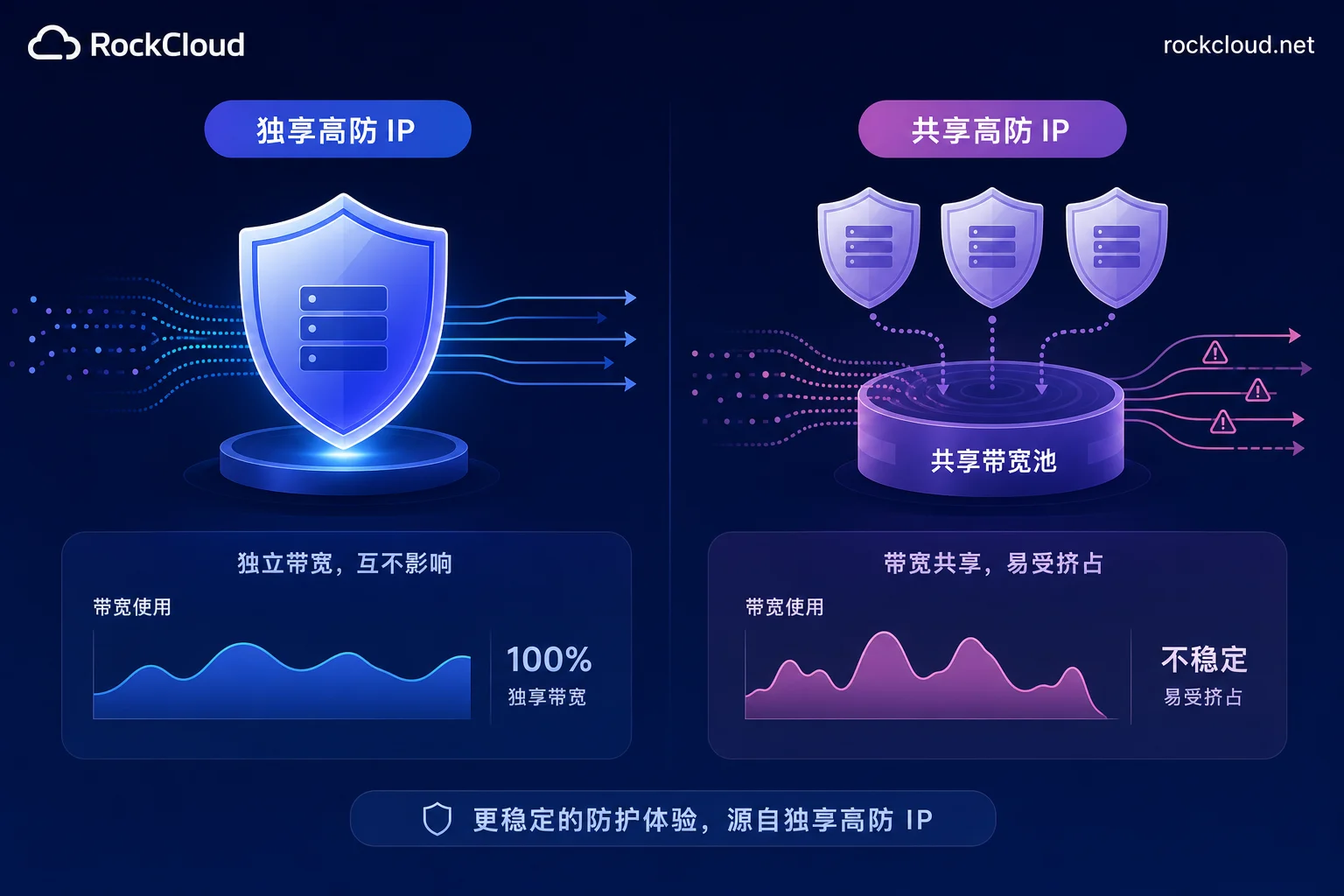
Difference 2: Scope of Blackhole and Rate-Limiting Collateral – Will You Go Down When a Neighbor in the Same Pool Is Hit?
As of June 2026, Alibaba Cloud and Tencent Cloud high-protection product documentation describes blackhole and rate-limiting at the IP level. Therefore, when any tenant under a shared IP triggers an upstream carrier blackhole or rate limit due to exceeding thresholds, all other tenants on that IP will experience total service interruption. However, the actual impact depends on the types of businesses in the pool, whether the attack penetrates baseline quota, and the provider’s dynamic CNAME traffic diversion capabilities; it cannot be generalized.
Things to verify before signing: Is the blackhole granularity IP-level or business-level? What is the recovery time as mentioned in DDoS Emergency Response? Is it possible to switch to a backup IP? If the provider promises “one-click traffic diversion,” confirm whether triggering is automatic or manual, and require a diversion drill during onboarding, not first used during a real attack.
Difference 3: IP Reputation and the Risk of Misjudgment from Co-Tenancy
Shared front-end IPs share historical reputation with unfamiliar businesses, potentially causing third-party risk control misjudgments, email and payment channel blocks, and upstream markings. Dedicated IPs have an advantage in reputation controllability: the outbound behavior of a newly allocated dedicated IP is entirely determined by your business, and reputation records are traceable and self-manageable. If the provider cannot explain the IP source and history, it indicates that the IP ownership and reputation status are unverifiable – itself a red flag.
Things to verify before signing: Is the IP newly allocated? Can the history be queried? Can you request a replacement? If any of these three questions cannot be answered in writing, treat it as a red flag indicating the IP ownership and reputation are unverifiable, and do not directly infer the specific source of the IP based on that.
Difference 4: Who Decides on Over-Peak, Unblocking, and Temporary Scaling?
With dedicated specs, the decision on whether to trigger a blackhole during an over-peak attack and whether to enable pay-as-you-go elastic protection lies with the single tenant. With shared specs, providers make the decision uniformly, and tenants can only passively wait. This difference is reflected in the spec descriptions in Alibaba Cloud and Tencent Cloud high-protection product documentation (June 2026), but specific policies are still architectural inferences and must be confirmed by the provider’s contract terms.
Before signing, write the following into the contract or ticket: “When attack traffic exceeds the baseline value, the provider shall notify the customer within X minutes and allow the customer to independently choose whether to enable elastic protection”; “Blackhole unblocking shall not exceed X hours.” If the provider refuses to include these, the pace of over-peak handling is entirely out of your hands.
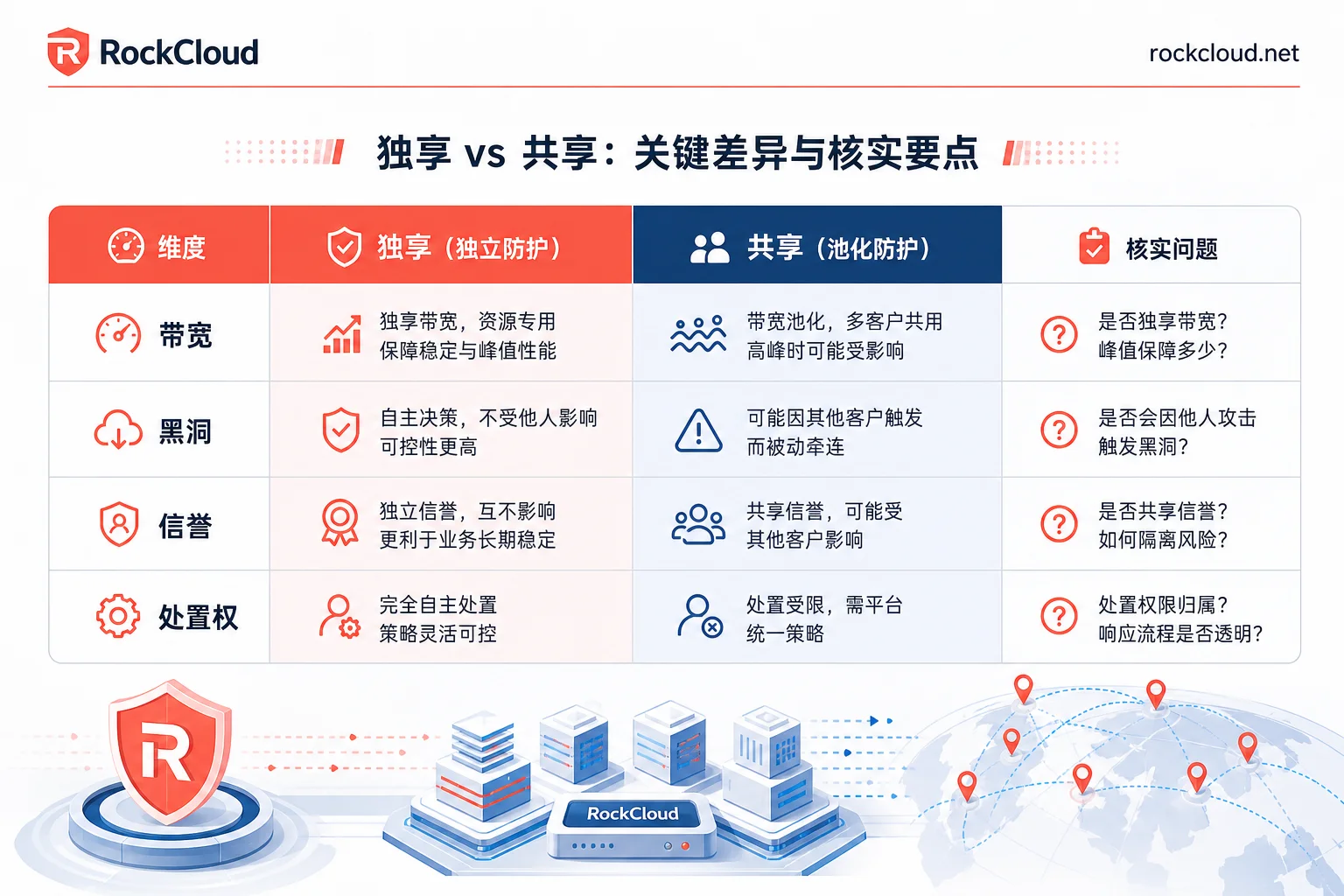
Comparison Table of Four Differences and Quick Red Flags
Lay out the four conclusions from the analysis of dedicated vs. shared high-protection IPs and bring them directly to the next price comparison meeting.
| Difference | Dedicated Performance | Shared Performance | Pre-Contract Verification Questions | Red Flags |
|---|---|---|---|---|
| Protection Bandwidth | Independent baseline + elastic | Shared scrubbing pool quota | Is baseline reserved? Does elastic share? | Only a “maximum protection” number |
| Blackhole Fault Domain | Business-level isolation | IP-level collateral | Blackhole granularity? Recovery time? | Refuses to explain |
| IP Reputation | Self-controllable | Mixed | New IP? Can history be checked? Can it be replaced? | No answer |
| Over-Peak Handling Authority | Tenant | Provider | Can choose elastic? Costs? | Not in contract |
Conclusion by Business Type: How to Choose for Websites and APIs, Games, and Non-HTTP Proprietary Protocols
For low-peak display-type websites, starting with shared is feasible, but keep a migration path ready. For transaction APIs and games, where tolerance for collateral interruption is low, prefer dedicated or business-level isolation. For non-HTTP proprietary protocols, dedicated forwarding capabilities for layer-4 traffic are mostly custom solutions from various vendors, with limited standardized public metrics; stress testing during the selection phase is necessary.
Is a dedicated high-protection IP worth it for small companies? If your business is availability-sensitive or in an attack-prone industry (e.g., gaming, finance), the fault isolation value of dedicated outweighs the price difference. If you only run a display site, shared can suffice, but have an emergency plan. Ultimately, the core of dedicated vs. shared high-protection IP analysis always hinges on availability requirements and fault tolerance.
Pre-Contract Checklist: Questions to Ask Your Provider
When comparing prices, bring the key points from the dedicated vs. shared high-protection IP analysis into your questions:
- Is the baseline protection bandwidth reserved for this instance? Does elastic protection share upstream quota?
- Is blackhole granularity IP-level or business-level? How long until recovery after blackholing?
- How is the unblocking SLA described? Can you opt into elastic protection during over-peak? Who bears the cost?
- Is the IP newly allocated? Can history be queried? Can you request a replacement?
- Does the provider support automatic traffic diversion during attacks? How long does it take to take effect? The diversion capability should be verified during onboarding, not first used when an attack occurs.
- Is source hiding mandatory? Refer to How to Prevent Real Source IP Exposure. What to do if the origin IP is exposed?
- Is over-peak billing per day or per event? Is there a cap?
- Does the provider offer DDoS emergency response support? What is the response time?
If the provider answers these questions vaguely, it indicates that their isolation granularity or responsibility boundaries cannot be documented; request written explanations before continuing price comparison.
RockCloud’s Role in Edge Carrying and Origin Protection
In the context of resource exclusivity and handling authority, RockCloud serves as a comparative example in architecture division: its high-protection CDN and DDoS/CC defense handle edge traffic carrying and scrubbing triggers; intelligent WAF handles application-layer abnormal requests; Anycast network disperses entry pressure; origin-sourced convergence combined with origin IP hiding reduces bypass risk. These capabilities complement the differences between dedicated and shared, but specific metrics such as protection peak, node count, and scrubbing latency are not public and are not compared here. Refer to How to Choose High-Protection CDN for a similar approach.
FAQ
Quick answers to common questions about dedicated vs. shared.
What should I do if a shared high-protection IP gets blackholed?
First, confirm whether the blackhole is caused by a neighbor in the same pool. If it's collateral, immediately switch to a backup IP and contact the provider to apply for unblocking. After unblocking, evaluate whether to migrate to a dedicated IP or request business-level isolation from the provider.
Won’t dedicated high-protection IPs get blackholed?
Dedicated IPs can also trigger blackholes when traffic exceeds the instance’s configured limits. The difference is that the threshold is determined by the instance’s own baseline and elastic bandwidth specs, unaffected by pool neighbors, and decisions on enabling elastic or applying for unblocking are yours. The specific threshold terms and upstream carrier policies need written confirmation from the provider.
Why are dedicated high-protection IPs expensive?
The cost lies in independent bandwidth reservation, business-level fault isolation, controllable IP reputation, and authority over over-peak handling. These are valuable for businesses with SLA requirements.
Is the protection capability of shared high-protection IPs weaker?
Not necessarily. Shared IPs may use the same scrubbing technology, but bandwidth and fault domains are shared. During extreme peaks, you might get squeezed by same-pool traffic.
Should I prepare a backup IP for high-protection IPs?
Yes. Whether dedicated or shared, a backup IP allows quick traffic diversion during blackholes or failures. Combined with dynamic CNAME, it can further reduce interruption risk.
We recommend taking the four-item comparison table and the question checklist directly into the next round of price comparison. First, require the provider to confirm in writing the bandwidth ownership, blackhole granularity, and over-peak handling authority, then decide on dedicated or shared.


Comments(0)