 RockCloud-基石云安全-官方博客
Bottom line: CN2 line acceleration is worth buying, but only if your server is overseas, your core users are in mainland China, and your business involves dynamic interaction, real-time APIs, or zero tolerance for packet loss during peak hours. It is several times more expensive than ordinary international bandwidth because of the scarce submarine cable resources of Telecom's dedicated AS4809 channel and its high scheduling priority during peak hours; however, if you buy a 'half-route CN2' that mixes with the public internet, or only buy Telecom CN2 for the origin while ignoring Mobile and Unicom users and edge cache optimization, the money is likely to be spent on the wrong thing.
When many operations and business managers type 'CN2 line acceleration' into the search box, what they are really struggling with is usually not the concept itself, but three practical questions: where exactly the money goes, why some people still experience lag after buying it, and if they are already using overseas cloud hosts or ordinary CDN, is it still necessary to go for expensive CN2? Let's break it down one by one.
1. Why is CN2 line acceleration so expensive? The cost lies in scarce egress and peak-hour priority
Ordinary international lines mostly go through China Telecom's 163 backbone network (AS4134, common routing nodes 202.97.*.*), equivalent to a 'regular national highway' carrying the vast majority of civilian traffic. It is fast during the day when there is little traffic, but during the evening peak from 20:00 to 23:00, cross-sea egress becomes congested, and packets are prone to detours, ping spikes, or even packet loss over 15%.
CN2 (China Telecom Next Carrying Network, AS4809, common routing nodes 59.43.*.*) is a separately built 'high-priority dedicated channel'. Its high cost mainly comes from three points:
- Scarce direct submarine cables and high-quality egress resources: Premium submarine cables directly connecting the trans-Pacific and Asia-Pacific to China have strict approval and limited total capacity, and operators tightly control the allocation of CN2 egress bandwidth.
- High cost of full-route scheduling and disaster recovery: High-quality CN2 lines not only use an independent core network but also deploy monitoring in key global landing data centers, automatically switching to backup direct paths when submarine cables fluctuate, with engineering maintenance costs far higher than ordinary public BGP.
- Different upstream port thresholds and billing mechanisms: Ordinary international lines can be purchased on-demand with low thresholds, while premium CN2 often requires higher committed ports or adopts strict billing such as 95th percentile, making it hard to lower costs like ordinary large bandwidth.
The most common trap here is the price difference trap between CN2 GT and CN2 GIA. Many low-priced solutions vaguely label 'CN2 optimized' but actually provide half-optimized CN2 GT—the domestic segment is still crowded in the 163 backbone, and congestion and packet loss persist during peak hours; only CN2 GIA, which uses the dedicated AS4809 link end-to-end, can maintain extremely low packet loss and stable latency during peak hours. For the routing differences and testing methods of the two, you can refer to our previous articles What is the difference between CN2 GIA and CN2 GT and How to tell if it's a real CN2 line.
2. Why does it still feel laggy after spending money on CN2? Three common truths
Many teams have paid high prices to switch to lines or servers labeled CN2, yet users still report loading spinners. The common reasons often lie in the following three aspects:
1. CN2 is a Telecom network; Mobile and Unicom users may not benefit
The international egress strategies of China's three major operators differ greatly. CN2 is essentially China Telecom's premium network, naturally prioritizing Telecom broadband only. If your business serves a large number of mobile users or northern broadband users, the situation is different:
- China Mobile has a large user base but its ordinary international egress (AS9808) has longer routes and obvious congestion during peak hours. With ordinary CN2 solutions that do not separate three-network traffic, it is still prone to timeouts and lag.
- China Unicom may also take ordinary international paths when not connected to optimized routes, or when cross-network merging into Telecom nodes, it may be limited by inter-network QoS, resulting in the awkward situation of 'low Ping but actual download speed not improving'.
To make users nationwide enjoy smooth access, relying solely on a single Telecom CN2 is not enough; you need Telecom via CN2 GIA, Unicom via AS9929, Mobile via CMI, with each of the three networks using its own direct premium channel.
2. Low Ping does not mean web pages or APIs are fast
Ping tests only measure ICMP round-trip latency, while a complete page or API request also goes through DNS resolution, TCP connection, TLS handshake, edge or origin computation, static resource fetching, and more. If the overseas origin itself does not enable HTTP/3, TLS 1.3 0-RTT, or Brotli compression, or if the page loads many uncached small files at once and backend database queries are slow, even if line latency is low, time to first byte (TTFB) may still exceed one or two seconds, and users will still feel 'slow'.
3. Overwhelmed by malicious traffic or sudden concurrency
CN2 solves transmission routing quality, but does not inherently provide DDoS/CC resilience. High-priced CN2 bandwidth usually has a small total capacity. Once hit by hundreds of Gbps of traffic or CC floods against dynamic APIs, it can easily be saturated instantly, triggering data center blackholing, or be forcibly switched back to ordinary detours during scrubbing and degradation, causing all users to disconnect.
3. Don't rush to order: calculate the cost against your business scenario
Not all businesses with an 'overseas' attribute need CN2 line acceleration. Before purchasing, you can use the table below to judge the return on investment:
| Business situation | Need CN2 line acceleration? | Basis and optimization focus |
|---|---|---|
| Cross-border e-commerce independent sites, SaaS/AI applications going overseas targeting China, admin backends, payment and API interfaces | Strongly recommended | Domestic users are sensitive to first-packet response and form/API stability; peak-hour packet loss directly affects order conversion and call success rate |
| Game login/battle, online live streaming and VOD (targeting mainland, deployed overseas without ICP filing) | Strongly recommended (with corresponding transport protocols) | High requirements for jitter and long connection retention; non-HTTP game protocols need full-protocol forwarding and prevention of disconnections when switching nodes |
| Content sites already using ordinary CDN | Depends on cache hit rate | If CDN cache hit rate is above 90% and origin pull is rare, focus should be on improving edge node quality; if there are many dynamic requests and hit rate is below 70%, both origin pull and edge links must use optimized lines |
| Businesses with purely overseas local users, low-frequency offline data backup | No need to force it | Overseas local users have lower latency via local data centers or regular international BGP; spending money on China-return optimization is a waste of resources |
4. If you already have an ordinary overseas server, is it more cost-effective to 'replace the origin' or 'add an acceleration layer'?
When many technical managers decide to adopt CN2, their first reaction is to buy a CN2 GIA dedicated server in Hong Kong or the US West and migrate the entire system there. But in actual production, this approach has two obvious pain points:
- Dedicated CN2 origin bandwidth is too expensive, and scaling is rigid: Binding compute nodes with expensive CN2 egress means the marginal cost of upgrading to larger bandwidth is extremely high when business traffic grows or sudden access occurs.
- Risk of origin IP exposure: Directly serving externally means the origin IP is exposed on the public internet. Once attacked, even the most expensive CN2 line will become unavailable due to data center blackholing.
A more reasonable architecture with lower total cost of ownership is: keep your existing overseas ordinary large-bandwidth server as the origin, and only add a three-network direct-connect edge acceleration and protection layer on the front end.
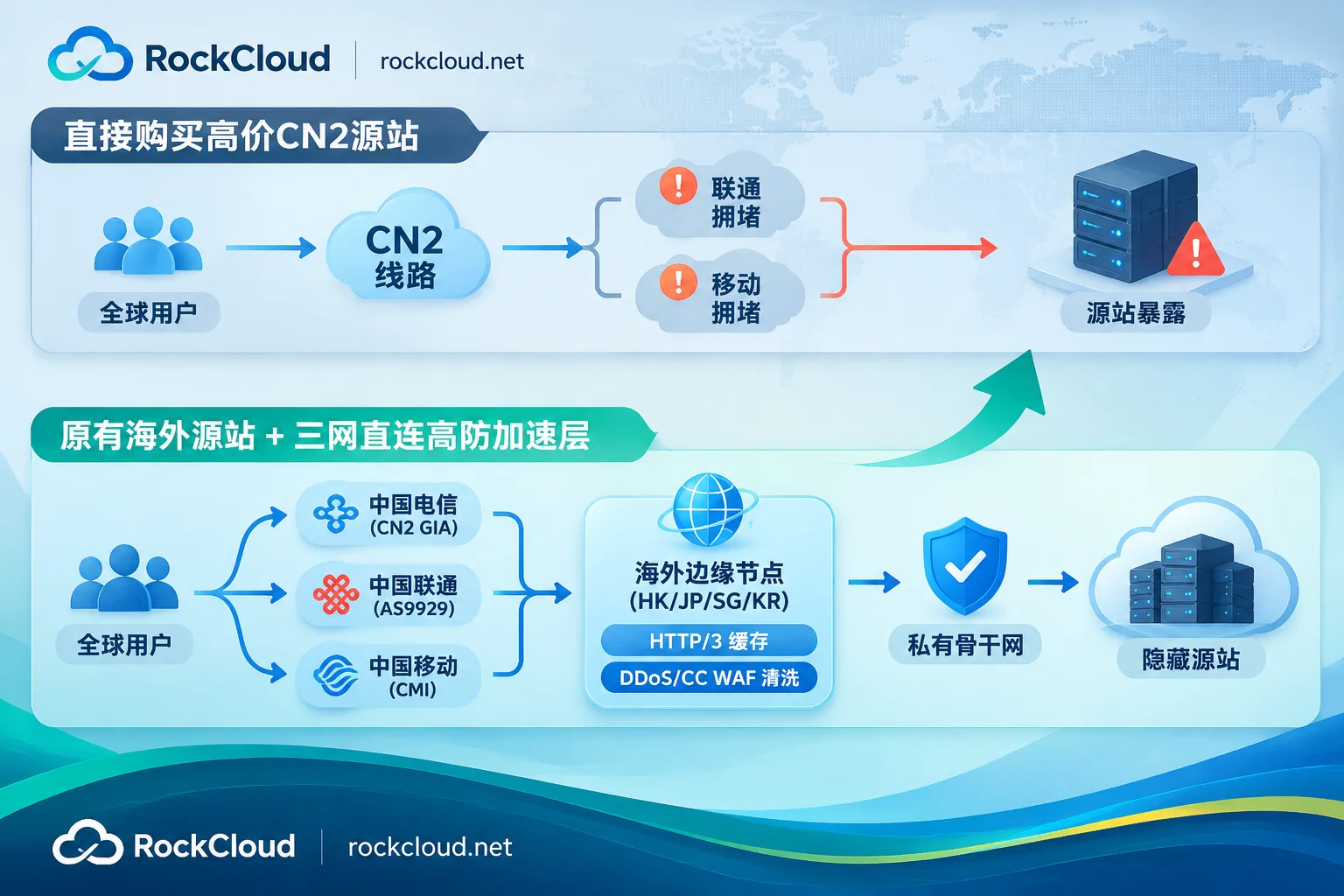
Taking the architecture of RockCloud as an example, RockCloud itself does not sell servers; customers can continue to use their existing hosts on AWS, Azure, GCP, Alibaba Cloud International, Huawei Cloud International, or Tencent Cloud International as origins (if the team needs international cloud account opening, real-name exemption procedures, or USDT recharge, they can also use RockCloud international cloud recharge together). After connecting to CN2 line acceleration at the front end, the division of labor in the entire link becomes much clearer:
- Each of the three networks uses premium direct connections, no ICP filing required: Access from edge nodes around China such as Hong Kong, Japan, South Korea, and Singapore to achieve Telecom CN2 GIA, Unicom AS9929, Mobile CMI three-network direct return to China, filling the cross-network shortcomings of Mobile and Unicom users at once.
- Edge offloading + protocol acceleration: Combined with global CDN acceleration's Anycast nearby access and intelligent routing, the edge layer directly supports HTTP/3, TLS 1.3 0-RTT, and Brotli compression, with customizable caching, origin retry, and backup origin rules. Static resources are consumed directly at edge nodes around China, while dynamic requests return to origin via private backbone and CN2 dedicated lines, reducing both origin bandwidth consumption and connection time.
- No architecture change, zero-downtime access, and built-in origin hiding: Simply add a CNAME record at your existing DNS provider to access, without modifying NS, and old and new links run in parallel during the switch. At the same time, acceleration and Anycast distributed DDoS/CC defense, intelligent WAF, and fully automated SSL run on the same request path, hiding the real origin IP and avoiding the dilemma of 'accelerated but unable to withstand attacks' (regarding the defense limitations of a single CN2 origin, we also detailed in Why a CN2 server alone is not enough, and you need to add three-network direct connection and high-defense CDN architecture).
5. Four practical checklists to verify before buying CN2 line acceleration
No matter which provider you ultimately choose, before officially signing and paying, it is recommended to complete verification in the following four steps:
- Use real peak-hour data, not daytime Ping charts: Between 20:00 and 23:00, perform MTR and real HTTPS request tests from Telecom, Unicom, and Mobile network environments to the test node, focusing on whether the return path uses
59.43/AS9929/CMIdirect connections, continuous packet loss rate, and page TTFB. - Check billing terms and beware of bill explosion from usage-based billing: For public-facing businesses, once malicious traffic flooding or CC attacks occur, usage-based acceleration services can easily generate high bills. Confirm whether fixed peak billing, unlimited traffic and requests are supported, and whether defense and acceleration are included in the same package. For example, in RockCloud's billing system, the basic high-defense acceleration package is billed monthly by fixed peak, with unlimited traffic and requests, including DDoS/CC, WAF, and SSL, while CN2 mainland acceleration dedicated lines and anti-hijacking features are billed separately; specific defense levels, latency metrics, prices, and test durations are subject to the specifications confirmed on the RockCloud official pricing page and with customer service.
- Apply for a free test before switching production traffic: Taking advantage of CNAME access without changing NS, first use a test subdomain to complete cache hit rate, dynamic API origin pull, and three-network speed verification, and switch the main business domain after meeting standards (for specific preparation materials and verification steps, refer to How to apply for a free test of high-defense CDN).
- For games or non-HTTP long-connection businesses, do not apply web acceleration solutions: For chess/card or battle businesses involving full TCP/UDP protocol forwarding, ordinary HTTP CDN cannot handle them; evaluate a game shield solution with private protocol encapsulation and full-protocol forwarding to ensure players do not disconnect when a single node under attack switches.
In one sentence: When buying CN2 line acceleration, you are not buying the two letters 'CN2', but the ability for users of all three networks in mainland China to reach overseas origins stably with low packet loss during peak hours. Keep your existing overseas compute origin, and leave three-network direct connection, protocol optimization, and security scrubbing to a professional edge acceleration layer—this is the most cost-effective and easiest-to-maintain selection path today.